20 Civilization Books That Illuminate History’s Core
Insights from Mahatma Gandhi, Nate Maingard, and Roland Emmerich on Civilization Books
Updated on June 26, 2025·We may earn commissions for purchases made via this page
7 of 20 books have Audiobook versions
We're launchingLaunching on Product Hunt today 🎉We just launchedJust launched on Product Hunt 🎉
Modelpeers, from the BookAuthority teamFrom the BookAuthority team: Modelpeers, a free way to follow AI models and agents like you follow people. We'd love your support.
What if I told you that the story of civilization is far more intricate than textbooks suggest? From ancient empires to modern societal shifts, the layers of human history reveal surprising connections and profound lessons. Civilization isn't just about dates and battles; it's an ongoing dialogue between culture, environment, and human ingenuity that shapes who we are today.
Mahatma Gandhi, a leader who reshaped India's destiny, found value in understanding the rise and fall of empires like Rome. Film director Roland Emmerich credits Fingerprints of the Gods with inspiring his creative vision of ancient floods. Archaeologists like Eric Cline and historians such as Edward Watts deepen our grasp of civilization's fragility and resilience through their work on Bronze Age collapses and Mesopotamian empires.
While these expert-curated books provide proven frameworks, readers seeking content tailored to their specific historical interests and learning goals might consider creating a personalized Civilization book that builds on these insights. Such tailored books bridge general scholarship with your unique perspective, accelerating your journey through history's complex narratives.
Lloyd Llewellyn-Jones, author of Persians and a distinguished scholar of ancient empires, praises this book as "a superb, compelling, and exuberantly written history of the Assyrians," highlighting how it reshapes perceptions of these often misunderstood figures. He was drawn to Frahm’s thorough research and nuanced portrayal during his own studies of Near Eastern history, finding the book changed his understanding of Assyria’s cultural and political complexity. Alongside him, Edward Watts, author of Mortal Republic, notes the book's relevance in revealing the empire's enduring influence over 3000 years, emphasizing its lessons for understanding imperial power. Together, their perspectives underscore the book’s authority and appeal.
“A superb, compelling, and exuberantly written history of the Assyrians, popularly known only as the bad guys of the Old Testament, but actually one of the most significant of all ancient Near Eastern empire builders. This book is filled with fascinating detail and cliché-busting analysis. Sweeping yet nuanced, Eckart Frahm challenges—and changes—the way we think about the Assyrians and the culture they fashioned.”
Eckart Frahm is professor of Assyriology in the department of Near Eastern Languages and Civilizations at Yale. One of the world’s foremost experts on the Assyrian Empire, he is the author or coauthor of six books on ancient Mesopotamian history and culture. He lives in New Haven, Connecticut.
Eckart Frahm's deep expertise as a Yale professor of Assyriology shapes this detailed exploration of Assyria, the ancient empire that laid the groundwork for later civilizations. You gain insights into Assyria's political strategies, cultural innovations, and the pivotal roles of royal women, illuminated by nearly two centuries of archaeological and textual research. The book moves beyond familiar battlefield accounts to reveal the empire’s extensive trade networks and rich libraries, offering a nuanced perspective on its lasting influence up to the Roman Empire. This work suits you if you want a balanced, richly detailed understanding of one of history's earliest and most influential empires.
Roland Emmerich, the director behind major disaster films, credits this book with inspiring his approach to biblical flood stories, saying, "I always wanted to do a biblical flood movie, but I never felt I had the hook. I first read about the Earth's Crust Displacement Theory in Graham Hancock's Fingerprints of the Gods." His perspective highlights the book’s influence beyond academia, blending history with cinematic imagination. The Times (UK) adds that readers will enjoy the inspired storytelling throughout, while Kirkus Reviews praises it as intriguing and thought-provoking historical sleuthing.
“I always wanted to do a biblical flood movie, but I never felt I had the hook. I first read about the Earth's Crust Displacement Theory in Graham Hancock's Fingerprints of the Gods.”
Graham Hancock was formerly East Africa correspondent for The Economist and a correspondent for the London Sunday Times. His The Sign and the Seal, an international bestseller, documented his real-life quest for the Ark of the Covenant. He has appeared on television with Michael Palin in his Pole to Pole series, and on the BBC and CNN, as well as the National Geographic’s Explorer series.
578 pages·Civilization, Ancient History, Archaeology, Geology, Mythology
Graham Hancock challenges the conventional wisdom that ancient civilizations were primitive and isolated by weaving together archaeological enigmas and geological theories. Drawing on his experience as a seasoned journalist and investigator, Hancock explores the possibility of a lost advanced civilization predating recorded history, supported by intriguing evidence such as Earth's crust displacement. You’ll gain insight into how ancient myths and physical clues might interconnect, especially if you’re curious about alternative histories and deep-time mysteries. This book suits those ready to question mainstream archaeology and eager to explore bold hypotheses about humanity’s distant past.
This AI-created book on civilization studies is crafted based on your unique background, interests, and learning goals. By sharing what aspects of civilization most intrigue you and your current understanding, the book offers a focused journey through history’s complex layers. Personalization makes sense here because civilization covers vast, varied topics, and this book zeroes in on what matters most to you. It’s about getting an efficient, relevant exploration without wading through unrelated material—perfect for making your study both meaningful and manageable.
TailoredRead AI creates personalized nonfiction books that adapt to your unique background, goals, and interests. Instead of reading generic content, you get a custom book written specifically for your profession, experience level, and learning objectives. Whether you're a beginner looking for fundamentals or an expert seeking advanced insights, TailoredRead crafts a book that speaks directly to you. Learn more.
2026·50-300 pages·Civilization, Historical Development, Cultural Dynamics, Empire Building, Societal Collapse
This personalized AI-created book on civilization provides a tailored exploration that matches your background and specific interests. It examines the evolution, dynamics, and complexities of human societies from ancient times to the present, focusing on cultural, political, and environmental factors that shape civilizations. By concentrating on your goals, this book reveals the intricate connections between historical events, societal development, and human ingenuity, offering a customized pathway through the vast landscape of civilization studies. It invites you to engage deeply with themes such as empire building, societal collapse, cultural continuity, and the impact of environment on human progress.
Nassim Nicholas Taleb, professor of risk engineering and author of "The Black Swan," brings a deep appreciation for historical depth to his recommendation of this book. Having studied risk and uncertainty extensively, Taleb values Bonner's erudition across languages and cultures, which enriches his understanding of Western civilization's fragile achievements. Taleb describes Bonner as "a rare bird," highlighting how his grasp of ancient and modern languages gives the book a unique perspective on civilization's enduring challenges. This nuanced view helped Taleb reconsider the importance of historical continuity amid contemporary crises. Pulitzer Prize-winning journalist David Marks Shribman also praises the book’s rich arguments filled with "pearls of wisdom," reinforcing its intellectual appeal.
“Michael Bonner is a rare bird: he is a classicist and an erudite in the broadest sense of the word, familiar with Greek, Latin, Persian, Arabic, Aramaic, and Hebrew, not counting (I checked) modern languages such as French. This gives him a considerable edge over historians, and depth and perspective in identifying and understanding the true Western Civilization and the dangers of straying from its achievements over the past six thousand years.”
Dr. Michael R.J. Bonner is a communications and public policy expert, and a historian with a masters in Late Antique and Byzantine Studies and a PhD in Oriental Studies, both from the University of Oxford.
2023·230 pages·Civilization, History, Cultural Studies, Political Theory, Historical Analysis
Dr. Michael R.J. Bonner brings a unique blend of historian and policy expert to this exploration of civilization's resilience. Drawing from his Oxford background in Late Antique, Byzantine, and Oriental studies, he challenges the notion that progress depends solely on innovation. Instead, Bonner highlights how societies throughout history, such as post-Roman Europe and China after foreign invasions, revived by revisiting and learning from their own pasts. You’ll gain insight into civilization’s core elements—clarity, order, and beauty—and understand the risks of neglecting these foundations. This book suits anyone interested in the cycles of history and the possibilities for renewing modern society by reflecting on our shared heritage.
Dean W. Arnold is an acclaimed author praised by figures like U.S. Senator Bob Corker and Pulitzer Prize winner Jon Meacham for his unique storytelling style that weaves history with narrative. His deep engagement with culture and faith drives this book, offering you a nuanced portrait of Ethiopia’s past and its significance for the future of civilization.
Dean W. Arnold, Prince Asfah Wossen Asserate PhD(you?)·
About the Author
Dean W. Arnold is an acclaimed author known for his unique storytelling style that blends history with narrative. His works have received praise from notable figures, including U.S. Senator Bob Corker and Pulitzer Prize-winning author Jon Meacham. Arnold's background includes a deep engagement with historical themes, often focusing on the intersection of culture and faith. He has written extensively on various subjects, including the Cherokee people and the complexities of modern society. His approach to history is characterized by thorough research and a compelling narrative style, making his books both informative and engaging.
Drawing from his extensive experience blending history with narrative, Dean W. Arnold crafts a vivid account of Ethiopia’s enduring legacy and its pivotal role in the future of civilization. You’ll explore how Ethiopia uniquely resisted colonial conquest, delving into episodes like their 1896 victory over European forces and Mussolini’s failed invasion. The book also connects historical threads—such as the Ark of the Covenant and the Queen of Sheba—to present-day cultural and geopolitical tensions. If you want a richly detailed perspective on a complex civilization that challenges Western narratives, this book offers thoughtful insights grounded in meticulous research.
Nate Maingard, a musician and cultural commentator, highlights this book as a necessary wake-up call for those seeking deeper truths about society. He suggests that "Civilized to Death" offers insights into how far current societal beliefs stray from reality, reflecting his own journey through self-reflection to see beyond common narratives. His recommendation underscores the book’s power to challenge and expand your understanding of civilization’s impact, encouraging you to question what you accept as progress.
“@karkassklark @BufferingJuffy @AllyMalinenko Read the book civilised to death if you want a just a little insight into how far we are from truth right now as a society. I understand how you think what you do, and i have done my inner work to see through it. You can too, but only if you choose. Enough, i love you, peace” (from X)
Christopher Ryan, PhD, and his work have been featured just about everywhere, including MSNBC, Fox News, CNN, NPR, The New York Times, The Times of London, Playboy, The Washington Post, Time, Newsweek, The Atlantic, Outside, El Pais, La Vanguardia, Salon, Seed, and Big Think. A featured speaker from TED to The Festival of Dangerous Ideas at the Sydney Opera House to the Einstein Forum in Pottsdam, Germany, Ryan has consulted at various hospitals in Spain, provided expert testimony in a Canadian constitutional hearing, and appeared in well over a dozen documentary films. The author of Civilized to Death and the coauthor of the New York Times bestseller Sex at Dawn, Ryan puts out a weekly podcast, called Tangentially Speaking, featuring conversations with interesting people, ranging from famous comics to bank robbers to drug smugglers to porn stars to authors to plasma physicists.
After analyzing numerous examples of societal shifts, Christopher Ryan challenges the widely accepted notion that progress is inherently beneficial. He explores how modern civilization has altered fundamental aspects of human life—our eating habits, social interactions, health, and mortality—in ways that may not be improvements. Drawing on comparisons between prehistoric dangers and contemporary afflictions like chronic diseases and prolonged death, Ryan invites you to reconsider what true progress means. This book suits anyone curious about the costs behind modern comforts and those seeking to understand civilization’s broader impact on human well-being.
This AI-created book on civilization history is crafted based on your background, skill level, and specific interests. By sharing what aspects of civilization intrigue you most and your learning goals, you receive a book tailored to help you grasp the subject efficiently. Instead of sifting through countless resources, this custom guide focuses precisely on the milestones and strategies you want to explore, making your study both engaging and effective.
TailoredRead AI creates personalized nonfiction books that adapt to your unique background, goals, and interests. Instead of reading generic content, you get a custom book written specifically for your profession, experience level, and learning objectives. Whether you're a beginner looking for fundamentals or an expert seeking advanced insights, TailoredRead crafts a book that speaks directly to you. Learn more.
2026·50-300 pages·Civilization, Civilization History, Cultural Milestones, Societal Development, Empire Dynamics
This tailored book explores the pivotal milestones that have shaped human civilization, offering a personalized roadmap for rapid learning and application. It examines key historical events, cultural shifts, and societal transformations with a focus on your interests and background, making complex narratives accessible and engaging. By concentrating on the most influential developments and underlying patterns, this book matches your specific goals and accelerates your understanding of civilization’s evolution.
With a tailored approach, it synthesizes diverse sources and expert knowledge into a coherent sequence designed for efficient comprehension and meaningful insights. This personalized guide reveals how civilizations rise, adapt, and sometimes collapse, equipping you with a clear framework to grasp and apply these lessons in a way that resonates with your unique perspective.
Adam Gopnik, a respected writer for The New Yorker, highlights how this book paints a "strangely recognizable picture" of the Late Bronze Age, emphasizing its surprising level of globalization and cultural exchange. His recommendation reflects the book’s power to change how you see ancient times—not as isolated events, but as deeply interconnected societies. The comprehensive exploration by Publisher's Weekly further confirms Eric Cline’s skill in weaving together diverse causes like natural disasters and invasions, making this an insightful read for anyone seeking to understand civilization collapse from multiple angles.
“The memorable thing about Cline's book is the strangely recognizable picture he paints of this very faraway time. It was as globalized and cosmopolitan a time as any on record, albeit within a much smaller cosmos. The degree of interpenetration and of cultural sharing is astonishing.”
Eric H. Cline is an acclaimed archaeologist and best-selling author known for his expertise in ancient history and archaeology. He has authored several influential works, including '1177 B.C.: The Year Civilization Collapsed', which explores the complexities surrounding the collapse of ancient civilizations. Cline's research focuses on the Late Bronze Age and the interconnectedness of ancient cultures, making him a prominent figure in the field. His engaging writing style and thorough scholarship have earned him recognition among both academic and general audiences.
What if everything you knew about the collapse of ancient civilizations was wrong? Eric H. Cline, an archaeologist with deep expertise in the Late Bronze Age, challenges the simplistic notion that invasions alone destroyed these societies. Instead, he unpacks a complex web of interconnected failures, including environmental disasters, economic disruptions, and political upheaval. You’ll gain a clear understanding of how fragile interdependence among kingdoms accelerated their downfall, illuminated by vivid accounts of the Sea Peoples’ raids and the domino-like fall of empires like the Hittites and Mycenaeans. This book suits anyone curious about the intricate causes behind the end of one of history’s most fascinating eras.
The Independent, a respected UK newspaper, highlights how this book blends politics, history, myth, and culture to capture Babylon's essence. Their appreciation reflects deep expertise in cultural history, underscoring the book's ability to bring ancient Mesopotamia vividly to life. This perspective helped many reframe Babylon not just as an ancient city but as a dynamic crucible of civilization. Similarly, Publisher's Weekly praises its lively pace, making complex history accessible and engaging for those passionate about ancient worlds.
Paul Kriwaczek was born in Vienna. He travelled extensively in Asia and Africa before developing a career in broadcasting and journalism. In 1970, he joined the BBC full-time and wrote, produced, and directed for twenty-five years. He also served as head of Central Asian Affairs at the BBC World Service. He is the author of Yiddish Civilisation: The Rise and Fall of a Forgotten Nation, which was shortlisted for the Jewish Quarterly Wingate Literary Award, as well as In Search of Zarathustra: The First Prophet and the Ideas that Changed the World.
When Paul Kriwaczek discovered the intricate origins of civilization along Mesopotamia's fertile riverbanks, he crafted an engaging narrative tracing Babylon's rise from early settlements to its peak under Hammurabi. You gain a vivid understanding of urban development, political systems, and cultural innovations that shaped half of human history. Chapters detail social structures and technical advancements that made Babylon a magnet of ancient power. This book suits those intrigued by ancient history and the foundational forces behind modern society, offering concrete insights into how one of the earliest civilizations flourished and faded.
Booklist, a respected authority in literature recommendations, highlights this book for its accessible and visually engaging approach to Chinese history. They emphasize that "This reasonably priced illustrated book deserves display," reflecting how the rich images and thorough coverage brought new clarity to their understanding of China's imperial heritage. Their endorsement suggests this book offers a compelling way to connect with the vast scope of Chinese civilization, making it a standout resource for anyone wanting to explore this subject visually and contextually.
DK is a renowned publisher known for creating visually stunning and informative books that explore a wide range of topics, from history to science. Their commitment to quality and educational value has made them a trusted source for readers seeking to expand their knowledge and understanding of the world.
Unlike most civilization histories that rely heavily on text, this book by DK combines authoritative scholarship with vivid visual storytelling to illuminate China's imperial past. You move through more than five millennia, from prehistoric clans to the last Qing emperor, understanding key events like the rise of Confucianism and the silk trade through detailed images of artifacts rarely seen outside China. This approach gives you both the political shifts and cultural achievements that shaped Chinese civilization. If you want a richly illustrated guide that balances political history with cultural context, this book suits you well, though it may be less focused on deep narrative detail than traditional histories.
Nupur J Sharma, editor at OpIndia.com and a recognized voice in Indian political discourse, praises this work enthusiastically. Her recommendation reflects a deep engagement with the book's themes, describing it as a meeting of "partners in crime" that sparks new ideas to be explored in the future. Her endorsement underscores the book’s impact on those examining India's historical and constitutional complexities, highlighting its role in shaping contemporary understanding of Bharat’s identity and its colonial legacy.
“Partners in crime finally met and hatched more plans to be set in motion.. someday.. sometime. In the meantime, please do buy his fantastic book!” (from X)
J. Sai Deepak is an engineer-turned-litigator, practising as an arguing counsel primarily before the Supreme Court of India and the High Court of Delhi. A mechanical engineer from Anna University, he graduated with a bachelor's degree in law from IIT Kharagpur's Law School in 2009, and has carved a niche for himself as a litigator in civil commercial and constitutional matters. Over the years, he has been part of several landmark matters, such as the ones relating to the Sabarimala Ayyappa Temple, the Sri Padmanabhaswamy Temple and Basmati Geographical Indications. In 2019, he was awarded the Young Alumni Achiever's Award by his alma mater IIT Kharagpur. Apart from delivering lectures on constitutional issues, he is a prolific writer for leading newspapers and magazines.
Unlike most books on civilization that focus on broad historical narratives, J Sai Deepak’s legal and engineering background informs a detailed examination of how European colonial perspectives shaped modern India. You’ll explore the deep roots of colonial consciousness in religious and racial ideas, and how these distorted Bharat’s indigenous traditions through constitutional reforms introduced by British rule. The book challenges you to reconsider concepts like secularism and humanism as products of Christian political theology rather than universal constructs, particularly in chapters tracing the influence of the League of Nations and the Government of India Act of 1919. If you’re interested in the intersection of law, history, and cultural identity, this book offers a rigorous, thought-provoking perspective on India’s civilizational journey.
This abridged edition of Edward Gibbon's monumental History of the Decline and Fall of the Roman Empire offers a compelling narrative of a civilization's long collapse. Through detailed accounts of barbarian invasions and Byzantine resilience, the book explores critical historical episodes that shaped the fate of Rome. Published by Penguin Classics, it combines scholarly insight with accessible storytelling, making it a valuable resource for those fascinated by the complexities of civilization and empire dynamics. Its focus on the causes and events surrounding one of history's most significant declines provides a rich perspective for anyone seeking to understand the forces that influence the rise and fall of great societies.
Unlike most civilization histories that may skim over details, Edward Gibbon delves deeply into the complex factors behind Rome's thirteen-century saga, highlighting the interplay of political, military, and social forces. Through vivid narratives of barbarian invasions led by figures like Alaric and Attila, and Byzantine struggles under Justinian and Belisarius, you gain a layered understanding of how internal weaknesses and external pressures converged to topple one of history's greatest empires. This abridged edition, carefully edited by David P. Womersley, offers you accessible insights into the grand sweep of Roman decline with scholarly notes enhancing comprehension. If your interest lies in the rise and fall of civilizations with a focus on cause and consequence, this work will enrich your grasp of historical dynamics.
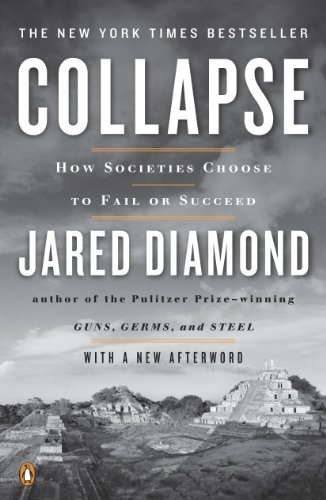
Stefan Lessard, known for his thoughtful reflections on human progress, recommends this book as a must-read, emphasizing Jared Diamond as one of his favorite historical authors. His appreciation stems from the book’s thorough exploration of how environmental and societal factors intertwine to determine the fate of civilizations. This perspective profoundly influenced his understanding of history’s complexities. In addition, Publisher's Weekly highlights Diamond’s ability to connect ecological science with historical narratives, underscoring the relevance of these lessons to contemporary environmental challenges.
Jared Diamond is a professor of geography at the University of California, Los Angeles. Among his many awards are the National Medal of Science, the Tyler Prize for Environmental Achievement, Japan’s Cosmos Prize, a MacArthur Foundation Fellowship, and the Lewis Thomas Prize honoring the Scientist as Poet.
Jared Diamond draws from his extensive background as a geography professor and environmental scientist to explore why some societies collapse while others endure. This book analyzes historical cases like the Anasazi, Maya, and Greenland Vikings, revealing how environmental degradation, climate shifts, and political decisions intertwine to shape societal fates. You'll gain insight into the complex feedback loops between human actions and natural limits, illustrated with detailed case studies and patterns of resource mismanagement. If you're interested in how civilizations interact with their environments and the consequences of those relationships, this book provides a well-reasoned framework for understanding societal resilience and failure.
Dominic Haynes is a historian dedicated to making history accessible through well-researched and engaging narratives. His expertise spans epochs from ancient civilizations to modern events, aiming to ignite discussion and foster understanding of the past. This background equips him uniquely to guide you through Ancient Greece's political dynasties and cultural mosaics, giving you a clear overview of the Hellenistic world and its enduring influence on Western civilization.
Dominic Haynes is a historian dedicated to making history accessible through well-researched and engaging narratives. His work focuses on various epochs, from ancient civilizations to modern events, aiming to ignite discussion and foster understanding of the past.
Dominic Haynes, a historian focused on making history accessible, guides you through the rich tapestry of Ancient Greece in this concise narrative. You’ll learn how Greek geography shaped city-states, the roots of democracy, and the intertwined legacies of myth and history—from the Trojan War to Alexander the Great's conquests. The book offers clear explanations of pivotal events like the Peloponnesian War and the Golden Age of Athens, helping you grasp why Greek culture remains foundational to Western civilization. If you want a readable introduction to Greece’s political dynasties, cultural achievements, and lasting influence, this book lays it out without overwhelming detail.
Marc Andreessen, General Partner at Andreessen Horowitz and co-founder of Ning, brings a unique perspective to civilization studies. His recommendation of this book as "the single best book I have found on who we are and how we got here" reflects his deep engagement with understanding societal foundations. This endorsement highlights the book's profound impact on his thinking about the roots of human social order and identity, underscoring its value for anyone curious about the origins of civilization.
Numa Denis Fustel de Coulanges, Dennis Bouvard(you?)·
About the Author
Numa Denis Fustel de Coulanges, born March 18, 1830, in Paris, France, and died September 12, 1889, in Massy, was a French historian known for his scientific approach to history. He studied at the École Normale Supérieure and directed excavations in Athens. Fustel served as a professor at the University of Strasbourg and held various prestigious academic positions, including at the Sorbonne. His work laid the foundation for modern historical methodology in France.
Unlike most civilization books that focus on political events or military conquests, this work by Numa Denis Fustel de Coulanges digs into the religious and social roots of classical societies. His exploration of the Indo-European domestic cult reveals how family-based religious practices shaped the rise and eventual decline of ancient civilizations. The foreword by Dennis Bouvard connects these ancient dynamics to modern social orders, offering a framework to understand contemporary society through a post-liberal lens. If you want to grasp the foundational cultural forces behind civilization rather than just dates and battles, this book offers a distinct and thought-provoking perspective.
Patricia Buckley Ebrey has dedicated her career to teaching Chinese history and culture at major universities. Her leadership in educating students and her editorial role at the Journal of Chinese History reflect deep expertise that informs this book. Motivated by a desire to present China’s vast historical narrative with clarity, her work balances scholarly rigor with engaging storytelling, making complex developments accessible and illuminating the civilization's global context.
Patricia Buckley Ebrey has taught Chinese history and culture for many years, both at the University of Illinois and later the University of Washington. She has played a leadership role helping students learn about Chinese history and civilization. Among her best-known books are The Inner Quarters: Marriage and the Lives of Women in the Sung Period (1993) and Emperor Huizong (2014), both also available in Chinese translation. She currently is editor of the Journal of Chinese History and working on a book on China as an outlier in world history.
Patricia Buckley Ebrey, a seasoned scholar with decades of teaching Chinese history, offers a richly detailed narrative that spans the entire arc of Chinese civilization. You’ll gain insight into how political innovations, influential thinkers, and cultural developments shaped China from prehistoric times to its modern global role. The book’s updated third edition highlights recent archaeological finds and explores environmental history alongside China’s global interactions, giving you a balanced view of its enduring legacy and contemporary challenges. This is ideal if you want a vivid, well-illustrated guide grounded in academic expertise rather than a simplified overview.
Thomas R. Trautmann is Professor Emeritus of History at the University of Michigan, bringing decades of scholarship on Indian history and civilization. His expertise shines through in this concise overview that spans five millennia, reflecting his dedication to highlighting the enduring influence of India’s deep past on its present and future. His previous works on the Aryan debate and environmental history inform this thoughtful narrative, making it a compelling read for anyone seeking a clear yet rich understanding of Indian civilization’s long arc.
Thomas R. Trautmann is Professor Emeritus of History at the University of Michigan. He is the editor of The Aryan Debate (OUP, 2008) and the author of Elephants and Kings: An Environmental History (2015), Arthashastra: The Science of Wealth (2012), Languages and Nations (2006), and Aryans and British India (2004).
Unlike most civilization books that emphasize recent history, Thomas R. Trautmann’s work takes you through 5,000 years of Indian history in a concise format that respects the weight of the distant past. You’ll gain a mental map of Indian civilization’s evolution, from ancient foundations to modern complexities, appreciating how early traditions still shape today’s India. The book challenges the notion that Indian history peaks with the nation-state by illustrating how deep historical currents remain vital resources. If you want a broad yet nuanced grasp of India’s long timeline without getting lost in dense detail, this book offers a compact, thoughtful guide.
Greg Carr, chair of Howard University's Department of Afro American Studies and two-time Male HBCU Professor of the Year, highlights this book’s enduring impact on understanding African history. He honors Chancellor Williams as a master teacher and historian, noting how Williams's powerful theory reshaped perspectives since 1946 when Eleanor Roosevelt cited his work. Carr’s endorsement reflects his comprehensive expertise and personal respect for Williams’s challenge to dominant historical narratives, emphasizing the book’s role in deepening awareness of African civilization’s complex legacy.
“Happy 126th birthday, Chancellor James Williams: #HBCUMasterTeacher, Historian & Jegna. His book, “Destruction of Black Civilization,” articulates a powerful theory of African history. In 1946, Eleanor Roosevelt used one of Williams's essays to tell White world to check itself.” (from X)
Chancellor Williams was a prominent historian and author known for his extensive research on African history and civilization. His works, including 'Destruction of Black Civilization', have been influential in educating readers about the historical experiences of Africans and people of African descent. Williams dedicated his life to uncovering the truths of African history, challenging prevailing narratives, and advocating for a deeper understanding of the African experience.
When Chancellor Williams uncovered the overlooked complexities of African history, he reshaped how you might see civilization’s rise and fall across millennia. This book digs into the forces that shaped African peoples from 4500 B.C. through 2000 A.D., exploring political, social, and economic dynamics often ignored in mainstream history. You’ll find detailed examinations of cultural development, external invasions, and internal challenges, with chapters that trace how these factors intertwined to influence global history. If you seek a rigorous perspective on civilization through the lens of African experiences, Williams’s work offers a deeply researched foundation that challenges conventional narratives.
Robert Macfarlane, an acclaimed author and Cambridge fellow known for his work on landscape and culture, valued this book deeply during his research for Mountains of the Mind. His connection to the book is personal—owning his grandfather’s edition—and he highlights its surprising insights into civilization’s layers. Macfarlane’s endorsement underscores the book’s role as a revealing source that challenges how you might understand the human story embedded in the natural world and history.
“@garyhusband Yes - I own my grandfather's edition. I used it as a source document while writing Mountains of the Mind. A fascinating book, unexpectedly disclosing.” (from X)
Charles Eisenstein's extensive exploration in this book stems from his deep engagement with cultural and ecological crises, focusing on the illusion of the separate self that underpins many societal systems. You encounter a thoughtful critique of how disconnection from each other and the natural world has distorted science, economics, and technology, leading to unsustainable pursuits of progress. Through detailed analysis, Eisenstein invites you to reconsider civilization not as a linear ascent but as an evolving journey toward reunion and self-discovery, illustrated with reflections on history and potential futures. If you're interested in how our collective mindset shapes institutions and environment, this book offers a nuanced framework for reimagining civilization’s foundations.
Michael Loewe, a University Lecturer in Chinese Studies at the University of Cambridge, draws on his extensive expertise to highlight this book as a clear and current overview of China's dynastic history. His recommendation underscores the value of its balanced attention to both political events and cultural developments, making it approachable even for newcomers to the topic. He notes its careful inclusion of recent research and economic aspects, which has helped him appreciate the complexity of China's past in new ways. "A solid, clearly written and up-to-date account of China's dynastic history, taking note of recent research, and with attention to cultural developments and economic practice," he affirms, marking it as a resource that both students and instructors find rewarding.
University Lecturer in Chinese Studies, University of Cambridge
“A solid, clearly written and up-to-date account of China's dynastic history, taking note of recent research, and with attention to cultural developments and economic practice. An accessible read, even for first-comers to this highly complex subject; this is an excellent introduction to China that instructors will welcome and students will enjoy.”
Harold Tanner is a native of Princeton, New Jersey. He received education at Friends World College and New England College. He has traveled extensively, studied in Nepal, and has a Ph.D. from Columbia University. Tanner is the author of two books and is working on two more.
What started as Harold M. Tanner's deep dive into China's vast history evolved into a thoughtful narrative tracing the nation's transformation from the Qing Empire through the People's Republic era. You gain insight into nuanced political shifts, social changes, and cultural evolutions, supported by detailed maps, illustrations, and chronological tables. Chapters explore everything from imperial decline to revolutionary upheaval, offering clarity on complex events like the Opium Wars and Maoist reforms. This book suits anyone wanting a balanced, accessible entry into modern Chinese civilization's pivotal centuries without getting lost in jargon or overly dense academic prose.
Michael Knowles, a conservative commentator known for his deep engagement with historical ideas, highlights this book’s unique perspective on Western civilization. He notes, "One of its more prominent graduates wrote an interesting book on industrial society and its future," reflecting on how this work reshaped his understanding of the Church’s role in history. Knowles appreciates how the book challenges conventional narratives and sheds light on overlooked contributions that have shaped modern society, making it a thought-provoking read for those exploring civilization's roots.
Thomas E. Woods Jr. holds his master's, M.Phil., and Ph.D. in history from Columbia University and his bachelor's from Harvard. He's written numerous books, including The Church Confronts Modernity and two New York Times bestsellers. Woods has appeared on major media outlets and produced his own program for EWTN. He lives in central Florida with his wife and five daughters.
Unlike most histories that focus on conflict or decline, Thomas E. Woods Jr. explores how the Catholic Church actively shaped the foundations of Western civilization. Drawing on his deep academic background from Columbia and Harvard, Woods challenges common misconceptions, such as the Galileo affair, and reveals the Church's role in pioneering modern science, free-market economics, and the university system. You’ll gain insight into how Church canon law influenced Western legal traditions and why the Church’s emphasis on human dignity transformed societal values. This book suits anyone interested in understanding the roots of Western culture beyond surface stereotypes, particularly those curious about the intersection of religion, law, and intellectual history.
Firas Alkhateeb is an American researcher and historian specializing in the Islamic world, holding a BA in History from the University of Illinois, Chicago. He teaches Islamic history and founded the Lost Islamic History website, bringing scholarly insight to a broad audience. His background equips him to guide you through the expansive history of Muslim civilization, connecting the dots across continents and centuries to reveal a cohesive story often overlooked in popular discourse.
Firas Alkhateeb is an American researcher, writer, and historian who specializes in the Islamic world. He completed his BA in History from the University of Illinois, Chicago, in 2010 and has since been teaching Islamic history at Universal School in Bridgeview, Illinois. He founded and writes the website Lost Islamic History.
Firas Alkhateeb approaches the complex history of the Muslim world with a keen historian's eye and a teacher's clarity. His book uncovers the political, religious, and cultural milestones that shaped Muslim civilization from its origins to the modern era, giving you insight into key dynasties like the Umayyads and Ottomans, as well as lesser-known regions such as West African savannah kingdoms. By exploring how Islamic beliefs influenced scientific and social developments, you gain a nuanced perspective rarely found in mainstream histories. This book is ideal if you want a balanced narrative that challenges simplified views and reconnects you with a rich, multifaceted past.
The best Civilization books and more, in your inbox each week. No account needed.
Conclusion
This collection of 20 books weaves a tapestry of civilization’s vast landscape—from the ancient Assyrian empire to modern critiques of progress. The recurring themes reveal how civilizations rise through cultural innovation, face environmental and political challenges, and transform or collapse under pressure.
If you’re exploring empire dynamics, start with Assyria and The History of the Decline and Fall of the Roman Empire for foundational perspectives. For environmental and societal critiques, Collapse and Civilized to Death offer compelling analyses. Combine Babylon and Imperial China to understand urban development and cultural achievements.
Alternatively, you can create a personalized Civilization book to bridge the gap between general principles and your specific situation. These books can help you accelerate your learning journey and deepen your understanding of how civilizations shape human destiny.
Frequently Asked Questions
I'm overwhelmed by choice – which book should I start with?
Start with Assyria if you're interested in empire-building, or 1177 B.C. for understanding civilization collapse. Both offer accessible insights and set the stage for deeper exploration.
Are these books too advanced for someone new to Civilization?
Not at all. Many, like A Brief History of Ancient Greece, provide clear introductions. You can choose based on your interest and gradually delve into more detailed works.
What's the best order to read these books?
Consider beginning with broad historical overviews like Babylon or The Cambridge Illustrated History of China, then explore specialized topics such as Destruction of Black Civilization or Lost Islamic History.
Do I really need to read all of these, or can I just pick one?
You can pick based on your interest area. Each book stands alone yet complements the others, so choose what resonates most to deepen your knowledge efficiently.
Which books focus more on theory vs. practical application?
Civilized to Death and The Ascent of Humanity lean toward philosophical and theoretical views, while In Defense of Civilization discusses practical renewal strategies from historical examples.
Can I get a Civilization book tailored to my specific interests and goals?
Yes! While these expert books offer valuable insights, you can also create a personalized Civilization book that aligns precisely with your background, skill level, and learning objectives for a more targeted experience.
📚 Love this book list?
Help fellow book lovers discover great books, share this curated list with others!