20 Decision Making Books That Separate Experts from Amateurs
Curated by Brian Tracy, Ray Dalio, and Daniel Kahneman — Dive into expert-recommended Decision Making Books for sharper choices
Updated on June 25, 2025·We may earn commissions for purchases made via this page
We're launchingLaunching on Product Hunt today 🎉We just launchedJust launched on Product Hunt 🎉
Modelpeers, from the BookAuthority teamFrom the BookAuthority team: Modelpeers, a free way to follow AI models and agents like you follow people. We'd love your support.
What if the key to better decisions isn't just more information, but a shift in how you think? In a world flooded with choices, the ability to make sound decisions can feel elusive. Decision making shapes everything from business strategies to personal life paths, yet even the smartest among us fall prey to hidden biases and faulty instincts.
Consider Patrick Bet-David, a refugee turned CEO, whose book 'Your Next Five Moves' caught the attention of Brian Tracy and Ray Dalio. They praise his approach to thinking several steps ahead, a skill that transforms reactive habits into strategic mastery. Similarly, cognitive psychologist Daniel Kahneman champions Olivier Sibony's work on biases, underlining how even seasoned leaders can fall into predictable traps.
While these expert-curated books provide proven frameworks, you might wonder if there's a way to tailor these insights to your unique context. For personalized guidance, you can create a custom Decision Making book that aligns with your experience level, goals, and specific challenges, enhancing your ability to make decisions that truly fit your life and work.
Brian Tracy, a best-selling author of more than 78 books with over 10 million copies sold, recognizes the clarity Patrick Bet-David brings to entrepreneurs struggling to map their next steps. Tracy points out, "Patrick helps entrepreneurs understand exactly what they need to do next." This endorsement carries weight, given Tracy's decades of experience guiding personal development and business strategy. His appreciation reflects how this book reshaped his view on strategic planning, encouraging a forward-looking mindset rather than reactive decisions. Alongside him, Ray Dalio, founder of Bridgewater Associates, praises Patrick as "one of the most exciting thinkers I've had a chance to converse with," underscoring the book's appeal to even the most seasoned strategists.
Patrick Bet-David went from escaping war-torn Iran to founding his own financial services firm, raising tens of millions of dollars, and creating Valuetainment, the leading YouTube channel for entrepreneurs. His unorthodox approach to business as well as life has led to compelling interviews with Ray Dalio, Kevin Hart, the late Kobe Bryant, President George W. Bush, and a host of other luminaries. His content on social media has been viewed over a billion times. Patrick never obtained a college degree and went from the army to selling health club memberships before entering the field of financial services. At age thirty, he founded PHP, a financial services agency. He lives in Dallas with his wife and three children.
Unlike most business strategy books that focus narrowly on theory, Patrick Bet-David draws on his personal journey from refugee to CEO to craft a method for thinking five moves ahead in business. You learn to clarify your goals, build strategic teams, and apply leverage effectively, with concrete frameworks like growth tactics and power plays illustrated throughout. The book is particularly useful if you want to sharpen your strategic thinking beyond day-to-day decisions and navigate complex business challenges with foresight. It’s a solid fit for entrepreneurs and executives aiming to elevate their game rather than beginners seeking basic advice.
Stephen Hayes, Editor and CEO of The Dispatch and Fox News contributor, shared his appreciation for Julia Galef's insights during a podcast discussion where they explored the mindset needed to see the world more clearly. Hayes highlighted how the book challenges instinctive defensiveness, offering a way to approach beliefs with curiosity rather than bias. This perspective resonated with him as he sought greater clarity in a polarized media landscape. Psychologist Paul Bloom also named it among his top scholarly reads, reflecting its impact across disciplines interested in human judgment and decision making.
“We hosted Julia Galef on the Friday Dispatch Pod to discuss her forthcoming book, "The Scout Mindset: Why Some People See Things Clearly and Others Don't." Great book, fascinating discussion.” (from X)
Julia Galef is the host of the popular Rationally Speaking podcast, where she has interviewed thinkers such as Tyler Cowen, Sean Carroll, Phil Tetlock, and Neil deGrasse Tyson. She is an advisor to OpenAI, works with the Open Philanthropy Project, and cofounded the Center for Applied Rationality. Her 2016 TED Talk 'Why You Think You're Right--Even If You're Wrong' has been viewed over 4 million times.
Julia Galef's background as a host of the Rationally Speaking podcast and advisor to OpenAI informs her exploration of how our minds distort reality. In this book, you learn to recognize and shift from a "soldier" mindset, which defends beliefs, to a "scout" mindset focused on accurate understanding. Specific examples include how Jeff Bezos avoids overconfidence and how superforecasters outperform intelligence analysts, illustrating practical mental habits that improve clarity and reduce bias. If you're aiming to refine your decision-making by developing intellectual humility and curiosity, this book offers a clear framework without requiring special prior knowledge.
This AI-created book on decision mastery is crafted based on your unique background, skill level, and specific decision-making goals. By sharing which aspects of decisions you want to focus on, the book is tailored to your interests and challenges. This personalized approach helps you navigate complex choices with clarity and confidence, providing a pathway through expert knowledge that's directly relevant to your life and work.
TailoredRead AI creates personalized nonfiction books that adapt to your unique background, goals, and interests. Instead of reading generic content, you get a custom book written specifically for your profession, experience level, and learning objectives. Whether you're a beginner looking for fundamentals or an expert seeking advanced insights, TailoredRead crafts a book that speaks directly to you. Learn more.
This personalized book explores the art and science of decision making by focusing on your unique background, interests, and goals. It covers essential principles of how decisions are formed, the cognitive biases that can influence your choices, and techniques for improving clarity and confidence. Tailored to your specific needs, this book bridges expert knowledge with your personal learning path, presenting a customized synthesis of effective decision practices and insights drawn from psychology, behavioral science, and strategic thinking. Through this focused approach, you engage deeply with concepts that matter most to you, making complex decision theories accessible and relevant.
Daniel Kahneman, professor of psychology and Nobel Prize winner, highlights this book as a masterful and surprisingly enjoyable introduction to managerial decision making. His endorsement carries weight given his pioneering work on judgment and decision science. Kahneman's appreciation stems from how Olivier Sibony distills complex behavioral insights into practical frameworks that leaders can apply. Adding to this endorsement, Safi Bahcall, bestselling author of Loonshots, praises the book as the funniest and most useful guide on cognitive bias in business, emphasizing its broad appeal and effectiveness in improving decisions.
Olivier Sibony is a Professor of Strategy at HEC Paris and an Associate Fellow at Saïd Business School, Oxford University. Previously, he spent 25 years in the Paris and New York offices of McKinsey & Company, where he was a senior partner. Sibony's research on improving the quality of strategic decision making has been featured in many publications, including Harvard Business Review and MIT Sloan Management Review. He is a graduate of HEC Paris and holds a PhD from Paris Sciences et Lettres University. He is a coauthor, with Daniel Kahneman and Cass R. Sunstein, of Noise.
Drawing from Olivier Sibony's extensive experience as a strategy professor and former McKinsey partner, this book zeroes in on how cognitive biases subtly sabotage decision-making, even among seasoned leaders. You learn to identify nine common traps that skew judgment and, more importantly, discover 40 practical methods to build organizational decision architectures that leverage collective intelligence. For example, Sibony explores case studies showing how group dynamics can either amplify or mitigate bias, challenging the usual focus on individual debiasing. If you're involved in making or influencing business decisions, this book offers a grounded framework to refine your thinking and improve outcomes.
Daniel Terhorstnorth, a software development innovator known for creating BDD and coaching organizations, highlighted how this book reshaped his leadership language. After engaging deeply with Marquet's ideas, he expressed high regard for the shift in how he discusses leadership concepts, emphasizing the book's impact on his communication approach. His endorsement underscores the book’s practical influence on leaders seeking to rethink how they motivate and engage their teams.
“@ldavidmarquet @YvesHanoulle @RisingLinda @MaryLynnManns @AmyCEdmondson It is a fantastic book, thank you for writing it. It has genuinely changed how I talk about leadership. I haven't got to "Leadership is Language" yet but I'm afraid I have very high expectations :)” (from X)
L. David Marquet is a former US Navy captain and a renowned leadership expert. He is best known for his innovative approach to leadership, which emphasizes empowering individuals and fostering a culture of collaboration. Marquet's first book, 'Turn the Ship Around!', details his experience transforming the USS Santa Fe from one of the worst-performing submarines to one of the best in the fleet. His insights have been widely recognized and have influenced leaders across various industries.
What happens when a seasoned Navy captain turns his leadership lessons into a language playbook? L. David Marquet developed a method that transforms how leaders communicate to spark ownership and collaboration. You learn concrete ways to shift from commanding to empowering, like replacing binary decisions with confidence scales and encouraging your team to improve rather than just comply. The book’s six language plays—such as "Commit, don't comply" and "Collaborate, don't coerce"—offer precise tools to reshape conversations and decision-making. If you lead teams facing complex, fast-moving challenges, this book gives you fresh ways to unlock better information flow and collective problem-solving.
Marc Andreessen, General Partner at Andreessen Horowitz, regards decision-making as akin to managing an investment portfolio, where every choice contributes to your overall trajectory. Facing complex business and life decisions, he turned to Annie Duke's book for tools that help navigate uncertainty and improve outcomes. He shares, 'The decisions you make are like a portfolio of investments.' This perspective reshaped how he approaches choices, emphasizing structured exercises over guesswork. Likewise, Seth Godin, marketing thought leader, praises the book as 'vitally important,' highlighting its simplicity and power that make it essential reading for anyone seeking clearer judgment.
“'The decisions you make are like a portfolio of investments.' I believe that almost everything can be viewed as a portfolio—whether it's products a company makes or life choices. Annie provides exercises for how to decide. All of us—not just investors—should be obsessed with making better decisions.”
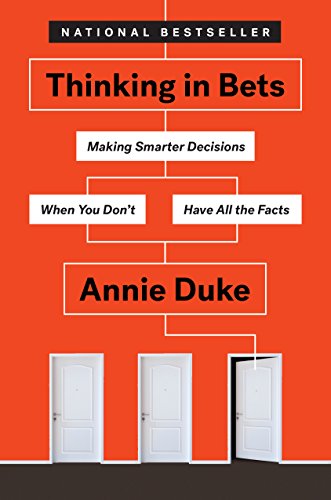
Annie Duke is an author, corporate speaker, and consultant in the decision-making space. Annie's book, Thinking in Bets: Making Smarter Decisions When You Don't Have All the Facts is a national bestseller. As a former professional poker player, Annie won more than $4 million in tournament poker before retiring from the game in 2012. Prior to becoming a professional player, Annie was awarded a National Science Foundation Fellowship to study Cognitive Psychology at the University of Pennsylvania. Annie is the co-founder of The Alliance for Decision Education, a non-profit whose mission is to improve lives by empowering students through decision skills education. She is also a member of the National Board of After-School All-Stars and the Board of Directors of the Franklin Institute. In 2020, she joined the board of the Renew Democracy Initiative.
Drawing from her unique background as a professional poker player and cognitive psychologist, Annie Duke offers a fresh approach to decision-making that moves beyond the usual pros and cons lists. You’ll learn how to recognize your hidden biases, assess the role of luck, and tailor your decision speed to the situation—whether it calls for quick judgment or careful deliberation. Exercises throughout the book invite you to analyze past choices and sharpen your intuition for future ones, making it practical for anyone from investors to those navigating personal dilemmas. This book suits you if you want to feel more confident and purposeful in how you decide, rather than relying on gut feelings alone.
This AI-created book on decision systems is tailored to your specific goals and experience level. By sharing your background and the aspects of decision making you want to focus on, you receive a book that matches your interests precisely. Customizing daily actionable steps makes learning efficient and relevant, helping you develop sharper, more adaptive decision skills. Instead of generic advice, this book delivers a focused plan designed just for you.
TailoredRead AI creates personalized nonfiction books that adapt to your unique background, goals, and interests. Instead of reading generic content, you get a custom book written specifically for your profession, experience level, and learning objectives. Whether you're a beginner looking for fundamentals or an expert seeking advanced insights, TailoredRead crafts a book that speaks directly to you. Learn more.
This personalized book explores a step-by-step pathway to enhance decision-making agility through daily, tailored exercises. It covers cognitive approaches and practical techniques designed to match your unique background and goals, guiding you to make faster, smarter choices. By focusing on your specific interests, this tailored guide bridges expert knowledge with your personal learning needs, offering a clear structure for building confidence and clarity in complex decisions. The book examines decision processes in detail, reveals common pitfalls, and provides a daily system that cultivates sharper judgment and adaptive thinking. Engaging and focused, it helps you integrate essential decision skills into your everyday life efficiently and meaningfully.
Scott Allan, an Amazon #1 bestselling author known for his extensive reviews, recommends this book for anyone seeking clarity in their choices. He emphasizes how it helped him sharpen his decision-making power during crucial moments, noting, "Invest in the future of your choices and read the book to gain more clarity on your decision making ...". This endorsement highlights the book's ability to transform how you approach complex decisions by simplifying the mental process and focusing on what truly matters.
Som Bathla loves to research human psychology & behavior in order to get maximum out of life. He is always eager to learn, embody and then impart the fundamental of optimal living to help others lead a resourceful life. He has written multiple bestseller books on topics about how to transform your mindset and enhance performance to get better and faster results. He is deeply convinced about the vastness of the human potential and is dedicated to teaching the ways to overcome self-doubt and fears, unleash the true human potential and thus enable one to take massive action through principles backed by psychological research and scientific evidence.
Som Bathla's background in psychology and behavior research informs a practical guide to sharpening your decision-making skills. You learn to identify and overcome mental traps, such as psychological biases and autopilot behavior, that often cloud your judgment. The book breaks down how your brain handles choices and offers a four-step model to help you make clearer, faster decisions by focusing on what truly matters. Whether you struggle with everyday choices or high-stakes problems, this book equips you with tools to improve your thinking and reduce overwhelm caused by too many options.
Tony Blair, former Prime Minister of the United Kingdom, highlights this book's nuanced take on decision-making, emphasizing that while instinct and experience play roles, "there is no substitute for thoughtful analysis." His perspective carries weight given the complex decisions he faced in leadership, and he appreciates how the book makes the process both conclusive and accessible. Alongside him, David Bornstein, author of 'How to Change the World,' praises the book as a journey into self-knowledge, showing how understanding our cognitive tendencies enriches how we live and decide.
“This is a really interesting account of the process of decision-making and why, even if it's shaped in part by instinct honed by experience, there is no substitute for thoughtful analysis. However, Cheryl Strauss Einhorn also shows how that process can be conducted in a way that is conclusive and not merely analytical. The book succeeds in being informative and accessible!”
Cheryl Strauss Einhorn is the creator of the AREA Method, a decision-making system for individuals, companies, and nonprofits to solve complex problems. Cheryl is the founder of the decision-sciences company Decisive, offering leadership training, curriculum, coaching, and professional development services, and an adjunct professor at Cornell University. She is the author of the award-winning books Problem Solved and Investing in Financial Research.
What started as Cheryl Strauss Einhorn's quest to understand the psychology behind our choices became a methodical exploration of how we can harness our unique decision-making styles. In this book, you learn to identify your dominant Problem Solver Profile—be it Adventurer, Detective, Listener, Thinker, or Visionary—and how each style influences the way you assess risk and interpret information. The chapters guide you through recognizing your blind spots and cognitive biases, offering tools to navigate decisions with greater self-awareness and confidence. If you want to move beyond instinct and make decisions that truly reflect your strengths, this book will provide a clear framework for doing just that.
Winner of the Independent Press Award in Psychology
Charles Duhigg, a New York Times bestselling author known for his work on habits and productivity, found this book packed with insights that sharpen how we manage time, space, and effort. He calls it "Compelling and entertaining, Algorithms to Live By is packed with practical advice about how to use time, space, and effort more efficiently. And it’s a fascinating exploration of the workings of computer science and the human mind." This recommendation comes from someone who deeply understands decision-making patterns, making his endorsement especially meaningful. Similarly, Sriram Krishnan, an investor and former product lead at Twitter and Facebook, simply states, "Yes! Love that book," echoing the high regard this work holds among decision-making experts.
“Compelling and entertaining, Algorithms to Live By is packed with practical advice about how to use time, space, and effort more efficiently. And it’s a fascinating exploration of the workings of computer science and the human mind. Whether you want to optimize your to-do list, organize your closet, or understand human memory, this is a great read.”
Brian Christian is the author of The Most Human Human: What Artificial Intelligence Teaches Us About Being Alive, which was a Wall Street Journal bestseller and a New Yorker favorite book of the year. Alongside Steven Pinker and Daniel Kahneman, he was shortlisted for the Best Book of Ideas prize in the UK. Tom Griffiths is the Henry R. Luce Professor of Information Technology, Consciousness and Culture in the Departments of Psychology and Computer Science at Princeton University. He also directs Princeton’s Computational Cognitive Science Lab, a research group focused on understanding the mathematical foundations of human cognition, and the Princeton Laboratory for Artificial Intelligence, a new effort that supports innovative research efforts in AI and related fields.
Drawing from deep expertise in cognitive science and computer science, Brian Christian and Tom Griffiths explore how algorithms designed for computers can illuminate everyday human decisions. You’ll discover how to optimize common dilemmas—like when to stop searching for a parking spot or how to balance new experiences with familiar routines—by applying computational principles. The book offers practical insights into managing time, effort, and choices, blending technical concepts with relatable examples such as organizing your inbox or understanding memory quirks. If you’re curious about enhancing your decision-making with a fresh perspective grounded in science, this book provides a thoughtful framework without overwhelming jargon.
Jonah Lehrer is an editor at large for Seed magazine and a Rhodes Scholar who studied under Nobel Prize-winning neuroscientist Eric Kandel. His experience writing for top publications like the New Yorker and Wired informs this book’s exploration of how neuroscience reveals the complexity of human decision making. Lehrer wrote this to move beyond the simplistic rational-versus-emotional debate and give you tools to understand when to rely on intuition or reason. His unique background offers a fresh lens on how you can make better choices in varied real-life situations.
Jonah Lehrer is editor at large for Seed magazine and the author of Proust Was a Neuroscientist (2007) and How We Decide (February 2009). A graduate of Columbia University and a Rhodes Scholar, Lehrer has worked in the lab of Nobel Prize-winning neuroscientist Eric Kandel and has written for the New Yorker, Wired, Boston Globe, Washington Post, and Nature, and writes a highly regarded blog, The Frontal Cortex. Lehrer also commentates for NPR's Radio Lab.
Jonah Lehrer challenges the conventional wisdom that decision-making is purely rational or emotional by revealing neuroscience's nuanced insights into how your brain really works. Drawing on research from Nobel laureate Eric Kandel's lab and stories from pilots, investors, and poker players, he shows when to trust your gut and when to engage deliberate thinking. For example, he explains why unconscious processing helps in complex choices like buying a house but can mislead in stock trading. This book offers you a clearer understanding of your mental processes and practical guidance on balancing intuition with reason, valuable whether you're a CEO or just facing daily decisions.
Josh Kopelman, a venture capitalist and partner at First Round Capital, highlights how this book reshaped his thinking about perseverance versus quitting. He shares how the frameworks in Quit helped him recognize that grit can sometimes cloud judgment, emphasizing the importance of knowing when to walk away. Kopelman's endorsement reflects his deep experience guiding startups where deciding when to pivot or quit is critical. Similarly, Michael Mauboussin, adjunct professor at Columbia Business School, found the book provided valuable insights even in familiar territory, underscoring quitting as a crucial but often overlooked skill across various fields.
“So excited that Annie Duke's new book Quit is out today. The book is packed with frameworks to help people figure out when to persist at something -- and when to walk away. Sometimes grit gets in the way of good decision making. A must read!” (from X)
Annie Duke is a bestselling author, corporate speaker, and consultant in the decision-making space. As a former professional poker player, Annie won more than $4 million in tournament poker before retiring from the game in 2012. Prior to becoming a professional player, Annie was awarded a National Science Foundation Fellowship to study Cognitive Psychology at the University of Pennsylvania. She is the co-founder of The Alliance for Decision Education, a non-profit whose mission is to improve lives by empowering students through decision skills education.
Drawing from her background as a professional poker player and cognitive psychologist, Annie Duke challenges the common reluctance to quit by teaching you how to recognize the power in walking away at the right time. You’ll learn how to overcome psychological traps like escalation commitment and status quo bias, and apply concepts such as expected value thinking and quitting contracts to improve your decisions. The book offers practical insights through stories of entrepreneurs, athletes, and performers, illustrating when persistence becomes counterproductive. If you’re grappling with tough choices in business or life, this book equips you to make smarter, more flexible decisions about when to hold on and when to fold.
Marshall Goldsmith, an executive coach and professor of management, emphasizes the book’s importance in today’s disrupted business landscape. He calls it "groundbreaking", highlighting its blend of behavioral economics and cognitive neuroscience to provide effective decision-making strategies essential for leaders aiming to succeed. His perspective holds weight given his extensive work with top executives, and his endorsement underscores how this book challenges traditional reliance on gut instincts. Alongside him, Brian Tracy, a best-selling personal development author, praises the book’s practical approach to improving mental resources for better decisions, reinforcing its value for anyone serious about leadership and judgment.
“*This groundbreaking book is badly needed! With cutting-edge research in behavioral economics and cognitive neuroscience, this book provides truly effective decision-making strategies that any business leader who hopes to succeed in the increasingly disrupted world of tomorrow needs to adopt.*”
Dr. Gleb Tsipursky serves as the CEO of the boutique consulting firm Disaster Avoidance Experts, whose clients range from Fortune 500 companies to mid-size businesses and nonprofits. Tsipursky’s expertise stems from 20 years of consulting, coaching, and speaking across three continents. He lives in Columbus, Ohio. Known as the Disaster Avoidance Expert, Dr. Gleb Tsipursky is on a mission to protect leaders from dangerous judgment errors known as cognitive biases, which devastate bottom lines and bring down high-flying careers. His expertise and passion is developing the most effective and profitable decision-making strategies, based on pragmatic business experience and cutting-edge behavioral economics and cognitive neuroscience, to empower leaders to avoid business disasters and maximize their bottom lines. A best-selling author, he wrote Never Go With Your Gut: How Pioneering Leaders Make the Best Decisions and Avoid Business Disasters (2019), The Truth Seeker’s Handbook: A Science-Based Guide (2017), and The Blindspots Between Us: How to Overcome Unconscious Cognitive Bias and Build Better Relationships (2020). Dr. Tsipursky’s cutting-edge thought leadership was featured in over 400 articles he published and over 350 interviews he gave to popular venues that include Fast Company, CBS News, Time, Scientific American, Psychology Today, The Conversation, Business Insider, Government Executive, The Chronicle of Philanthropy, and Inc. Magazine. Dr. Tsipursky’s expertise comes from over 20 years of consulting, coaching, speaking, and training for mid-size and large businesses and nonprofits as the CEO of Disaster Avoidance Experts. Its hundreds of clients, mid-size and large companies and nonprofits, span North America, Europe, and Australia, and include Aflac, Honda, Wells Fargo, the World Wildlife Fund, and Xerox. His expertise also stems from his research background as a behavioral economist and cognitive neuroscientist with over 15 years in academia, including 7 years as a professor at the Ohio State University. He published dozens of peer-reviewed articles in academic journals such as Behavior and Social Issues and Journal of Social and Political Psychology. Dr. Tsipursky earned his PhD in the History of Behavioral Science at the University of North Carolina at Chapel Hill in 2011, his M.A. at Harvard University in 2004, and his B.A. at New York University in 2002. He lives in and travels from Columbus, OH. In his free time, he enjoys tennis, hiking, and playing with his two cats, and most importantly, he makes sure to spend abundant quality time with his wife to avoid disasters in his personal life.
Gleb Tsipursky draws on two decades of consulting and research in behavioral economics to challenge the popular belief that gut instincts lead to the best business decisions. Instead, he exposes how cognitive biases often mislead leaders, causing costly errors. You’ll learn how to recognize these mental traps and apply evidence-based strategies to improve judgment, supported by case studies from pioneering organizations. Chapters on decision-making processes and bias mitigation provide concrete tools for leaders aiming to prevent disasters and optimize outcomes. This book suits anyone responsible for critical decisions who wants to move beyond intuition toward more reliable, data-driven choices.
Marc Andreessen, general partner at Andreessen Horowitz and tech investor, highlights this book as a compact guide for probabilistic thinking applicable to real-world challenges like poker and venture capital. His endorsement reflects deep experience navigating uncertainty in high-stakes environments. He notes it’s especially useful for people operating in unpredictable domains, helping them better assess risks and outcomes. This perspective is echoed by Seth Godin, marketing thought leader, who praises the book’s clarity and urges sharing it widely among colleagues. Their views underscore how Annie Duke’s expertise as a poker champion and decision strategist offers fresh thinking for mastering decisions when facts are incomplete.
Annie Duke is a World Series of Poker bracelet winner, the winner of the 2004 Tournament of Champions and the only woman to win the NBC National Poker Heads Up Championship. Now, as a professional speaker and decision strategist, she merges her poker expertise with her cognitive psychology graduate work at UPenn. She is a founder of How I Decide, a non-profit that creates curricula and tools to improve decision making and critical thinking skills for under-served middle schoolers.
Annie Duke, a former World Series of Poker champion and cognitive psychology graduate, draws from her unique blend of poker expertise and academic insight to challenge how you approach uncertainty in decision making. Instead of seeking false certainty, you learn to evaluate choices as bets, weighing probabilities and outcomes, much like a poker player assessing a hand. The book guides you through recognizing how luck and incomplete information influence results, offering frameworks such as assessing "resulting" and embracing probabilistic thinking, illustrated with examples from sports and business. If you're willing to rethink your assumptions and tolerate ambiguity, this book sharpens your ability to make smarter decisions under uncertainty.
Tim O'Reilly, founder of O'Reilly Media, highlights this book as a compelling exploration of decision-making's toughest challenges. He calls it "a lovely little teaser from Stevenbjohnson’s brilliant book Farsighted. The book is a must-read!" O'Reilly appreciates how Johnson shifts the focus from gut feelings to future-oriented deliberation, which influenced his own thinking about leadership and strategy. Similarly, Steven Pinker, cognitive scientist and author, praises Johnson as an insightful analyst who brings deep cultural and scientific perspectives to the art of choosing wisely.
Steven Johnson is a best-selling author known for his works on innovation and decision-making. His previous book, 'Where Good Ideas Come From', has inspired countless readers with its insights into creativity and innovation. Johnson's writing combines historical analysis with contemporary examples, making complex ideas accessible to a broad audience. He has also contributed to various publications and is a prominent speaker on topics related to technology, culture, and the future.
2018·256 pages·Decision Making, Strategy, Problem Solving, Foresight, Risk Assessment
Unlike most decision-making books that focus on quick fixes or intuition, Steven Johnson digs into the complexity of life-altering choices such as where to live or how to end a war. Drawing from his background exploring innovation and culture, he examines how experts—from novelists to city planners—approach these tough decisions with foresight and creativity rather than gut instinct. You’ll learn to model deliberative tactics and imagine multiple futures, gaining a nuanced appreciation for how profound choices shape personal and societal paths. This book suits anyone facing significant crossroads seeking deeper insight rather than simple answers.
Chip Heath, a professor at Stanford Graduate School of Business, and his brother Dan Heath, a senior fellow at Duke University’s CASE, bring a wealth of academic and practical expertise to this exploration of decision making. Their backgrounds in behavioral science and social entrepreneurship equip them to dissect why we often make flawed choices and how to fix that. Motivated by the complex challenges both individuals and organizations face, they crafted a four-step process to help you navigate decisions more effectively, blending engaging stories with actionable insights.
Chip Heath is a professor at the Graduate School of Business at Stanford University. He lives in Los Gatos, California. Dan Heath is a senior fellow at Duke University's Center for the Advancement of Social Entrepreneurship (CASE). He lives in Raleigh, North Carolina. The Heath brothers are the bestselling authors of Made to Stick and Switch.
Unlike most decision-making books that focus on theory alone, this one delivers a practical four-step framework grounded in extensive psychological research. Chip and Dan Heath expose common mental traps like overconfidence and confirmation bias, then guide you through methods to counteract them, such as widening your options and reality-testing assumptions. For example, the book details a memorable case where a rock star’s unique decision technique helped avoid costly errors, illustrating the real-world application of its principles. If you want to sharpen your judgment in both personal and professional settings, this book lays out clear, evidence-backed strategies worth adopting.
Daniel Kahneman, Nobel Laureate and Princeton psychology professor, highlights the profound impact this book has on understanding both individual and societal decision processes. He recommends it as essential for anyone aiming to improve decision quality, noting, "This gem of a book is a must-read for anyone who wants to see both our minds and our society working better." His expertise in cognitive biases aligns closely with the book’s behavioral economics foundation, making his endorsement particularly weighty. Similarly, entrepreneur Ivar The Boneless encourages readers to seize the opportunity to engage with this insightful work, underscoring its practical relevance.
“This gem of a book is a must-read for anyone who wants to see both our minds and our society working better. It will improve your decisions and it will make the world a better place.”
Richard H. Thaler was awarded the 2017 Nobel Prize in Economics. He is the Charles R. Walgreen Distinguished Service Professor of Behavioral Science and Economics at the University of Chicago’s Booth School of Business, where he is the director of the Center for Decision Research. He is also the co-director of the Behavioral Economics Project at the National Bureau of Economic Research and has been published in several prominent journals. Thaler is the author of numerous books, including Misbehaving: The Making of Behavioral Economics.
Richard H. Thaler's decades of work in behavioral economics culminate in this book co-authored with Cass R. Sunstein, which dissects the subtle ways our choices are shaped by context and presentation. You’ll explore how "choice architecture" influences decisions on health, finance, and happiness, with examples ranging from retirement savings plans to public policy. The book clarifies how small nudges can guide better decisions without limiting freedom, making it clear why no choice is truly neutral. If you’re interested in understanding the mechanics behind everyday decisions and how to influence them ethically, this book offers grounded insights rather than quick fixes.
Scott Plous is a renowned psychologist and author, known for his work in social psychology and decision-making. His research, honored with the William James Book Award, underpins this book’s exploration of how people judge and decide. Plous wrote this to make psychological research accessible, offering readers clear insights into biases and errors that affect everyday decisions across fields like law, medicine, and business.
Scott Plous is a renowned psychologist and author, known for his work in social psychology and decision-making. He has contributed significantly to the understanding of human judgment and biases, and his books are widely used in academic settings. Plous's research has earned him recognition, including the prestigious William James Book Award.
What happens when a social psychologist unpacks the quirks of human judgment? Scott Plous, with his deep expertise, draws you into how biases and context shape decisions in everyday life, from medicine to business. You’ll explore how perception, memory, and question framing influence choices, gaining insights by comparing your own answers to those in classic studies. The book doesn’t drown you in theory but offers vivid examples and a unique reader survey to spotlight common pitfalls. If you want a grounded understanding of why decisions sometimes go awry and how to spot traps, this book serves you well—especially if you appreciate a clear, approachable lens on decision making.
Joan Poliner Shapiro, Co-Director Emerita of the New DEEL Community Network and Professor Emerita at Temple University, teams with Jacqueline Stefkovich, Professor Emerita at Pennsylvania State University, to bring their extensive expertise in educational leadership to this edition. Their combined academic and consulting backgrounds uniquely position them to tackle the ethical challenges faced by today’s educational leaders. The book’s focus on multiple ethical paradigms and diverse case studies reflects their commitment to equipping you with thoughtful approaches for real situations.
Joan Poliner Shapiro, Jacqueline A. Stefkovich(you?)·
About the Author
Joan Poliner Shapiro is Co-Director Emerita of the New DEEL (Democratic Ethical Educational Leadership) Community Network and Professor Emerita of Higher Education at Temple University, USA. Jacqueline Stefkovich is an Independent Consultant, Researcher, and Professor Emerita in the Department of Education Policy Studies at the Pennsylvania State University, USA.
2021·290 pages·Ethics, Decision Making, Educational Leadership, Ethical Paradigms, Case Studies
What happens when seasoned experts in educational leadership examine the complex ethical challenges school leaders face today? Joan Poliner Shapiro and Jacqueline A. Stefkovich, drawing from decades of academic and practical experience, developed a framework using four ethical paradigms—justice, critique, care, and profession—to guide decision making in diverse educational settings. You’ll explore real-world cases from urban to rural schools, including issues like pandemic impacts, student identity, and hate speech, with questions prompting critical reflection. This book suits educational administrators, policy makers, and teacher leaders seeking to navigate ethical dilemmas with nuanced insight and practical tools.
Antonio Wedral, CEO and eCommerce specialist at ThisIsNovos, highlights how this book sharpened his strategic thinking during critical business moments. He shared, "@MikaelKrogerus @halloguzo I’m glad, amazing book!!!" This concise volume’s practical models helped him cut through complexity and make confident decisions under pressure.
Mikael Krogerus, Roman Tschäppeler, Jenny Piening(you?)·
About the Author
Mikael Krogerus is a freelance journalist and an editor with Das Magazin, the weekly supplement to Switzerland’s biggest newspaper.
2018·176 pages·Decision Making, Strategy, Business Analysis, Problem Solving, Cognitive Psychology
Mikael Krogerus, a seasoned journalist with a knack for distilling complex ideas, co-authored this concise guide to decision-making that compiles fifty models drawn from MBA courses and strategic thinking frameworks. You’ll explore tools like the Eisenhower Matrix and SWOT Analysis, gaining practical ways to clarify your priorities and assess options in business and personal life. The book’s visual approach simplifies concepts such as cognitive dissonance and conflict resolution, making abstract ideas accessible and actionable. Whether you’re pitching a project or reevaluating your goals, this book offers a structured way to think through choices without jargon or fluff.
Finn V. Jensen is a professor at the department of computer science at Aalborg University, Denmark, alongside associate professor Thomas D. Nielsen. Their combined expertise in computer science and statistics drives this detailed exploration of Bayesian networks and decision graphs. The book offers a well-founded introduction to probabilistic graphical models and decision-making frameworks, reflecting their academic rigor and practical insights. This makes it a substantial resource for those seeking to deepen their understanding of decision processes under uncertainty.
Finn V. Jensen is a professor at the department of computer science at Aalborg University, Denmark. Thomas D. Nielsen is an associate professor at the same department.
The breakthrough moment came when Thomas Dyhre Nielsen and Finn V. Jensen applied their extensive academic expertise to clarify the complex world of probabilistic graphical models and decision graphs. This book guides you through Bayesian networks and influence diagrams with precise examples and exercises that demystify how to model uncertainty and make informed decisions. You’ll learn concrete skills such as belief updating algorithms, sensitivity analysis, and constructing decision trees from domain knowledge, making it ideal if you handle decision making under uncertainty. While it demands some mathematical maturity, it rewards you with a robust toolkit for systematic analysis and strategic problem solving.
This book stands out in decision making because it challenges the traditional view that more information and complex analysis always lead to better choices. Instead, it offers a fresh perspective on how people can become "risk savvy" by relying on simple, effective rules to navigate uncertainty. It’s designed for anyone interested in improving their ability to make sound decisions in everyday life, from financial investments to health matters. The author’s approach demystifies how we assess risk and offers tools to help you avoid common pitfalls, making it a noteworthy contribution to the field of decision making and problem solving.
Gerd Gigerenzer's decades as a psychologist specializing in heuristics led to this exploration of how people can improve their decision-making skills by understanding risk and uncertainty. He breaks down complex concepts into understandable lessons, such as how simple rules often outperform complex algorithms when facing real-world uncertainty. You’ll find practical insights into interpreting probabilities, avoiding common cognitive traps, and making better choices in areas ranging from finance to health. This book suits anyone who wants to sharpen their judgment and become more confident navigating the risks inherent in everyday decisions.
The best Decision Making books and more, in your inbox each week. No account needed.
Conclusion
Across these 20 books, several themes emerge: the importance of recognizing biases, the value of strategic foresight, and the power of combining intuition with data. Whether you’re leading a business, navigating personal crossroads, or seeking to understand the science behind choices, these works offer diverse paths to sharpen your judgment.
If you're grappling with risk assessment, start with Gerd Gigerenzer's 'Risk Savvy' and Annie Duke's 'Thinking in Bets.' For enhancing leadership communication, 'Leadership Is Language' provides actionable language shifts. And to ground your approach in behavioral science, 'Nudge' by Thaler and Sunstein offers a profound look at choice architecture.
Alternatively, you can create a personalized Decision Making book to bridge the gap between general principles and your specific situation. With these resources, you have the tools to accelerate your learning journey and make decisions with greater confidence and clarity.
Frequently Asked Questions
I'm overwhelmed by choice – which book should I start with?
Start with 'Decisive' by Chip and Dan Heath for clear, practical strategies that clarify your options and reduce decision stress. It's accessible and sets a solid foundation for exploring other books in this list.
Are these books too advanced for someone new to Decision Making?
Not at all. Many, like 'How to Decide' by Annie Duke and 'The Decision Book', are designed for readers at all levels, offering practical tools and frameworks that build your confidence gradually.
What's the best order to read these books?
Begin with foundational books like 'Decisive' and 'How to Decide' to grasp core concepts, then explore specialized topics such as biases with 'You're About to Make a Terrible Mistake' or probabilistic thinking in 'Thinking in Bets.'
Should I start with the newest book or a classic?
Both have value. Newer books often incorporate recent research and examples, like 'Problem Solver.' Classics like 'Nudge' provide enduring insights. Mixing both ensures a well-rounded understanding.
Which books focus more on theory vs. practical application?
'The Psychology of Judgment and Decision Making' offers in-depth theory, while 'Make Smart Choices' emphasizes practical steps. Choose based on whether you want conceptual background or actionable techniques first.
Can I get personalized guidance instead of reading all these books?
Yes! While these expert books provide valuable frameworks, personalized Decision Making books can tailor insights to your unique goals and challenges. You can create your own custom Decision Making book here for focused, relevant learning.
📚 Love this book list?
Help fellow book lovers discover great books, share this curated list with others!