7 Electronic Sensors Books That Separate Experts from Amateurs
Brian Culshaw, University of Strathclyde expert, and other thought leaders recommend these essential Electronic Sensors Books to boost your skills and understanding
Updated on June 28, 2025·We may earn commissions for purchases made via this page
0 of 7 books have Audiobook versions
We're launchingLaunching on Product Hunt today 🎉We just launchedJust launched on Product Hunt 🎉
Modelpeers, from the BookAuthority teamFrom the BookAuthority team: Modelpeers, a free way to follow AI models and agents like you follow people. We'd love your support.
What if I told you that the key to mastering electronic sensors lies within just a handful of expertly recommended books? Electronic sensors underpin everything from industrial monitoring to wearable tech, yet many find the field bewildering due to its technical depth and rapid innovation. As sensor technology becomes increasingly integral to modern systems, having authoritative resources is more critical than ever.
Brian Culshaw, a distinguished figure at the University of Strathclyde specializing in sensor technology, highlights "An Introduction to Distributed Optical Fibre Sensors" as a cornerstone text. His extensive work in distributed sensing, combined with a career that spans academia and industry, lends weight to his endorsement. Culshaw’s insights reveal how foundational knowledge and real-world applications converge in this dynamic field.
While these expert-curated books provide proven frameworks and practical projects, readers seeking content tailored to their specific background, interests, and goals might consider creating a personalized Electronic Sensors book that builds on these insights. Such customization can accelerate your mastery by focusing on the exact sensor types and technologies relevant to your work or curiosity.
Brian Culshaw, a leading figure at the University of Strathclyde specializing in sensor technology, highlights this book as the most authoritative resource on distributed optical fibre sensors. His endorsement reflects his deep engagement with the field, where comprehensive knowledge of emerging applications is crucial. Culshaw’s review praises the book’s balance of fundamental principles and forward-looking insights, which shaped his understanding of the technology’s expanding role. His recommendation signals to you that this text serves not only as a foundational guide but also as a doorway to the latest developments in sensor engineering.
“The most authoritative account available of an important and ever expanding technology. The text encompasses basic principles, established and emerging application and insights into ongoing development. It will appeal to the student as well as the practising engineer and also presents insight into current and prospective applications…promises to become the essential reference text for many years to come!” (from Amazon)
Arthur H. Hartog is a Schlumberger Fellow at the oilfield services company Schlumberger. For most of his professional life, Arthur Hartog has worked on all aspects of distributed sensing from basic science, through to engineering, manufacturing and applications development. He demonstrated the first distributed temperature sensor and later, at York Sensors Ltd, led the development of several successful families of Raman-based distributed sensors. Since 2001, he has been with Schlumberger where his activities have broadened into the research and development of a range of sensor technologies including long-range temperature, strain and vibration distributed sensing for pipeline monitoring. More recently he led the research and development of distributed vibration sensors, primarily for borehole seismic surveying but also for production monitoring applications. His current research interests are the investigation of new distributed sensing techniques and their applications to borehole measurements. Arthur Hartog is a Senior Member of the Institute of Electrical and Electronics Engineers (IEEE) and Optical Society of America (OSA) and a member of the European Association of Geoscientists and Engineers (EAGE). He was educated in Belgium, France and the UK and holds BSc, PhD and MBA degrees from the University of Southampton (UK). He has authored or co-authored more than 100 journal articles and conference papers and is the inventor or co-inventor of some 50 granted patents.
Arthur H. Hartog’s decades of experience in distributed sensing culminate in this detailed examination of distributed optical fibre sensors (DOFS). You’ll gain a thorough understanding of the physical principles behind DOFS, along with practical insights into their performance criteria and limitations, such as backscattering and receiver sensitivity. The book doesn’t just stick to theory; it walks you through a wide range of industrial applications, from oil and gas to environmental monitoring, providing concrete examples that illustrate how these sensors are implemented in real-world settings. If you’re involved with sensor technology or engineering fields where monitoring and detection are critical, this book will deepen your technical knowledge without overwhelming you with unnecessary jargon.
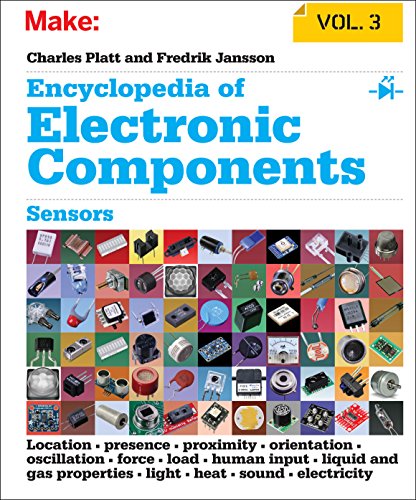
Charles Platt is an accomplished author and electronics expert known for his contributions to the Make: series. With a background in engineering and a passion for teaching, he has written extensively on electronics, making complex concepts accessible to hobbyists and professionals alike. This volume reflects his expertise by delivering detailed, fact-checked information on sensors that sense light, sound, heat, motion, and more, helping you deepen your understanding of electronic components essential for modern projects.
Charles Platt is an accomplished author and electronics expert known for his contributions to the Make: series. With a background in engineering and a passion for teaching, he has written extensively on electronics, making complex concepts accessible to hobbyists and professionals alike.
Drawing from his engineering background and passion for teaching, Charles Platt crafted this volume to demystify the complex world of electronic sensors. You’ll explore detailed explanations of components that detect everything from light and sound to force and electrical signals, with clear photographs and schematics that illustrate their function and variants. Chapters cover practical topics like proximity sensors, human input devices, and oscillation components, making it a useful reference whether you're refreshing knowledge or tackling a new project. This book suits hobbyists, educators, and engineers who want a reliable, fact-checked source beyond typical datasheets or online tutorials.
This AI-created book on electronic sensors is tailored to your experience level and specific interests. By sharing what you want to focus on—whether it's sensor types, applications, or technologies—you receive a book that matches your unique goals. Personalization makes sense here because sensor technology spans so many fields and complexities, so having content that directly fits your background helps you learn faster and deeper. This custom approach ensures you explore the topics that matter most to you without unnecessary information.
TailoredRead AI creates personalized nonfiction books that adapt to your unique background, goals, and interests. Instead of reading generic content, you get a custom book written specifically for your profession, experience level, and learning objectives. Whether you're a beginner looking for fundamentals or an expert seeking advanced insights, TailoredRead crafts a book that speaks directly to you. Learn more.
This personalized book explores the fascinating world of electronic sensors, offering you a tailored journey through sensor technologies that match your background and interests. It examines core principles such as sensor types, signal processing, and interfacing techniques, while also diving into specialized topics like environmental sensing, wireless sensor networks, and electrochemical sensors. By focusing on your specific goals and experience, this book reveals the nuances that make each sensor application unique, helping you deepen your understanding efficiently.
Crafted to blend expert knowledge with your personal learning needs, this tailored guide covers both foundational concepts and advanced sensor applications, ensuring you gain practical insights aligned precisely with your objectives in sensor mastery.
Tero Karvinen teaches Linux and embedded systems at Haaga-Helia University of Applied Sciences, with a background in curriculum development and wireless networking research. His expertise in both teaching and practical application inspired this hands-on guide to sensor projects using Arduino and Raspberry Pi. With a Masters of Science in Economics and experience as a CEO, Karvinen brings a unique blend of technical and managerial insight, making this book a valuable resource for anyone looking to dive into building real-world sensor applications.
Tero Karvinen, Kimmo Karvinen, Ville Valtokari(you?)·
About the Author
Tero Karvinen teaches Linux and embedded systems in Haaga-Helia University of Applied Sciences, where his work has also included curriculum development and research in wireless networking. He previously worked as a CEO of a small advertisement agency. Tero's education includes a Masters of Science in Economics.
Unlike most electronic sensors books that focus purely on theory, this one draws from Tero Karvinen's extensive experience teaching Linux and embedded systems to offer a practical path for creating sensor projects with Arduino and Raspberry Pi. You’ll explore how to select the right platform depending on your needs—Arduino for straightforward, low-power sensing tasks, and Raspberry Pi when you need more processing power with Linux. The book walks you through diverse sensors like accelerometers, gyroscopes, and gas detectors, providing hands-on projects that clarify their real-world applications. If you’re interested in building tangible sensor systems rather than just reading about them, this book aligns well with your goals.
Kimmo Karvinen leverages his experience as a CTO in hardware manufacturing to demystify sensor technology in this book. His background in integrated AV and security systems, combined with creative leadership in marketing communications, brings a unique perspective that bridges practical engineering with accessible communication. This foundation helps you grasp how to measure the physical world with electronics, Arduino, and Raspberry Pi, making the book a solid starting point for anyone looking to build sensor-based projects from scratch.
Kimmo Karvinen works as a CTO in hardware manufacturer that specializes in integrated AV and security systems. Before that he worked as a marketing communications project leader and as a creative director and partner in advertisement agency. Kimmo's education includes a Masters of Art.
Kimmo Karvinen's expertise as a CTO in hardware manufacturing informs this focused guide on sensor technology, where you learn to build circuits that detect physical phenomena using electronics, Arduino, and Raspberry Pi. The book walks you through foundational electronic circuits before advancing to programming sensor systems with Arduino and finally crafting projects with the Raspberry Pi’s Linux environment. For example, it explains how to convert sensor signals into actionable data and connect sensors to the Internet. If you're eager to understand sensor integration from the ground up and enhance your hands-on skills with microcontrollers, this book offers a clear path, though it suits those ready to engage with both hardware and software aspects.
Robert Faludi, Chief Innovator at Digi International and a professor at NYU and SVA, brings extensive expertise in wireless sensor technology to this book. His work on projects like large-scale home energy monitoring and innovative systems such as LilyPad XBee wearable radios underpin the practical insights offered here. This book reflects his deep understanding of ZigBee and Arduino platforms, making it a valuable resource for anyone interested in creating wireless sensor networks.
Robert Faludi is the Chief Innovator at Digi International. He is an NYU Professor, SVA professor, and an expert consultant on commercial projects, including large-scale home energy monitoring. His work has appeared in The New York Times, CNet, Good Morning America, and elsewhere. He is a co-creator of the LilyPad XBee wearable radios, and Botanicalls, a system that allows thirsty plants to place phone calls for human help.
Robert Faludi's decades of experience as Chief Innovator at Digi International and as a professor at NYU and SVA shaped this book into a detailed guide for building wireless sensor networks using ZigBee, XBee radios, Arduino, and Processing. You learn how to assemble distributed sensor systems, create scalable networks, and handle technical aspects like power management and source routing, all through hands-on projects such as constructing a complete ZigBee network. The book suits inventors, hobbyists, and students who want to understand wireless sensor networking practically and affordably, offering clear pathways from basic setups to complex applications. Its stepwise projects and extensive parts list make it accessible even if you’re new to radio networking technologies.
This AI-created book on sensor projects is crafted based on your background, skill level, and specific interests within electronics. You share what types of sensors and project goals you want to explore, and the book is tailored to guide you through relevant experiments and applications. This personalized approach ensures you focus on learning exactly what matters to you, making complex sensor concepts more accessible and engaging. It’s a hands-on pathway designed to help you build skills efficiently and confidently.
TailoredRead AI creates personalized nonfiction books that adapt to your unique background, goals, and interests. Instead of reading generic content, you get a custom book written specifically for your profession, experience level, and learning objectives. Whether you're a beginner looking for fundamentals or an expert seeking advanced insights, TailoredRead crafts a book that speaks directly to you. Learn more.
2026·50-300 pages·Electronic Sensors, Sensor Basics, Microcontroller Integration, Data Acquisition, Signal Processing
This personalized book offers an immersive journey into sensor projects carefully tailored to your background and goals, designed to accelerate your practical skills through hands-on experience. It explores a curated selection of sensor types and project designs that match your specific interests, allowing you to deepen your understanding step-by-step. By focusing on your unique learning needs, the book reveals the nuances of sensor integration, data collection, and real-world applications in ways that resonate personally. This tailored approach helps bridge the gap between complex expert knowledge and your individual pace, providing clear, focused pathways to achieve tangible results rapidly.
Dr. Giuseppe Maruccio, an Associate Professor specializing in spintronics and lab-on-a-chip technology with over 130 publications and 4 patents, brings his extensive research experience to this book. His deep knowledge in physics and materials science shapes a thorough examination of electrochemical sensors, focusing on the critical role of working electrodes and their functionalization. This background ensures the book serves as a solid reference for those interested in advancing sensor technology and miniaturized device applications.
Dr. Maruccio is currently Associate Professor at the Department of Mathematics and Physics and responsible for the spintronics and lab on a chip group. Dr. Maruccio is author of more than 130 publications and 4 patents in addition to several invited contributions at international conferences, institutions and PhD schools.
Drawing from decades of expertise in spintronics and lab-on-a-chip research, Dr. Giuseppe Maruccio, along with Jagriti Narang, delivers a detailed exploration of electrochemical sensors focusing on working electrodes and their functionalization. You’ll gain a clear understanding of the materials and fabrication techniques that underpin biosensor technology, including how gold, carbon, and metal oxides behave as electrode materials. The book delves into key properties such as electron transfer kinetics and electrode fouling resistance, providing insights valuable for both academic researchers and industry practitioners in materials science, analytical chemistry, and biomedical engineering. If you’re looking to deepen your grasp of electrode design and miniaturized device fabrication, this book offers targeted knowledge without unnecessary complexity.
Thomas Petruzzellis is an accomplished author known for his engaging and educational books on electronics and DIY projects. With a focus on making complex concepts accessible, he has inspired countless readers to explore the fascinating world of electronics through hands-on projects. This book reflects his commitment to demystifying sensor technology and empowering you to create your own electronic devices that detect everything from rain to radiation.
Thomas Petruzzellis is an accomplished author known for his engaging and educational books on electronics and DIY projects. With a focus on making complex concepts accessible, he has inspired countless readers to explore the fascinating world of electronics through hands-on projects.
Thomas Petruzzellis brings his knack for making electronics approachable to this collection of 54 hands-on projects that illuminate the hidden signals in nature. You learn to build devices like rain detectors, lightning sensors, and radiation monitors, each with clear schematics and parts lists, turning abstract concepts into tangible experiments. The book balances fun with learning, showing how everyday phenomena can be measured and understood through electronic sensing. It's particularly suited for hobbyists and DIY enthusiasts eager to deepen their grasp of sensor technology without wading through dense theory or expensive equipment.
The best Electronic Sensors books and more, in your inbox each week. No account needed.
Conclusion
Across these seven carefully selected books, a few themes emerge clearly: foundational theory paired with practical application, a spectrum from beginner-friendly introductions to advanced technical treatises, and a focus on both wired and wireless sensor technologies. Together, they form a roadmap to mastering electronic sensors in diverse contexts.
If you’re grappling with understanding sensor fundamentals, starting with "Getting Started with Sensors" and "Make" will ground you in hands-on projects and integration techniques. For those aiming to innovate in industrial or biomedical fields, "An Introduction to Distributed Optical Fibre Sensors" and "Electrochemical Sensors" offer deep dives into cutting-edge materials and methods. Meanwhile, "Building Wireless Sensor Networks" bridges hardware and networking, ideal for scalable sensor deployments.
Alternatively, you can create a personalized Electronic Sensors book to bridge the gap between general principles and your specific situation. These books can help you accelerate your learning journey, equipping you with the knowledge to innovate and excel in the evolving world of sensor technology.
Frequently Asked Questions
I'm overwhelmed by choice – which book should I start with?
Starting with "Getting Started with Sensors" offers a gentle introduction to sensor basics and practical projects, making it ideal if you’re new to the field. It lays the groundwork before you tackle more advanced texts like "An Introduction to Distributed Optical Fibre Sensors."
Are these books too advanced for someone new to Electronic Sensors?
Not at all. Books like "Getting Started with Sensors" and "Make" are designed for beginners, with hands-on projects and clear explanations. More technical titles provide depth once you're comfortable with the basics.
What's the best order to read these books?
Begin with foundational guides like "Getting Started with Sensors" then move to practical project books like "Make." Follow with specialized topics such as "Building Wireless Sensor Networks" or "Electrochemical Sensors" based on your interests.
Do I really need to read all of these, or can I just pick one?
You can pick based on your goals. For practical DIY projects, "Electronics Sensors for the Evil Genius" is great. For advanced industrial applications, "An Introduction to Distributed Optical Fibre Sensors" stands out. Choose what fits your focus.
Which books focus more on theory vs. practical application?
"An Introduction to Distributed Optical Fibre Sensors" and "Electrochemical Sensors" dive deep into theory and materials science. Meanwhile, "Make" and "Electronics Sensors for the Evil Genius" emphasize practical, hands-on projects.
How can I get sensor knowledge tailored to my specific needs?
Great question! While these books offer solid foundations, personalized content can align sensor knowledge directly with your background and goals. You might find it helpful to create a personalized Electronic Sensors book that bridges expert insights with your unique situation.
📚 Love this book list?
Help fellow book lovers discover great books, share this curated list with others!