10 History Books That Separate Experts from Amateurs
Recommended by Peter Frankopan, Jenna Wortham, and Ida Bae Wells, these History books offer profound insights and expert perspectives.
Updated on June 22, 2025·We may earn commissions for purchases made via this page
We're launchingLaunching on Product Hunt today 🎉We just launchedJust launched on Product Hunt 🎉
Modelpeers, from the BookAuthority teamFrom the BookAuthority team: Modelpeers, a free way to follow AI models and agents like you follow people. We'd love your support.
What if the history you thought you knew was just a part of the story? History isn’t a dry list of dates; it’s a dynamic narrative packed with human struggles, power plays, and cultural revolutions that shape our present. Today, understanding history means questioning traditional tales and embracing new perspectives that challenge old assumptions. This is especially urgent as global events demand deeper context and insight.
Leading historians and commentators like Peter Frankopan, professor at Oxford, and Jenna Wortham, New York Times Magazine writer, have found fresh revelations in books like The Greeks and The 1619 Project. Frankopan’s research into Byzantine and Greek history reshaped his views on cultural influence, while Wortham’s engagement with racial history deepened her understanding of America’s complex past. These experts discovered that history is often messier and more interconnected than textbooks suggest.
While these expert-curated books provide proven frameworks for understanding history’s many layers, you might find value in creating a personalized History book tailored to your interests, profession, or prior knowledge. Explore how you can build your own custom History book to deepen your journey beyond these foundational works.
Shahid Buttar For Congress, an advocate and organizer who ran for California's 12th congressional district, highlights Howard Zinn’s work as a transformative force in understanding American history from the grassroots level. After engaging deeply with social movements, he calls this book an "illuminating tour de force" and the top recommendation for grasping the often untold stories of the nation's past. This perspective reshaped his view on history's role in activism and social justice. Similarly, George Stroumboulophòulos emphasizes its importance for anyone seeking to understand the past and envision paths forward, underscoring its continued relevance.
Advocate and organizer, CA-12 congressional candidate
“@bourgeoisalien @scotty2971 Zinn’s “A People’s History” is an illuminating tour de force, an immense contribution to both history and the movement, and by far our #1 most recommended book. Enjoy—and share—it!” (from X)
Howard Zinn (1922–2010) was a historian, playwright, and social activist. In addition to A People’s History of the United States, which has sold more than two million copies, he is the author of numerous books including The People Speak, Passionate Declarations, and the autobiography, You Can’t Be Neutral on a Moving Train. Zinn grew up in Brooklyn in a working-class, immigrant household. At 18 he became a shipyard worker and then flew bomber missions during World War II. These experiences helped shape his opposition to war and passion for history. After attending college under the GI Bill and earning a Ph.D. in history from Columbia, he taught at Spelman, where he became active in the civil rights movement. After being fired by Spelman for his support for student protesters, Zinn became a professor of Political Science at Boston University, where he taught until his retirement in 1988. Zinn was the author of many books, including an autobiography, You Can't Be Neutral on a Moving Train, the play Marx in Soho, and Passionate Declarations. He received the Lannan Foundation Literary Award for Nonfiction and the Eugene V. Debs award for his writing and political activism.
When Howard Zinn first discovered the power of history told from the perspective of ordinary people, he reshaped how American history could be understood. In this book, you encounter a narrative that centers on the struggles of women, workers, African-Americans, Native Americans, and immigrants rather than political elites, revealing grassroots battles for labor rights, racial equality, and suffrage. You’ll gain insight into events often overlooked in traditional textbooks, such as the fight for the eight-hour workday and child labor laws, told through compelling stories and analysis. This approach challenges you to reconsider accepted narratives and deepens your understanding of America's complex social fabric. It's a book that suits anyone wanting a more inclusive and critical view of U.S. history.
Jenna Wortham, writer for The New York Times Magazine and culture commentator, praised this book during a time when conversations about race and history were especially urgent. She called it "transformative, powerful, extremely potent and one that will strike back if needed," highlighting its forceful impact. Wortham's appreciation stems from how the book reshaped her understanding of American history by centering the legacy of slavery in contemporary life. Following her, Ida Bae Wells, a reporter covering race at The New York Times Magazine, emphasized the book’s scholarly rigor, noting that every word was meticulously reviewed by leading historians, strengthening its arguments beyond the original magazine issue.
“congrats to @nhannahjones & @OneWorldLit for the most Scorpio-ass book — transformative, powerful, extremely potent and one that will strike back if needed” (from X)
Nikole Hannah-Jones, The New York Times Magazine, Caitlin Roper, Ilena Silverman, Jake Silverstein(you?)·
About the Author
Nikole Hannah-Jones is a Pulitzer Prize–winning reporter covering racial injustice for The New York Times Magazine, and creator of the landmark 1619 Project. In 2017, she received a MacArthur Foundation Fellowship, known as the Genius Grant, for her work on educational inequality. She has also won a Peabody Award, two George Polk Awards, three National Magazine Awards, and the 2018 John Chancellor Award for Excellence in Journalism from Columbia University. In 2016, Hannah-Jones co-founded the Ida B. Wells Society for Investigative Reporting, a training and mentorship organization geared toward increasing the number of investigative reporters of color. Hannah-Jones is the Knight Chair in Race and Journalism at Howard University, where she has founded the Center for Journalism and Democracy. In 2021, she was named one of Time’s 100 most influential people in the world.
When Nikole Hannah-Jones, a Pulitzer Prize-winning journalist known for her incisive coverage of racial injustice, expanded the original 1619 Project into this extensive volume, she shifted the lens on American history to center African American experiences and the legacy of slavery. You’ll encounter eighteen essays and dozens of poems and stories that explore how the arrival of enslaved Africans in 1619 shaped every facet of U.S. society, from capitalism and democracy to culture and identity. For anyone eager to deepen their understanding of America's racial past and present, this book offers a nuanced, layered exploration without shying away from difficult truths, such as the ongoing impact of systemic racism. Its detailed scholarship and literary voices make it a rich resource for educators, activists, and history enthusiasts alike.
#1 New York Times Bestseller
NAACP Image Award Winner
Kirkus Reviews Best Nonfiction Book of the Century
This AI-tailored book on ancient civilizations develops a systematic approach with frameworks that adapt to your specific interests and background. The content adjusts based on your focus areas and goals to address the nuanced challenges of tracing early empires’ global influence. By creating a tailored narrative, it bridges the gap between broad historical overviews and the particular facets of ancient societies relevant to you, offering a deep dive into their interconnected legacies.
TailoredRead AI creates personalized nonfiction books that adapt to your unique background, goals, and interests. Instead of reading generic content, you get a custom book written specifically for your profession, experience level, and learning objectives. Whether you're a beginner looking for fundamentals or an expert seeking advanced insights, TailoredRead crafts a book that speaks directly to you. Learn more.
2026·50-300 pages·History, Ancient Civilizations, Empire Dynamics, Cultural Exchange, Political Structures
This personalized book on ancient civilizations provides a tailored framework that explores the rise, influence, and interconnectedness of early empires across the globe. It examines key methodologies in historical analysis, tracing cultural, political, and technological legacies through comparative frameworks adapted to your specific interests and background. By focusing on tailored approaches to understanding ancient power dynamics, societal structures, and cross-cultural exchanges, the content cuts through irrelevant generalizations and fits your unique context. This nuanced examination helps uncover how ancient civilizations shaped the modern world, offering insights into their global footprints through a carefully curated, personalized lens.
Peter Frankopan, professor of global history at Oxford and director of the Oxford Centre for Byzantine Research, praised this book as "a monumental, sweeping history of the Greeks covering more than three thousand years right up to the present day." He discovered this volume while deepening his understanding of the Byzantine era and found it broadened his view of Greek influence far beyond classical antiquity. This comprehensive narrative helped reshape his perspective on the global impact of Greek civilization. Following his lead, Paul Cartledge, senior fellow at Cambridge University, also commends Beaton's expansive scope and illuminating encapsulation of Greek achievements across millennia.
“A monumental, sweeping history of the Greeks covering more than three thousand years right up to the present day. Authoritative, compelling, and beautifully written. A wonderful book.”
Roderick Beaton is an Emeritus Professor at King’s College London and Commander of the Order of Honor of the Hellenic Republic. His previous book, Greece: Biography of a Modern Nation, was shortlisted for the Cundill History Prize. He is the four-time winner of the prestigious Runciman Award and lives in Kent, England.
2023·624 pages·History, World History, Greek Civilization, Classical Studies, Byzantine History
Unlike most history books that focus narrowly on classical Greece or modern nationhood, Roderick Beaton expands the narrative to cover more than three millennia of Greek civilization, from the Bronze Age Mycenaeans to today's global diaspora. You gain a nuanced understanding of how Greek culture, politics, and influence evolved across continents and epochs, illustrated through detailed explorations of key chapters like Alexander the Great’s conquests and Byzantine Christianity’s spread. This book suits anyone eager to grasp how Greek identity and contributions have shaped world history beyond the usual confines. It’s a measured, richly documented journey rather than a glorified national epic, making it especially rewarding if you want depth over mythology.
Balaji S. Srinivasan, CEO and Co-Founder of 21 and Board Partner at Andreessen Horowitz, highlights how this book reshaped his understanding of World War II by uniting the European and Asian theaters through the Soviet lens. "In the Asian theater, World War 2 arguably began in 1937 with the Japanese attack on China. One of the interesting things about McMeekin's book is that it unifies the European and Asian theaters from the Soviet perspective." This perspective challenged conventional narratives and illuminated Stalin's central role across continents. Likewise, Peter Hitchens points out the surprising depth of American support for Stalin, emphasizing how the book reveals the strategic generosity that bolstered Soviet power. Together, their insights invite you to reconsider the war's true dynamics beyond familiar stories.
CEO and Co-Founder of 21, Board Partner at Andreessen Horowitz
“@ScottFlear In the Asian theater, World War 2 arguably began in 1937 with the Japanese attack on China. One of the interesting things about McMeekin's book is that it unifies the European and Asian theaters from the Soviet perspective.” (from X)
Sean McMeekin is a professor of history at Bard College. The award-winning author of several books, including Stalin’s War, The Russian Revolution, and July 1914, McMeekin lives in Clermont, New York.
When Sean McMeekin first examined World War II through newly accessible Soviet, European, and US archives, he uncovered a perspective that challenges familiar narratives. This book reveals how Stalin, rather than Hitler, was the driving force behind the war's scope and outcome, showing readers the geopolitical strategies, alliances, and material dependencies that shaped the conflict. You’ll gain insight into the interconnected Asian and European theaters and how American and British aid empowered the Soviet war machine. It's particularly suited for those interested in understanding the war's broader global dynamics beyond the usual Eurocentric focus.
Trevor Ncube, a seasoned media executive and keynote speaker deeply engaged with African narratives, highlights the profound impact of this book during his exploration of Africa's historical role. He calls it "a must read for all who want to understand our proud, most times painful, role in the making of the modern world," emphasizing how French's use of primary sources combined with lived experience uncovers new historical ground. This perspective reshaped his understanding of Africa’s centrality in global history. Similarly, Peter Frankopan, professor of global history at Oxford, praises the book's powerful challenge to traditional views, calling it "a masterpiece even" for its bold reshaping of historical thought.
“Howard French’s book is a must read for all who want to understand our proud, most times painful, role in the making of the modern world. Beautifully written from primary sources, with flavor of Howard’s lived experience, the book breaks plenty new ground.” (from X)
Howard W. French is a renowned journalist and author, known for his extensive reporting for the New York Times from various regions including Asia, Latin America, and the Caribbean. His work often focuses on the historical and cultural narratives that shape our understanding of the modern world, particularly regarding Africa's significant yet often overlooked contributions to global history.
2021·512 pages·World History, History, African History, Colonialism, Global Trade
What if everything you knew about modern history was wrong? Howard W. French argues that Africa and Africans lie at the heart of the story often told as Europe's rise. Drawing from his decades of journalism and deep historical research, French reconstructs a narrative where Africa’s economic power and cultural influence shaped the Age of Discovery, democracy, and Enlightenment ideals. You’ll encounter vivid accounts of medieval African emperors, resilient Kongo rulers, and freed slaves who changed American history, all challenging the conventional Eurocentric view. This book suits anyone eager to rethink global history through a more inclusive, nuanced lens, though it demands engagement with complex and sometimes uncomfortable truths.
This AI-tailored book on military strategy develops a systematic approach with frameworks that adapt to your specific historical interests and focus areas. The content adjusts based on your preferred eras and campaigns to address the nuanced complexities of pivotal battles. It bridges the gap between broad military history and detailed strategic analysis, offering insights into leadership decisions, tactical innovations, and the consequences of conflict within your chosen context.
TailoredRead AI creates personalized nonfiction books that adapt to your unique background, goals, and interests. Instead of reading generic content, you get a custom book written specifically for your profession, experience level, and learning objectives. Whether you're a beginner looking for fundamentals or an expert seeking advanced insights, TailoredRead crafts a book that speaks directly to you. Learn more.
2026·50-300 pages·History, Military Strategy, Battle Analysis, Campaign Tactics, Leadership Decisions
This personalized framework examines pivotal battles and military strategies across diverse historical eras, offering a tailored approach that fits your specific interests and context. The book provides in-depth analysis of strategic decision-making, battlefield tactics, and campaign outcomes, adjusted to your preferred regions, time periods, and military doctrines. It explores the evolution of warfare methodologies from ancient conflicts to modern engagements, emphasizing how key campaigns shaped political and cultural landscapes. By cutting through generic overviews, it delivers a focused, adaptive exploration of conflict dynamics, helping you understand how strategy, leadership, and technology intersect in military history.
Peter Frankopan, professor of global history at Oxford and director of the Oxford Centre for Byzantine Research, endorses this work as "a great achievement, pulling together many strands with aplomb." Known for his deep expertise on historical connectivity, Frankopan found this book’s synthesis of medieval events especially illuminating during his research on the Silk Roads. His appreciation highlights how the book ties the medieval past to broader global narratives. Alongside him, Dan Carlin, famed podcaster of Hardcore History, praises it as "an audacious, entertaining page-turner," emphasizing its engaging storytelling and breadth across a millennium. Their insights reveal how this book both clarifies and enlivens a complex era.
Dan Jones is the New York Times bestselling author of Crusaders, The Templars, The Plantagenets, Wars of the Roses, and Magna Carta. He wrote and presented the popular Netflix series Secrets of Great British Castles, and has an exclusive deal with Sony Pictures Television to produce and develop historical TV series, including adaptations of his books.
When Dan Jones first realized how the medieval world was shaped by forces still familiar today—like climate change and pandemics—he crafted a narrative that extends beyond simple chronology. You gain an understanding of how Europe evolved from Rome’s fall through the rise of nations, law, and culture, with vivid portraits of figures like Eleanor of Aquitaine and Attila the Hun. The book’s chapters systematically connect medieval events to modern systems, making the past relevant rather than distant. If you want to grasp how foundational shifts in governance, religion, and society during the Middle Ages underpin today’s world, this book will serve you well; however, if you seek a narrowly focused military or economic history, this broad panorama may feel too sprawling.
Publisher's Weekly, a respected voice in literary and historical circles, highlights this book's vivid account of imperial tensions in Central Asia. Their recommendation, "Chronicles the imperial struggle for power in Central Asia between Victorian England and Czarist Russia," underscores how this work illuminates the complex rivalry that shaped the region. This perspective enriches your understanding of 19th-century geopolitical conflicts, shifting how you view the era's history and influence on modern boundaries.
Peter Hopkirk is the author of Like Hidden Fire: The Plot to Bring Down the British Empire, Trespassers on the Roof of the World: The Race for Lhasa, and two other books. A staff writer for The Times of London for nineteen years, five as its chief reporter, he is a Middle and Far East specialist.
What started as Peter Hopkirk's deep dive into nineteenth-century geopolitical contests reshaped how you understand the intricate power plays in Central Asia. Drawing from his extensive reporting career at The Times of London, Hopkirk unpacks the tensions between Victorian England and Czarist Russia, revealing the strategies and missteps that defined their rivalry. You gain detailed insight into diplomatic maneuvers, espionage, and military expeditions that shaped the region's fate, especially through chapters that trace key figures and their covert operations. This book suits anyone fascinated by imperial history or geopolitical strategy, offering a vivid window into the forces shaping Central Asia beyond mere dates and battles.
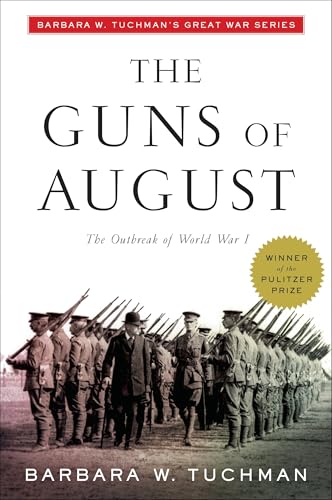
Ben Dreyfuss, editorial director at Mother Jones, credits much of his knowledge about the July Crisis to Barbara Tuchman’s vivid account in The Guns of August. Reflecting on his understanding shaped by the book and a BBC miniseries, he states, "I shall confess that all of my knowledge about the July crisis comes from either the first chapter of Barbra Tuchman’s ‘Guns of August’ or the BBC docudrama ‘37 Days’... But that’s a great book and the miniseries is really good." His recommendation highlights how the book brings clarity to the complex events that triggered World War I, reshaping his view of this pivotal moment in history.
“I shall confess that all of my knowledge about the July crisis comes from either the first chapter of Barbra Tuchman’s “Guns of August” or the BBC docudrama “37 Days” starring the actor who played Emperor Palpatine. But that’s a great book and the miniseries is really good.” (from X)
When Barbara W. Tuchman first realized how the tangled web of decisions, personalities, and politics led to the outbreak of World War I, she crafted a narrative that focuses on the critical month of August 1914. You gain a detailed understanding of how historical events unfolded through vivid portraits of key figures like kings, kaisers, and generals, along with insight into the abrupt shift from 19th-century pomp to 20th-century warfare. Chapters dissecting the July Crisis reveal how miscalculations and diplomacy failures ignited a global conflict. This book is ideal if you want a gripping look at the origins of WWI beyond dry dates and facts, especially if you're interested in military history and political dynamics.
Keith Ellison, Minnesota Attorney General known for fighting for affordable living and dignity, found new depth in this book during his public service efforts. He shared, "Just listened to the audio version of one of my favorite books, The Color of Law... Highly recommend." This endorsement highlights how Rothstein’s research reshaped Ellison’s understanding of racial segregation as a product of deliberate government policy, not just social forces. Similarly, Jared Bernstein, former Chief Economist to Vice President Biden, praises the book’s meticulous documentation of government discrimination, underscoring its importance for understanding racial disparities in housing and opportunity.
“Just listened to the audio version of one of my favorite books, The Color of Law: A Forgotten History of How Our Government Segregated America by Richard Rothstein. Highly recommend.” (from X)
Richard Rothstein, the author of The Color of Law and father to co-author Leah Rothstein, has written many books and articles on educational policy and racial inequality. He lives in the San Francisco Bay Area.
The Color of Law challenged the long-held belief that racial segregation in American cities happened naturally or by individual choices. Richard Rothstein, with his deep expertise in housing policy, lays out how explicit government laws and policies systematically enforced segregation, shaping metropolitan America. You gain a detailed understanding of how zoning laws, public housing policies, and federal subsidies combined to create lasting racial divides — insights grounded in chapters that trace these policies from the 1920s through post–World War II suburbanization. If you're looking to grasp the legal and governmental role in racial inequality, this book illuminates those mechanisms clearly and rigorously.
The New York Times, a respected authority in book reviewing, highlights this book as "a mini museum between the covers of a book," underscoring its unique ability to bring World War I to life through vivid visuals and compelling firsthand accounts. Such praise reflects how the book transforms a complex, often daunting topic into an accessible and tangible experience. Following this, Newsweek notes how DK has revitalized non-fiction publishing, especially for younger audiences, through engaging and richly illustrated content. Together, these perspectives emphasize the book's success in merging educational depth with captivating presentation.
Dorling Kindersley was founded in London in 1974 and is now the world's leading illustrated reference publisher and part of Penguin Random House, formed on July 1, 2013. DK publishes highly visual, photographic nonfiction for adults and children. DK produces content for consumers in more than 87 countries and 62 languages, with offices in Delhi, London, Melbourne, Munich, New York, and Toronto. DK’s extensive children’s list showcases a fantastic store of information for children, toddlers, and babies. DK covers everything from animals and the human body, to homework help and craft activities, together with an impressive list of licensing titles, including the best-selling LEGO books. DK acts as the parent company for Alpha Books, publisher of the Idiot's Guides series and Prima Games, video gaming publishers, as well as the award-winning travel publisher Rough Guides.
Unlike most history books that rely heavily on text, this visual history from DK offers an immersive experience by combining detailed maps, vivid photographic galleries, and firsthand soldier accounts to convey the complex narrative of World War I. You get a chronological journey from the assassination of Archduke Franz Ferdinand to the Treaty of Versailles, with chapters dedicated to major battles like the Somme and Verdun, alongside profiles of key figures such as David Lloyd George. The book’s rich visuals and eyewitness testimonies help you grasp the war’s evolving technologies and human impact, making it particularly useful if you prefer learning through powerful imagery and personal stories. It’s ideal for history enthusiasts seeking a well-rounded understanding rather than an academic-heavy tome.
The best History books and more, in your inbox each week. No account needed.
Conclusion
This collection of ten History books reveals several key themes: the importance of diverse perspectives, the interconnectedness of global events, and the lasting impact of political and social decisions. Whether it’s exploring the sweeping influence of Greek civilization or unpacking the forces behind racial segregation in America, these books offer you multiple lenses to view history’s complexity.
If you’re navigating the challenge of understanding systemic inequality, The 1619 Project and The Color of Law provide profound insights. For those eager to grasp the origins of global conflicts, Stalin’s War and The Guns of August offer detailed analysis. Readers looking for a broader cultural panorama will find Powers and Thrones and Born in Blackness especially rewarding.
Once you’ve absorbed the expert insights here, create a personalized History book to connect these general principles with your unique goals and background. Tailored reading can help you bridge gaps and make history truly relevant to your perspective and needs.
Frequently Asked Questions
I'm overwhelmed by choice – which book should I start with?
Start with a book that matches your interests. For a broad social view, try A People’s History of the United States. If you want global perspectives, The Greeks offers a sweeping narrative. Choosing a starting point that excites you makes the journey more rewarding.
Are these books too advanced for someone new to History?
Not at all. Many, like The Guns of August and Powers and Thrones, are written with engaging storytelling that welcomes newcomers. They provide rich context without assuming deep prior knowledge.
What's the best order to read these books?
There’s no single order. You might start with broader histories like Born in Blackness or The Greeks and then move to more focused works like The Great Game or Stalin’s War to deepen specific areas of interest.
Should I start with the newest book or a classic?
Both approaches work. Newer books like The 1619 Project offer fresh perspectives on history, while classics such as The Guns of August provide foundational understanding. Mixing both enriches your grasp.
Do I really need to read all of these, or can I just pick one?
You can absolutely pick one that resonates most with your interests. Each book stands strong alone, but reading multiple offers layered insights that deepen your understanding of history’s complexity.
Can I get tailored History insights without reading all these books?
Yes, you can. While these expert books offer valuable perspectives, creating a personalized History book lets you focus directly on your interests and goals. Discover tailored History books here.
📚 Love this book list?
Help fellow book lovers discover great books, share this curated list with others!