"Designing the User Interface" by Ben Shneiderman, Catherine Plaisant, Maxine Cohen made it to BookAuthority's Best Human-Computer Interaction eBooks of All Time!
7 Human-Computer Interaction Books That Define the Field
Insights from Jakob Nielsen, Tom Peters, and Jeff Atwood on Human-Computer Interaction Books
Updated on June 25, 2025·We may earn commissions for purchases made via this page
5 of 7 books have Kindle versions
We're launchingLaunching on Product Hunt today 🎉We just launchedJust launched on Product Hunt 🎉
Modelpeers, from the BookAuthority teamFrom the BookAuthority team: Modelpeers, a free way to follow AI models and agents like you follow people. We'd love your support.
What if the way you interact with your devices could feel as natural as talking to a friend? Human-Computer Interaction (HCI) is transforming how technology and people connect, shaping our digital world more deeply than ever before. From smartphones to social media, the design choices in HCI influence everything you touch and see on your screens every day.
Jakob Nielsen, co-founder of Nielsen Norman Group, revolutionized web usability with his clear, user-focused principles. Tom Peters, a leadership expert, champions simplicity in design, echoing Nielsen's impact. Meanwhile, Jeff Atwood, co-founder of StackOverflow, recognizes interface design as fundamental to software success. These thought leaders help us understand why HCI matters now, not just as tech, but as a human-centered discipline.
While this collection of seven books offers proven frameworks and timeless insights, if you want content tailored to your specific experience, goals, or interests within HCI, consider creating a personalized Human-Computer Interaction book. It merges expert knowledge with your unique learning path for real-world impact.
Tom Peters, known for his advocacy of people-centered leadership and extreme humanism, praises this work amid countless writings about the web. His endorsement highlights the book's unique mastery, calling it a "masterpiece" and "a pleasure to read." Peters appreciates how Jakob Nielsen's expertise reshaped his understanding of web design simplicity, emphasizing how the book champions clarity and usability above all else.
Advocate of Extreme Humanism and leadership expert
“Eighty gajillion things have been written about the Web. Do we need one more? Answer: Yes! If it's from Jakob Nielsen. Designing Web Usability: The Practice of Simplicity is a masterpiece. Jakob knows his stuff like, literally, no one else! This book is a pleasure to read. And invaluable. May simplicity rule!”
Jakob Nielsen, Ph.D. is a User Advocate specializing in web usability and a principal of Nielsen Norman Group, which he co-founded with Dr. Donald A. Norman. Until 1998, Dr. Nielsen was a Sun Microsystems Distinguished Engineer and led that company's web usability efforts starting with the original design of SunWeb in early 1994. His previous affiliations include the IBM User Interface Institute, Bell Communications Research, and the Technical University of Denmark. Nielsen is the author and editor of 8 other books and more than 75 research papers on usability engineering, user interface design, and hypertext. He is also a frequent keynote presenter at industry conferences. Nielsen's Alertbox column about web usability has been published on the Internet since 1995 and currently has about 100,000 readers. He holds 46 U.S. patents, mainly on ways to make the Internet easier to use.
Jakob Nielsen's decades of experience in user advocacy and web usability shaped this guide that dissects how users interact with websites before committing to engagement or purchase. You learn to design pages that satisfy users' dual desires: to find specific information quickly and to browse intuitively when unsure of what they want. The book covers everything from navigation strategies to accessibility considerations, grounded in Nielsen's well-documented principles and real-world examples. It's particularly useful if you're involved in web design, UX, or digital product development and want to understand the psychology behind effective site usability.
Matt Jones, co-author at the Future Interaction Technology Lab and an expert in mobile user experience, highlights how this book reshaped his view on designing for human interaction with technology. He notes its unique ability to inspire and empower students and practitioners alike by blending foundational principles with emerging trends. "This book has changed the world of a generation of students, educators and designers – helping them to see life and technology in ways that inspire and inform appealing, delightful and effective interactive devices and services," he says. His endorsement underscores the book’s role in advancing person- and community-centered design for a broad range of users.
“This book has changed the world of a generation of students, educators and designers – helping them to see life and technology in ways that inspire and inform appealing, delightful and effective interactive devices and services. Foundational knowledge and emerging topics are presented with virtuoso flair. It charms from the start: page after page you'll encounter stimulating, thoughtful wisdom written in a friendly, encouraging and empowering way. If you only ever buy one interaction design book in your life, this is the one: buy it and join the vital movement of person, community and society centred design that is building a bright future for billions of users worldwide.”
Jenny Preece is Professor and Dean in the College of Information Studies, Maryland's iSchool – at the University of Maryland. Yvonne Rogers is the Director of the Interaction Center at University College London as well as a Professor of Interaction Design. Helen Sharp is Professor of Software Engineering and Associate Dean at the Open University.
Jenny Preece, Helen Sharp, and Yvonne Rogers bring a rich blend of academic leadership and practical insight to this book, which dives deep into the principles and application of interaction design within human-computer interfaces. You’ll find detailed discussions on designing for social, ethical, and technological contexts, including chapters that explore contemporary platforms like Facebook and YouTube. The inclusion of interviews with HCI pioneers offers a valuable look into emerging trends and challenges. This book suits those looking to understand not only the theory but also how to apply interaction design methods across diverse user groups and devices.
This AI-created book on human-computer interaction is tailored to your experience level, interests, and specific goals within user experience design. By sharing what you want to focus on and your background, you receive a book that matches your learning needs precisely. This personalized approach helps you navigate complex HCI concepts efficiently, making your study more relevant and engaging. It’s designed to support your unique pathway to mastering user-centered design.
TailoredRead AI creates personalized nonfiction books that adapt to your unique background, goals, and interests. Instead of reading generic content, you get a custom book written specifically for your profession, experience level, and learning objectives. Whether you're a beginner looking for fundamentals or an expert seeking advanced insights, TailoredRead crafts a book that speaks directly to you. Learn more.
2026·50-300 pages·Human-Computer Interaction, User Experience, Usability Principles, Interaction Models, User Research
This tailored book explores core principles of Human-Computer Interaction (HCI) with a focus on user experience design specific to your background and goals. It examines fundamental concepts such as usability, cognitive psychology, and interaction models, while also delving into advanced topics like accessibility, prototyping, and user research. By concentrating on your areas of interest, this personalized guide reveals how to create intuitive, effective interfaces that resonate with real users. The tailored content encourages deeper understanding and practical application of HCI theories, allowing you to cultivate skills that align precisely with your needs in designing human-centered technology.
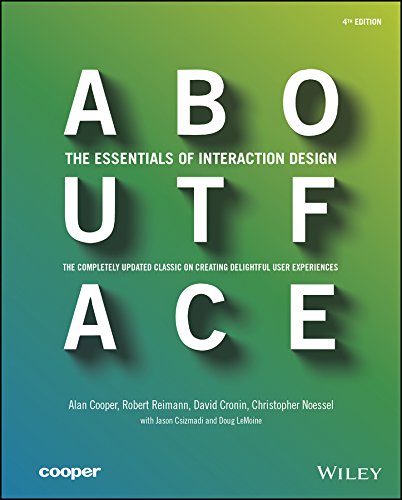
Alan Cooper is a founder of Cooper and a pioneer of modern computing whose groundbreaking work has shaped how programmers, business people, and users interact with software. His expertise in crafting user-centered interfaces drives this book, which reflects decades of experience and a commitment to elevating interaction design as a discipline. Cooper and his co-authors wrote this to address the shifting landscape toward mobile and touch devices, ensuring you have a relevant framework to design for today’s users with clarity and purpose.
Alan Cooper, Robert Reimann, David Cronin, Christopher Noessel(you?)·
About the Author
Alan Cooper is a founder of Cooper and a pioneer of modern computing. His groundbreaking work has influenced a generation of programmers, business people, and users.
Alan Cooper challenges the conventional wisdom that interaction design is merely about aesthetics, arguing instead for a goal-directed approach that centers on user needs and behaviors. Drawing from decades of experience shaping software interfaces, this book equips you with deep insights into designing effective digital products, especially for mobile and touch platforms. It walks you through practical concepts like interface patterns, user expectations, and product design trade-offs, with updated chapters addressing the evolving landscape of smartphones and tablets. If you’re involved in crafting user experiences, this book sharpens your ability to create intuitive, purposeful designs that resonate with real users.
Albrecht Schmidt, professor at the University of Stuttgart and an authority in Human-Computer Interaction, emphasizes the enduring relevance of this book despite today's digital learning trends. He notes, "Over the last 20 years research and practice in Human-Computer-Interaction have matured. An in-depth understanding of methods in this field is essential... This book is at the same time an accessible textbook as well as a comprehensive reference." Schmidt appreciates how the book balances foundational topics with new research areas like ubiquitous computing, shaping how students and practitioners approach HCI research. Following Schmidt, Elizabeth Churchill, Director of User Experience at Google, praises its clarity and engaging style, highlighting the book's detailed rationale and ethical discussions that deepen understanding for both newcomers and experts alike.
Professor of Computer Science, University of Stuttgart
“Over the last 20 years research and practice in Human-Computer-Interaction have matured. An in-depth understanding of methods in this field is essential and the key to success in research as well as in industry. The big question is how we teach and learn about these methods? Is a book in the digital age, in times when people are excited about MOOCs, and when video tutorials are everywhere still an appropriate medium? Absolutely! This book is at the same time an accessible text book as well as a comprehensive reference. The topics are well selected and are highly relevant for students, researchers, and practitioners. Each chapter has a focus, communicates the basics, and teaches how to practically apply it. The new edition includes all the basics I would teach, and additionally provides a profound introduction to new topics, including Human-computer Interaction in the context of online systems and ubiquitous computing.”
Jonathan Lazar, Jinjuan Heidi Feng, Harry Hochheiser(you?)·
About the Author
Jonathan Lazar is a professor in the Department of Computer and Information Sciences at Towson University and has served as director of the Undergraduate Program in Information Systems since 2003. He also founded the Universal Usability Laboratory at Towson University and served as director from 2003 to 2014. In the area of human-computer interaction, Lazar is involved in teaching and research on web accessibility for people with disabilities, user-centered design methods, assistive technology, and law and public policy related to HCI. He has previously authored or edited 10 books, including Ensuring Digital Accessibility Through Process and Policy (coauthored with Dan Goldstein and Anne Taylor), Disability, Human Rights, and Information Technology Accessibility (coedited with Michael Stein), Universal Usability: Designing Computer Interfaces for Diverse User Populations, and Web Usability: A User-Centered Design Approach. He has published over 140 refereed articles in journals, conference proceedings, and edited books, and has been granted two US patents for his work on accessible web-based security features for blind users. He frequently serves as an adviser to government agencies and regularly provides testimony at federal and state levels, and multiple US federal regulations cite his research publications. His research has been funded by the National Science Foundation; National Institute on Disability, Independent Living, and Rehabilitation Research (NIDILRR); American Library Association; and TEDCO. He currently serves on the executive board of the Friends of the Maryland Library for the Blind and Physically Handicapped and the State of Maryland Work Group on Increasing the Teaching of IT Accessibility Concepts in State Universities. He has served in multiple roles in the Association for Computing Machinery Special Interest Group on Computer-Human Interaction (ACM SIGCHI), most recently, adjunct chair of public policy (2010–15) and Digital Accessibility Chair (CHI 2014). Lazar has been honored with the 2017 University System of Maryland Board of Regents Award for Excellence in Research, the 2016 SIGCHI Social Impact Award, given annually to an individual who has promoted the application of human-computer interaction research to pressing societal needs, the 2015 AccessComputing Capacity Building Award (sponsored by the University of Washington and the National Science Foundation) for advocacy on behalf of people with disabilities in computing fields, the 2011 University System of Maryland Board of Regents Award for Excellence in Public Service, and the 2010 Dr. Jacob Bolotin Award from the National Federation of the Blind, for working towards achieving the full integration of the blind into society on a basis of equality. In 2012, Lazar was selected to be the Shutzer Fellow at the Radcliffe Institute for Advanced Study at Harvard University, where he investigates the relationship between human-computer interaction for people with disabilities and US disability rights law.
2017·560 pages·Human-Computer Interaction, Research Methods, User Experience, Data Analysis, Ethnography
Drawing from Jonathan Lazar's extensive experience in accessible web design and public policy, this book lays out a broad array of research methods tailored specifically to human-computer interaction. You’ll gain concrete skills in both quantitative and qualitative techniques, such as ethnography, physiological measurements, and crowdsourcing, all illustrated through detailed case studies from companies like Google and Yahoo. The second edition updates the content to include emerging technologies and research with diverse populations, including children and older adults. This text suits anyone engaged in HCI research, from students to seasoned professionals, offering a practical toolkit to design, conduct, and analyze studies in this evolving field.
Grady Booch, a scientist and storyteller known for his work in software engineering and design, praised this book during a Twitter exchange, calling it a "fantastic book". His endorsement matters because Booch’s extensive experience in technology and design gives weight to how this book rethinks human-computer interactions. The insights here helped Booch reflect on how technology feels more like interaction with real people, challenging traditional views. His subtle comment about "looking for a word" hints at the nuanced understanding this book offers beyond typical technical manuals.
Byron Reeves, Ph.D., is the Paul C. Edwards Professor in the Department of Communication at Stanford University, and currently serves Co-Director of the Stanford H-STAR Institute (Human Sciences and Technologies Advanced Research), a Stanford laboratory working at the intersection of computing and social sciences. He is also Founder and Faculty Director of the Stanford Media X Program that organizes research and knowledge transfer between industry and Stanford researchers working on information technology. Byron is an expert on the psychological processing of media in the areas of attention, emotions, and physiological responses, and is co-author of The Media Equation: How People Respond to Computer, Television and New Media Like Real People and Places. He has published over 100 research papers about media psychology and his research has been the basis for a number of products at companies such as Microsoft, IBM, and Hewlett-Packard, in the areas of voice interfaces, automated dialogue systems, conversational agents, enterprise software and interaction design. He is currently working on applications of multi-player game technology to the conduct of serious work and is Co-Founder, with Leighton Read, of Seriosity, Inc. Byron received his Ph.D. in Communication from Michigan State University, and his B.F.A. in Graphic Design and Journalism from Southern Methodist University. Prior to joining the faculty at Stanford in 1986, Byron was a professor for ten years in the School of Journalism & Mass Communication and Associate Director of the Mass Communication Research Center at the University of Wisconsin-Madison.
What started as a quest to understand how people emotionally and cognitively interact with technology, Byron Reeves brings decades of research from Stanford to this exploration of humanizing digital interfaces. You’ll discover how users unconsciously treat computers, television, and new media as social actors, shaping the way interfaces should be designed for more natural engagement. Specific chapters delve into psychological responses like attention and emotion, offering insights into voice interfaces and conversational agents. This book suits anyone involved in designing or studying user interactions, especially those aiming to bridge technology and human psychology without oversimplified assumptions.
This AI-created book on human-computer interaction is crafted based on your current skills and the specific aspects of interface design you want to improve. It focuses on giving you rapid, focused exercises and clear steps that match your goals, turning complex HCI concepts into manageable daily actions. Because it’s tailored just for you, it concentrates on what you need most to develop your design skills efficiently.
TailoredRead AI creates personalized nonfiction books that adapt to your unique background, goals, and interests. Instead of reading generic content, you get a custom book written specifically for your profession, experience level, and learning objectives. Whether you're a beginner looking for fundamentals or an expert seeking advanced insights, TailoredRead crafts a book that speaks directly to you. Learn more.
This tailored book offers a focused, hands-on journey through human-computer interaction (HCI) with clear, practical exercises designed to boost your interface design skills rapidly. It explores core HCI principles and applies them in actionable steps that match your background and specific goals, providing a personalized path that makes complex concepts accessible and engaging. Each chapter builds on your progress, encouraging active learning through real-world tasks and reflective challenges.
By concentrating on tailored content that aligns with your interests and experience level, this book bridges expert knowledge and personal learning needs, helping you develop effective user interfaces through meaningful practice. It reveals how small, targeted actions can accelerate your growth as an HCI practitioner.
Jakob Nielsen, principal at Nielsen Norman Group and founder of the 'discount usability engineering' movement, brings decades of experience to this book. Known as the world's leading expert on web usability, Nielsen crafted this guide to share efficient, cost-conscious methods for improving user interfaces. His background as a Sun Microsystems Distinguished Engineer and long-standing contributor to usability research uniquely positions him to offer practical strategies that help you enhance user experience while keeping development lean.
Jakob Nielsen, Ph.D. is a principal of Nielsen Norman Group. He is the founder of the 'discount usability engineering' movement, which emphasizes fast and efficient methods for improving the quality of user interfaces. Nielsen was noted as 'the world's leading expert on Web usability' by U.S. News and World Report and 'the next best thing to a true time machine' by USA Today. Nielsen's Alertbox column on Web usability has been published on the Internet since 1995 and currently has about 200,000 readers. From 1994 to 1998, Nielsen was a Sun Microsystems Distinguished Engineer. His previous affiliations include Bell Communications Research, the Technical University of Denmark, and the IBM User Interface Institute. See his biography page at www.nngroup.com for additional biographical information.
Drawing from his extensive background as a principal at Nielsen Norman Group and founder of the 'discount usability engineering' movement, Jakob Nielsen offers a practical guide focused on efficient methods to improve user interfaces. You’ll learn specific usability testing techniques tailored for different stages of software development and how to conduct tests that provide immediate, actionable feedback. The book lays out a clear approach to identifying interface problems early and cost-effectively, making it a solid tool for developers and designers looking to enhance user experience without unnecessary complexity. If you're involved in creating or refining digital products, this book gives you grounded methods to make interfaces more intuitive and user-friendly.
Ben Shneiderman, Distinguished University Professor and founder of the Human-Computer Interaction Laboratory at the University of Maryland, brings decades of pioneering work in HCI to this book. His innovations, from touchscreen keyboards to treemaps for data visualization, inform a text that not only teaches you design fundamentals but also updates you on emerging trends like social media and voice interaction. Driven by his commitment to improving user experience and universal usability, Shneiderman’s expertise makes this a foundational resource for anyone looking to understand or refine user interface design.
Ben Shneiderman, Catherine Plaisant, Maxine Cohen, Steven Jacobs, Niklas Elmqvist, Nicholas Diakopoulos(you?)·
About the Author
Ben Shneiderman is a Distinguished University Professor in the Department of Computer Science and Founding Director of the Human-Computer Interaction Laboratory at the University of Maryland. He is a Fellow of the AAAS, ACM, IEEE, NAI, and the Visualization Academy and a Member of the U.S. National Academy of Engineering. He has received six honorary doctorates in recognition of his pioneering contributions to human-computer interaction and information visualization. His widely-used contributions include clickable highlighted web links, high-precision touchscreen keyboards for mobile devices, and tagging for photos. Shneiderman’s information visualization innovations include dynamic query sliders for Spotfire, treemaps for viewing hierarchical data, and event sequence analysis for electronic health records. He is the lead author of this book and has authored several others, including works on information visualization and human-centered AI.
Ben Shneiderman, a leading figure in human-computer interaction and a Distinguished University Professor, crafted this book to guide designers and students through the evolving landscape of user interface design. You dive into practical principles that help create user interfaces that are intuitive, predictable, and controllable, supported by updated research on topics like augmented reality and voice interaction. The book balances theory with design methods such as usability testing and expert reviews, making it particularly useful if you're aiming to improve user experience across platforms. Chapters include new case studies and 170 color figures that illuminate everything from social media interfaces to information visualization, offering concrete insights for both novices and experienced designers.
The best Human-Computer Interaction books and more, in your inbox each week. No account needed.
Conclusion
These seven books reveal distinct but complementary facets of Human-Computer Interaction—from understanding user psychology to mastering practical usability testing and designing intuitive interfaces. If you're just starting out, begin with Alan Cooper's "About Face" to grasp goal-directed design strategies. For researchers, "Research Methods in Human-Computer Interaction" offers indispensable methodologies. Developers seeking to improve user experience fast will find Jakob Nielsen's "Usability engineering" especially actionable.
Pairing foundational theory with hands-on techniques accelerates your learning and application. Alternatively, you can create a personalized Human-Computer Interaction book to bridge the gap between broad principles and your specific challenges. These books can help you accelerate your learning journey and make your designs resonate with real users.
Frequently Asked Questions
I'm overwhelmed by choice – which book should I start with?
Start with "About Face" by Alan Cooper. It introduces goal-directed design and user-centered thinking that form a solid foundation for any HCI journey.
Are these books too advanced for someone new to Human-Computer Interaction?
No. Several, like "Interaction Design" and "Designing the User Interface," balance theory with approachable examples, making them accessible for beginners.
Which books focus more on theory vs. practical application?
"Research Methods in Human-Computer Interaction" focuses on research theory, while "Usability engineering" and "Designing Web Usability" offer practical, hands-on guidance.
Are any of these books outdated given how fast Human-Computer Interaction changes?
While technology evolves, the core principles in these books remain relevant, as they address human behavior and interaction fundamentals that persist over time.
How long will it take me to get through these books?
Most books range from 300 to 700 pages. Depending on your pace, plan weeks to months, but applying insights as you go speeds learning.
Can personalized books complement these expert recommendations?
Yes, personalized Human-Computer Interaction books build on these expert insights by tailoring content to your background and goals. Explore creating one here.
📚 Love this book list?
Help fellow book lovers discover great books, share this curated list with others!