8 Numerical Analysis Books That Accelerate Learning
Explore Numerical Analysis Books authored by leading experts like Svein Linge, Hans Petter Langtangen, and Richard W. Hamming who offer trusted knowledge and practical insights.
Updated on June 25, 2025·We may earn commissions for purchases made via this page
5 of 8 books have Kindle versions
We're launchingLaunching on Product Hunt today 🎉We just launchedJust launched on Product Hunt 🎉
Modelpeers, from the BookAuthority teamFrom the BookAuthority team: Modelpeers, a free way to follow AI models and agents like you follow people. We'd love your support.
What if your understanding of numerical analysis could leap forward by diving into just the right books? Numerical analysis lies at the heart of solving complex problems across engineering, physics, and computational science — a field where precision meets practical algorithms. Whether you're tackling differential equations or optimizing simulations, the quality of your resources matters profoundly.
The books featured here come from authors deeply embedded in academia and industry, such as Svein Linge and Richard W. Hamming. Their works don't just teach methods; they illuminate the reasoning behind algorithms, blending theory with real-world applications. These texts stand out for their clarity, depth, and the way they connect computational thinking with mathematical foundations.
While these expert-authored books provide proven frameworks, readers seeking personalized learning tailored to their background, skill level, and specific numerical analysis interests might consider creating a personalized Numerical Analysis book that builds on these insights. This approach can streamline your journey through complex topics in a way that fits your goals perfectly.
Best for programming beginners in numerical simulations
Kindle version available
Svein Linge is a professor of modelling and simulation at the University College of Southeast Norway with a Dr. Scient. degree in biomechanics and over a decade of experience reforming engineering education through programming and simulation. His close work at the Center for Biomedical Computing and Simula Research Laboratory informs this book, which distills his expertise into an accessible introduction to numerical simulations using Python 3.6. This background makes the book particularly valuable for those seeking to blend programming with engineering and scientific problem-solving.
Svein Linge is a professor of modelling and simulation at the University College of Southeast Norway and holds a Dr. Scient. degree in biomechanics from the Norwegian School of Sport Sciences. He works part-time at a Norwegian Center of Excellence: 'Center for Biomedical Computing', at Simula Research Laboratory, to which he has been linked for the last 13 years. His main research interests include cerebrospinal fluid dynamics, cardiac electro-mechanics, and sport biomechanics. Over the last decade, Linge has been particularly engaged in reforming the engineering education in mathematics and physics to take advantage of computer programming and simulation.
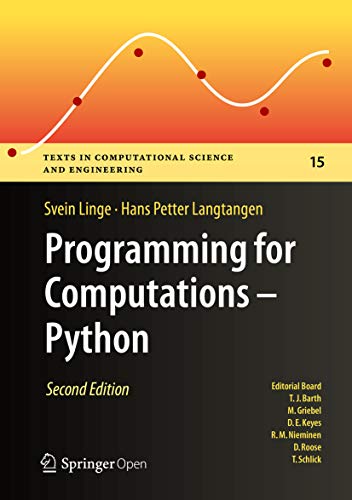
The breakthrough moment came when Svein Linge and Hans Petter Langtangen expanded the introduction to programming from 50 to 150 pages, creating a more accessible path into numerical simulations using Python 3.6. This book guides you through applying programming to solve mathematical problems, emphasizing clean design, generic algorithms, and verification through automatic tests. You’ll find detailed explanations and updated examples that demystify coding for engineering and science applications, especially in numerical methods. If you want to move from zero programming experience to confidently writing simulation programs, this text is tailored for you, particularly if you appreciate learning by doing with clear, concise instructions.
Best for foundational scientific computing techniques
Kindle version available
Richard W. Hamming was a key figure in early digital computing, having programmed one of the first computers for the Manhattan Project and contributed extensively at Bell Labs and the Naval Postgraduate School. His background as a mathematician and computer scientist informs this book’s unique focus on connecting numerical methods with practical computational insight. Hamming’s passion for clarity and precision in scientific computing led him to structure this text around fundamental concepts like error avoidance and algorithm stability, making it a valuable guide for anyone working with numerical analysis in science and engineering.
Richard W. Hamming (1915–1998) was first a programmer of one of the earliest digital computers while assigned to the Manhattan Project in 1945, then for many years he worked at Bell Labs, and later at the Naval Postgraduate School in Monterey, California. He was a witty and iconoclastic mathematician and computer scientist whose work and influence still reverberates through the areas he was interested in and passionate about. Three of his long-lived books have been reprinted by Dover: Numerical Methods for Scientists and Engineers, 1987; Digital Filters, 1997; and Methods of Mathematics Applied to Calculus, Probability and Statistics, 2004.
Richard W. Hamming’s extensive experience as a pioneering programmer and mathematician shines through in this exploration of numerical methods tailored for scientists and engineers. You’ll learn to connect computational techniques directly with the underlying problems, ensuring that the numerical results don’t just exist but provide genuine insight. The book delves into avoiding roundoff and truncation errors while emphasizing algorithm stability, with chapters on polynomial and Fourier approximations that offer concrete tools for complex calculations. If you’re engaged in rigorous scientific computing or engineering applications, this book provides a solid foundation to deepen your understanding of both methods and their implications.
This AI-created book on numerical analysis is crafted based on your background, skill level, and specific interests in the field. By sharing your goals and preferred topics, you receive a tailored guide that focuses exactly on what you want to learn. This personalized approach makes navigating complex numerical methods more efficient and aligned with your unique needs, helping you build solid mastery in this challenging subject.
TailoredRead AI creates personalized nonfiction books that adapt to your unique background, goals, and interests. Instead of reading generic content, you get a custom book written specifically for your profession, experience level, and learning objectives. Whether you're a beginner looking for fundamentals or an expert seeking advanced insights, TailoredRead crafts a book that speaks directly to you. Learn more.
This tailored book offers an immersive exploration of numerical analysis, crafted to match your unique background and learning goals. It covers fundamental concepts such as numerical algorithms, error estimation, and stability analysis while delving into specialized topics like differential equation solvers and interpolation techniques. By focusing on your specific interests, it reveals practical pathways through complex computations and mathematical reasoning, making challenging material approachable and relevant.
Through this personalized resource, you engage with a custom synthesis of knowledge that bridges expert theory with your individual learning journey. The content adapts to your pace and objectives, ensuring a focused and meaningful mastery of numerical analysis principles and applications.
Steve Chapra is the Emeritus Professor and Emeritus Berger Chair in the Civil and Environmental Engineering Department at Tufts University. With a distinguished career including work at the U.S. Environmental Protection Agency and NOAA, and teaching roles at Texas A&M and Imperial College London, his expertise deeply informs this book. Driven by his commitment to education, Chapra designed this text to help students and engineers tackle real-world numerical challenges using MATLAB, blending theory with practical application for a thorough understanding of numerical methods.
Steve Chapra is the Emeritus Professor and Emeritus Berger Chair in the Civil and Environmental Engineering Department at Tufts University. His other books include Surface Water-Quality Modeling, Numerical Methods for Engineers, and Applied Numerical Methods with Python. Dr. Chapra received engineering degrees from Manhattan College and the University of Michigan. Before joining Tufts, he worked for the U.S. Environmental Protection Agency and the National Oceanic and Atmospheric Administration, and taught at Texas A&M University, the University of Colorado, and Imperial College London. His general research interests focus on surface water-quality modeling and advanced computer applications in environmental engineering. He is a Fellow and Life Member of the American Society of Civil Engineering (ASCE) and has received many awards for his scholarly and academic contributions, including the Rudolph Hering Medal (ASCE) for his research, and the Meriam-Wiley Distinguished Author Award (American Society for Engineering Education). He has also been recognized as an outstanding teacher and advisor among the engineering faculties at Texas A&M University, the University of Colorado, and Tufts University. As a strong proponent of continuing education, he has also taught over 90 workshops for professionals on numerical methods, computer programming, and environmental modeling.
While working as an environmental engineering professor, Steven C. Chapra crafted this book to bridge theory and practical problem-solving using MATLAB. You gain hands-on skills in applying numerical methods to engineering and science challenges, with clear explanations of algorithm limitations and solution techniques. For example, Chapra dedicates chapters to root-finding, differential equations, and optimization with MATLAB coding exercises that deepen understanding. This book suits students and professionals who want to grasp numerical tools beyond formulas, focusing on implementation and analysis rather than pure theory.
David Kincaid is a prominent figure in numerical analysis known for making complex mathematical computing concepts accessible to diverse learners. Collaborating with Ward Cheney, he crafted this book to bridge theory and practical application, offering clarity and depth that benefit students and professionals tackling scientific computing challenges.
David Kincaid is a prominent figure in the field of numerical analysis, known for his contributions to mathematical computing. He has co-authored several influential texts that bridge the gap between theory and practical application in mathematics. His work is recognized for its clarity and depth, making complex concepts accessible to students and professionals alike. Kincaid's expertise is complemented by his collaborative efforts with Ward Cheney, another respected author in the field, ensuring a comprehensive approach to the subject matter.
Unlike most numerical analysis texts that lean heavily on application without deep mathematical rigor, this book takes a distinctly theoretical yet accessible approach. David Kincaid and Ward Cheney offer a thorough mathematical treatment of scientific computing methods, complete with proofs and motivations that clarify why algorithms work, not just how. You’ll find carefully explained pseudocode enabling you to translate theory into practice immediately, alongside chapters that explore advanced topics often skipped in undergraduate courses. This blend makes it ideal if you want to understand both the foundations and nuances of computational methods rather than just how to apply them.
S. S. Sastry is a renowned author and educator in mathematics, widely respected for his contributions to numerical analysis and teaching. His extensive academic experience informs this book, which aims to clarify complex numerical methods for students and practitioners alike. The text is designed to demystify challenging concepts and provide a dependable foundation in the subject, making it a valuable resource for those seeking a thorough understanding of numerical techniques.
S. S. Sastry is a renowned author and educator in the field of mathematics, known for his contributions to numerical analysis and mathematical education. His works are widely used in academic institutions and have helped countless students grasp complex mathematical concepts.
S. S. Sastry is a well-established mathematician whose deep expertise in numerical methods shines through in this text. You’ll gain a solid grasp of foundational numerical algorithms, from interpolation and numerical integration to solving linear and nonlinear equations, with clear explanations and practical examples. The book’s structured approach walks you through key techniques like finite difference methods and iterative solutions, making it well-suited for those who want to master core computational tools. If your goal is to build a reliable base in numerical methods applicable across engineering and science, this book provides precisely that without unnecessary complexity.
This AI-created book on numerical methods is tailored to your current skill level and specific goals. By sharing your background and areas of interest, you receive a book that focuses precisely on the numerical problem-solving techniques you want to develop quickly. This personalized approach helps you cut through general content and concentrate on what accelerates your learning effectively. It’s like having a guide that matches your pace and challenges you exactly where you are.
TailoredRead AI creates personalized nonfiction books that adapt to your unique background, goals, and interests. Instead of reading generic content, you get a custom book written specifically for your profession, experience level, and learning objectives. Whether you're a beginner looking for fundamentals or an expert seeking advanced insights, TailoredRead crafts a book that speaks directly to you. Learn more.
This tailored book explores focused strategies designed to rapidly enhance your numerical problem-solving skills within 30 days. It covers essential numerical methods, algorithmic thinking, and practical application techniques that match your current background and interests. By concentrating on your specific goals, it presents a clear pathway through complex numerical concepts, making advanced topics accessible and engaging. The personalized content ensures that you delve deeply into areas that matter most for your learning journey, fostering skill growth through carefully structured challenges and examples. With an enthusiastic approach, this book reveals how to accelerate your numerical skills efficiently, blending foundational knowledge with targeted practice tailored to your unique needs.
D. James Benton brings over 40 years' expertise in mechanical engineering and thermodynamics to this work. His deep background in the power industry and software development lends authority to the book’s focus on practical numerical methods. Benton’s journey, sparked by a transformative experience at a mission hospital in Kenya, informs his balanced approach to applied mathematics. This book reflects his commitment to teaching techniques that reliably solve real-world nonlinear and differential equations.
D. James Benton is married to his high school sweetheart, has three wonderful daughters and six grandchildren. He lives in Tennessee on a little farm next to a creek. He has worked in the power industry for 40+ years and has a Ph.D. in Mechanical Engineering. His specialties include: thermodynamics, heat transfer, and software development. His life was turned around at seventeen while visiting a mission hospital in Kenya, The Lighthouse for Christ.
When D. James Benton began exploring numerical methods, his extensive experience in mechanical engineering and the power industry shaped a uniquely practical approach to solving complex equations. This book guides you through nonlinear equations, numerical calculus, and differential equations with a focus on robust algorithms that hold up across various scientific and engineering disciplines. You’ll gain clarity on tackling both single and multi-variable problems, understanding which computational techniques are most reliable. It’s especially suited for those who want applied math that works in real-world scenarios rather than abstract theory.
Kyle A. Novak is an applied mathematician, data scientist, and decision analyst with over twenty-five years of experience spanning autonomous systems, cryptanalysis, and federal policy. His authoritative background positions him uniquely to illuminate the complexities of numerical methods for scientific computing. This book emerges from his deep expertise, aiming to give you a solid grasp of the mathematical theory alongside practical coding skills in Julia, Python, and Matlab/Octave. It’s a resource shaped by real-world challenges and academic rigor alike.
Kyle Novak is an applied mathematician, data scientist, and decision analyst with over twenty-five years of experience on topics ranging from autonomous systems and cryptanalysis to complex networks and federal policy. He is the author of Numerical Methods for Scientific Computing: The Definitive Manual for Math Geeks and Special Functions of Mathematical Physics: A Tourist's Guidebook and is featured in the American Mathematical Society's 101 Careers in Mathematics.
Kyle A. Novak's extensive experience as an applied mathematician and data scientist fuels this detailed exploration of numerical methods essential to scientific computing. The book demystifies complex algorithms, revealing their inner workings and potential pitfalls, which is crucial for both users and creators of computational tools. You’ll gain hands-on familiarity with linear algebra, differential equations, and analysis through worked examples and exercises using Julia, Python, and Matlab/Octave code. This manual is tailored for advanced undergraduates, graduate students, and researchers aiming to deepen their understanding and practical skills in numerical methods.
This textbook stands out in the numerical analysis landscape by embedding its approach within the rich framework of functional analysis. Designed primarily for graduate students, it offers a pathway to research by covering essential topics such as approximation theory, Sobolev spaces, finite difference and finite element methods, and numerical solutions to integral and boundary value problems. Its third edition enriches the content with updates on multivariable polynomials and refined chapters, reflecting ongoing advances in the field. If your goal is to grasp the theoretical foundations that underpin computational methods, this book provides a structured, in-depth guide to that journey.
When Kendall Atkinson and Weimin Han crafted this textbook, their goal was clear: equip graduate students with a solid mathematical foundation in numerical analysis framed through functional analysis. You’ll gain in-depth exposure to core areas like approximation theory, Fourier analysis, Sobolev spaces, finite element methods, and numerical solutions to boundary value problems. The book doesn’t just skim topics — it balances theory with examples, exercises, and extensive references for deeper study, making it ideal if you want to quickly transition into research. If you’re looking for a text that blends rigor with practical pathways to advanced computational mathematics, this work serves that purpose well, especially for those committed to mastering the mathematical backbone behind numerical methods.
The best Numerical Analysis books and more, in your inbox each week. No account needed.
Conclusion
The collection of books above reveals a few key themes: the balance between theory and application, the importance of understanding algorithmic stability, and the value of computational tools like MATLAB and Python in implementing numerical methods. If you face challenges in bridging mathematical concepts with programming, "Programming for Computations" and "Applied Numerical Methods with MATLAB for Engineers and Scientists" provide practical pathways.
For those eager to deepen theoretical understanding, "Numerical Analysis" by Kincaid and Cheney or "Theoretical Numerical Analysis" by Atkinson and Han offer rigorous mathematical foundations. Combining these with more application-focused texts can accelerate your comprehension and ability to solve complex problems.
Alternatively, you can create a personalized Numerical Analysis book to bridge the gap between general principles and your specific situation. These carefully selected books can help you accelerate your learning journey and master numerical analysis with confidence.
Frequently Asked Questions
I'm overwhelmed by choice – which book should I start with?
Start with "Programming for Computations" if you want an accessible introduction blending programming and numerical methods. It’s great for building foundational skills before moving to more advanced theory or applications.
Are these books too advanced for someone new to Numerical Analysis?
Not necessarily. Books like "Introductory Methods of Numerical Analysis" are designed to build core skills from the ground up, while others progressively increase in complexity, allowing beginners to advance comfortably.
What's the best order to read these books?
Begin with approachable texts like Linge's "Programming for Computations," then explore Chapra’s MATLAB applications. Follow with theory-rich books such as Kincaid and Cheney’s "Numerical Analysis" to deepen your understanding.
Should I start with the newest book or a classic?
Both have value. Classics like Hamming’s text offer foundational insights, while newer works such as Novak’s "Numerical Methods for Scientific Computing" provide up-to-date computational approaches. A mix gives the best perspective.
Which books focus more on theory vs. practical application?
"Numerical Analysis" and "Theoretical Numerical Analysis" emphasize mathematical theory, while "Applied Numerical Methods with MATLAB" and "Programming for Computations" focus more on practical programming and implementation.
Can I get personalized Numerical Analysis learning tailored to my experience and goals?
Yes, while these expert books provide solid frameworks, personalized books can complement them by focusing on your specific interests and skill level. You can create a personalized Numerical Analysis book to bridge expert knowledge with your unique needs.
📚 Love this book list?
Help fellow book lovers discover great books, share this curated list with others!