"Relational Frame Theory" by Steven C. Hayes, Dermot Barnes-Holmes, Bryan Roche made it to BookAuthority's Best Relational Theory Audiobooks of All Time!
Dive into Relational Theory Books authored by leading experts like Michael J Hernandez, C. J. Date, Chris Date, and Terry Halpin, shaping database design and theory.
Updated on June 28, 2025·We may earn commissions for purchases made via this page
0 of 8 books have Audiobook versions
We're launchingLaunching on Product Hunt today 🎉We just launchedJust launched on Product Hunt 🎉
Modelpeers, from the BookAuthority teamFrom the BookAuthority team: Modelpeers, a free way to follow AI models and agents like you follow people. We'd love your support.
What if you could master the core principles that underpin modern databases through the insights of some of the most respected figures in the field? Relational Theory isn’t just academic jargon—it’s the foundation enabling reliable, efficient, and scalable data management systems that power everything from enterprise software to cloud applications. As data complexity grows, understanding these principles becomes more urgent.
The books chosen here reflect the deep expertise of authors like Michael J. Hernandez, whose decades consulting and teaching at Microsoft give practical clarity, and C. J. Date, whose pioneering work bridges rigorous theory with real-world database design. Chris Date's latest work deepens the understanding of keys and foreign keys, while Terry Halpin’s approach to conceptual schema offers a fresh perspective on modeling.
While these expert-curated books provide proven frameworks, readers seeking content tailored to their specific background, goals, or experience might consider creating a personalized Relational Theory book that builds on these insights, delivering a unique learning experience shaped around your needs.
C. J. Date is a pioneering expert in relational database technology with an honors degree in mathematics from Cambridge and a pivotal role in developing IBM's SQL/DS and DB2 systems. His extensive teaching experience and original contributions to database theory underpin his ability to clarify complex topics. This book reflects his deep commitment to helping professionals develop rigorous, maintainable database designs grounded in solid theory.
C. J. Date is an independent author, lecturer, researcher, and consultant, specializing in relational database technology, a field he helped pioneer. Prior to leaving IBM in 1983, he was involved in technical planning and externals design for the IBM products SQL/DS and DB2. His book An Introduction to Database Systems (8th edition) is the standard text on the subject and has sold 900,000 copies, not counting translations. It is used by several hundred colleges and universities worldwide. Mr. Date has delivered live lectures and seminars on database matters at locations throughout the world. He holds an honors degree in mathematics from Cambridge University and has made a number of original contributions to database theory. He enjoys a reputation that is second to none for his ability to explain complex technical issues in a clear and understandable fashion.
C. J. Date's decades of experience in relational database technology shine through this book, which bridges the gap between theoretical design and practical application. You gain a detailed understanding of advanced normal forms like essential tuple normal form and domain key normal form, learning how these concepts ensure data consistency and reduce redundancy. The book is especially useful if you want to move beyond basic database design into a more rigorous, theory-based approach, with clear explanations that demystify complex topics. Chapters on data consistency and normalization techniques provide concrete tools you can apply to real-world database challenges.
Chris Date has a stature that is unique in the database industry. He is best known for his textbook An Introduction to Database Systems (Addison-Wesley), which has sold close to a million copies at the time of writing. He enjoys a reputation that is second to none for his ability to explain complex technical issues in a clear and understandable fashion. He was inducted into the Computing Industry Hall of Fame in 2004.
Chris Date has a stature that is unique in the database industry. He is best known for his textbook An Introduction to Database Systems (Addison-Wesley), which has sold close to a million copies at the time of writing. He enjoys a reputation that is second to none for his ability to explain complex technical issues in a clear and understandable fashion. He was inducted into the Computing Industry Hall of Fame in 2004.
Chris Date approaches the complexity of keys and foreign keys in relational databases with unmatched authority, drawing on decades of experience and his bestselling textbook legacy. You’ll explore the subtle distinctions and historical evolution of these fundamental concepts, gaining clarity on why they often cause confusion despite their apparent simplicity. Detailed case studies, including analyses of the SQL standard and IBM DB2, illustrate practical implications and reinforce the theoretical foundations. This book suits database professionals and advanced practitioners seeking to deepen their understanding of relational structures beyond surface-level definitions.
This AI-created book on relational theory is crafted based on your background, experience, and specific goals. You share which areas of relational databases and theory intrigue you most, and the book is written to focus exactly on those aspects. This personalized approach helps you navigate complex concepts efficiently, making the learning process more relevant and engaging for your needs.
TailoredRead AI creates personalized nonfiction books that adapt to your unique background, goals, and interests. Instead of reading generic content, you get a custom book written specifically for your profession, experience level, and learning objectives. Whether you're a beginner looking for fundamentals or an expert seeking advanced insights, TailoredRead crafts a book that speaks directly to you. Learn more.
This tailored book explores the depths of relational theory through a personalized lens, matching your unique background and goals. It examines core principles, such as relational algebra, database schema design, and key integrity, while weaving in advanced concepts relevant to your interests. By focusing on your specific learning objectives, this book reveals connections between foundational theory and practical database architecture, offering a clear, coherent pathway through complex material. Tailored to your experience level, it guides you toward mastering relational models with a nuanced understanding that aligns with your personal and professional aspirations.
Michael J. Hernandez is a modern-day Renaissance man whose 25-plus years in database consulting and seven years at Microsoft lend authority to this guide. His experience as a technical instructor and speaker across industries shapes this book’s approachable style, making complex relational database concepts accessible. Hernandez’s hands-on perspective drives the book’s focus on sound, flexible database structures, helping you design robust systems tailored to today’s varied needs.
Michael J. Hernandez is a man with many talents and has done quite a bit in his life, and he continues to do many things to keep him busy. You could say he's a modern-day Renaissance Man. For instance, he has been an independent database consultant with more than 25 years of experience in the technology industry, and has been a contributing author to a wide variety of magazine articles, white papers, books, and periodicals. Mike has also been a top-rated and noted technical instructor for two national training organizations, the government, the military, the private sector, and companies throughout the United States, and he has been a top-rated speaker and presenter at numerous national and international conferences. He also worked full-time at Microsoft for seven years as a program manager, product manager, and marketing manager in the Visual Studio Group. Mike is mainly pursuing his artistic side at this point in his life. He is currently a professional actor (with more than seven years of experience as of this writing), performing in commercials for the likes of U.S. Bank, Allstate Insurance, and Subaru; in TV for shows such as Veep, American Crime, and Unbelievable; and feature films such as Ernesto's Manifesto, The Honor List, and Almost Home.
What happens when a seasoned database consultant distills decades of practical experience into a guide for everyday users? Michael J. Hernandez, with his extensive background including seven years at Microsoft and wide-ranging consulting and teaching roles, delivers a clear, methodical tutorial on relational database design that anyone can follow. You’ll learn how to plan and define tables, keys, and relationships while understanding business rules and data integrity, with updated chapters that address remote collaboration and modern applications. Whether you're starting fresh or refining an existing schema, the book offers a grounded approach to building reliable, flexible databases without drowning in jargon or vendor lock-in.
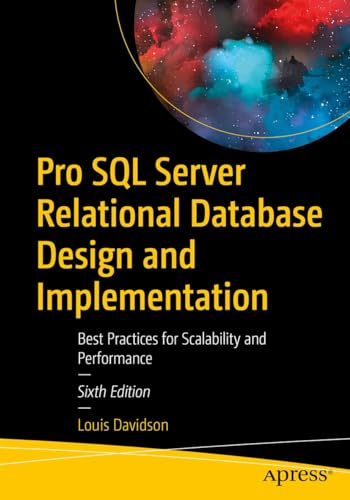
Louis Davidson has been a corporate database developer and architect for over 20 years and a Microsoft MVP for 15 years. His extensive experience working with SQL Server and commitment to teaching database design shines through in this book, which covers both foundational theory and the latest SQL Server 2019 features. Drawing from years of speaking engagements and practical work, Davidson offers readers a grounded roadmap for designing and implementing high-quality relational databases suited for modern cloud and on-premises environments.
Louis Davidson has been working with databases for more than 20 years as a corporate database developer and architect. He has been a Microsoft MVP for 15 years. And he has completed a sixth edition of his SQL Server database design book (Apress). Louis has been active speaking about database design and implementation at many conferences over the past 17 years, including SQL PASS, SQL Rally, SQL Saturday events, CA World, Music City Data, and the devLink Technical Conference. Louis has worked for the Christian Broadcasting Network (CBN) as a developer, DBA, and data architect for over 21 years. He has a bachelor’s degree in computer science from the University of Tennessee at Chattanooga.
Louis Davidson combines decades of hands-on experience with a deep understanding of relational database principles to deliver this detailed guide on SQL Server design and implementation. You'll find precise explanations on crafting OLTP databases that balance integrity, scalability, and performance, backed by practical examples like implementing temporal data storage and in-memory OLTP. The book’s chapters range from foundational concepts such as normalization to advanced SQL Server 2019 features including graph enhancements and row-level security, making it useful whether you're new to database design or a seasoned DBA seeking to leverage the latest technology. If you're aiming to master SQL Server's evolving capabilities with a focus on reliable, high-performing relational systems, this book speaks directly to your needs.
David Maier is a prominent figure in database theory with a career dedicated to advancing understanding of relational databases. His authoritative background and numerous influential texts make him uniquely qualified to write this book, which dives into the theoretical foundations of relational algebra and database management systems. Maier’s expertise ensures readers gain a thorough and precise grasp of complex relational concepts, making this work a valuable resource for those serious about the field.
David Maier is a prominent figure in the field of database theory, known for his contributions to relational databases. He has authored several influential texts that have shaped the understanding of database systems and their underlying principles. His work emphasizes the importance of relational algebra and the theoretical foundations of database management systems.
Drawing from his extensive background in database theory, David Maier presents a rigorous exploration of relational databases that goes beyond typical introductions. You’ll encounter deep analysis of relational algebra and its role in structuring and querying data, with detailed discussions on theoretical models that underpin database management systems. This book benefits those aiming to master the mathematical and logical foundations of relational databases, particularly students and professionals seeking a solid theoretical framework. For example, chapters on normalization theory and dependency preservation offer concrete insights that illuminate how databases maintain consistency and integrity.
This AI-created book on relational schema design is tailored to your background, skill level, and project goals. You share what specific aspects of database schema construction interest you most, and the book focuses exclusively on those areas. This personalized approach makes sense here because schema design is complex and varies widely by use case, so a custom guide helps you learn efficiently without sifting through irrelevant material.
TailoredRead AI creates personalized nonfiction books that adapt to your unique background, goals, and interests. Instead of reading generic content, you get a custom book written specifically for your profession, experience level, and learning objectives. Whether you're a beginner looking for fundamentals or an expert seeking advanced insights, TailoredRead crafts a book that speaks directly to you. Learn more.
This tailored book explores the art of designing relational database schemas through a personalized, step-by-step approach suited to your unique projects. It covers foundational concepts of relational theory and guides you through practical schema construction, emphasizing clarity and efficiency. The content matches your background and goals, focusing on actionable schema design paths that fit your specific context. By synthesizing expert knowledge into a format aligned with your needs, this book reveals how to build effective, scalable database models within a structured timeframe. Whether refining normalization or defining keys, it offers a tailored journey that deepens your understanding while honing your design skills.
Dr. Terry Halpin is a Senior Lecturer and Director of the Asymetrix Research Laboratory at the University of Queensland, Brisbane, Australia. His expertise in computer science and database research shaped this book, which aims to provide you with a clear, structured approach to relational database design. Drawing on his academic background, Halpin explains complex concepts through the Natural Language Information Analysis Method and Object-Role Modeling, making this book a valuable resource for anyone serious about mastering database schema development and implementation.
Dr. Terry Halpin is a Senior Lecturer and Director of the Asymetrix Research Laboratory in the Department of Computer Science at the University of Queensland, Brisbane, Australia.
After years immersed in computer science research, Terry Halpin developed a methodical approach to teaching relational database design that steers clear of jargon and theory-heavy abstractions. This book introduces you to high-level data modeling through the Natural Language Information Analysis Method (NIAM), a version of Object-Role Modeling (ORM), which clarifies complex concepts like uniqueness constraints and mandatory roles with real classroom exercises and practical questions. You'll learn how to transform conceptual schemas into relational implementations and understand the nuances of design methods, supported by appendices covering SQL and CASE tools. If you're aiming to master the foundations and applications of relational database design with clarity, this book fits that goal precisely.
Barbara Von Halle, managing partner of Knowledge Partners International and co-inventor of the Decision Model, brings over 25 years of expertise to this handbook. Her background as a data architecture and business rules pioneer, along with her recognition by International DAMA and experience as a keynote speaker, underpins the authoritative guidance found in this book. Drawing on decades of consulting and scholarly work, she offers a practical approach to relational database design that remains relevant and widely respected.
Barbara Von Halle is Managing Partner of Knowledge Partners International, LLC (KPI). She is co-inventor of the Decision Model and co-author of The Decision Model: A Business Logic Framework Linking Business and Technology published by Auerbach Publications/Taylor and Francis LLC 2009. The book reveals groundbreaking theory, an early reviewer states 'This book can become one of the classic books of a new era in computing that will have much traction in the next few years' - Opher Etzion, Ph.D., IBM Master Inventor. Barb writes a regular column in TDAN on the Decision Model. As the fifth recipient of the Outstanding Individual Achievement Award from International DAMA, Barb was inducted into the Hall of Fame in 1995. Known as a data architecture and business rules pioneer, she has consulted for over 25 years. She is an invited keynote speaker at conferences in the US and Europe. Her first book, Handbook of Relational Database Design published by Addison-Wesley since 1989 has over 21 printings and been cited in 28 books. A recent review on amazon.com states 'Still the best working reference... The only reference book I recommend to anyone needing to understand relational database design' - M.C. Kettelhut, Ph.D.
When Barbara Von Halle co-authored this handbook, her extensive experience in data architecture and business rules shaped a detailed guide to relational database design. You’ll learn two distinct but complementary methodologies: logical data modeling and practical relational database design, independent of any specific software product. The book walks you through how to construct robust, flexible database schemas that have been successfully applied across various relational platforms. If you’re involved in database development or architecture, this text offers a solid foundation and reference, though it assumes some familiarity with database concepts rather than serving absolute beginners.
This book offers a distinctive perspective on Relational Theory, moving past classical behavioral psychology to examine human language and cognition through a new lens. It equips you with empirical and conceptual tools designed for experimental analysis that address a wide range of subjects in both basic and applied settings. The authors challenge conventional views from Skinnerian behaviorism and invite you to reconsider how language and cognition interact from a behavioral standpoint. Whether you’re a behavior theorist, cognitive psychologist, therapist, or educator, this volume provides frameworks that deepen your understanding and approach to complex human behavior.
What started as a challenge to traditional behavioral psychology became a thorough re-examination of human language and cognition through Relational Frame Theory. Authors Steven C. Hayes, Dermot Barnes-Holmes, and Bryan Roche provide you with a toolkit that goes beyond abstract theory to enable experimental analysis across numerous topics in language and cognition. You’ll explore how this approach diverges from Skinnerian views and reshapes understanding in behavioral and cognitive psychology, offering insights valuable for therapists, educators, and behavior analysts. For example, the book carefully dismantles prior assumptions and introduces new conceptual frameworks that can influence your practical work or research in these fields.
The best Relational Theory books and more, in your inbox each week. No account needed.
Conclusion
These eight books collectively emphasize three themes: the balance of theory and practice, the centrality of keys and schema in relational design, and the expansion of relational ideas into areas like language cognition. If you’re navigating database design challenges, starting with Hernandez’s practical guide alongside Date’s theoretical texts offers a solid foundation.
For rapid implementation and scalability, Louis Davidson’s SQL Server-focused book pairs well with Barbara Von Halle’s handbook, providing strategic data architecture insights. Meanwhile, if your interests lean toward conceptual modeling or cognitive frameworks, Halpin’s and Hayes’s works open new frontiers.
Alternatively, you can create a personalized Relational Theory book to bridge the gap between general principles and your specific situation. These books can help you accelerate your learning journey by grounding you in the principles that make relational databases resilient and adaptable.
Frequently Asked Questions
I'm overwhelmed by choice – which book should I start with?
Start with Michael J. Hernandez's "Database Design for Mere Mortals" for a clear, practical introduction that grounds you before diving deeper into theory-focused works like C. J. Date's book.
Are these books too advanced for someone new to Relational Theory?
Not at all. Several books, such as Hernandez’s and Halpin’s, break down complex concepts in accessible ways, making them suitable for newcomers alongside more advanced readers.
What's the best order to read these books?
Begin with practical guides like Hernandez's, then explore foundational theory in Date's and Maier's books. Follow with specialized topics like keys in Chris Date’s work and SQL Server applications by Davidson.
Do these books assume I already have experience in Relational Theory?
Some books, like the "Handbook of Relational Database Design," expect familiarity, but others provide thorough introductions, so you can tailor your reading based on your background.
Which books focus more on theory vs. practical application?
C. J. Date's and Maier's books emphasize theory and normalization, while Hernandez’s and Davidson’s provide practical design and implementation strategies.
Can I get tailored insights if these books don’t cover my specific needs?
Yes. While these classics offer core knowledge, you can create a personalized Relational Theory book that adapts expert insights to your unique background and goals, bridging theory with your real-world context.
📚 Love this book list?
Help fellow book lovers discover great books, share this curated list with others!