10 Best-Selling Behavioral Economics Books Millions Love
Explore Behavioral Economics books recommended by experts Jeff Vandermeer, Raj Shamani, and Daniel Kahneman, offering proven, best-selling insights.
Updated on June 28, 2025·We may earn commissions for purchases made via this page
4 of 10 books have Audiobook versions
We're launchingLaunching on Product Hunt today 🎉We just launchedJust launched on Product Hunt 🎉
Modelpeers, from the BookAuthority teamFrom the BookAuthority team: Modelpeers, a free way to follow AI models and agents like you follow people. We'd love your support.
There's something special about books that both critics and crowds love—especially in a field as nuanced as Behavioral Economics. Millions of readers have turned to these works to uncover why humans make the decisions they do, blending psychological insights with economic realities. Behavioral Economics is reshaping how we understand choices in daily life, finance, and policy, revealing patterns that standard economics misses.
Experts like Daniel Kahneman, a Nobel laureate whose book "Thinking, Fast and Slow" revolutionized decision science, have set the foundation for this field. Innovators such as Dan Ariely, whose "Predictably Irrational" peels back the layers of our quirks and biases, and Richard Thaler, co-author of "Nudge," have propelled behavioral economics into mainstream understanding. These thought leaders' endorsements underscore the enduring relevance of these titles.
While these popular books provide proven frameworks, readers seeking content tailored to their specific Behavioral Economics needs might consider creating a personalized Behavioral Economics book that combines these validated approaches. Customization helps you focus on the aspects most relevant to your goals and background, enhancing your learning journey.
Satya Nadella, CEO of Microsoft, brings a unique perspective to behavioral economics, making his recommendation of this book especially noteworthy. His leadership at a technology giant demands sharp decision-making and an understanding of human behavior and cognition, aligning perfectly with the insights Daniel Kahneman offers in this work. Nadella’s endorsement underscores the book’s practical relevance in high-stakes environments where understanding cognitive biases and decision-making processes can influence outcomes dramatically. Alongside him, Daniel Kahneman himself, as a Nobel laureate and psychologist, anchors the book’s authority, providing readers with a profound exploration of the mind’s dual systems and their impact on choices and judgments.
“Love this book Thinking Fast and Slow, which feels of real use to fiction writers, too. Especially if like me you're looking for opportunities to create unexpected places for tension, psychological misdirection living in the words or spaces btwn words, etc.” (from X)
Daniel Kahneman was the Eugene Higgins Professor of Psychology Emeritus at Princeton University and a former professor of public affairs at the Woodrow Wilson School of Public and International Affairs. He received the 2002 Nobel Prize in Economic Sciences for his pioneering work with Amos Tversky on decision-making. He is the author of the international bestseller Thinking, Fast and Slow. He died in 2024.
Daniel Kahneman, a Nobel laureate and psychology professor, challenges how you think with a detailed exploration of two mental systems: the quick, instinctive System 1 and the slower, deliberate System 2. This book digs into how these systems influence your judgments, from overconfidence to cognitive biases affecting decisions in business and daily life. You gain insight into why your intuitions often mislead you and how deliberate thinking can improve your choices, as illustrated in chapters on loss aversion and happiness prediction. If you're curious about the hidden forces shaping your decisions, this book offers a nuanced perspective, though it's less about quick fixes and more about understanding your mind's workings.
Daniel Kahneman is a Nobel Prize-winning psychologist whose groundbreaking work shaped behavioral economics and decision-making science. Known for his bestselling book 'Thinking, Fast and Slow,' Kahneman's insights into how humans think and decide underpin this exploration of noise—unwanted variability in judgment that can lead to inconsistent decisions across fields. His expertise offers you a rare chance to understand and improve the quality of critical decisions in medicine, law, and business.
Daniel Kahneman, Olivier Sibony, Cass R. Sunstein·
About the Author
Daniel Kahneman is a Nobel Prize-winning psychologist known for his work in behavioral economics and decision-making. He is the author of the bestselling book 'Thinking, Fast and Slow', which explores the dual systems of thought that drive our decisions. Kahneman's research has significantly influenced how we understand human judgment and decision-making processes.
Daniel Kahneman, a Nobel Prize-winning psychologist, teams with Olivier Sibony and Cass R. Sunstein to dissect the hidden variability in human judgment known as noise. This book dives into how professionals across fields—from doctors to judges—make inconsistent decisions even when faced with identical information. You'll uncover the nature of noise, how it differs from bias, and practical ways organizations can detect and reduce it to improve decision quality. For example, chapters detail noise in legal sentencing and medical diagnoses, highlighting how seemingly small fluctuations can have serious consequences. If you seek to sharpen your understanding of judgment errors and improve decision processes, this book offers rich insights, though it demands careful reading rather than quick fixes.
This AI-created book on behavioral economics blueprint is tailored to your background and specific challenges. By sharing your experience and goals, you receive a book that focuses on proven behavioral methods relevant to your interests. This personalized approach helps you grasp complex concepts more efficiently, connecting popular behavioral economics lessons with practical applications that matter to you.
TailoredRead AI creates personalized nonfiction books that adapt to your unique background, goals, and interests. Instead of reading generic content, you get a custom book written specifically for your profession, experience level, and learning objectives. Whether you're a beginner looking for fundamentals or an expert seeking advanced insights, TailoredRead crafts a book that speaks directly to you. Learn more.
This tailored book on behavioral economics blueprint explores battle-tested methods that reliably influence decision-making and behavior. It examines key concepts from popular behavioral economics literature and integrates them with your unique background and interests. The book reveals how cognitive biases, choice architecture, and decision heuristics operate in real-world contexts, providing a deep understanding tailored to your specific goals. By focusing on reader-validated insights, it bridges established knowledge with your personal challenges, making complex behavioral concepts accessible and applicable. This personalized approach ensures you engage with content that matches your experience and learning objectives, fostering a meaningful grasp of how to harness behavioral economics effectively.
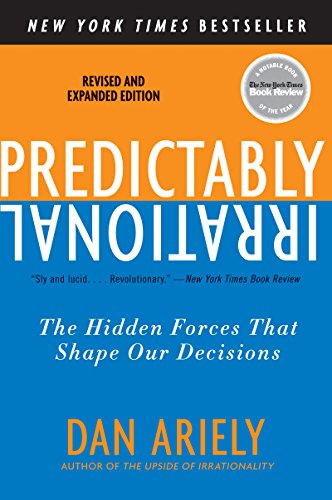
Max Levchin, co-founder of PayPal and CEO of Affirm, brings a unique perspective to behavioral economics, making his recommendation of Dan Ariely's book especially noteworthy. His background in fintech and payments highlights why understanding predictable irrationality is crucial in industries relying on consumer behavior insights. This endorsement aligns with widespread acclaim, underscoring the book's influence on both academic and practical fronts. Alongside Rand Fishkin, founder of Moz, whose expertise in marketing technology complements Ariely's insights, their combined endorsements emphasize the book's relevance for anyone seeking to decode the hidden forces guiding decisions.
Professor of Risk Engineering, Author of The Black Swan
“A marvelous book that is both thought provoking and highly entertaining, ranging from the power of placebos to the pleasures of Pepsi. Ariely unmasks the subtle but powerful tricks that our minds play on us, and shows us how we can prevent being fooled.” (from Amazon)
Dan Ariely is the James B. Duke Professor of Psychology and Behavioral Economics at Duke University. He is a founding member of the Center for Advanced Hindsight; a cocreator of the film documentary (Dis)Honesty: The Truth About Lies; and a three-time New York Times bestselling author. His books include Predictably Irrational, The Upside of Irrationality, The (Honest) Truth About Dishonesty, Irrationally Yours, Payoff, Dollars and Sense, and Amazing Decisions. His TED Talks have been viewed more than 27 million times. His work has been featured in the New York Times, the Wall Street Journal, the Washington Post, the Boston Globe, and elsewhere. He lives in North Carolina with his family.
Dan Ariely's decades of research in behavioral economics led to this examination of why humans consistently make irrational decisions that are surprisingly predictable. You learn to identify systematic biases behind everyday choices, from why a pricier aspirin seems more effective to why you might splurge unnecessarily on meals yet clip coupons for trivial savings. The book offers insights into cognitive biases and decision-making quirks through engaging experiments and real-life examples, such as the placebo effect's role in perceived value. You'll benefit most if you're curious about human behavior in economics, marketing, or personal finance, and want to understand the hidden forces shaping your own decisions.
Meir Statman is the Glenn Klimek Professor of Finance at Santa Clara University's Leavey School of Business, specializing in behavioral finance. Holding a Ph.D. from Columbia University and with a career dedicated to uncovering how real investors behave, Statman brings unmatched authority to this book. His work challenges traditional finance by incorporating a broader view of human wants, making this an insightful read for those wanting a richer understanding of financial decision-making.
Meir Statman is the Glenn Klimek Professor of Finance at the Leavey School of Business, Santa Clara University. His research focuses on behavioral finance. Meir's latest book, 'Finance for Normal People: How Investors and Markets behave' has been published by Oxford University Press. Meir received his Ph.D. from Columbia University and his B.A. and M.B.A. from the Hebrew University of Jerusalem.
When Meir Statman began exploring the limits of traditional finance theories, he realized that people’s financial behavior couldn’t be fully explained by the narrow concept of rational wants. In this book, he expands on this by defining "normal" wants that include not just utilitarian goals like high returns and low risk, but also expressive and emotional desires such as nurturing family, achieving social status, and staying true to personal values. You’ll learn how these complex wants influence real-world financial decisions, from saving strategies to portfolio choices, and gain a more nuanced understanding of market behavior. This book suits anyone curious about the human side of finance beyond standard models, especially professionals seeking deeper insights into investor psychology and market dynamics.
Andrei Shleifer is a professor of Economics at Harvard University known for his influential work in behavioral finance. His expertise and academic rigor shape this book, which challenges traditional views by integrating psychological insights into financial market analysis. Shleifer’s approach offers you a new lens for understanding how real investors and institutions impact market behavior, making it a valuable read for anyone seeking a deeper grasp of finance beyond efficient market theories.
When Andrei Shleifer noticed persistent anomalies in financial markets that traditional theories couldn’t explain, he delved into behavioral finance to challenge the efficient markets hypothesis. This book offers you a detailed look at how real-world investor behavior, bounded rationality, and institutional constraints shape market prices differently from classical models. You’ll explore models that better reflect how risk aversion, short-term horizons, and agency problems limit arbitrage and create pricing inefficiencies. If you're interested in understanding the psychological and economic forces behind market dynamics, this book provides a solid foundation and fresh perspectives that go beyond standard finance texts.
This AI-created book on behavioral economics is tailored to your skill level and specific goals. You share your background and which behavioral topics interest you most, along with the outcomes you want to achieve. The book is then written to focus on practical, step-by-step actions that match your personal context, helping you apply behavioral economics concepts quickly and effectively. Personalization makes all the difference, especially in a field where individual habits and motivations vary so much.
TailoredRead AI creates personalized nonfiction books that adapt to your unique background, goals, and interests. Instead of reading generic content, you get a custom book written specifically for your profession, experience level, and learning objectives. Whether you're a beginner looking for fundamentals or an expert seeking advanced insights, TailoredRead crafts a book that speaks directly to you. Learn more.
This tailored book explores the practical application of behavioral economics to help you achieve fast, tangible outcomes in just 30 days. By focusing on step-by-step actions, it reveals how everyday decision-making and subtle behavioral nudges can be harnessed to shape habits, influence choices, and improve personal and professional results. The content is carefully crafted to match your background and interests, ensuring the insights you gain are directly relevant and easily integrated into your routines. This personalized guide examines key behavioral principles and real-world examples, making complex concepts accessible and actionable, so you can experience meaningful change without wading through extensive theory.
Ryan Holiday, known for his expertise in media strategy and marketing, recommends this book, highlighting its broad appeal and practical impact on decision-making. His background in understanding human behavior in markets aligns with the book’s exploration of subtle influences shaping your choices. This endorsement resonates with the widespread acclaim from behavioral economics leaders. Daniel Kahneman, Nobel laureate and psychology professor, praises it as a transformative work for improving individual and societal decisions. Their combined authority signals that this book is not just popular but highly credible for anyone curious about why we decide the way we do.
“This gem of a book is a must-read for anyone who wants to see both our minds and our society working better. It will improve your decisions and it will make the world a better place.” (from Amazon)
Richard H. Thaler was awarded the 2017 Nobel Prize in Economics. He is the Charles R. Walgreen Distinguished Service Professor of Behavioral Science and Economics at the University of Chicago’s Booth School of Business, where he is the director of the Center for Decision Research. He is also the co-director of the Behavioral Economics Project at the National Bureau of Economic Research and has been published in several prominent journals. Thaler is the author of numerous books, including Misbehaving: The Making of Behavioral Economics.
What if everything you knew about decision-making was wrong? Richard H. Thaler, a Nobel Prize-winning economist, teams up with Harvard Law professor Cass R. Sunstein to explore how subtle influences—"nudges"—shape your choices daily. You’ll discover how "choice architecture" can be designed to improve decisions on health, finances, and happiness without limiting freedom. For example, the book details how automatic enrollment in retirement plans boosts savings rates, revealing biases you might not even recognize. If you want to understand why you act the way you do and how to make better decisions for yourself and society, this book offers clear, evidence-based insights.
New York Times Bestseller
Named Best Book by The Economist and Financial Times
Aaron Klein, CEO of Riskalyze and advocate for social causes, found this book particularly insightful during his work helping investors navigate market volatility. He notes, "Dr. Daniel Crosby is one of the preeminent behavioral psychologists in investing today, and it shows with this tour de force of how an investor can manage their wealth." Klein’s experience aligns with the book’s focus on managing emotional biases and practical investing behaviors, making it a solid choice if you want to understand the psychology behind your financial decisions.
“Dr. Daniel Crosby is one of the preeminent behavioral psychologists in investing today, and it shows with this tour de force of how an investor can manage their wealth.” (from Amazon)
Dr. Daniel Crosby is a psychologist and behavioral finance expert who helps organizations understand the intersection of mind and markets. Dr. Crosby’s first book, Personal Benchmark: Integrating Behavioral Finance and Investment Management, was a New York Times bestseller. His second book, The Laws of Wealth, was named the best investment book of 2017 by the Axiom Business Book Awards and has been translated into 12 languages. His third book, The Behavioral Investor, was Axiom’s best investment book of 2019 and is a comprehensive look at the neurology, physiology and psychology of sound financial decision-making. When he’s not decoding market psychology, Daniel is a husband and father of 3, a fanatical follower of the St. Louis Cardinals, an explorer of the American South, and an amateur hot sauce chef.
What started as Dr. Daniel Crosby’s fusion of clinical psychology and finance became a guidebook for investors wrestling with their own biases. You’ll find ten behavioral rules like "Forecasting is for Weathermen" that cut through common investing myths and help manage emotional pitfalls. The book dives into a fresh classification of behavioral risks and offers five equity selection methods tailored to exploit market psychology. If you're looking to sharpen your investing mindset and understand why you make certain financial choices, this book lays out a clear path without fluff or jargon.
Advances in Behavioral Economics offers a unique window into the field's transformation over the past two decades, highlighting how psychological insights have reshaped traditional economic thinking. This collection, curated by leading figures in the discipline, brings together seminal and contemporary papers that have defined and expanded behavioral economics. It stands as a vital resource for those wanting to grasp how economic decisions are affected by human behavior and psychology. Whether you are a student, researcher, or professional economist, this volume provides authoritative perspectives on the evolving landscape of behavioral economics and its practical implications.
Colin F. Camerer, George Loewenstein, Matthew Rabin
2003·768 pages·Behavioral Economics, Economics, Psychology, Decision Making, Economic Theory
What makes this book a staple in behavioral economics circles is its collection of key papers that trace the field's evolution from skepticism to widespread acceptance. Edited by Colin Camerer, George Loewenstein, and Matthew Rabin—experts who shaped the discipline—it offers you insight into how psychological principles have reshaped economic theory and practice. You'll explore foundational concepts and cutting-edge research, including contributions from Nobel laureates like Daniel Kahneman and Amos Tversky, giving you a front-row seat to pivotal debates and breakthroughs. This volume suits anyone eager to understand the nuances behind economic decisions influenced by human behavior, from students to seasoned economists and social scientists.
Caroline Webb is a former partner at McKinsey and Company with over a decade of experience helping organizations improve performance. She founded Sevenshift to apply behavioral science insights toward making work more productive and fulfilling. Drawing on this expertise, her book distills research from economics, psychology, and neuroscience into actionable guidance that empowers you to transform your working life, offering clear strategies to tackle everyday challenges and enhance your effectiveness at work.
Caroline Webb is a former partner at McKinsey and Company, where she worked for over a decade, before starting her consulting firm, Sevenshift, to help clients be more productive, inspired, and effective at work.
Unlike most behavioral economics books that focus on theory, Caroline Webb grounds her insights in practical applications drawn from her decade-long experience as a McKinsey partner. You learn precise ways to harness behavioral science to improve daily work life—from managing priorities and navigating difficult conversations to boosting resilience and energy. Webb breaks down complex research into three core scientific principles, each linked to actionable techniques, such as setting priorities in chapter three and mastering workplace interactions in chapter five. This book suits anyone looking to improve their workday experience with scientifically informed methods rather than abstract ideas.
Advances in Behavioral Finance offers a unique glimpse into how real-world financial markets diverge from classical economic theories due to human behavior. Edited by Richard H. Thaler, this collection of studies highlights specific ways investors and managers act irrationally, explaining puzzles like why some poorly performing firms can still see price gains. This book stands as a foundational work in behavioral economics, helping you understand the psychological factors that influence financial decisions and market outcomes. If you're keen on the intersection of economics and psychology, this volume gives you detailed research that pushes beyond traditional finance models.
Drawing from his extensive background in economics and psychology, Richard H. Thaler assembled this volume to challenge the assumption that financial markets operate under perfectly rational behavior. Within these pages, you explore how biases like overconfidence and overreaction shape market anomalies, with chapters illustrating phenomena such as why firms with poor earnings sometimes outperform and how managers' misjudgments affect stock prices. This collection benefits anyone interested in understanding the psychological underpinnings behind financial decision-making, especially economists, investors, and behavioral scientists seeking a deeper grasp of market dynamics beyond traditional models.
The best Behavioral Economics books and more, in your inbox each week. No account needed.
Conclusion
This selection of 10 books spans foundational theory to practical application, reflecting the rich tapestry of Behavioral Economics. From Kahneman's exploration of cognitive systems to Webb's actionable workplace strategies, these works offer validated approaches embraced by both experts and readers worldwide.
If you prefer proven methods to deepen your understanding, start with "Thinking, Fast and Slow" and "Predictably Irrational". For those interested in applying behavioral insights to investing, "Behavioral Finance" and "The Laws of Wealth" provide valuable perspectives. Combining "Nudge" with "Noise" offers a powerful toolkit for improving decision-making processes.
Alternatively, you can create a personalized Behavioral Economics book to combine proven methods with your unique needs. These widely-adopted approaches have helped many readers succeed by unlocking a deeper understanding of human behavior and decision-making.
Frequently Asked Questions
I'm overwhelmed by choice – which book should I start with?
Start with "Thinking, Fast and Slow" by Daniel Kahneman. It lays the groundwork for understanding how your mind works, making other books easier to grasp.
Are these books too advanced for someone new to Behavioral Economics?
Not at all. Books like "Predictably Irrational" and "How to Have a Good Day" offer engaging, accessible insights perfect for newcomers.
What's the best order to read these books?
Begin with foundational titles like "Thinking, Fast and Slow," then explore practical applications such as "Nudge" and "The Laws of Wealth."
Do I really need to read all of these, or can I just pick one?
You can definitely pick one based on your interest, but reading multiple offers a broader view of behaviors and decisions.
Which books focus more on theory vs. practical application?
"Advances in Behavioral Economics" and "Inefficient Markets" dive deep into theory, while "How to Have a Good Day" and "Nudge" focus on practical use.
Can personalized books complement these expert recommendations?
Yes! While these books provide expert insights, a personalized Behavioral Economics book can tailor these concepts to your specific goals and background. Explore this option here.
📚 Love this book list?
Help fellow book lovers discover great books, share this curated list with others!