Bill Gates, Prasanna Viswanathan, and Charity Majors recommend these best-selling Engineering Books for proven insights and expert guidance.
Updated on June 28, 2025·We may earn commissions for purchases made via this page
We're launchingLaunching on Product Hunt today 🎉We just launchedJust launched on Product Hunt 🎉
Modelpeers, from the BookAuthority teamFrom the BookAuthority team: Modelpeers, a free way to follow AI models and agents like you follow people. We'd love your support.
There's something special about books that both critics and crowds love—especially in engineering, where practical knowledge meets innovation. Engineering continues to shape our world with breakthroughs in technology, infrastructure, and management, making trusted guidance more valuable than ever. Millions turn to proven resources as they build skills and solve real-world problems, highlighting the enduring relevance of these books.
Bill Gates, co-founder of Microsoft and energy philanthropist, champions The Grid for its deep dive into America's power infrastructure challenges. Meanwhile, Prasanna Viswanathan, CEO of Swarajyamag, praises Chip War for unpacking the strategic role of semiconductors in global power. Engineering leaders like Charity Majors, CTO at Honeycomb.io, have found An Elegant Puzzle invaluable for managing complex teams, illustrating how these books resonate across disciplines.
While these popular books provide proven frameworks, readers seeking content tailored to their specific engineering needs might consider creating a personalized Engineering book that combines these validated approaches into a focused guide just for you.
Prasanna Viswanathan, CEO of Swarajyamag, highlights this book as the best economics read of 2022, emphasizing its lessons for India. His endorsement reflects an appreciation for the book's blend of technology and economic insight during a critical time for global tech competition. "Chip War: The Best Economics Book Of 2022 And Lessons For India" captures how this story reshapes understanding of semiconductor dominance and geopolitical stakes. Alongside Adam Ozimek, Chief Economist at Upwork, who praises Miller's transition from Soviet economic history to chip technology, this book offers you a rare view into how engineering achievements affect global power dynamics.
Chris Miller teaches International History at Fletcher School at Tufts University. He is also Jeane Kirkpatrick Visiting Fellow at the American Enterprise Institute and a director at Greenmantle, a macroeconomic and geopolitical consultancy. He is regularly quoted in publications such as the Wall Street Journal and the New York Times, is featured on CNBC and NPR, and writes for publications like Foreign Affairs and Foreign Policy. He is author of three books: Putinomics: Power and Money in Resurgent Russia, The Struggle to Save the Soviet Economy and We Shall Be Masters: Russian Pivots to East Asia from Peter the Great to Putin. He received his PhD and MA from Yale University and his AB in history from Harvard University. For more information, see www.christophermiller.net
What started as an exploration of geopolitical shifts became a deep dive into the technology underpinning global power. Chris Miller, an expert in international history and economics, unpacks the microchip's rise from a technical marvel to a strategic asset shaping military and economic dominance. You’ll gain insight into the complex interplay between semiconductor technology and international relations, illustrated by case studies on U.S. innovation and China’s aggressive chip-building initiatives. This book suits anyone curious about how engineering feats intertwine with policy and global competition, especially those interested in the critical technologies defining today’s world order.
Charles R. Miller brings extensive expertise as a seasoned electrical industry educator and former business owner to this authoritative guide. With decades spent teaching and authoring key electrical texts, Miller's experience informs every page, ensuring the book addresses real-world needs. His history of writing for the National Fire Protection Association and co-hosting a home improvement radio show adds to the book’s practical credibility, making it a go-to resource for those working with electrical codes and systems.
Charles R. Miller teaches classes and seminars covering various aspects of the electrical industry. For 18 years, Mr. Miller owned and operated Lighthouse Electric Co., Inc. in Nashville, TN. In 1988, he began a second company dedicated to electrical related training known as Lighthouse Educational Services. In 1999, Mr. Miller wrote and illustrated a nationally published text book on the NEC® titled Illustrated Guide to the National Electrical Code®. In 2001, he was contracted by NFPA to write two more pocket guides to the NEC®. Currently, in addition to writing and illustrating, Mr. Miller is a co-host for a home improvement radio show in Nashville.
What happens when decades of hands-on electrical experience meets the latest industry updates? Charles R. Miller delivers a tightly focused reference packed with essential data electricians rely on daily. You'll find updated 2023 NEC code changes, conduit bending guides, wiring diagrams, and ampacity tables that help you navigate complex electrical systems with confidence. Chapters cover everything from transformer currents to grounding conductors, making it a practical asset whether you're in the field or training. If you need a compact, trustworthy electrical guide that aligns with current standards, this book is tailored for you, though those outside electrical trades might find it too specialized.
This AI-created book on engineering mastery is designed specifically around your background, skill level, and the unique challenges you face. You share what engineering topics and methods you want to focus on, along with your goals, and the book is crafted to match those precisely. Personalizing this knowledge ensures you learn the most relevant, battle-tested engineering approaches tailored just for your success.
TailoredRead AI creates personalized nonfiction books that adapt to your unique background, goals, and interests. Instead of reading generic content, you get a custom book written specifically for your profession, experience level, and learning objectives. Whether you're a beginner looking for fundamentals or an expert seeking advanced insights, TailoredRead crafts a book that speaks directly to you. Learn more.
2026·50-300 pages·Engineering, Engineering Principles, Problem Solving, Systems Design, Project Execution
This tailored engineering book explores battle-tested techniques and proven methods, combining widely respected knowledge with your unique challenges and interests. It covers key engineering principles, practical problem-solving approaches, and specialized insights that many readers have found valuable, all matched to your background and goals. By focusing on your specific needs, this book reveals pathways to deeper understanding and mastery in areas like systems design, project execution, and innovation management. The personalized content ensures you engage with material that directly supports your engineering ambitions, making learning more efficient and relevant.
Jeff Morris Jr., Director of Product at Tinder, discovered this book during his leadership journey and shared "Great book — highly recommend." His endorsement highlights the book’s alignment with the practical needs of product and engineering leaders alike. Jeff’s experience scaling one of the top grossing apps adds weight to his recommendation, making this a trusted guide for managing engineering challenges. Additionally, Charity Majors, CTO at Honeycomb.io, called it possibly the best book on engineering teams she’s ever read, urging every engineer—not just managers—to explore its insights.
CTO at Honeycomb.io, database reliability coauthor
“Holy fuckola. I got ~4 pages through @lethain's new book before realizing "this might be the best book I have ever read on engineering teams" and by page 42 I knew for sure. Every engineer should read this. Not just managers.” (from X)
Will Larson is an experienced engineering leader who has worked at companies like Digg, Uber, and Stripe. He is known for his thoughtful approach to engineering management and has shared his insights through his books and articles.
2019·288 pages·Management, Engineering, Team Building, Technical Debt, Succession Planning
Drawing from his leadership roles at Digg, Uber, and Stripe, Will Larson developed a human-centric approach to managing engineering teams that tackles challenges ranging from team sizing to technical debt management. You’ll find practical insights on succession planning and balancing structured management principles with empathy to create environments where engineers can thrive. For example, Larson discusses how to evaluate team growth phases and implement thoughtful delegation strategies that prevent burnout. Whether you're an engineering manager or aspiring leader, this book guides you through resolving the complex puzzles of engineering management with clarity and nuance.
Paul Scherz, a systems operation manager with a physics background, teamed up with Dr. Simon Monk, a cybernetics and software engineering expert, to write this book. Their combined experience as engineers and passionate hobbyists shines through, making complex electronics accessible and engaging. Driven by their early fascination and academic involvement in electronics and software, they crafted a guide that bridges academic knowledge and hands-on application, offering you a resource grounded in both theory and real-world tinkering.
Paul Scherz is a Systems Operation Manager who received his B.S. in physics from the University of Wisconsin. He is an inventor/hobbyist in electronics, an area he grew to appreciate through his experience at the University’s Department of Nuclear Engineering and Engineering Physics and the Department of Plasma Physics. Dr. Simon Monk has a degree in Cybernetics and Computer Science and a PhD in Software Engineering. Dr. Monk spent several years as an academic before he returned to industry, co-founding the mobile software company Momote Ltd. He has been an active electronics hobbyist since his early teens and is a full time writer on hobby electronics and open source hardware. Dr. Monk is the author of numerous electronics books, including Programming Arduino, Hacking Electronics, and Programming the Raspberry Pi.
Unlike most engineering books that focus solely on theory, this one dives straight into practical electronics with clear, detailed guidance. The authors, both seasoned engineers and lifelong hobbyists, offer you insights into selecting components, building circuits, and working with microcontrollers and programmable logic. For example, chapters on operational amplifiers and digital electronics provide hands-on schematics and explanations that help you move from concept to functioning gadget. If you're keen on developing tangible electronics skills rather than just understanding concepts, this book suits your ambitions well, though those looking for purely theoretical discussions might find it too applied.
Bill Gates, co-founder and former CEO of Microsoft, brings considerable weight to his endorsement of this book, reflecting his deep interest in energy innovation and climate solutions. His recommendation highlights how this examination of America’s power grid resonates with both technical experts and a broader audience concerned with sustainable energy futures. Given Gates's involvement in energy philanthropy and technology, his support signals this book’s relevance for anyone seriously engaged in the energy sector and infrastructure policy. His perspective underscores the book’s value in understanding the complex challenges facing the electrical grid today.
Gretchen Bakke holds a Ph.D. from the University of Chicago in Cultural Anthropology. She has done research on several failing nations, including the Soviet Union, the former Yugoslavia, and Cuba. She is a former fellow in Wesleyan University's Science in Society Program and currently an assistant professor of anthropology at McGill University. Born in Portland, Oregon, Bakke lives in Montreal and calls Washington, D.C. home when she's in the United States.
Gretchen Bakke combines her cultural anthropology expertise with a deep dive into America's electrical grid, revealing it as more than infrastructure—it's a reflection of national history and values. You learn why the grid, though once a marvel, now struggles under the weight of modern energy demands and how its transformation involves a complex interplay of technology, politics, and social change. Chapters detail the grid’s evolution and current challenges, such as integrating renewable energy sources and navigating regulatory hurdles. If you’re curious about the intersection of engineering, policy, and society or involved in energy sectors, this book offers insights into the urgent need to reimagine how power reaches us all.
This AI-created book on engineering acceleration is crafted based on your background and goals. You share which engineering areas you want to improve and your current skill level, and the book focuses on concrete steps tailored to your needs. This personalized approach makes the learning process more direct and effective, so you spend time on what matters most to you. Having a custom guide means you avoid generic advice and instead gain focused insights designed for your rapid improvement.
TailoredRead AI creates personalized nonfiction books that adapt to your unique background, goals, and interests. Instead of reading generic content, you get a custom book written specifically for your profession, experience level, and learning objectives. Whether you're a beginner looking for fundamentals or an expert seeking advanced insights, TailoredRead crafts a book that speaks directly to you. Learn more.
2026·50-300 pages·Engineering, Engineering Fundamentals, Problem Solving, Process Improvement, Design Principles
This tailored engineering book explores practical, step-by-step approaches to accelerate your engineering skills within 30 days. It covers essential techniques for rapid improvement, focusing on actions that align with your specific background and goals. By combining widely validated engineering knowledge with your personal interests, the book reveals how to make tangible progress quickly and effectively. Through a tailored lens, it examines core engineering principles alongside targeted techniques suited to your needs, ensuring the content remains relevant and engaging. This personalized resource encourages focused learning, helping you build competence and confidence in your engineering endeavors.
Walt Jung, author of the IC Op-Amp Cookbook and a respected voice in electronics, praises this third edition for its thorough updates and practical focus tailored for working engineers. His recommendation emerged from years of relying on earlier editions, highlighting how the book's detailed treatment of analog circuitry and component data filled gaps he often encountered. As he puts it, "Horowitz and Hill's third edition, beautifully upgrades their earlier work, with substantial updates to detail, and without compromise to style, content, or technical quality." Similarly, Jim Williams of Linear Technology Corp found particular value in Chapter 5’s deep dive, calling it "simply spectacular". Their insights reveal why this book remains a cornerstone for anyone deeply involved in electronics design.
“Horowitz and Hill's third edition, beautifully upgrades their earlier work, with substantial updates to detail, and without compromise to style, content, or technical quality. Like the second edition I've used for years, it is laser-focused on the working engineer. Delivered in folksy Horowitz and Hill style, it is rich with the kind of nitty-gritty information that's invaluable to circuit designers and manufacturers, much of which is absent (or difficult to find) elsewhere. This new book is a superb update, one which I'm sure will be treasured by those close to the art of analog circuitry.” (from Amazon)
Paul Horowitz is Professor of Physics at Harvard University, where he originated the Laboratory Electronics course in 1974, from which emerged The Art of Electronics. He was one of the pioneers of the search for intelligent life beyond the Earth, and one of the leaders behind SETI. Other research interests include observational astrophysics, x-ray and particle microscopy, and optical interferometry. He is the author of some 200 scientific articles and reports, has consulted widely for industry and government, and is the designer of numerous electronic and photographic instruments.
Drawing from decades of experience as a Harvard physics professor and electronics innovator, Paul Horowitz, alongside Winfield Hill, developed this definitive guide to electronic circuit design. You’ll find not only theoretical explanations but also practical data like oscilloscope screenshots and measured component characteristics that rarely appear in datasheets. Chapters such as the detailed analysis of active components and circuit behavior equip you to make informed design choices. Whether you’re a student, researcher, or hobbyist, this book offers a deep dive into the nuances of analog and digital electronics that will sharpen your understanding and technical skills.
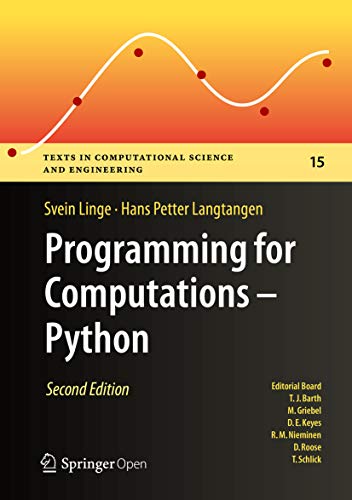
Svein Linge is a professor of modelling and simulation at the University College of Southeast Norway with a doctorate in biomechanics. He has contributed extensively to biomedical computing and has devoted over a decade to reforming engineering education by integrating computer programming and simulation. His expertise in both practical science and education uniquely qualifies him to guide you through learning Python programming tailored specifically for engineering applications, making this book a valuable resource for those stepping into computational methods.
Svein Linge is a professor of modelling and simulation at the University College of Southeast Norway and holds a Dr. Scient. degree in biomechanics from the Norwegian School of Sport Sciences. He works part-time at a Norwegian Center of Excellence: 'Center for Biomedical Computing', at Simula Research Laboratory, to which he has been linked for the last 13 years. His main research interests include cerebrospinal fluid dynamics, cardiac electro-mechanics, and sport biomechanics. Over the last decade, Linge has been particularly engaged in reforming the engineering education in mathematics and physics to take advantage of computer programming and simulation.
Svein Linge, a professor specializing in modeling and simulation, co-authored this book to bridge the gap between programming and engineering education. You get introduced to Python 3.6 through a methodical expansion from basics to applying numerical methods for mathematical problems, with chapters dedicated to clean program design and verification techniques. The book’s approach suits those new to programming who want to write functional code for engineering challenges, emphasizing generic algorithms and practical coding habits. If you’re aiming to integrate programming skills directly into science or engineering contexts, this book lays down a clear, focused path without unnecessary complexity.
Diesel Engines (Marine Engineering Series) by A J Wharton offers a targeted approach to understanding diesel engines specifically in marine contexts. Recognized for addressing the needs of candidates preparing for high-level Department of Transport marine engineering certifications, this book delivers updated content on emerging engine types and operating systems. Its concise length and focused scope make it a practical choice for professionals aiming to deepen their technical knowledge and maintain proficiency in marine engine technology.
A J Wharton's experience in marine engineering shines through in this focused examination of diesel engines used in maritime contexts. The book methodically explores diesel engine theory, technology, and operational practices tailored for those pursuing Department of Transport Certificates of Competency, Class One and Two. It doesn't just cover basics; it also introduces readers to the latest engine types and emerging operating systems, making it relevant for professionals staying current with industry developments. You will gain practical insights into engine maintenance and performance optimization, especially valuable if your work involves marine diesel engines or certification preparation.
Feed Water Systems and Treatment by G T H Flanagan offers a specialized look into marine engineering, addressing the critical need for reliable feed water management aboard ships. Despite its brevity, this book has resonated with professionals responsible for maintaining marine boilers, focusing on water treatment processes and system upkeep that impact vessel performance and safety. It serves as a practical guide for engineers seeking to deepen their understanding of marine water system dynamics, contributing valuable technical knowledge to the field of engineering.
1978·128 pages·Engineering, Marine Systems, Water Treatment, Boiler Maintenance, System Design
G T H Flanagan's extensive experience in marine engineering informs this focused examination of feed water systems, a critical component in shipboard operations. The book offers detailed insights into the design, maintenance, and treatment techniques essential for ensuring efficiency and reliability in marine boilers. You explore practical aspects such as water chemistry control and system troubleshooting, skills vital for marine engineers and technical professionals in the maritime industry. While concise, the text delivers targeted knowledge beneficial for those responsible for maintaining vessel integrity and operational safety.
Michael J Neale, the author of 'The Tribology Handbook', is a former President of the Institution of Mechanical Engineers. His extensive experience in mechanical engineering leadership underpins this revised edition, which focuses on practical guidance for machine component design and lubrication. Neale's expertise ensures the book serves as a useful reference for engineers seeking to deepen their understanding of tribology principles and improve machine performance.
Unlike most engineering books that zero in on theory alone, Michael J Neale's The Tribology Handbook offers an in-depth practical guide to selecting and designing machine components with an emphasis on lubrication. Drawing on his leadership as a former President of the Institution of Mechanical Engineers, Neale revises this edition with insights from top experts, focusing on real-world application rather than abstract concepts. You’ll find detailed discussions on wear mechanisms, lubrication methods, and component materials that provide tangible skills for engineers working on machine reliability and maintenance. If your work involves mechanical design or upkeep, this book delivers clear technical frameworks and case studies that enhance your decision-making.
The best Engineering books and more, in your inbox each week. No account needed.
Conclusion
This collection of ten best-selling engineering books highlights a few clear themes: the importance of practical, field-tested knowledge; the value of leadership and management insights tailored to technical teams; and the critical role of understanding infrastructure and systems in today’s engineering challenges. If you prefer proven methods with broad appeal, start with The Art of Electronics and Ugly’s Electrical References for solid technical foundations.
For validated approaches that bridge management and innovation, An Elegant Puzzle pairs well with Chip War’s strategic perspective on technology’s global impact. Alternatively, you can create a personalized Engineering book to combine proven methods with your unique needs. These widely-adopted approaches have helped many readers succeed in advancing their engineering expertise.
Frequently Asked Questions
I'm overwhelmed by choice – which book should I start with?
Start with a book that aligns with your current focus. For hands-on circuit work, The Art of Electronics is a reliable foundation. If you're interested in management, An Elegant Puzzle offers practical guidance. Choosing based on your immediate goals helps you build confidence and see results quickly.
Are these books too advanced for someone new to Engineering?
Not at all. While some books like Programming for Computations ease you into programming, others offer reference-level detail useful as you grow. You can pick books that match your experience and revisit others as your skills develop.
What’s the best order to read these books?
Consider starting with practical technical guides like Ugly’s Electrical References or Practical Electronics for Inventors. Then explore broader topics like Chip War or The Grid for context, and finish with leadership insights in An Elegant Puzzle.
Do I really need to read all of these, or can I just pick one?
You can definitely pick based on your needs. Each book stands strong on its own. For example, if marine engineering interests you, Diesel Engines or Feed Water Systems and Treatment are focused choices without needing the whole list.
Are any of these books outdated given how fast Engineering changes?
These books are updated or respected classics trusted by experts. For example, Ugly’s Electrical References is the 2023 edition, reflecting current codes. Still, pairing them with tailored, up-to-date resources can keep your knowledge fresh.
How can I get engineering knowledge tailored to my specific needs and goals?
Great question! While these expert-recommended books cover proven methods, personalized content can complement them perfectly. By creating a personalized Engineering book, you get targeted insights suited to your background, focus areas, and objectives, making learning efficient and relevant.
📚 Love this book list?
Help fellow book lovers discover great books, share this curated list with others!