Discover NoSQL books authored by top experts like Pramod Sadalage and Martin Fowler offering best-selling, proven insights
Updated on June 28, 2025·We may earn commissions for purchases made via this page
0 of 7 books have Audiobook versions
We're launchingLaunching on Product Hunt today 🎉We just launchedJust launched on Product Hunt 🎉
Modelpeers, from the BookAuthority teamFrom the BookAuthority team: Modelpeers, a free way to follow AI models and agents like you follow people. We'd love your support.
There's something special about books that both critics and crowds love — and NoSQL literature has carved out a vital niche in modern software development. As organizations wrestle with massive data volumes and evolving application requirements, NoSQL databases offer flexible, scalable solutions. These seven best-selling books have helped countless professionals navigate this landscape, providing time-tested strategies and hands-on guidance.
The authors behind these titles bring deep expertise and industry experience. For example, Pramod Sadalage's work at ThoughtWorks and collaboration with Martin Fowler deliver a clear, concise foundation for understanding NoSQL's core principles. Similarly, Rick Copeland shares real-world MongoDB design patterns honed through consulting and community engagement. This collection combines authoritative voices who have shaped how developers and managers approach NoSQL technologies.
While these popular books provide proven frameworks, readers seeking content tailored to their specific NoSQL needs might consider creating a personalized NoSQL book that combines these validated approaches with your unique background and goals. This way, you get focused insights that fit your projects and experience level perfectly.
Pramod J. Sadalage, Principal Consultant at ThoughtWorks, bridges the gap between database professionals and developers. His pioneering work on evolutionary database design and collaboration with Martin Fowler, a renowned software architect and author, grounds this book. Their combined expertise offers you a practical guide to understanding and applying NoSQL technologies, making sense of complex concepts through clear explanations and relevant examples.
Pramod J. Sadalage, Principal Consultant at ThoughtWorks, enjoys the rare role of bridging the divide between database professionals and application developers. He regularly consults with clients who have particularly challenging data needs requiring new technologies and techniques. He developed pioneering techniques that allowed relational databases to be designed in an evolutionary manner based on version-controlled schema migrations. With Scott Ambler, he coauthored Refactoring Databases (Addison-Wesley, 2006). Martin Fowler, Chief Scientist at ThoughtWorks, focuses on better ways to design software systems and improve developer productivity. His books include Patterns of Enterprise Application Architecture; UML Distilled, Third Edition; Domain-Specific Languages (with Rebecca Parsons); and Refactoring: Improving the Design of Existing Code (with Kent Beck, John Brant, and William Opdyke). All are published by Addison-Wesley.
2012·192 pages·Databases, NoSQL, Data Modeling, Database Architecture, Schema Migration
Pramod Sadalage’s decades of consulting experience at ThoughtWorks, combined with Martin Fowler’s deep expertise in software design, led to this concise introduction to NoSQL databases. You’ll learn foundational concepts such as schemaless data models, aggregates, the CAP theorem, and map-reduce, alongside architectural considerations and real-world use cases involving technologies like MongoDB and Cassandra. The book also details evolutionary design through schema migration, a crucial technique for working with NoSQL. If you’re evaluating whether NoSQL fits your project or want a clear grasp of its trade-offs, this book lays out the essentials without unnecessary complexity.
Rick Copeland is the Principal Consultant and Founder at Arborian Consulting, specializing in MongoDB and Python custom development and training. As a charter member of 10gen's 'Masters of MongoDB' and a frequent speaker at MongoDB events, his deep expertise shapes this book. Copeland’s background as a Python developer and contributor to open-source projects uniquely positions him to bridge practical development with MongoDB’s capabilities, making this guide an insightful resource for developers eager to leverage NoSQL effectively.
Rick Copeland is the Principal Consultant and Founder at Arborian Consulting, a business focusing on MongoDB and Python custom development and training. Rick is a frequent speaker at MongoDB events, an avid MongoDB enthusiast, and is a charter member of 10gen's 'Masters of MongoDB.' In the non-MongoDB side of things, Rick is also a well-known Python developer and member of the Python Software Foundation, having contributed to a number of open-source projects and spoken at various events and user groups. Rick is also the author of Essential SQLAlchemy, a book published by O'Reilly that introduces the reader to the excellent SQLAlchemy Python database toolkit.
Rick Copeland challenges the conventional wisdom that NoSQL databases like MongoDB are just for simple or unstructured data. Instead, he shows you how to apply specific design patterns to solve complex business problems across ecommerce, social networking, and online gaming. The book dives into concepts like document embedding and polymorphic schemas, illustrated with Python and JavaScript examples, helping you understand how to scale data models while keeping development efficient. If you build or maintain applications that require flexible, scalable data storage, this book offers concrete techniques rather than abstract theory.
This AI-created book on NoSQL mastery is tailored to your skill level and specific challenges. By sharing your background and goals, you receive content focused exactly on what you need to know. It combines widely validated NoSQL knowledge with insights that match your unique projects, making the learning process focused and efficient. This personalized approach helps you navigate complex NoSQL topics in a way that suits your experience and objectives.
TailoredRead AI creates personalized nonfiction books that adapt to your unique background, goals, and interests. Instead of reading generic content, you get a custom book written specifically for your profession, experience level, and learning objectives. Whether you're a beginner looking for fundamentals or an expert seeking advanced insights, TailoredRead crafts a book that speaks directly to you. Learn more.
2026·50-300 pages·NoSQL, NoSQL Fundamentals, Data Modeling, Database Architecture, Performance Tuning
This tailored book explores battle-tested NoSQL techniques that address your unique challenges and goals in database management. It covers core NoSQL concepts, data modeling practices, and performance tuning while focusing specifically on your interests and background. By combining proven methods validated by millions with insights suited to your needs, the book delivers a personalized journey through NoSQL systems, revealing practical solutions to real-world problems.
The content examines various NoSQL paradigms such as document, key-value, columnar, and graph databases, emphasizing adaptability to your projects. This personalized approach ensures you gain relevant knowledge efficiently, making complex NoSQL topics accessible and directly applicable to your specific context.
Dan McCreary brings decades of experience from Bell Labs to the forefront in this book, cofounding the NoSQL Now! Conference and consulting on advanced technologies. Alongside Ann Kelly, who has over 20 years of hands-on NoSQL development and project management in both federal and commercial sectors, they deliver a guide born from deep industry knowledge. Their combined backgrounds ensure you’re learning from practitioners who have shaped and witnessed the evolution of NoSQL solutions firsthand.
Dan McCreary is a consultant with a focus on advanced technologies. He has worked for Bell Labs, the supercomputing industry, Steve Jobs NeXT Computer and cofounded a 75-person consulting company. Beginning in 2000 he has focused on XML integration technologies and in 2006 he started focusing on native XML and XQuery systems. He is cofounder of the NoSQL Now! Conference. Ann Kelly is a NoSQL developer and NoSQL project manager with over 20 years experience in the computer and insurance industries. She has built NoSQL solutions for federal agencies as well as commercial projects. She is a CPCU (Chartered Property Casualty Underwriter).
2013·312 pages·NoSQL, Databases, Data Architecture, Big Data, Search
When Dan McCreary and Ann Kelly set out to write this book, their combined expertise in NoSQL and enterprise technology shaped a clear, practical guide for anyone stepping beyond traditional SQL databases. You’ll discover how to evaluate NoSQL patterns side-by-side with familiar relational models, understand real-world use cases like big data management and high availability, and navigate the challenges of security and scalability. The chapters on selecting architectures and leveraging cloud resources offer you concrete frameworks to make informed decisions tailored to your projects. This book suits managers and developers alike who want a straightforward yet thorough introduction to applying NoSQL effectively in business contexts.
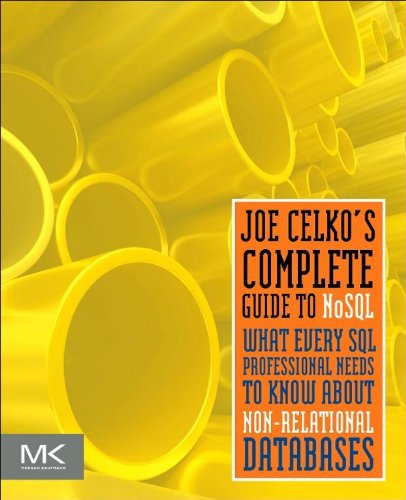
Joe Celko’s Complete Guide to NoSQL offers a thoughtful exploration of non-relational database technologies from one of the field’s seasoned experts. The book addresses the growing challenges of managing big data in forms and speeds that traditional SQL tools struggle with. Celko lays out a clear framework for understanding when and why NoSQL approaches are advantageous, covering key concepts like data velocity, volume, and variety. This guide serves SQL professionals and data architects who need to expand their knowledge beyond relational models to effectively handle modern, complex datasets.
2013·244 pages·NoSQL, Data Management, Database Design, Big Data, Columnar Databases
Joe Celko, a well-established figure in SQL and database theory, wrote this book to bridge the gap between traditional SQL databases and the rising prominence of NoSQL technologies. Through clear explanations, he guides you in understanding the key challenges of handling big data's velocity, volume, and variety, areas where SQL often falls short. You'll learn to identify when NoSQL solutions like columnar, streaming, or graph databases might serve your needs better, especially for data types like genetic or social network information. This book caters to SQL professionals keen to expand their toolkit and adapt to rapidly evolving data environments, offering practical insights without oversimplifying complex concepts.
David Hows is an honours graduate in Information and Communications Technology and has built his career around performance engineering, including at Accenture. His practical experience with performance technologies and deep understanding of MongoDB’s evolution inform this guide, making it a trustworthy source for developers wanting to leverage MongoDB's full potential.
David Hows, Eelco Plugge, Peter Membrey, Tim Hawkins·
About the Author
David Hows is an Honours graduate in Information and Communications Technology from Australia. He began working with performance technologies in order to find ways to drive further performance from his home PC - without increasing his spendings. This drive lead him through a university degree and lead to him becoming a technology consultant in Accenture's Performance Engineering discipline. David currently lives and works in Sydney.
David Hows and his co-authors bring deep hands-on experience from the tech industry to this guide, driven by their work with MongoDB's evolving capabilities. You learn detailed techniques for harnessing MongoDB's features like the aggregation framework and hashed indexes, which are crucial for managing large-scale NoSQL databases effectively. Chapters break down practical implementations, from data modeling to performance tuning, making it a solid resource for developers aiming to master MongoDB. If you're building applications that rely on flexible, document-oriented storage and want to understand MongoDB's unique approach, this book fits your needs well.
This AI-created book on NoSQL mastery is tailored to your current knowledge and the specific areas you want to focus on, such as MongoDB or other NoSQL technologies. You share your background, experience level, and goals, and the book is crafted to cover exactly what you need. Personalizing the content this way helps you gain practical skills efficiently without wading through unrelated material. It's a smart way to fast-track your understanding and application of NoSQL concepts.
TailoredRead AI creates personalized nonfiction books that adapt to your unique background, goals, and interests. Instead of reading generic content, you get a custom book written specifically for your profession, experience level, and learning objectives. Whether you're a beginner looking for fundamentals or an expert seeking advanced insights, TailoredRead crafts a book that speaks directly to you. Learn more.
2026·50-300 pages·NoSQL, NoSQL Fundamentals, Data Modeling, MongoDB Usage, Schema Design
This tailored book dives into NoSQL databases with a clear focus on accelerating your learning and practical application. It explores core concepts, data modeling, and hands-on use of MongoDB and other popular NoSQL systems, all within a personalized framework that matches your background and goals. By concentrating on your specific interests, it reveals how to design effective schemas, manage distributed data, and optimize queries for real-world success. The approach emphasizes actionable steps to build your skills rapidly, combining knowledge validated by millions with your unique learning needs. This focused, tailored resource makes mastering NoSQL engaging and achievable.
Brad Dayley, a senior software engineer with more than 20 years in enterprise application development, brings his extensive background to this guide on MongoDB. Having designed large-scale business applications with NoSQL back ends, he is well-equipped to teach you MongoDB's ins and outs through a series of concise, practical lessons. This book distills complex concepts into accessible steps, reflecting Dayley's proven track record and deep understanding of both software engineering and database technologies.
Brad Dayley is a senior software engineer with more than 20 years of experience developing enterprise applications. He has designed and developed large-scale business applications, including SAS applications with NoSQL database back ends and rich Internet web applications as front ends. He is the author of the jQuery and JavaScript Phrasebook, Sams Teach Yourself jQuery and JavaScript in 24 Hours, and Node.js, MongoDB and AngularJS Web Development.
2014·538 pages·NoSQL, Mongoose, Database Design, MongoDB, Data Modeling
While working as a senior software engineer, Brad Dayley noticed a growing demand for clear, accessible guidance on MongoDB, the leading NoSQL database. Drawing from over two decades of experience designing enterprise applications, he developed this book to help you navigate NoSQL concepts and MongoDB's features in manageable, hourly lessons. You’ll learn to design diverse data models, work with multiple programming languages, and manage database administration tasks including replication and sharding. If you’re looking to transition from relational databases or build scalable, high-performance applications, this book offers a practical pathway without overwhelming jargon.
Peter Membrey is a Chartered Fellow of the British Computer Society and a Chartered Engineer with nearly 25 years of experience in IT, specializing in information security. His extensive background is reflected in this book, which distills complex database concepts into accessible lessons on MongoDB and NoSQL. Membrey's commitment to raising STEM awareness and fostering technical potential shines through in the approachable explanations and practical examples found here.
Peter Membrey is a Chartered Fellow of the British Computer Society, a Chartered IT Professional and a Chartered Engineer with nearly a quarter of a century in the field. He has a doctorate in engineering and a masters degree in IT specializing in Information Security. He's co-authored over a dozen books, a number of research papers on a variety of topics and has recently been awarded the Distinguished Contributor award by the IEEE Computer Society. These days he is focusing his efforts on creating a more private Internet, raising awareness of STEM and helping people to reach their potential in the field. His personal site is at https://the.engineer/
When Peter Membrey, David Hows, and Eelco Plugge wrote MongoDB Basics, they crafted a straightforward guide to understanding the document-oriented approach that sets MongoDB apart from relational databases. You’ll learn how to install and navigate MongoDB, grasp fundamental design principles including geospatial indexing, and explore practical querying techniques. The book also introduces GridFS integration with Python, offering hands-on skills that are immediately applicable. If you’re new to NoSQL or seeking a clear entry point into MongoDB’s ecosystem, this concise volume serves as a focused primer without overwhelming detail.
The best NoSQL books and more, in your inbox each week. No account needed.
Conclusion
These seven books collectively emphasize proven approaches to NoSQL databases, validated by wide adoption and expert authorship. They cover foundational concepts, practical MongoDB patterns, architectural decisions, and SQL-to-NoSQL transitions, offering a well-rounded toolkit for different roles and experience levels.
If you prefer established methods grounded in deep expertise, start with NoSQL Distilled and Making Sense of NoSQL for foundational understanding. For hands-on MongoDB strategy, combine MongoDB Applied Design Patterns with The Definitive Guide to MongoDB. SQL professionals expanding their scope will find Joe Celko’s guide indispensable.
Alternatively, you can create a personalized NoSQL book to combine proven methods with your unique needs. These widely-adopted approaches have helped many readers succeed in mastering NoSQL databases with confidence and clarity.
Frequently Asked Questions
I'm overwhelmed by choice – which book should I start with?
Start with NoSQL Distilled. It offers a clear foundation on core concepts and helps you understand if NoSQL fits your needs before diving deeper.
Are these books too advanced for someone new to NoSQL?
Not at all. Titles like MongoDB Basics and NoSQL with MongoDB in 24 Hours break down concepts step-by-step, perfect for beginners.
What's the best order to read these books?
Begin with foundational books like NoSQL Distilled and Making Sense of NoSQL. Then explore practical guides such as MongoDB Applied Design Patterns for applied techniques.
Do I really need to read all of these, or can I just pick one?
You can pick based on your focus. For example, SQL pros might prioritize Joe Celko’s guide, while developers might choose MongoDB-specific books.
Are any of these books outdated given how fast NoSQL changes?
While technology evolves, these books cover fundamental principles and design patterns that remain relevant despite platform updates.
Can I get tailored NoSQL insights without reading multiple books?
Yes! While these expert books are valuable, you can create a personalized NoSQL book that combines proven knowledge with your specific goals and experience for a focused learning path.
📚 Love this book list?
Help fellow book lovers discover great books, share this curated list with others!