8 User Interface Books That Elevate Your Design Expertise
Recommended by Nir Eyal, Jeff Atwood, and Jakob Nielsen, these User Interface books offer expert-driven insights and practical guidance.
Updated on June 25, 2025·We may earn commissions for purchases made via this page
7 of 8 books have Kindle versions
We're launchingLaunching on Product Hunt today 🎉We just launchedJust launched on Product Hunt 🎉
Modelpeers, from the BookAuthority teamFrom the BookAuthority team: Modelpeers, a free way to follow AI models and agents like you follow people. We'd love your support.
What if the secret to designing compelling user interfaces lies not just in aesthetics but in understanding how users think and feel? User Interface design is no longer just about making things look good; it’s about crafting seamless experiences that align with human cognition and behavior. In an era where digital interactions define success, mastering UI principles is vital for designers and developers alike.
Leaders like Nir Eyal, author of "Hooked," emphasize the importance of cognitive psychology in design, while Jeff Atwood, co-founder of StackOverflow, highlights practical interaction design methods. Meanwhile, Jakob Nielsen’s decades of work on usability engineering have shaped industry standards worldwide. These experts have relied on influential books that blend theory with actionable advice, providing invaluable frameworks to elevate your UI craft.
While these expert-curated books provide proven frameworks, readers seeking content tailored to their specific background, skill level, and focus areas can consider creating a personalized User Interface book that builds on these insights. This approach allows you to accelerate learning with targeted knowledge suited to your unique goals and challenges.
Jeff Johnson brings decades of hands-on experience from roles at Xerox, Hewlett-Packard, and Stanford to this book, grounded in both research and real-world design challenges. As an assistant professor and usability consultant, he wrote this to help you understand the cognitive science behind UI guidelines rather than just follow them blindly. His insights into habit formation and decision-making offer a fresh lens that many designers overlook. This perspective allows you to make smarter design choices that resonate with user psychology, elevating your work beyond surface-level rules.
Jeff Johnson is an Assistant Professor of Computer Science at the University of San Francisco. He is also a principal at Wiser Usability, a consultancy focused on elder usability. After earning B.A. and Ph.D. degrees from Yale and Stanford, he worked as a UI designer, implementer, manager, usability tester, and researcher at Cromemco, Xerox, US West, Hewlett-Packard, and Sun. He has taught at Stanford, Mills, and the University of Canterbury. He is a member of the ACM SIGCHI Academy and a recipient of SIGCHI's Lifetime Achievement in Practice Award. He has authored articles on a variety of topics in HCI, as well as the books GUI Bloopers (1st and 2nd eds.), Web Bloopers, Designing with the Mind in Mind (1st and 2nd eds.), Conceptual Models: Core to Good Design (with Austin Henderson), and Designing User Interfaces for an Aging Population (with Kate Finn).
After years of working across major tech companies and academia, Jeff Johnson PhD developed this guide to bridge the gap between cognitive psychology and practical UI design. You’ll gain a clear understanding of why certain design rules exist by exploring the mental processes behind user interactions, from perception to habit formation. For example, the book delves into decision-making and trust, helping you evaluate tradeoffs between usability and project constraints. If you design or develop interfaces and want to move beyond rote guidelines to informed choices, this book equips you with the science to explain and justify your design decisions.
Laurent Bugnion, a software engineer and UX enthusiast at Microsoft, highlights the book's relevance by pointing out the intuitive nature of user interfaces compared to command-line alternatives. His endorsement underscores how this book reshaped his understanding of usability principles. As he notes, "There's a reason why one of the best design book is called 'Don't make me think'", reflecting how the book's straightforward approach to user experience design has influenced his perspective on creating accessible, user-friendly applications.
“@DeborahKurata @ejpbruel @EmmaBostian There are better ways. It's called a user interface. Everyone is raging about command line but it's really counter intuitive. There's a reason why one of the best design book is called "Don't make me think"” (from X)
Steve Krug is best known as the author of Don't Make Me Think: A Common Sense Approach to Web Usability, now in its third edition with over 700,000 copies in print. His consulting firm, Advanced Common Sense, is based in Chestnut Hill, MA. He has worked for clients like Apple, Bloomberg, and NPR, and spends most of his time teaching usability workshops and consulting.
After years consulting for clients like Apple and NPR, Steve Krug crafted this approachable guide to simplify web usability. You’ll learn key principles that make websites intuitive, such as minimizing cognitive load and designing for scanning rather than reading. The book’s chapters, including a fresh focus on mobile usability, offer clear examples of common pitfalls and how to avoid them. If you’re involved in web design or development, this book breaks down complex usability concepts into straightforward, actionable insights that improve user experience without overwhelming jargon.
This AI-created book on user interface design is crafted based on your unique background, skill level, and specific design interests. You share the aspects of UI you want to explore, and it focuses on your goals to deliver content that matches your experience and learning needs. Instead of a one-size-fits-all guide, this tailored book provides a clear path through the complexities of UI design that matters most to you.
TailoredRead AI creates personalized nonfiction books that adapt to your unique background, goals, and interests. Instead of reading generic content, you get a custom book written specifically for your profession, experience level, and learning objectives. Whether you're a beginner looking for fundamentals or an expert seeking advanced insights, TailoredRead crafts a book that speaks directly to you. Learn more.
This tailored book explores the core principles and applications of User Interface design with a focus on your unique background and goals. It examines essential design concepts, usability considerations, and interactive elements to build interfaces that align with how users perceive and engage with digital products. By synthesizing broad expert knowledge, this book offers a personalized pathway through UI fundamentals and advanced topics that match your interests and skill level. You will discover how to create intuitive, effective, and engaging interfaces that respond to real user needs and behaviors. The tailored content ensures a learning experience that feels relevant and directly applicable to your design challenges.
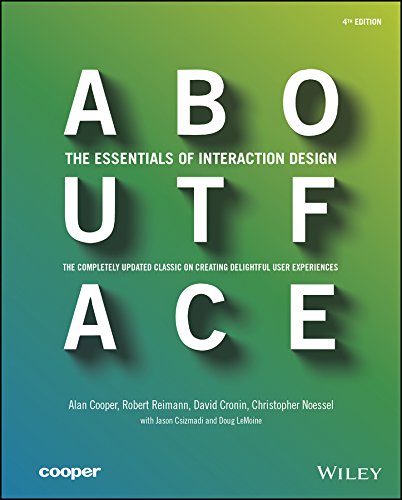
Alan Cooper is a founder of Cooper and a pioneer of modern computing whose groundbreaking work has influenced countless programmers, business professionals, and users. His deep expertise drove him to write this book, which captures decades of experience shaping how we interact with digital products. The book’s focus on updated interaction design methods, particularly the Goal-Directed Design framework, makes it an invaluable guide for anyone involved in creating user interfaces today. Cooper’s leadership in the field ensures you’re learning from one of the original voices who helped define modern UI principles.
Alan Cooper, Robert Reimann, David Cronin, Christopher Noessel(you?)·
About the Author
Alan Cooper is a founder of Cooper and a pioneer of modern computing. His groundbreaking work has influenced a generation of programmers, business people, and users.
What started as Alan Cooper's determination to make software more usable evolved into this landmark book on interaction design. You learn how to approach interface challenges through the updated Goal-Directed Design methodology, with chapters addressing modern concerns like mobile platforms, touch interfaces, and screen size considerations. The book offers detailed examples and design principles that help you create intuitive, user-centered digital products. If you’re involved in designing or developing apps, websites, or consumer electronics, this book offers a solid foundation and practical insights to keep your work aligned with evolving user expectations.
Everett McKay is Principal of UX Design Edge and a UX design trainer and consultant with over 30 years of global experience. Having crafted UX guidelines for Windows 7 and Vista at Microsoft, he brings unmatched expertise to this book. His focus on practical, intuitive, and highly usable solutions shines through, making this work a valuable resource for anyone seeking to master intuitive UI design across web, mobile, and desktop platforms.
Everett N McKay, Rob Nance, Devon Musgrave, Jodi Hersh(you?)·
About the Author
Everett McKay is Principal of UX Design Edge and a UX design trainer and consultant with global clientele. Everett's specialty is finding practical, intuitive, simple, highly usable solutions quickly for web, mobile, and desktop applications. Everett has over 30 years' experience in user interface design and has delivered UX design workshops to an international audience that includes Europe, Asia, South America, and Africa. In addition to this book, Everett is author of UI Is Communication: How to Design Intuitive, User Centered Interfaces by Focusing on Effective Communication, which provides a groundbreaking approach to user interface interaction and visual design using human communication-based principles and techniques. While at Microsoft, Everett wrote the Windows UX Guidelines for Windows 7 and Windows Vista.
Everett McKay's decades of experience in user interface design led to this practical guide that demystifies what "intuitive UI" really means. You learn a clear, eight-step process to create interfaces that are immediately self-explanatory and easy to use, cutting through subjective debates with objective principles. The book thoroughly covers design for mobile, web, and desktop apps, with actionable guidelines to streamline your team's collaboration. If you struggle with vague definitions or unproductive discussions about intuitive design, this book provides clarity and a shared language to improve your projects. It's especially beneficial for UX designers and product teams aiming to align on usability and reduce guesswork.
Jakob Nielsen, Ph.D., principal at Nielsen Norman Group and founder of the 'discount usability engineering' movement, wrote this book drawing on his extensive background including his time as a Sun Microsystems Distinguished Engineer. Recognized as a leading authority on Web usability, he focuses on fast, practical methods to improve user interface quality. His expertise shapes a guide designed to help you navigate usability testing and implementation with efficiency and clarity, reflecting decades of experience in the field.
Jakob Nielsen, Ph.D. is a principal of Nielsen Norman Group. He is the founder of the 'discount usability engineering' movement, which emphasizes fast and efficient methods for improving the quality of user interfaces. Nielsen was noted as 'the world's leading expert on Web usability' by U.S. News and World Report and 'the next best thing to a true time machine' by USA Today. Nielsen's Alertbox column on Web usability has been published on the Internet since 1995 and currently has about 200,000 readers. From 1994 to 1998, Nielsen was a Sun Microsystems Distinguished Engineer. His previous affiliations include Bell Communications Research, the Technical University of Denmark, and the IBM User Interface Institute. See his biography page at www.nngroup.com for additional biographical information.
What started as Jakob Nielsen's pursuit to streamline web usability evolved into a methodical guide that teaches you how to evaluate and enhance user interfaces efficiently. You learn practical techniques for conducting usability tests and selecting appropriate methods during various development stages, all focused on cost-effectiveness. Nielsen's experience at Sun Microsystems and founding the 'discount usability engineering' movement informs the book's straightforward approach, making it ideal for developers and designers aiming to improve interface quality without excessive resources. While it may not cover every advanced UX theory, it delivers clear, applicable insights if you want to improve usability systematically.
This AI-created book on user interface design is crafted based on your current skills, interests, and goals. By sharing what you want to focus on and your background, the book provides a clear, personalized path to improve your UI capabilities quickly. This tailored approach ensures you spend time on what matters most to you, making your learning efficient and directly relevant to your design challenges. It’s a practical way to get targeted knowledge without wading through unrelated material.
TailoredRead AI creates personalized nonfiction books that adapt to your unique background, goals, and interests. Instead of reading generic content, you get a custom book written specifically for your profession, experience level, and learning objectives. Whether you're a beginner looking for fundamentals or an expert seeking advanced insights, TailoredRead crafts a book that speaks directly to you. Learn more.
This tailored book offers a focused journey through user interface design, crafted to match your background and accelerate skill development. It explores core UI principles, interaction techniques, and visual design fundamentals tailored specifically to your interests and goals. Through a step-by-step approach, it reveals practical methods to refine your design capabilities and enhance user experience understanding. By emphasizing your unique context, this tailored guide bridges expert knowledge with personalized learning, helping you quickly grasp complex concepts and apply them effectively. Whether refining layouts, mastering usability, or improving visual clarity, this book provides a clear path designed to elevate your UI skills confidently and efficiently.
Ben Shneiderman, Distinguished University Professor and founding director of the Human-Computer Interaction Laboratory, brings decades of pioneering work in HCI and information visualization to this book. His expertise, including innovations like high-precision touchscreen keyboards and dynamic query sliders, grounds the book’s extensive exploration of interface design. Driven to chart the evolution of user interfaces and guide designers, Shneiderman’s authoritative background makes this an essential resource for understanding and applying effective human-computer interaction strategies.
Ben Shneiderman, Catherine Plaisant, Maxine Cohen, Steven Jacobs, Niklas Elmqvist, Nicholas Diakopoulos(you?)·
About the Author
Ben Shneiderman is a Distinguished University Professor in the Department of Computer Science and Founding Director of the Human-Computer Interaction Laboratory at the University of Maryland. He is a Fellow of the AAAS, ACM, IEEE, NAI, and the Visualization Academy and a Member of the U.S. National Academy of Engineering. He has received six honorary doctorates in recognition of his pioneering contributions to human-computer interaction and information visualization. His widely-used contributions include clickable highlighted web links, high-precision touchscreen keyboards for mobile devices, and tagging for photos. Shneiderman’s information visualization innovations include dynamic query sliders for Spotfire, treemaps for viewing hierarchical data, and event sequence analysis for electronic health records. He is the lead author of this book and has authored several others, including works on information visualization and human-centered AI.
When Ben Shneiderman first realized how rapidly user interfaces were evolving, he aimed to create a resource that not only tracks this progression but equips you with concrete design principles for effective interaction. This book walks you through critical skills like usability testing, expert reviews, and the nuances of designing predictable and controllable interfaces. You’ll find updated coverage on cutting-edge topics such as voice interaction, augmented reality, and social media integration, supported by 170 new color figures illustrating key concepts. If you’re involved in HCI or UX design, this book offers a measured, research-backed approach to building interfaces that serve both novice and expert users well.
Everett McKay is Principal of UX Design Edge, a user experience design training and consulting company specializing in mobile, web, and desktop applications. With over 30 years of experience, he has delivered UX workshops internationally, grounding this book in deep practical expertise. His focus on user interfaces as communication tools drives the book's unique perspective, helping you approach design decisions with clarity and confidence.
Everett McKay is Principal of UX Design Edge, a user experience design training and consulting company for mobile, web, and desktop applications. He has over 30 years of experience in user interface design and has delivered UX design workshops internationally.
Drawing from over three decades as Principal of UX Design Edge, Everett McKay offers a fresh lens on user interface design by treating it as a form of communication. Instead of drowning in conflicting design theories, you learn to view interfaces as conversations between technology and users, aiming to make interactions intuitive and emotionally resonant. The book breaks down complex concepts into a communication-based framework that ties interaction and visual design together, with clear examples like design makeovers that demonstrate principles in action. This approach suits anyone aiming to confidently navigate UI challenges and create user-centered designs that feel natural and engaging.
Val Head is a Pittsburgh-based designer whose work spans web projects, installations, and print. Author of The Pocket Guide to CSS Animations and a respected educator on animation for the web, she brings her deep expertise to this book. Her role as editor in chief of the UI Animation Newsletter and frequent speaker at design conferences underscores her authority. This book reflects her commitment to helping designers use animation thoughtfully to improve user experience.
Val Head is a designer based in Pittsburgh, PA. Her work spans web projects, interactive installations, and print. She authored The Pocket Guide to CSS Animations, teaches CSS Animations on Lynda.com, and hosts the All The Right Moves tutorial screencast. Val speaks at events like An Event Apart and co-hosts the Ladies in Tech podcast. She co-founded the Web Design Day conference and leads workshops globally on interface animation for the web.
Val Head's extensive experience as a designer and educator, especially her work with CSS animations and interactive projects, informs this focused examination of interface animation. You gain practical knowledge about using animation to enhance user experience—improving feedback, guiding orientation, and conveying brand personality—without sacrificing usability. Chapters dive into motion design theory alongside hands-on techniques to balance style and function seamlessly in web interfaces. If you create or manage digital products, this book clarifies how purposeful animation can shape interaction and user understanding effectively.
The best User Interface books and more, in your inbox each week. No account needed.
Conclusion
This collection of eight books reveals three key themes: understanding the psychological foundations behind user interactions, applying tested usability and interaction design principles, and embracing emerging trends like communication-focused interfaces and animation. These books provide a roadmap for creating interfaces that feel intuitive, efficient, and engaging.
If you’re grappling with usability challenges, start with Jakob Nielsen’s "Usability engineering" for practical testing methods. For hands-on interaction design, Alan Cooper’s "About Face" offers a comprehensive methodology. To quickly enhance web usability, Steve Krug’s "Don't Make Me Think, Revisited" delivers clear, actionable advice.
Alternatively, you can create a personalized User Interface book to bridge the gap between general principles and your specific situation. These books can help you accelerate your learning journey and craft interfaces that truly resonate with users.
Frequently Asked Questions
I'm overwhelmed by choice – which book should I start with?
Start with "Don't Make Me Think, Revisited" by Steve Krug. Its practical approach to web usability offers clear, actionable advice that's easy to digest, making it ideal for those new to User Interface design or seeking straightforward improvements.
Are these books too advanced for someone new to User Interface?
Not at all. Books like "Don't Make Me Think" and "Intuitive Design" provide accessible entry points. Others, like "Designing the User Interface," offer deeper insights for progressing your skills gradually.
What's the best order to read these books?
Begin with usability basics in "Don't Make Me Think" and "Usability engineering." Follow with interaction design principles in "About Face" and "Designing with the Mind in Mind." Then explore specialized topics like communication and animation.
Should I start with the newest book or a classic?
Balance classics with newer perspectives. Foundational works like "About Face" remain relevant, while newer books like "Designing Interface Animation" address evolving UI trends.
Which books focus more on theory vs. practical application?
"Designing with the Mind in Mind" offers theory rooted in cognitive psychology, while "Don't Make Me Think" and "Intuitive Design" emphasize practical, hands-on techniques you can apply immediately.
How can I get UI insights tailored to my specific needs and goals?
While these expert books offer valuable foundations, personalized content can bridge general principles with your unique context. Consider creating a personalized User Interface book that adapts expert knowledge to your background and objectives for focused learning.
📚 Love this book list?
Help fellow book lovers discover great books, share this curated list with others!