8 Beginner Bayesian Statistics Books That Build Real Foundations
Experts like Andrew Gelman, Christopher Fonnesbeck, and Stanley Lazic recommend these accessible Bayesian Statistics books perfect for newcomers.
Updated on June 25, 2025·We may earn commissions for purchases made via this page
7 of 8 books have Kindle versions
We're launchingLaunching on Product Hunt today 🎉We just launchedJust launched on Product Hunt 🎉
Modelpeers, from the BookAuthority teamFrom the BookAuthority team: Modelpeers, a free way to follow AI models and agents like you follow people. We'd love your support.
Starting your journey into Bayesian Statistics can feel daunting, but it doesn’t have to be. Bayesian methods offer a powerful framework for interpreting data and uncertainty, and with the right resources, anyone can grasp these concepts progressively. These books ease newcomers into Bayesian thinking with clear explanations, practical examples, and approachable computational techniques, making Bayesian Statistics not just accessible but engaging.
Notable experts like Andrew Gelman, a professor at Columbia University who has profoundly shaped Bayesian methodology, and Christopher Fonnesbeck, a senior analyst integrating Bayesian methods in medical research, vouch for the value of these texts. Their insights stem from years of teaching and applying Bayesian approaches in complex real-world contexts, ensuring these books provide both theory and practice in harmony.
While these selections offer a solid foundation, if you want content tailored to your background, skills, and goals, consider creating a personalized Bayesian Statistics book designed specifically for your learning journey—helping you build confidence without overwhelm.
Christopher Fonnesbeck, a senior quantitative analyst at Vanderbilt University Medical Center and the New York Yankees, highlights this book for its rare balance between mathematical rigor and computational application, noting how it fills a gap by integrating Python deeply into Bayesian modeling. He remarks, "From a technical standpoint, the reviewed chapters are excellent. Too often, statistical textbooks are mathematically sound, but lacking in computational sophistication, or vice versa." His endorsement comes from practical experience teaching and applying Bayesian methods, emphasizing the book's accessibility for those moving into applied computation. Alongside him, Stanley Lazic appreciates the authors' insider knowledge as contributors to major Python Bayesian packages, which enriches the book's treatment of advanced topics like BART and approximate Bayesian computation.
Senior Quantitative Analyst, Vanderbilt University Medical Center
“From a technical standpoint, the reviewed chapters are excellent. Too often, statistical textbooks are mathematically sound, but lacking in computational sophistication, or vice versa. These chapters are sound on both fronts. My current primary textbook for Bayesian computation is Bayesian Data Analysis, by Gelman et al. which is probably the standard in academia and industry with respect to applied Bayesian methods. Where Martin et al. differentiate themselves from Gelman et al. (and others) is in the incorporation of Python as the computing language used throughout the book…This manuscript has the potential to be a preferred textbook for those looking for a practical introduction to these methods.”
Osvaldo A. Martin, Ravin Kumar, Junpeng Lao(you?)·
About the Author
Osvaldo A. Martin is a Researcher at IMASL-CONICET in Argentina and the Department of Computer Science from Aalto University in Finland. He has a PhD in biophysics and structural bioinformatics. Over the years he has become increasingly interested in data analysis problems with a Bayesian flavor. He is especially motivated by the development and implementation of software tools for Bayesian statistics and probabilistic modeling.
Osvaldo A. Martin's extensive background in biophysics and structural bioinformatics informs this book's thoughtful approach to bridging Bayesian statistical theory with practical computation. You’ll learn not only foundational Bayesian inference refreshed in the opening chapters but also how to implement models using PyMC3, TensorFlow Probability, and other leading Python libraries. The book walks you through diverse models such as linear regression, splines, and time series, culminating in advanced topics like approximate Bayesian computation and probabilistic programming internals. If you're aiming to move beyond beginner basics into more applied Bayesian modeling with modern computational tools, this book offers a clear path without overwhelming you with unnecessary complexity.
Andrew Gelman, a professor at Columbia University and a leading figure in Bayesian statistics, recommends this book for newcomers eager to grasp Bayesian analysis. He calls it "a thoughtful and entertaining book, and a great way to get started with Bayesian analysis." His endorsement highlights the book’s approachable style and practical guidance, which helped clarify Bayesian modeling concepts during his teaching and research. Gelman’s perspective assures you that this book is a solid starting point for integrating Bayesian methods into your statistical practice.
Alicia A. Johnson, Miles Q. Ott, Mine Dogucu(you?)·
About the Author
Alicia Johnson is an Associate Professor of Statistics at Macalester College in Saint Paul, Minnesota. She enjoys exploring and connecting students to Bayesian analysis, computational statistics, and the power of data in contributing to this shared world of ours. Miles Ott is a Senior Data Scientist at The Janssen Pharmaceutical Companies of Johnson & Johnson. Prior to his current position, he taught at Carleton College, Augsburg University, and Smith College. He is interested in biostatistics, LGBTQ+ health research, analysis of social network data, and statistics/data science education. He blogs at milesott.com and tweets about statistics, gardening, and his dogs on Twitter. Mine Dogucu is an Assistant Professor of Teaching in the Department of Statistics at University of California Irvine. She spends majority of her time thinking about what to teach, how to teach it, and what tools to use while teaching. She likes intersectional feminism, cats, and R Ladies. She tweets about statistics and data science education on Twitter.
What started as a clear pathway to demystify Bayesian modeling for students and practitioners unfolds in "Bayes Rules!" by Alicia A. Johnson, Miles Q. Ott, and Mine Dogucu. This book guides you through applying Bayesian methods with data-driven examples and R code, making complex concepts accessible without sacrificing rigor. You’ll learn how to build and evaluate models iteratively, explore hierarchical and multivariable regression, and grasp Markov chain Monte Carlo simulations. Ideal if you have some statistics and calculus background—or if you’re willing to learn alongside—the book balances theory with practical application, helping you weave Bayesian thinking into your data analysis toolkit.
This AI-created book on Bayesian foundations is crafted specifically for your background and skill level. You share your experience, the topics you want to focus on, and your learning goals. The book then focuses on delivering a gentle, clear introduction to Bayesian Statistics that matches your pace and preferences. This personalized approach helps you build confidence and understanding without feeling overwhelmed, making the complex concepts feel approachable and relevant to your needs.
TailoredRead AI creates personalized nonfiction books that adapt to your unique background, goals, and interests. Instead of reading generic content, you get a custom book written specifically for your profession, experience level, and learning objectives. Whether you're a beginner looking for fundamentals or an expert seeking advanced insights, TailoredRead crafts a book that speaks directly to you. Learn more.
This tailored book explores the foundational concepts of Bayesian Statistics with a clear, step-by-step progression designed to match your background and skill level. It builds your understanding gradually, addressing core principles such as Bayesian inference, prior and posterior distributions, and probabilistic reasoning. Through a personalized approach, it focuses on your interests and goals, making complex ideas accessible without overwhelming detail. By emphasizing a comfortable learning pace, the book reveals how to apply Bayesian thinking to real-world problems while fostering confidence in statistical reasoning. This tailored guide supports your journey from beginner to proficient, making Bayesian Statistics approachable and engaging.
Therese Donovan is a wildlife biologist with the U.S. Geological Survey and an instructor in ecological modeling. Her experience teaching graduate students in conservation biology shaped this book's accessible style, blending humor and clear explanations to introduce Bayesian statistics. Donovan’s practical background ensures readers receive a grounded, easy-to-follow approach ideal for grasping Bayesian inference and its uses across scientific fields.
Therese Donovan is a wildlife biologist with the U.S. Geological Survey, Vermont Cooperative Fish and Wildlife Research Unit. She teaches graduate courses on ecological modeling and conservation biology.
Unlike most statistics texts that dive straight into formulas, this book takes a refreshingly approachable question-and-answer route, making Bayesian concepts accessible through everyday language and humor. Therese M. Donovan, a wildlife biologist and educator, brings her practical experience teaching ecological modeling to shape this guide focused on how Bayesian methods update probabilities as new data emerges. You'll find clear explanations of key ideas like Bayes' theorem and its applications across biology, medicine, and social sciences, supported by illustrations and references to online materials. It’s a solid starting point if you want to grasp Bayesian thinking without getting overwhelmed by heavy math or jargon.
James V Stone, an Honorary Associate Professor at the University of Sheffield, brings his deep expertise in Bayesian analysis and artificial intelligence to this accessible introduction. Known for making complex subjects clear, Stone wrote this book to demystify Bayes' rule with intuitive explanations and practical examples, helping you grasp the essentials of Bayesian statistics without getting lost in technicalities.
James V Stone is an Honorary Associate Professor at the University of Sheffield, England. He has authored several books on topics including Bayesian analysis, information theory, and artificial intelligence. His works are known for their clarity and accessibility, making complex subjects understandable for a wide audience.
This book transforms the often daunting topic of Bayesian analysis into clear, approachable content, thanks to Dr. James V Stone's expertise as an Honorary Associate Professor at the University of Sheffield. You’ll find the core of Bayes' rule unpacked through intuitive graphical methods and relatable examples that connect probability to everyday reasoning. It covers practical skills like parameter estimation with supplemental Matlab and Python code, making abstract concepts tangible. If you’re new to Bayesian statistics and want a solid foundation without wading through excessive jargon, this book is tailored for you, especially with its helpful glossary and tutorial style.
The American Statistician, a respected voice in statistics, highlights how this book "covers a broad yet essential scope of topics necessary for one to understand and conduct applied Bayesian analysis." Their endorsement carries weight because they represent the audience of social science researchers seeking practical Bayesian tools. They emphasize the value of the BaM R package, which makes the subject accessible for newcomers. Similarly, The Journal of Politics praises Jeff Gill's approach to reintroducing Bayesian inference for social scientists, noting its relevance for those new to MCMC methods and hierarchical modeling. Together, these perspectives underline the book’s role as a thoughtful bridge for beginners to engage confidently with Bayesian statistics.
“Bayesian Methods covers a broad yet essential scope of topics necessary for one to understand and conduct applied Bayesian analysis. The numerous social science examples should resonate with the target audience, and the availability of the code and data in an R package, BaM, further enhances the appeal of the book.”
Jeff Gill is a professor in the Department of Political Science, the Division of Biostatistics, and the Department of Surgery (Public Health Sciences) at Washington University. He is the author of several books and has published numerous research articles. His research applies Bayesian modeling and data analysis to questions in general social science quantitative methodology, political behavior and institutions, and medical/health data analysis using computationally intensive tools. He received his B.A. from UCLA, MBA from Georgetown University, Ph.D. from American University, and Post-Doctorate from Harvard University.
Drawing from his rich interdisciplinary background in political science, biostatistics, and public health, Jeff Gill crafted this edition to shift focus from justifying Bayesian procedures to their practical implementation. You’ll delve into chapters like Bayesian decision theory and hierarchical models, gaining hands-on understanding through extensive social science examples and exercises. The book also integrates the BaM R package, making it easier for you to apply Bayesian methods using real data and BUGS software. This is ideal if you want to bridge theory and practice in social and behavioral sciences without getting lost in abstract math.
This AI-created book on Bayesian modeling is designed based on your background, experience level, and the specific modeling topics you want to explore. You share your current skills and learning goals, and the book is created to help you build confidence through a comfortable, progressive pace. Bayesian modeling can feel complex, but this tailored guide focuses on your personal learning needs, breaking down concepts with practical examples to make the subject approachable and engaging.
TailoredRead AI creates personalized nonfiction books that adapt to your unique background, goals, and interests. Instead of reading generic content, you get a custom book written specifically for your profession, experience level, and learning objectives. Whether you're a beginner looking for fundamentals or an expert seeking advanced insights, TailoredRead crafts a book that speaks directly to you. Learn more.
2026·50-300 pages·Bayesian Statistics, Bayesian Modeling, Probabilistic Inference, Model Building, Data Interpretation
This personalized book explores the foundations and practical applications of Bayesian modeling tailored specifically to your background and goals. It covers essential concepts progressively, helping you build and interpret Bayesian models with real data confidently. By focusing on your interests and skill level, this tailored guide removes the overwhelm often associated with probabilistic modeling, offering clear explanations and hands-on examples that deepen understanding. The book examines how to approach uncertainty through Bayesian methods, fostering a learning experience designed to match your pace and comfort. With this personalized approach, you gain focused knowledge that aligns perfectly with your unique learning journey in Bayesian statistics.
Marco Scutari, a research associate in statistical genetics at University College London, brings his deep expertise in Bayesian networks and R programming to this accessible guide. As the author and maintainer of the bnlearn package, Scutari is uniquely qualified to teach newcomers the foundations of Bayesian network modeling with practical R examples. His background in statistical genetics informs the book’s focus on biological data applications, making it a valuable resource for graduate students and professionals eager to gain hands-on experience with Bayesian statistics.
Marco Scutari is a research associate in statistical genetics at the Genetics Institute, University College London (UCL). He studied statistics and computer science at the University of Padova. He is the author and maintainer of the bnlearn R package. His research focuses on the theory of Bayesian networks and their applications to biological data.
This book transforms the complexity of Bayesian networks into approachable steps, guided by Marco Scutari's expertise in statistical genetics and R programming. You gain clear insights into modeling processes from structure learning to inference, with concrete R examples that gradually build your understanding. The authors differentiate probabilistic models from data estimation, which helps you grasp both theory and application. If you're keen to explore discrete, Gaussian, and hybrid networks or want a concise introduction to causal Bayesian networks, this book serves well. It’s particularly suited for graduate students or anyone new to Bayesian networks seeking a practical foundation without getting lost in jargon.
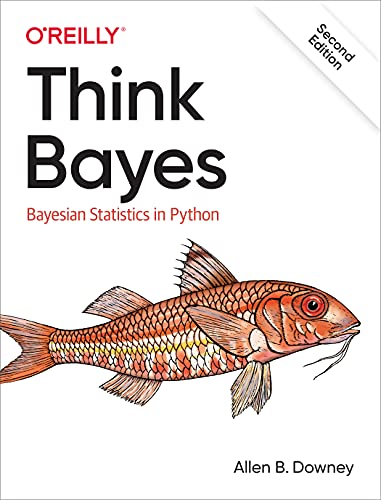
Allen Downey is a professor of computer science at Olin College of Engineering with advanced degrees from MIT and U.C. Berkeley. His extensive teaching experience and authorship of several programming books inform this approachable guide to Bayesian statistics. Downey's focus on using Python to demystify complex statistical concepts makes this book a solid starting point for programmers eager to grasp Bayesian methods without diving deep into heavy mathematics.
Allen Downey is a Professor of Computer Science at Olin College of Engineering. He has taught computer science at Wellesley College, Colby College and U.C. Berkeley. He has a Ph.D. in Computer Science from U.C. Berkeley and Master’s and Bachelor’s degrees from MIT. He is the author of Think Python, Think Bayes, Think DSP, and a blog, Probably Overthinking It.
Allen Downey challenges the conventional wisdom that mastering Bayesian statistics requires heavy math by offering a programming-first approach using Python. You learn to work with discrete probability distributions and solve estimation, prediction, and hypothesis testing problems through code rather than formulas. The book includes relatable examples like coins, dice, and cookies, making abstract concepts tangible. If you have basic programming skills and want to understand Bayesian methods applied to real-world scenarios, this book guides you gently without overwhelming mathematical complexity.
Osvaldo Martin is a researcher at CONICET in Argentina with expertise in Markov Chain Monte Carlo methods and Bayesian inference. Passionate about Python programming, he contributes to major Bayesian libraries like PyMC, ArviZ, and Bambi. His experience with developing and implementing Bayesian tools shapes this book, which offers a user-friendly introduction to Bayesian statistical modeling. Martin’s background ensures you gain not only theoretical insight but also practical skills to build and evaluate models using Python.
Osvaldo Martin is a researcher at CONICET, in Argentina. He has experience using Markov Chain Monte Carlo methods to simulate molecules and perform Bayesian inference. He loves to use Python to solve data analysis problems. He is especially motivated by the development and implementation of software tools for Bayesian statistics and probabilistic modeling. He is an open-source developer, and he contributes to Python libraries like PyMC, ArviZ and Bambi among others. He is interested in all aspects of the Bayesian workflow, including numerical methods for inference, diagnosis of sampling, evaluation and criticism of models, comparison of models and presentation of results.
What if Bayesian statistics could shed its intimidating reputation? Osvaldo Martin, a seasoned researcher at CONICET with hands-on experience in Markov Chain Monte Carlo simulations, has crafted a guide that eases you into probabilistic modeling using Python. You’ll navigate through foundational concepts, from hierarchical models to Gaussian processes, with practical examples leveraging PyMC and Bambi libraries. The book walks you through evaluating, comparing, and refining your models, emphasizing not just theory but also the computational techniques that bring Bayesian inference to life. It’s especially suited if you have basic Python skills and want to build a solid understanding of Bayesian approaches without getting lost in jargon or unnecessary complexity.
The best Bayesian Statistics books and more, in your inbox each week. No account needed.
Conclusion
This collection of 8 books covers a range of beginner-friendly approaches to Bayesian Statistics—from intuitive introductions to hands-on computational guides in Python and R. They share a commitment to clear explanations and progressive learning, making complex ideas approachable.
If you’re completely new, starting with Therese Donovan’s "Bayesian Statistics for Beginners" or James V Stone’s "Bayes' Rule" will ground you in the essentials with accessible language. For those ready to apply Bayesian modeling with code, "Think Bayes" and "Bayesian Modeling and Computation in Python" provide practical programming pathways. Social science enthusiasts will find Jeff Gill’s "Bayesian Methods" especially relevant.
Alternatively, you can create a personalized Bayesian Statistics book that fits your exact needs, interests, and goals to build your expertise more efficiently. Remember, building a strong foundation early on sets you up for success in mastering Bayesian methods.
Frequently Asked Questions
I'm overwhelmed by choice – which book should I start with?
Start with "Bayesian Statistics for Beginners" by Therese Donovan for an approachable introduction that avoids heavy math. It builds your confidence gently before moving to more technical books like "Bayes Rules!" or "Think Bayes."
Are these books too advanced for someone new to Bayesian Statistics?
Not at all. Several books, like "Bayes' Rule" and "Bayesian Statistics for Beginners," are specially designed for newcomers. Others gradually increase complexity, letting you learn at your own pace.
What's the best order to read these books?
Begin with intuitive texts like "Bayes' Rule," then explore "Bayes Rules!" for applied modeling. Next, try "Think Bayes" or "Bayesian Modeling and Computation in Python" to add programming skills.
Do I really need any background knowledge before starting?
Basic familiarity with probability helps but isn’t mandatory. Books like "Bayesian Statistics for Beginners" explain concepts clearly for those without prior stats experience.
Which books focus more on theory vs. practical application?
"Bayes' Rule" emphasizes theory with intuitive explanations, while "Bayesian Modeling and Computation in Python" and "Bayes Rules!" focus on hands-on application with code examples.
Can I get a Bayesian book tailored to my specific learning goals or schedule?
Yes! While these expert books are excellent, you can also create a personalized Bayesian Statistics book tailored to your background, interests, and pace for a focused, efficient learning experience.
📚 Love this book list?
Help fellow book lovers discover great books, share this curated list with others!