Congratulations! 🎉
"The Cosmic Revolutionary's Handbook" by Luke A. Barnes, Geraint F. Lewis made it to BookAuthority's Best Astrophysics Books of All Time!
20 Astrophysics Books That Separate Experts from Amateurs
Recommended by astrophysicists John Scalzi, Alexandra Petri, and Sean Carroll, these Astrophysics Books offer proven cosmic insights.







This list spans the full range of astrophysics reading, from playful general-audience tours of the cosmos to focused explorations of black holes, stars, dark matter and gravity. Casual readers will find accessible overviews and essay-style introductions. Students and specialists will find undergraduate and graduate textbooks on astrophysics and relativity. creating a personalized Astrophysics book
1. The End of Everything
Recommended by John Scalzi
Science Fiction Author
“Weird science, explained beautifully.” (from Amazon)

A lively tour through five possible ways the universe could end, including the Big Crunch, Heat Death, the Big Rip, Vacuum Decay and the Bounce. Each scenario serves as a doorway into major concepts in cosmology, quantum mechanics and string theory.
2. A Brief History of Black Holes
Recommended by Jim Al-Khalili
on Space: 10 Things You Should Know
“A lot of astrophysics is packed into this neat little book” (from Amazon)

A history of discoveries about black holes, from the earliest observations of the universe and the collapse of massive stars to the first photographs of a black hole. Along the way, it corrects common misconceptions, including why black holes are not really black.
Astrophysics Mastery Blueprint
This AI-created astrophysics book offers a tailored exploration of cosmic phenomena designed to align with your interests and background. It examines fundamental concepts such as stellar evolution, black holes, and cosmology, weaving in advanced topics according to your goals. By focusing on what matters most to you, it navigates the vast universe of astrophysics with clarity and depth, making complex ideas accessible and engaging. The personalized approach ensures you receive a pathway through astrophysics that matches your current knowledge and desired areas of mastery, blending foundational principles with specialized subjects that fuel your curiosity and learning journey.
3. How to Die in Space
Recommended by Publisher's Weekly
“Sutter’s tone is suffused with enthusiasm for his topic and with disarming humor. Funny and informative, Sutter’s gleefully bleak interstellar survey will foster a greater appreciation for humanity’s home, and a deeper understanding of space.” (from Amazon)

A vivid tour of the dangerous side of the cosmos, from comets and dying stars to black holes and remnants of the Big Bang. It uses metaphors and plain language to show how particles, forces and fields create cosmic drama.
4. Welcome to the Universe
Recommended by The New Scientist
“Riveting questions fielded by three top astrophysicists in engaging style, with great illustrations and just a handful of equations. They may just have produced the best book about the universe in the universe.” (from Amazon)

An illustrated tour of the cosmos that grew out of an introductory astronomy course. It covers planets, stars, galaxies, black holes, wormholes and time travel, along with questions about cosmic expansion, the multiverse and life elsewhere.
5. Astrophysics for People in a Hurry
Recommended by Goodreads
“Engaging and illuminating.” (from Amazon)
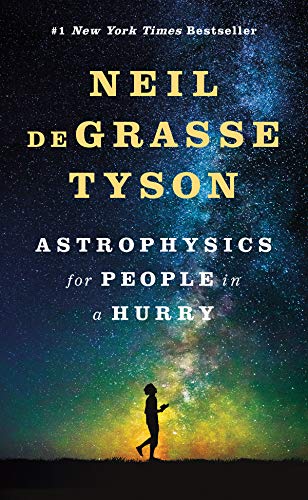
A compact guide to essential astrophysics, written in short chapters meant for busy days. It ranges from the Big Bang and black holes to quarks, quantum mechanics and the search for life in the universe.
Cosmic Transformation
This tailored book offers a personalized journey through astrophysics, designed to match your background and accelerate your understanding in just 30 days. It explores fundamental concepts such as cosmic structures, stellar phenomena, and gravitational forces, while tailoring explanations and learning paths to your specific interests. By focusing on daily, manageable actions, it reveals complex astrophysical ideas in a way that resonates with your goals and prior knowledge. This personalized approach ensures you engage deeply with topics that matter most to you, from black holes to cosmic evolution, fostering both curiosity and clarity in your study of the universe.
6. The Cosmic Revolutionary's Handbook
Recommended by Sean Carroll
Homewood Professor of Natural Philosophy at Johns Hopkins University
“Overthrowing all of modern cosmology isn’t easy, but it could happen. Maybe you will be the one to do it! If you’re up for the challenge, Luke A. Barnes and Geraint F. Lewis tell you exactly what you have to accomplish. Even if you don’t topple the stodgy edifice of modern science, you’ll certainly learn some exciting things about the universe along the way.” (from Amazon)

A tour of modern cosmology framed as a handbook for anyone hoping to overthrow the Big Bang. It sets out the observations behind ideas such as dark matter and black holes, and it shows how messy real science can be.
7. The Little Book of Black Holes
Recommended by Raphael Bousso
University of California, Berkeley
“This timely book provides an excellent summary of what we know about black holes in the universe. Gubser and Pretorius are among the world's most prominent experts on this exciting subject.” (from Amazon)

A concise introduction to black holes that begins with special and general relativity. It then treats black holes both as astrophysical objects and as theoretical laboratories, covering rotating and colliding black holes, gravitational waves and Hawking radiation.
8. Astrophysics in a Nutshell
Recommended by Avi Loeb
Harvard University; author of Extraterrestrial: The First Sign of Intelligent Life Beyond Earth
“This is, without a doubt, one of the best books that I have used for an introductory course in astrophysics over the past decade. The book is unique in providing a pedagogical and authoritative overview of all the important topics in present-day astrophysics with mathematical rigor. The equations are self-contained and well explained, and the results are derived in a concise, factual manner with careful attention to details. My students, teaching assistant, and I have all found the book to be outstanding.” (from Amazon)

A one-semester introduction to astrophysics for advanced undergraduate science majors. It emphasizes physical intuition and the interplay between theory and observation, and it includes problem sets along with topics such as dark matter, dark energy and gravitational lensing.
9. Gravity's Fatal Attraction

A richly illustrated account of how black holes were discovered and what role they play in cosmic evolution. It avoids mathematics and blends theory with observations, including gravitational waves and images near an event horizon.
10. Gravity’s Century
Recommended by John Mather
Winner of the Nobel Prize in Physics
“Cowen is a gifted science writer and storyteller, and the story is amazing!” (from Amazon)

An account of a century of experiments testing general relativity, from an eclipse observation showing that gravity bends light to a globe-spanning radio telescope array studying the black hole at the center of the Milky Way. It also touches on quasars and the unresolved place of gravity in quantum theory.
11. Bright Galaxies, Dark Matter, and Beyond
Recommended by Emily Lakdawalla
Senior Editor, The Planetary Society
“Yeager explains the science of the unseen mass that holds galaxies together with sprightly, accessible language and shows Vera Rubin to be a luminary and binding force of the global community of dark-matter astrophysicists.” (from Amazon)

A biography of the astronomer whose observations of galaxies helped convince scientists that dark matter might exist. It covers her education, the dismissals and sexism she faced, and the scientific revolution her work helped drive.
12. Searching for the Oldest Stars

A firsthand account of stellar archaeology, the hunt for the oldest observable stars. It explains how chemical fingerprints in ancient stars reveal clues about the first stars, the origin of the elements and the assembly of the Milky Way.
13. Einstein's Telescope
Recommended by Marcia Bartusiak
Wall Street Journal
“Cogent review of this intriguing topic.” (from Amazon)

An exploration of dark matter and dark energy through gravitational lensing, a technique rooted in general relativity. It explains why the universe's accelerating expansion suggests something stronger than gravity is at work.
14. Death by Black Hole
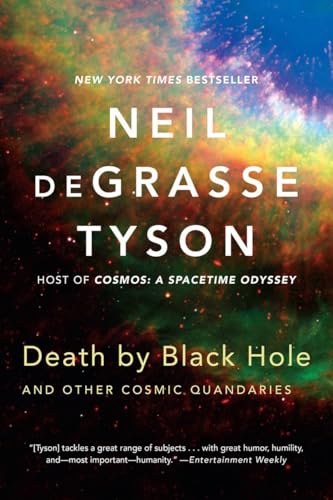
A collection of essays on cosmic topics, including black holes, the search for life in the universe, conflicts between science and religion, and inaccurate night skies in movies.
15. Gravity
Recommended by Kip Thorne
Feynman Professor of Theoretical Physics at CalTech
“This remarkable book gives a superb pedagogical treatment of topics that are crucial for modern astrophysics and gravitational-wave science, but (sadly) are generally omitted from textbooks on general relativity, or treated much too briefly. With enthusiasm, I recommend this book to all astrophysicists, gravitational physicists, and students of these subjects.” (from Amazon)

A graduate textbook on approximate solutions to general relativity, beginning with a thorough treatment of Newtonian gravity. It develops post-Newtonian and post-Minkowskian methods and applies them to gravitational waves, binary pulsars and binary black holes.
16. The Secret Life of Stars
Recommended by The Wall Street Journal
“A sparkling work of narrative nonfiction... Dr. Harvey-Smith casts deep-space phenomena such as stars, magnetic fields and nebulae not as remote and impersonal entities but as 'temperamental personalities' with human-like quirks, frailties and emotional relationships... Having hard science presented in the form of lively character sketches is a godsend for those who may find the details of conventional nonfiction hard to retain. Readers will finish this narrative feeling both better-informed and in awe of the vast forces at work.” (from Amazon)

An illustrated introduction to some of the strangest stars in the galaxy, including pulsars, blue stragglers, white dwarfs, cannibal stars and supernovae. Each chapter explores the traits of an unusual type of star.
17. Simulating the Cosmos
Recommended by John Peacock
University of Edinburgh, Royal Society, and winner of the Shaw Prize
“Building imaginary universes in a supercomputer has been a great success of modern astronomy. Here we have one of the world’s masters of this numerical alchemy giving us both the science and the personal story behind our current understanding of how galaxies like the milky way came to exist.” (from Amazon)

A behind-the-scenes look at computer simulations of cosmology and galaxy formation. It shows how supercomputers are being used to uncover how galaxies form and why the universe looks the way it does.
18. Our Universe
Recommended by Jamie Mckelvie in
Comic creator at Image Comics, Marvel designer
“From this book, btw. Does a great job of going through the discoveries in astronomy over time, while working to restore the names of women scientists whose contributions have been uncredited in the past.” (from X)

A clear introduction to the structure and history of the universe, moving outward from the Solar System and the Milky Way to the edge of the observable universe. It also explores dark matter, accelerating expansion and the possibility of other universes.
19. Black Holes, Wormholes and Time Machines
Recommended by David Malone
Producer of BBC's Documentary 'The Flow of Time'
“If you want to know about time, this is the book. I don't know of another nearly as good and I've read a lot of them. But more than telling you about time, what makes this book exceptional is that it conveys a wonderful sense of the beautiful excitement of scientific ideas.” (from Amazon)

A nontechnical guide to black holes, space warps, the Big Bang, time travel, wormholes and parallel universes. This updated edition adds developments in high-energy astroparticle physics and Big Bang cosmology.
20. Exploring Black Holes

A concise introduction to general relativity and black holes that uses calculus and algebra. Its projects guide readers through their own investigations of curved spacetime.
Enjoying these picks?
The best Astrophysics books and more, in your inbox each week. No account needed.
Conclusion
If you are new to the subject, start with a broad cosmic tour or a short overview. If black holes interest you most, choose from several popular and technical treatments. If you are studying formally, the textbooks on astrophysics, relativity and gravity will serve you best. create a personalized Astrophysics book
Frequently Asked Questions
I'm overwhelmed by choice – which book should I start with?
Start with Astrophysics for People in a Hurry by Neil deGrasse Tyson. It offers a clear, engaging overview without heavy jargon, perfect for building foundational knowledge before diving deeper.
Are these books too advanced for someone new to Astrophysics?
Not at all. Several books like How to Die in Space and The Secret Life of Stars explain complex ideas with accessible language, making them welcoming for newcomers.
What's the best order to read these books?
Begin with approachable titles that give broad context, then progress to specialized books like The Little Book of Black Holes or Astrophysics in a Nutshell for technical depth.
Do these books assume I already have experience in Astrophysics?
Many are written for a general audience, but some, like Gravity by Poisson and Will, require more background. Choose based on your comfort with physics and math.
Are any of these books outdated given how fast Astrophysics changes?
These selections include recent works like Simulating the Cosmos (2023), ensuring coverage of the latest discoveries alongside foundational insights.
Can I get tailored Astrophysics insights without reading all these books?
Yes, while these expert books offer proven knowledge, personalized Astrophysics books can be created to focus on your interests and goals. Learn more here.
Help fellow book lovers discover great books, share this curated list with others!
Related Articles You May Like
Explore more curated book recommendations