21 Physics Books That Unlock the Universe's Secrets
Recommended by physicists John Scalzi, Alexandra Petri, Sean Carroll — essential reads for physics enthusiasts
Updated on June 25, 2025·We may earn commissions for purchases made via this page
We're launchingLaunching on Product Hunt today 🎉We just launchedJust launched on Product Hunt 🎉
Modelpeers, from the BookAuthority teamFrom the BookAuthority team: Modelpeers, a free way to follow AI models and agents like you follow people. We'd love your support.
What if the universe is stranger than you ever imagined? Physics books aren't just about formulas—they're gateways to understanding the fabric of reality, from the tiniest particles to the vast cosmos. Today, physics stands at the frontier of human curiosity, unraveling mysteries that shape our existence and future.
Physicists like John Scalzi, who praises The End of Everything for making cosmic finales accessible, and Carlo Rovelli, who illuminates quantum gravity's nuances, have guided this curated list. Their insights reflect decades of discovery and a passion for making complex ideas approachable.
While these expert-recommended books provide established frameworks, you might prefer a tailored learning experience. Creating a personalized physics book lets you focus on your background, interests, and goals, building on these works to accelerate your journey into the quantum and cosmic realms.
Jim Al-Khalili, a respected physicist and science communicator, highlights how this book condenses complex astrophysics into an accessible format, calling it "a lot of astrophysics packed into this neat little book." His appreciation reflects his deep understanding of physics and the challenge of making such content approachable. Alongside him, Chris Lintott, an astrophysics professor, praises the book’s enthusiasm and clarity, noting its ability to deliver cutting-edge science in bite-sized pieces. Together, their endorsements underscore the book’s ability to both inform and engage those fascinated by the mysteries of the universe.
Dr Becky Smethurst is an award-winning astrophysicist and science communicator at the University of Oxford, specialising in how galaxies co-evolve with their supermassive black holes. She was awarded the Royal Astronomical Society’s Research Fellowship for 2022. Her YouTube channel, ‘Dr Becky’, has over 400,000 subscribers who engage with her videos on weird objects in space, the history of science and monthly recaps of space news. A Brief History of Black Holes is her second book; her first, Space: 10 Things You Should Know was named one of Sky at Night magazine’s Top 20 books of 2019 and translated all around the world.
Dr Becky Smethurst draws on her extensive research at Oxford and her passion for astrophysics to challenge common misconceptions about black holes. You’ll explore how black holes aren’t just cosmic vacuum cleaners but complex phenomena with surprising properties, from the nature of event horizons to the quirks of spacetime near them. The book offers you a journey through five centuries of discoveries, peppered with humor and analogies like comparing black holes to sofa cushions rather than hoovers. If you’re curious about astrophysics and want a clear yet engaging explanation of black holes beyond the usual myths, this book invites you to rethink what you thought you knew.
J. J. Sakurai was a distinguished particle physicist and professor at UCLA and the University of Chicago, whose deep expertise shaped this influential textbook. His extensive academic background and research at institutions like CERN and Max Planck Institute inform the book's authoritative approach to quantum mechanics. This text reflects Sakurai's commitment to clarifying complex physics topics, making it a valuable resource for advanced students and professionals seeking to deepen their understanding of modern quantum theory.
J. J. Sakurai was a noted theorist in particle physics and Professor of Physics at UCLA (1970–1982) and University of Chicago (1964–1970). He received his Ph.D. from Cornell University, New York in 1958. He contributed greatly to the field of particle physics before passing away at the age of 49 in 1982, while he was visiting CERN in Geneva. In addition he had held visiting staff appointments at the California Institute of Technology, Universities of Tokyo and Nagoya, University of Paris d'Orsay, Scuola Normale Superiore at Pisa, Stanford Linear Accelerator, CERN at Geneva, and Max Planck Institute at Munich. He was a Sloan Fellow (1962–1966), Fellow of the American Physical Society (1964–1982), a Guggenheim Fellow (1975–1976) and a von Humboldt Fellow (1981–1982).
What happens when a leading particle physicist distills the complexities of quantum mechanics into a text that bridges classic theory and modern developments? J. J. Sakurai, renowned for his work at UCLA and the University of Chicago, crafted this book to clarify core quantum concepts while integrating advanced methods like Feynman path integrals and Bell's inequalities. The third edition, updated by Jim Napolitano, extends its relevance with modern mathematical techniques, offering you a rigorous exploration from neutron interferometer experiments to correlation measurements. This book suits graduate students and physicists seeking a thorough yet engaging dive into quantum mechanics' fundamental and evolving topics.
This AI-created book on quantum physics is designed around your specific interests and background. You share what aspects of quantum mechanics intrigue you, your current knowledge, and your learning objectives. Then, the book is crafted to focus on exactly what you want to explore, making complex quantum concepts more accessible and relevant. Personalizing this journey helps you engage deeply with the material without wading through unrelated topics.
TailoredRead AI creates personalized nonfiction books that adapt to your unique background, goals, and interests. Instead of reading generic content, you get a custom book written specifically for your profession, experience level, and learning objectives. Whether you're a beginner looking for fundamentals or an expert seeking advanced insights, TailoredRead crafts a book that speaks directly to you. Learn more.
This personalized book explores quantum physics concepts tailored specifically to your background and learning goals. It delves into fundamental principles such as wave-particle duality, quantum states, and entanglement, while also examining advanced topics like quantum measurement and uncertainty. By focusing on your interests, it offers a clear path through complex ideas and experimental findings, making the subject approachable yet intellectually rich. The content bridges foundational theory with the latest developments, supporting a deep understanding of quantum phenomena. This tailored guide enhances your grasp of quantum mechanics by aligning expert knowledge with your unique learning journey, encouraging both conceptual clarity and practical insight.
Smithsonian Magazine, an authority in science and culture, highlights how Michio Kaku presents complex physics in "clean, concise language," making the difficult quest for a unified theory approachable. Their recommendation underscores the book’s ability to offer a clear, engaging narrative that opens doors to understanding profound scientific challenges. Meanwhile, The Wall Street Journal praises Kaku as a masterful communicator who demystifies string theory and the search for a grand unified theory, providing readers with conceptual breakthroughs and preparing them for future discoveries.
Michio Kaku is a professor of theoretical physics at the City University of New York, co-founder of string field theory, and the author of several widely acclaimed science books, including Beyond Einstein, The Future of Humanity, The Future of the Mind, Hyperspace, Physics of the Future, and Physics of the Impossible. He is the science correspondent for CBS This Morning, the host of the radio programs Science Fantastic and Exploration, and a host of several science TV specials for the BBC and the Discovery and Science Channels.
After decades as a theoretical physicist and science communicator, Michio Kaku explores the monumental quest to unify relativity and quantum mechanics into a single "Theory of Everything." You’ll gain insight into complex ideas like string theory and multiverse hypotheses, framed by historical milestones and current debates among Nobel laureates. The book distills challenging physics concepts into accessible narratives, such as the mysteries before the Big Bang and the nature of black holes, making it suitable for those curious about fundamental forces shaping the universe. However, readers seeking detailed mathematical treatments may find the focus more conceptual than technical.
John Scalzi, a respected author known for his science fiction insights, praises this book for its ability to make complex astrophysical concepts accessible, describing it as "Weird science, explained beautifully." His appreciation comes from a genuine fascination with how Katie Mack unpacks the universe's possible endings with clarity and humor. Similarly, Alexandra Petri admires Mack’s witty and lucid prose that makes contemplating cosmic doom surprisingly delightful, highlighting the book’s balance between scientific depth and engaging storytelling.
Dr. Katie Mack is a theoretical astrophysicist, exploring a range of questions in cosmology, the study of the universe from beginning to end. She is currently an assistant professor of physics at North Carolina State University, where she is also a member of the Leadership in Public Science Cluster. She has been published in a number of popular publications, such as Scientific American, Slate, Sky & Telescope, Time, and Cosmos magazine, where she is a columnist. She can be found on Twitter as @AstroKatie.
Drawing from her background as a theoretical astrophysicist, Dr. Katie Mack explores the universe's possible endings with a blend of sharp wit and clear explanations. You’ll encounter five distinct cosmic finales—from the Big Crunch to Vacuum Decay—each revealing key concepts in cosmology, quantum mechanics, and string theory. Mack breaks down complex ideas, like the universe's expansion and fate, without getting bogged down in jargon, making advanced physics approachable. This book suits you if you’re curious about the cosmos' ultimate fate or want to grasp contemporary astrophysical debates.
New Statesman, a respected UK political and cultural magazine, highlights how Carlo Rovelli "writes with elegance, clarity and charm... A joy to read, as well as being an intellectual feast." Their endorsement carries weight given their deep engagement with cultural and intellectual discourse. This book helped them appreciate the profound implications of quantum gravity with a fresh perspective. Also, Publisher's Weekly notes Rovelli’s contagious excitement and skill in distinguishing belief from proof, adding to the book’s appeal for those fascinated by human understanding's frontiers.
Carlo Rovelli, an Italian theoretical physicist, is the head of the Quantum Gravity group at the Centre de Physique Théorique of Aix-Marseille University. He is one of the founders of the loop quantum gravity theory and the author of Seven Brief Lessons on Physics, an international bestseller translated into over forty languages, and the forthcoming The Order of Time. Rovelli lives in Marseille, France.
After leading the Quantum Gravity group at Aix-Marseille University and helping pioneer loop quantum gravity, Carlo Rovelli explores the fabric of reality from the smallest particles to the vast cosmos. You gain insight into how classical notions of space and time dissolve under modern physics, with chapters that unfold the history and ideas behind quantum theory and gravity. This book suits anyone curious about the fundamental nature of existence who doesn’t shy away from complex concepts presented with lyrical clarity. For example, Rovelli’s use of diagrams and footnotes helps you grasp abstract ideas like the quantization of space without dense mathematics.
This AI-created book on physics foundations is designed specifically around your background and learning goals. By focusing on the exact areas you want to improve, it offers a personalized learning experience that avoids unnecessary information. Tackling physics can feel overwhelming, but this tailored approach helps you build your understanding step-by-step, making it easier and more rewarding. Whether you aim to strengthen basics or prepare for advanced study, this custom book gives you a clear path forward.
TailoredRead AI creates personalized nonfiction books that adapt to your unique background, goals, and interests. Instead of reading generic content, you get a custom book written specifically for your profession, experience level, and learning objectives. Whether you're a beginner looking for fundamentals or an expert seeking advanced insights, TailoredRead crafts a book that speaks directly to you. Learn more.
This tailored physics book provides a focused pathway to rapidly enhance your foundational understanding of physics. It explores core principles, key theories, and essential problem-solving approaches, all aligned with your background and specific learning objectives. By concentrating on areas most relevant to your interests, it bridges the gap between expert-level content and your personal goals. The tailored content guides you through complex concepts such as mechanics, electromagnetism, and thermodynamics with clarity, making the learning process engaging and effective. This personalized approach ensures you build a solid physics foundation efficiently, empowering you to tackle advanced topics confidently.
Neil Gaiman, a celebrated author known for weaving imaginative tales, praises Carlo Rovelli as "a genius and an amazing communicator," highlighting how this book brings quantum physics vividly to life. Gaiman’s appreciation stems from his deep respect for how Rovelli transforms complex science into engaging narratives, sparking fresh wonder about the universe. Alongside, John Banville of The Wall Street Journal commends Rovelli’s clarity and warmth in unraveling quantum enigmas for general audiences. Their endorsements underscore the book’s unique ability to meld rigorous physics with accessible philosophy, inviting you to see the quantum world anew.
Carlo Rovelli is a theoretical physicist who has made significant contributions to the physics of space and time. He has worked in Italy and the United States and currently directs the quantum gravity research group of the Centre de Physique Théorique in Marseille, France. His books, including Seven Brief Lessons on Physics, The Order of Time, and Helgoland, are international bestsellers that have been translated into more than fifty languages.
After decades shaping the frontier of quantum gravity, Carlo Rovelli explores the perplexities of quantum mechanics in this thoughtful work. You get introduced to foundational concepts like Heisenberg’s breakthrough on Helgoland island and the radical idea that reality consists of relationships rather than isolated entities. Rovelli’s approach challenges traditional notions by emphasizing interactions over substances, inviting you to rethink the structure of reality and consciousness itself. This book is especially suited for those ready to engage with quantum theory beyond equations, aiming for a conceptual understanding grounded in physics and philosophy.
Sean Carroll, a physicist at Caltech and the Santa Fe Institute, emphasizes how central relativity and field theory are to modern physics, praising the book for explaining these topics masterfully with insight and wit. He notes that this approach reveals physics in full detail, without anything being swept under the rug. This endorsement comes from someone deeply embedded in contemporary physics, highlighting the book's ability to clarify complex ideas. Additionally, Publisher's Weekly applauds the clear, concise pacing and wry humor that make the mathematical depths approachable, while Nature acknowledges the book's engaging method of guiding novices through challenging material with wit and insight.
“Relativity and field theory are absolutely central to modern physics. Here they are explained masterfully, with insight and wit. This is physics the way it's really done, in all its glory, nothing swept under the rug.”
Leonard Susskind is the Felix Bloch Professor in Theoretical Physics at Stanford University. He is the author of Quantum Mechanics (with Art Friedman) and The Theoretical Minimum (with George Hrabovsky), among other books. He lives in Palo Alto, California. Art Friedman is a data consultant and the author of Quantum Mechanics (with Leonard Susskind). A lifelong student of physics, he lives in Murphys, California.
What if everything you thought about special relativity and classical field theory was presented with the rigor of real math yet explained in a way that invites you in? Leonard Susskind, a leading theoretical physicist at Stanford, teams up with Art Friedman to unpack Einstein's insights and Maxwell's classical field theory using precise equations, detailed illustrations, and a touch of humor. You’ll explore how waves, forces, and particles interplay, gaining a solid grasp of special relativity’s fundamentals and electromagnetism’s nuances. Whether you’re deepening your physics knowledge or approaching these concepts for the first time, this book offers clear pathways through complex terrain, especially chapters on Lorentz transformations and field equations.
Carl J. Pratt, influenced by his astronomer father and trained in physics and quantum mechanics in Europe, wrote this book to demystify quantum physics for curious minds. His background uniquely positions him to break down complex topics like quantum computing and quantum fields theory into accessible language, making this work especially valuable for those new to the subject.
Carl J. Pratt's father was an astronomer, sparking his interest in the universe's mysteries. He studied physics and quantum mechanics in Europe, aiming to share his knowledge with curious readers. Now, he enjoys teaching the basics of science and exploring quantum computing.
When Carlos J Pratt first realized how many people find quantum physics intimidating, he set out to simplify its most complex ideas without losing their essence. This book walks you through foundational concepts like wave-particle duality, the Heisenberg uncertainty principle, and Schrödinger's equation, all explained with minimal math to keep things accessible. You’ll also explore cutting-edge topics such as quantum fields theory and quantum computing, giving you a clear sense of how these principles apply beyond the classroom. If you’re curious about physics but hesitant about technical jargon, this book offers a gentle yet thorough introduction designed for anyone willing to engage with the quantum world.
The New Scientist, a respected science publication, highlights this book for its engaging style and rich illustrations, calling it potentially the best book about the universe ever written. Their endorsement matters because they evaluate science books rigorously, and their praise reflects the authors' success in making complex astrophysical questions approachable. This recommendation carries weight especially for those who appreciate clarity without oversimplification. Similarly, The Washington Post notes the authors' ability to communicate vast cosmic ideas accessibly, which helped shape a deeper appreciation for astrophysics. Together, these perspectives underscore the book’s value as a thorough yet readable tour of the cosmos.
“Riveting questions fielded by three top astrophysicists in engaging style, with great illustrations and just a handful of equations. They may just have produced the best book about the universe in the universe.”
Neil deGrasse Tyson, Michael A. Strauss, J. Richard Gott(you?)·
About the Author
Neil deGrasse Tyson is director of the Hayden Planetarium at the American Museum of Natural History. He is the author of many books, including Space Chronicles: Facing the Ultimate Frontier, and the host of the Emmy Award–winning documentary Cosmos: A Spacetime Odyssey. Michael A. Strauss is professor of astrophysics at Princeton University. J. Richard Gott is professor of astrophysics at Princeton University. His books include The Cosmic Web: Mysterious Architecture of the Universe (Princeton).
What makes this book different from others is the combined expertise of three leading astrophysicists who bring their classroom experience at Princeton directly to you. Neil deGrasse Tyson, Michael A. Strauss, and J. Richard Gott guide you through the cosmos with a focus on understanding not just what we know, but how we know it—from the lifecycle of stars to the mysteries of black holes and the expanding universe. You'll gain insights into cutting-edge concepts like multiverses and space colonization, all delivered with engaging prose and vivid illustrations. This is especially suited for those ready to deepen their grasp of astrophysics beyond the basics, with chapters that challenge even seasoned enthusiasts.
Best for accessible quantum mechanics introductions
Carl J. Pratt’s background—shaped by an astronomer father and advanced studies in physics and quantum mechanics in Europe—grounds this book in genuine expertise. His aim is to demystify quantum physics for anyone motivated to learn, breaking down complex ideas into accessible explanations. Pratt’s approach links foundational physics to exciting topics like quantum computing and even the science behind superheroes, making this an inviting entry point for those eager to understand the quantum world without prior experience.
Carl J. Pratt's father was an astronomer, sparking his interest in the universe. He studied physics and quantum mechanics in Europe. Now, he shares his knowledge with readers curious about the quantum world, emphasizing that anyone can grasp the basics of science with curiosity and a desire to learn.
What happens when a lifelong fascination with the cosmos meets a clear, approachable teaching style? Carl J. Pratt, shaped by his astronomer father and European physics education, offers a straightforward introduction to quantum physics designed for curious minds without a heavy math background. You’ll explore key concepts like wave-particle duality, the photoelectric effect, and Schrödinger’s famous cat thought experiment, all unpacked in digestible chapters. The book also ventures into modern applications like quantum computing and encryption, with engaging bonus materials connecting physics to superheroes and galactic sagas. This is well-suited if you want a solid grasp of quantum mechanics essentials without getting lost in technical jargon.
Eugene Demler, a physicist at Harvard University, highlights the book's clarity as a key strength, noting, "This excellent book stands out by its clarity of presentation." His background in physics research gives weight to this endorsement, especially for those navigating the complex interface of group theory and physics. Demler's recommendation points to how the book helped him grasp abstract concepts more intuitively. Barry Simon from Caltech also praises the text for covering both mathematical and physical perspectives comprehensively, recommending it for graduate-level courses, which underscores the book’s depth and balance.
A. Zee is professor of physics at the Kavli Institute for Theoretical Physics at the University of California, Santa Barbara. His books include Quantum Field Theory in a Nutshell, Einstein Gravity in a Nutshell, and Fearful Symmetry: The Search for Beauty in Modern Physics (all Princeton).
What happens when a seasoned theoretical physicist tackles group theory? Anthony Zee delivers a text designed specifically for physicists, bridging abstract mathematics with practical physics applications. You dive into group concepts starting from basic definitions and progressively explore their role in unifying fundamental forces and particle physics. Chapters cover essential tools like finite groups, representations, and gauge theories, all while including a compact review of linear algebra to bolster your understanding. This book suits physicists eager to master the mathematical backbone behind modern theoretical frameworks rather than casual readers or mathematicians seeking pure abstraction.
Brian Cox, Professor of Particle Physics at the University of Manchester, highlights this book as his go-to introduction for cosmological redshift calculations, emphasizing its clear physics-first method. His recommendation reflects a deep engagement with the text's ability to clarify complex general relativity concepts through accessible examples. Complementing this, Kip Thorne, CalTech's Feynman Professor of Theoretical Physics, praises it as the best elementary introduction that brings relativity within reach for undergraduates, a view echoed by Stephen Hawking who appreciates its focus on physically interesting phenomena like black holes. Together, their endorsements spotlight the book's unique approach that reshaped their understanding and teaching of modern physics.
Feynman Professor of Theoretical Physics at CalTech
“… the best elementary introduction to general relativity ever written. It brings relativity fully within the grasp of undergraduates and should trigger the creation of general relativity courses at colleges and universities around the world.”
James B. Hartle is Professor of Physics at the University of California–Santa Barbara. His scientific work is concerned with the application of Einstein's relativistic theory of gravitation (general relativity) to realistic astrophysical situations, especially cosmology. He has made important contributions to the understanding of gravitational waves, relativistic stars, and black holes. Professor Hartle is a member of the US National Academy of Sciences, a fellow of the American Academy of Arts and Sciences, and a member of the American Philosophical Society. He is a founder and past director of the Institute for Theoretical Physics in Santa Barbara. He was awarded the 2009 Einstein Prize of the American Physical Society for his work on gravitational physics.
James B. Hartle's decades of pioneering research in gravitational physics culminate in this accessible introduction to Einstein's general relativity, designed specifically for undergraduate physics majors. The book sidesteps the traditional math-heavy approach, focusing instead on physical intuition and applications such as black holes, warped spacetime, and gravitational waves, with clear explanations like the cosmological redshift calculation in chapter 18.2. You’ll gain a solid grasp of general relativity’s core concepts without needing advanced math beyond introductory mechanics. This text suits anyone aiming to understand modern physics foundations, especially students and educators seeking a physics-first perspective rather than a purely mathematical treatment.
Kirk Borne, Principal Data Scientist and PhD Astrophysicist, highlights this book’s unique position in explaining gravity — the only fundamental force still elusive to quantum theory. His recommendation underscores how the book traces gravity’s evolution from Newton to Einstein, providing a dense but rewarding study. For someone deeply involved in astrophysics and data science, it reshaped his understanding of the force that governs the cosmos. Meanwhile, Seamus Blackley, physicist and Xbox creator, shares a personal connection, noting how the book has been a longtime companion, marked by a heartfelt note from his father, illustrating its lasting impact beyond just scientific content.
“#Gravity is the only one of the four fundamental forces of #Physics that doesn’t (yet) have a quantum explanation — learn how our understanding of Gravity has evolved, from Newton’s great insight to Einstein’s:
👇See this gravitationally heavy 3-kg book👇” (from X)
Charles W. Misner, Kip S. Thorne, John Archibald Wheeler, David I. Kaiser(you?)·
About the Author
Charles W. Misner is professor emeritus of physics at the University of Maryland. Kip S. Thorne, co-winner of the 2017 Nobel Prize in physics, is the Feynman Professor Emeritus of Theoretical Physics at the California Institute of Technology. His books include Modern Classical Physics (Princeton), Black Holes and Time Warps, and The Science of Interstellar. John Archibald Wheeler (1911–2008) was professor of physics at Princeton University and later at the University of Texas, Austin. His books include Spacetime Physics and Geons, Black Holes, and Quantum Foam.
This book emerged from Charles W. Misner's extensive academic career and the Nobel-winning insights of Kip S. Thorne, offering a rigorous graduate-level journey through Einstein’s general theory of relativity. You’ll learn to navigate flat and curved spacetime, master calculations with modern geometry, and explore phenomena like black holes and gravitational waves in depth. The text’s dual-track design caters both to foundational understanding and advanced exploration, making it ideal if you want a structured yet expansive grasp of gravitation physics. While demanding, it rewards those diving into research or deep study with a thorough understanding of how gravity shapes the universe.
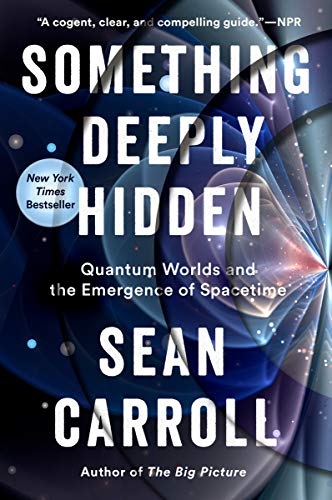
Ezra Klein, founder and editor-at-large known for his deep dives into complex science topics, shared how this book challenged his understanding of reality. He remarked, "This is a good place to recommend Sean Carroll's new book 'Something Deeply Hidden,' which is great if you like feeling very confused about the nature of reality, which I guess I do." Klein's engagement with the book shows how it pushes readers to rethink quantum mechanics beyond traditional views. Astrophysicist Priyamvada Natarajan also praised its lucid guidance through metaphysics, highlighting its appeal to those seeking clarity on the hidden nature of the cosmos.
“This is a good place to recommend Sean Carroll's new book "Something Deeply Hidden," which is great if you like feeling very confused about the nature of reality, which I guess I do” (from X)
Sean Carroll is a theoretical physicist at the California Institute of Technology, host of the Mindscape podcast, and author of From Eternity to Here, The Particle at the End of the Universe, and The Big Picture. He has been awarded prizes and fellowships by the National Science Foundation, NASA, the American Institute of Physics, and the Royal Society of London, among many others. He lives in Los Angeles with his wife, writer Jennifer Ouellette.
Sean Carroll, a theoretical physicist at Caltech with a rich background in quantum mechanics and cosmology, challenges the long-standing puzzles of quantum theory in this book. He explores the Many Worlds interpretation, arguing that every quantum event creates a branching universe, a concept that reshapes your understanding of reality and spacetime. Delving into the gaps and crises physics has faced since 1927, Carroll guides you through objections and implications with clarity, especially in chapters focusing on quantum foundations and the emergence of spacetime. This book suits those deeply curious about the nature of existence and the intersection of quantum mechanics and relativity, though it demands intellectual engagement and openness to complex ideas.
Reinhard Genzel, Nobel laureate and director at the Max Planck Institute for Extraterrestrial Physics, highlights how Schutz’s textbook has served several generations of students by making complex topics like tensor algebra and Einstein’s field equations approachable. He notes that recent groundbreaking discoveries, such as gravitational wave detections and black hole imaging, have revitalized interest in general relativity, making this book especially timely. Genzel praises its role in connecting theoretical concepts to precision experimental tests, deepening understanding of curved spacetime. Additionally, Nature commends the text for its rich set of problems and solutions, providing a practical edge to mastering these challenging physics topics.
“Several generations of students have benefitted from the first two editions of Professor Bernard Schutz’ beautiful introductory textbook on tensor algebra, manifolds, physics in curved space times, and Einstein’s field equations. Why another edition now? The answer is that, in the last years, precision measurements of stellar orbits around the central massive black hole in the Galactic Center, the detection of gravitational waves from in-spiraling binary black holes and neutron stars with LIGO, and the detection of the central ‘radio wave shadow’ of the supermassive black hole in the galaxy M87 have suddenly opened the magical world of strongly curved spacetime to precision experimental tests. These experiments and much more to come from ground- and space-based gravitational wave studies have started a renaissance of interest in Einstein’s theory.”
Bernard Schutz is a Professor in the School of Physics and Astronomy at Cardiff University, Wales, and Director (ret.) at the Max Planck Institute for Gravitational Physics (Albert Einstein Institute), Germany. In 2019 he was elected a member of the US National Academy of Sciences, and in 2021, he was elected a fellow of the Royal Society, in recognition of his seminal contributions to relativistic astrophysics.
Bernard Schutz, drawing from his extensive career as a professor and former director at the Max Planck Institute for Gravitational Physics, offers a precise yet approachable introduction to general relativity. You’ll gain a solid understanding of tensor algebra, curved spacetime physics, and Einstein’s field equations, all illuminated through worked examples and over 300 exercises designed to build your confidence. The third edition incorporates recent astronomical discoveries, including gravitational wave detections and new insights into black holes and neutron stars, making the complex subject matter accessible without oversimplifying. This book suits advanced undergraduates and anyone eager to grasp the mathematical underpinnings and physical interpretations of relativity in modern astrophysics.
David Tong, professor at the University of Cambridge known for his comprehensive expertise in theoretical physics, praises this book for its clarity and timely focus. He highlights how it offers a straightforward introduction to general relativity alongside cutting-edge topics like gravitational waves and black holes, areas that have transformed astrophysics in recent years. Tong's endorsement reflects his experience teaching complex physics concepts and his appreciation for how the book bridges foundational theory with modern discoveries, making it a valuable resource for anyone deepening their understanding in this demanding field.
“A timely book which offers a simple and clear introduction to the theory of general relativity and its modern applications to cosmology, astrophysical black holes, and the exciting field of gravitational wave astronomy.”
Mike Guidry is Professor of Physics and Astronomy at the University of Tennessee, Knoxville. His current research is focused on the development of new algorithms to solve large sets of differential equations, and applications of Lie algebras to strongly-correlated electronic systems. He has written five textbooks and authored more than 120 journal publications on a broad variety of topics. He previously held the role of Lead Technology Developer for several major college textbooks in introductory physics, astronomy, biology, genetics, and microbiology. He has won multiple teaching awards and is responsible for a variety of important science outreach initiatives.
Unlike most physics books that focus on abstract theory, Mike Guidry leverages his extensive background as a professor and researcher to present general relativity through hundreds of worked examples and accessible explanations. You’ll explore critical concepts such as black holes, gravitational waves, and cosmology with clear guidance on their physical implications, supported by end-of-chapter problems that deepen understanding. This book suits you if you're aiming to grasp both the mathematical framework and real astrophysical phenomena, bridging advanced undergraduate learning with emerging research topics. For instance, the chapters on gravitational wave astronomy highlight recent observational breakthroughs that have reshaped the field.
Sean Carroll, a Caltech physicist and author renowned for his work on spacetime, recommends this book highly. He emphasizes how General Relativity remains the most beautiful physical theory and highlights Rovelli's concise yet comprehensive introduction. Carroll appreciates the clarity with which Rovelli explains complex ideas, noting that anyone new to these concepts is fortunate to discover them through this work. His endorsement underscores the book's value for deepening your understanding of modern physics and the elegance of Einstein's theory.
Caltech physicist; author of Spacetime and Geometry
“General relativity is the most beautiful physical theory we have, and plays an increasingly central role in modern physics. Carlo Rovelli’s introduction is both concise and comprehensive, written by a master of exposition as well as of the material. I envy anyone encountering these ideas for the first time.”
Carlo Rovelli is Director of the Quantum Gravity group at the Centre de Physique Théorique of Aix-Marseille University; he also holds positions at the University of Western Ontario and the Perimeter Institute in Canada. Among his academic contributions in theoretical physics, he is best known as one of the formulators of Loop Quantum Gravity. He has written two monographs for Cambridge University Press, Quantum Gravity (2004) and (with Francesca Vidotto) Covariant Loop Quantum Gravity (2014). He is also the author of several international bestsellers in popular science such as Seven Brief Lessons on Physics (2016) and The Order of Time (2019).
What if everything you knew about gravity was wrong? Carlo Rovelli challenges the conventional presentation of General Relativity by focusing on conceptual clarity over complex mathematics. You learn the core physical, philosophical, and mathematical ideas behind Einstein's theory, including detailed explorations of black holes, gravitational waves, and cosmology, capped with an introduction to quantum gravity. This book suits university students deepening their understanding and curious science enthusiasts seeking a rigorous yet accessible approach beyond popular science treatments. For example, the chapter on black holes demystifies their properties without heavy equations, making abstract concepts tangible.
Raphael Bousso, professor at the University of California, Berkeley, brings a wealth of expertise in theoretical physics and cosmology, making his recommendation especially compelling. He praises this book as "a timely summary of what we know about black holes in the universe," highlighting the authors' status as leading experts. This endorsement reflects how the book deepened his understanding of black holes’ role in the cosmos. Additionally, Roger Penrose, noted author and physicist, warmly recommends it for its elegant and concise introduction, making it accessible to curious general readers alike.
“This timely book provides an excellent summary of what we know about black holes in the universe. Gubser and Pretorius are among the world's most prominent experts on this exciting subject.”
Steven S. Gubser (1972–2019) was professor of physics at Princeton University. His books include The Little Book of String Theory (Princeton). Frans Pretorius is professor of physics at Princeton. He lives in Princeton, New Jersey.
Steven S. Gubser and Frans Pretorius, both Princeton physics professors, bring their deep expertise to unravel the complexities of black holes in this accessible guide. You’ll explore foundational concepts like special and general relativity before diving into phenomena such as rotating black holes, gravitational waves, and Hawking radiation. The book’s creative analogies and thought experiments illuminate how black holes serve as natural laboratories for testing gravitational and quantum theories. If you’re curious about how recent discoveries like LIGO’s gravitational wave detections reshape our understanding, this book provides clear insight. Its approachable style suits anyone keen on astrophysics, though readers looking for exhaustive technical detail might prefer more specialized texts.
Sean Carroll, a physicist at Caltech and host of the Mindscape podcast, praises this book for its accessible explanation of fundamental physics and cosmic evolution. His recommendation comes from deep expertise in cosmology, and he highlights how Hooper takes readers on a journey from the universe’s birth to its ultimate future. This perspective helped Carroll appreciate the book’s ability to clarify complex concepts without losing scientific rigor. Alongside Carroll, Sophia Gadnasr, a cosmologist and astroparticle theorist, expressed enthusiasm, recalling her enjoyment of Hooper's previous work on dark matter and energy, anticipating this book’s equal merit.
“What a journey, from the very birth of the universe to its ultimate future. In accessible fashion, Hooper's book does a great job explaining the fundamental laws of physics and showing how they play out in cosmic evolution.”
Dan Hooper is a senior scientist and the head of the Theoretical Astrophysics Group at the Fermi National Accelerator Laboratory and a professor of astronomy and astrophysics at the University of Chicago. He is the author of Dark Cosmos and Nature’s Blueprint (both Smithsonian/Harper Collins). He lives in Oak Park, Illinois.
Dan Hooper brings his expertise as a senior scientist at Fermilab and professor at the University of Chicago to explore the universe's earliest moments in this detailed account. You’ll gain insight into how experiments like the Large Hadron Collider help recreate conditions just after the Big Bang and why phenomena such as dark matter and cosmic inflation remain pivotal mysteries. Chapters delve into the formation of matter versus antimatter and the era of cosmic inflation, offering a scientific narrative that balances complexity with accessibility. This book suits anyone curious about physical cosmology looking for a clear explanation of cutting-edge research rather than simplified storytelling.
Reinhard Genzel, a Nobel laureate and physicist at the Max Planck Institute, underscores the profound questions this book raises: "What are ‘black holes’ and do they exist in our Universe?" His expertise lends weight to the book’s exploration of gravitational physics and black holes. Genzel’s viewpoint reflects how the book deepens understanding of cosmic phenomena that shape our universe. Acclaimed astrophysicist Martin Rees adds that recent strides in black hole research, as detailed here, significantly expand our cosmic knowledge, while Avi Loeb appreciates the book’s insightful overview of gravity's subtle yet dominant influence.
Luciano Rezzolla is the Chair of Theoretical Astrophysics and Director at the Institute for Theoretical Physics in Frankfurt, Germany. His main research topics are the physics and astrophysics of compact objects, such as black holes and neutron stars. He is a member of the Event Horizon Telescope Collaboration (EHTC), where he sits on the Executive Board. He has received numerous prizes including the Karl Schwarzschild Prize, the Frankfurt Physics Prize, the Golden Seal of the University of Bari, the 2020 Breakthrough Prize for Fundamental Physics (with EHTC), and the Einstein Medal (with EHTC). Since 2019 he has been the Andrews Professor in Astronomy at Trinity College, Dublin.
Drawing from his extensive research as Chair of Theoretical Astrophysics and a key member of the Event Horizon Telescope Collaboration, Luciano Rezzolla unpacks the mysteries of gravity and black holes with clarity and precision. You’ll explore core concepts like spacetime curvature and general relativity, gaining insights into phenomena such as neutron stars and gravitational waves. The book offers a rare insider’s perspective on capturing the first image of a supermassive black hole, explaining both the science and the technology behind this feat. If you want to deepen your understanding of gravitational physics beyond popular science, this book delivers detailed explanations without sacrificing accessibility.
Thomas Appelquist, a physicist at Yale University, highlights how this book guides you from classical physics foundations through group theory to the nuances of gauge field theories. He appreciates its fresh perspective on quantum field theory’s core, noting its value for both students and researchers. "This new and very welcome introduction to quantum field theory takes the reader from the basics of classical physics and the beauty of group theory to the intricacies and elegance of gauge field theories," he says, revealing how the book reshaped his appreciation of the subject’s elegance and depth.
“This new and very welcome introduction to quantum field theory takes the reader from the basics of classical physics and the beauty of group theory to the intricacies and elegance of gauge field theories. Students and researchers alike will treasure this fresh approach to one of the foundation stones of modern physics.”
Anthony G. Williams is Professor in Physics at the University of Adelaide, Australia. He has worked extensively in the areas of hadronic physics and computational physics, studying quark and gluon substructure. For this work, he was awarded the Walter Boas Medal by the Australian Institute of Physics in 2001 and elected Fellow of the American Physical Society in 2002. In 2020, he became the Deputy Director of the Australian Research Council Centre of Excellence for Dark Matter Particle Physics, where he studies the direct detection of dark matter and extensions of the Standard Model.
After analyzing decades of research in particle physics, Anthony G. Williams developed a textbook that carefully bridges classical mechanics and modern gauge field theories. You’ll find a structured path starting from advanced dynamics and special relativity, moving toward relativistic quantum mechanics and the formalism of quantum fields. The book’s approach benefits anyone from advanced undergraduates to graduate students, particularly those without a formal background in elementary topics, by providing full derivations, worked examples, and challenging problems. Chapter 3’s thorough treatment of classical field theory and the later sections on gauge invariance stand out as particularly instructive, grounding you firmly in the fundamentals without losing rigor. This text serves as a solid foundation if you’re aiming to master quantum field theory within physics.
The best Physics books and more, in your inbox each week. No account needed.
Conclusion
Together, these 21 books reveal three clear themes: the interplay between the quantum and cosmic, the elegance of Einstein’s relativity reimagined, and the persistent quest to unify physics’ foundational theories. Whether you're grappling with quantum mechanics' mysteries or exploring black holes' enigmas, this collection offers a spectrum of depth and perspective.
If you're just starting, try Quantum Physics for Beginners alongside Welcome to the Universe to build a solid foundation. For rapid immersion, pair Modern Quantum Mechanics with Gravitation for a rigorous dive into theory and application.
Alternatively, you can create a personalized Physics book designed around your unique needs, blending expert knowledge with your specific context. These books can help you accelerate your learning journey and deepen your grasp of the universe’s fundamental laws.
Frequently Asked Questions
I'm overwhelmed by choice – which physics book should I start with?
Start with accessible books like Quantum Physics for Beginners or Welcome to the Universe. These provide clear explanations without heavy math, helping you build a solid understanding before tackling more advanced texts.
Are these physics books too advanced for someone new to the subject?
Not all. Titles like Quantum physics and mechanics for beginners and The Little Book of Black Holes are designed for newcomers, offering clear, engaging introductions without requiring prior expertise.
What's the best order to read these physics books?
Begin with beginner-friendly overviews to grasp core concepts, then progress to specialized works like Modern Quantum Mechanics or Gravitation for deeper study. Mixing conceptual and technical books can enrich your learning.
Should I start with the newest physics books or classic ones?
Balance is key. Newer books often reflect latest discoveries, while classics provide foundational knowledge. For example, The God Equation offers recent theoretical perspectives, while A First Course in General Relativity covers timeless fundamentals.
Can I skip around or do I need to read these physics books cover to cover?
Skipping is fine depending on your goals. Some books are structured for sequential learning, but many, like Reality Is Not What It Seems, can be read in thematic chapters focusing on your interests.
How can I get physics insights tailored to my background and goals?
Expert books are invaluable, but personalized physics books can complement them by focusing on your experience level and topics you care about. You can create a custom Physics book to bridge expert knowledge with your unique learning path.
📚 Love this book list?
Help fellow book lovers discover great books, share this curated list with others!