8 Classical Mechanics Books That Separate Experts from Amateurs
Recommended by Neil Degrasse Tyson, astrophysicist, and other thought leaders to elevate your physics knowledge
Updated on June 28, 2025·We may earn commissions for purchases made via this page
We're launchingLaunching on Product Hunt today 🎉We just launchedJust launched on Product Hunt 🎉
Modelpeers, from the BookAuthority teamFrom the BookAuthority team: Modelpeers, a free way to follow AI models and agents like you follow people. We'd love your support.
What if the laws that govern everything from falling apples to orbiting planets could be understood not just superficially, but deeply and intuitively? Classical mechanics remains the backbone of physics, yet its rich history and evolving modern interpretations mean you need more than just textbook formulas to truly grasp its power. Today, classical mechanics informs everything from engineering innovations to astrophysics breakthroughs, making it as vital now as it was centuries ago.
Neil Degrasse Tyson, an astrophysicist celebrated for making complex science accessible, highlights the enduring relevance of Newton’s Principia—a foundation stone of classical mechanics. Tyson’s work in space science and science communication roots his endorsement in both rigorous knowledge and public engagement, ensuring you learn from books that still shape modern physics.
While these expert-curated books provide proven frameworks for mastering classical mechanics, readers seeking content tailored to their specific background, skill level, and interests might consider creating a personalized Classical Mechanics book that builds on these insights and accelerates your learning journey.
Neil Degrasse Tyson, a leading astrophysicist known for bridging complex science and public understanding, lends significant weight to this edition of Newton's Principia. His endorsement signals the book’s enduring relevance, as Tyson’s expertise in celestial mechanics and space science aligns directly with Newton’s groundbreaking work on planetary motion and gravity. For those seeking rigorous, historically grounded insight into classical mechanics, Tyson's implicit recommendation highlights this book as an essential reference that continues to inform modern scientific exploration.
Sir Isaac Newton, Julia Budenz, I. Bernard Cohen, Anne Whitman(you?)·
About the Author
I. Bernard Cohen (1914–2003) was Victor S. Thomas Professor of the History of Science at Harvard University. He was the author of Benjamin Franklin's Science, Interactions, and Science and the Founding Fathers. Anne Whitman (1937–1984) was coeditor (with I. Bernard Cohen and Alexander Koyré) of the Latin edition, with variant readings, of the Principia. Julia Budenz, author of From the Gardens of Flora Baum, is a multilingual classicist and poet.
The breakthrough moment came when this authoritative translation of Newton's Principia resurfaced, shedding new light on his foundational work that defines much of classical mechanics. The editors, including Harvard's historian I. Bernard Cohen, meticulously modernize the original 1726 edition, clarifying Newton’s laws of motion and universal gravitation with updated mathematical notation and accessible prose. You’ll gain a deeper understanding of the principles governing acceleration, celestial motion, and fluid dynamics, along with insights into how Newton revolutionized scientific inquiry itself. This edition suits anyone serious about physics history or mathematical physics, though its dense content demands commitment rather than casual reading.
T. M. Helliwell, who taught at Harvey Mudd College for over forty years and served as Physics Department Chair, brings his extensive expertise in general relativity, cosmology, and quantum theory to this textbook. His dual National Science Foundation fellowships and consulting work at the Jet Propulsion Laboratory underpin the authoritative perspective of the book. This background informs a text that not only covers classical mechanics fundamentals but also connects them to the frontiers of physics research, making it especially valuable for students and instructors seeking a modern approach.
T. M. Helliwell taught at Harvey Mudd College for more than forty years, serving in several administrative roles, including Physics Department Chair. He received two National Science Foundation fellowships, was awarded the Henry T. Mudd Prize for service to the college in 1997, and served as a consultant at the Jet Propulsion Laboratory. He is the author or co-author of more than forty research papers on general relativity, cosmology, and quantum theory, and the author of two textbooks on special relativity.
Drawing from extensive academic and research experience, T. M. Helliwell and V. V. Sahakian offer a textbook that firmly situates classical mechanics within the landscape of modern physics. You gain detailed insights into how classical mechanics interconnects with quantum mechanics and general relativity, especially through capstone chapters that bridge theory and contemporary research. The book mixes rigorous theoretical exploration with numerous examples and problem sets, reinforcing your grasp of both fundamental and advanced mechanics concepts. If your goal is to understand classical mechanics as a living, evolving discipline rather than a static subject, this book provides a clear path, though it’s best suited for students or instructors comfortable with higher-level physics.
This AI-created book on classical mechanics is crafted from your background and physics knowledge to meet your learning needs. You share your current skill level and specific interests, and the book focuses on the aspects of classical mechanics that matter most to you. This tailored approach helps you engage deeply with the material without wading through unrelated content, making your study more efficient and personally relevant.
TailoredRead AI creates personalized nonfiction books that adapt to your unique background, goals, and interests. Instead of reading generic content, you get a custom book written specifically for your profession, experience level, and learning objectives. Whether you're a beginner looking for fundamentals or an expert seeking advanced insights, TailoredRead crafts a book that speaks directly to you. Learn more.
2026·50-300 pages·Classical Mechanics, Newtonian Dynamics, Kinematics, Forces, Energy Conservation
This tailored book explores classical mechanics by closely aligning its content with your unique background, experience, and learning goals. It examines fundamental principles such as Newtonian dynamics, energy conservation, and rotational motion while delving into applications that match your specific interests. Through a personalized approach, it reveals the nuances of kinematics, forces, Lagrangian and Hamiltonian mechanics, and problem-solving techniques that resonate with your current knowledge. By focusing on your individual goals, this book offers a clear, engaging pathway through complex concepts, making classical mechanics accessible and relevant to your learning journey. It is an immersive, customized exploration designed to deepen your understanding and mastery of this essential physics discipline.
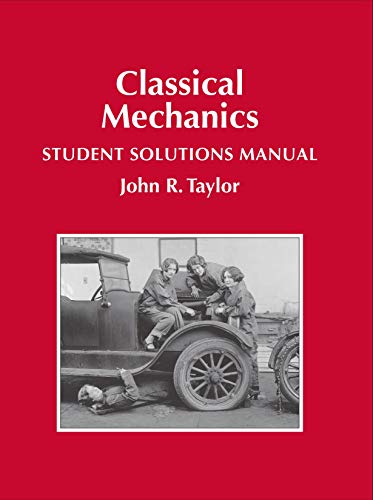
Professor John Taylor is the author of three best-selling textbooks and a Presidential Teaching Scholar at the University of Colorado in Boulder. With numerous teaching awards and experience as Associate Editor of the American Journal of Physics, he brings deep expertise to this Student Solutions Manual. His Emmy Award-winning educational approach, showcased in the 'Physics 4 Fun' series, informs the accessible and clear guidance found here, making this manual a trusted resource for students working through classical mechanics problems.
Professor John Taylor is the author of three best-selling textbooks, including Introduction to Error Analysis and Modern Physics. He is Professor Emeritus of Physics and Presidential Teaching Scholar at the University of Colorado in Boulder, where he has won numerous teaching awards, served as Associate Editor of the American Journal of Physics, and received an Emmy Award for his television series called 'Physics 4 Fun.'
John R. Taylor challenges the usual approach to classical mechanics study by providing a Student Solutions Manual that directly complements his renowned textbook. This manual restates odd-numbered problems and offers detailed, clear solutions, helping you understand where you might have taken a wrong turn or want to verify your work. Its well-structured explanations encourage independent problem-solving first, then support deeper learning through guided answers. If you're tackling Taylor's textbook and need a reliable companion to sharpen your problem-solving skills, this manual is designed precisely for that purpose.
Jakob Schwichtenberg is dedicated to making complex subjects understandable. His approach emphasizes clarity and accessibility, aiming to instill a way of thinking that empowers students to learn effectively. He believes in breaking down difficult concepts into manageable pieces, making them approachable for learners at all levels.
Jakob Schwichtenberg is dedicated to making complex subjects understandable. His approach emphasizes clarity and accessibility, aiming to instill a way of thinking that empowers students to learn effectively. He believes in breaking down difficult concepts into manageable pieces, making them approachable for learners at all levels.
Jakob Schwichtenberg brings a fresh perspective to classical mechanics with his focus on clarity and student needs. Instead of overwhelming you with formal lectures, he guides you through the subject like a knowledgeable peer, ensuring every equation and concept is motivated and carefully explained. You’ll explore the connections between Newtonian, Lagrangian, and Hamiltonian formalisms, and encounter deep insights such as Noether’s theorem and the links between classical mechanics and relativity. The book’s step-by-step annotated calculations and over 100 illustrations make complex ideas approachable, making it especially useful if you want to truly understand the foundations rather than just memorize formulas.
Moataz H. Emam, a professor of physics with advanced degrees from Cairo University and the University of Massachusetts, brings a deep blend of academic expertise and teaching passion to this book. His experience spans civil engineering to high energy theoretical physics, informing a text designed to guide you from core classical mechanics concepts to the complexities of general relativity with approachable mathematics. His role at SUNY Cortland and visiting positions in Egypt underscore his commitment to physics education, making this book a gateway for undergraduates and self-learners aiming to navigate modern physics research.
Moataz H. Emam is a professor of physics at the State University of New York College at Cortland. He holds a BS in civil engineering, a BS in physics, an MSc in high energy physics from Cairo University, as well as a PhD in theoretical physics from the University of Massachusetts at Amherst. Dr. Emam also serves periodically as Visiting/Adjunct Professor of Physics at the Zewail City for Science and Technology in Egypt. Teaching and research are Dr. Emam's main passions. In his spare time, he maintains a popular science blog in Arabic.
Unlike most classical mechanics books that emphasize rote problem solving, this text by Moataz H. Emam invites you into the elegant principle of covariance, connecting classical mechanics to general relativity through a clear, gradual introduction to tensors and geometry. You’ll work through familiar physics concepts while building a foundation in the mathematical language critical for modern theoretical physics, even if your background is limited to multivariable calculus and linear algebra. For example, chapters on tensor calculus use classical mechanics as a stepping stone, making complex ideas accessible and relevant. This book suits undergraduates and motivated self-learners eager to understand spacetime's underlying symmetries and prepare for research in advanced physics.
This AI-created book on classical mechanics is tailored specifically to your current knowledge and goals. By sharing your background and which aspects of classical mechanics you want to focus on, you receive a learning plan that matches your interests and skill level. This approach makes complex physics topics manageable and engaging. Instead of navigating broad texts, you get a clear path through the core principles and problem-solving techniques that matter most to you.
TailoredRead AI creates personalized nonfiction books that adapt to your unique background, goals, and interests. Instead of reading generic content, you get a custom book written specifically for your profession, experience level, and learning objectives. Whether you're a beginner looking for fundamentals or an expert seeking advanced insights, TailoredRead crafts a book that speaks directly to you. Learn more.
2026·50-300 pages·Classical Mechanics, Newtonian Dynamics, Energy Conservation, Motion Analysis, Force Systems
This tailored book offers a focused, step-by-step journey through classical mechanics designed specifically for your background and learning goals. It explores fundamental concepts such as Newtonian dynamics, energy conservation, and motion analysis, while progressively building your problem-solving abilities. By concentrating on topics that match your interests and skill level, the content reveals each principle clearly and connects theory directly to practical applications. This personalized approach helps you build confidence rapidly, ensuring you grasp both foundational ideas and more nuanced challenges without unnecessary detours. It provides a clear pathway through classical mechanics, making complex topics accessible and engaging through a tailored learning experience.
Dan Fullerton is a physics teacher at Irondequoit High School and adjunct professor at Rochester Institute of Technology. Recognized as a New York State Master Physics Teacher in 2014, he leverages his teaching and engineering background to create this companion book. Designed to support students throughout the AP Physics C: Mechanics course, the book reflects his commitment to making challenging physics topics accessible and understandable.
Dan Fullerton is a physics teacher at Irondequoit High School in Rochester, NY, an adjunct professor of microelectronic engineering at Rochester Institute of Technology, and director of APlusPhysics.com. He was named a NY State Master Physics Teacher in 2014. He lives in Webster, NY, with his beautiful wife, indefatigable daughters, and sleepy dog.
When Dan Fullerton first realized how daunting calculus-based physics could be for students, he crafted this companion to bridge the gap between theory and application. You gain a clear understanding of mechanics fundamentals, from kinematics through oscillations, supported by 350 fully worked-out problems that sharpen your problem-solving skills. The book’s integration with APlusPhysics.com adds depth with videos and Q&A forums, making it a practical resource for anyone tackling AP Physics C or university-level mechanics. It’s best suited for self-motivated learners who want a structured, example-driven guide rather than a traditional textbook or quick test prep.
John R. Taylor is a renowned physicist and educator celebrated for his ability to make complex physics concepts accessible. His extensive experience in teaching and authoring influential physics textbooks led him to write this book, focusing on deepening your understanding of classical mechanics fundamentals. Taylor’s clear and engaging style reflects his commitment to education, making this book a trusted resource for students worldwide seeking to grasp the principles that govern physical motion.
John R. Taylor is a renowned physicist and educator, known for his clear and engaging writing style. He has authored several influential textbooks in physics, including 'Classical Mechanics', which is widely used in universities around the world. Taylor's work emphasizes a deep understanding of fundamental concepts, making complex topics accessible to students. His contributions to the field of physics education have earned him recognition and respect among both students and educators.
John R. Taylor, a respected physicist and educator, crafted this book to bridge the gap between abstract theory and practical understanding in classical mechanics. His clear, engaging style guides you through core principles like Newtonian dynamics, Lagrangian and Hamiltonian formulations, and rotational motion, often referencing detailed examples and problem sets that sharpen your analytical skills. This book suits you if you're a physics or engineering student aiming to master the foundational mechanics that underpin much of modern science and technology, offering a rigorous yet accessible path through complex concepts.
G. Aruldhas is a renowned physics educator known for clear, concise writing and practical problem-solving approaches. His experience in teaching classical mechanics at undergraduate and graduate levels drives this book, making complex topics accessible and useful for students aiming to deepen their understanding of mechanics fundamentals.
G. Aruldhas is a renowned author and educator in the field of physics, known for his clear and concise writing style. He has authored several textbooks that are widely used in undergraduate and graduate courses, particularly in classical mechanics. His works are appreciated for their thorough explanations and practical problem-solving approaches, making complex concepts accessible to students.
What if everything you knew about classical mechanics needed a clearer explanation? G. Aruldhas, a respected physics educator, wrote this text to bridge the gap between abstract theory and student understanding. You’ll find detailed derivations of fundamental principles alongside practical problems that sharpen your problem-solving skills, particularly chapters on Lagrangian and Hamiltonian dynamics. This book suits physics students who want a solid grasp of classical mechanics concepts presented with clarity and rigor, rather than casual readers or those seeking a purely conceptual overview.
The best Classical Mechanics books and more, in your inbox each week. No account needed.
Conclusion
These eight books collectively reveal the layered nature of classical mechanics—from Newton’s original laws to modern approaches linking mechanics with relativity. If you’re grappling with conceptual clarity, start with Jakob Schwichtenberg’s No-Nonsense Classical Mechanics for its approachable explanations. For sharpening problem-solving skills, John R. Taylor’s Student Solutions Manual and his main Classical Mechanics textbook offer rigorous practice.
For a broader perspective connecting classical mechanics to cutting-edge physics, Modern Classical Mechanics and Covariant Physics provide deep insights into how classical principles evolve into quantum and relativistic frameworks. Students preparing for exams or AP courses will find The AP Physics C Companion invaluable.
Alternatively, you can create a personalized Classical Mechanics book to bridge the gap between general principles and your specific situation. These books can help you accelerate your learning journey and deepen your understanding of the physical world.
Frequently Asked Questions
I'm overwhelmed by choice – which Classical Mechanics book should I start with?
Start with No-Nonsense Classical Mechanics by Jakob Schwichtenberg. Its clear, student-friendly approach breaks down complex concepts, making it ideal for building a strong foundation before tackling more advanced texts.
Are these books too advanced for someone new to Classical Mechanics?
Not at all. Several, like The AP Physics C Companion and No-Nonsense Classical Mechanics, are designed with learners in mind. They guide you through fundamentals before moving to deeper topics.
What’s the best order to read these Classical Mechanics books?
Begin with accessible introductions like Schwichtenberg’s, then move to Taylor’s Classical Mechanics and its solutions manual for problem practice. Follow with Modern Classical Mechanics and Covariant Physics to explore advanced and modern connections.
Do these books assume prior experience in Classical Mechanics?
Some do, especially Modern Classical Mechanics and Covariant Physics, which expect familiarity with calculus and physics fundamentals. Others, like The AP Physics C Companion, are suitable for beginners.
Which books focus more on theory versus practical application?
The Principia and Modern Classical Mechanics lean heavily into theory and foundational principles. The AP Physics C Companion and Taylor’s manuals offer practical problem-solving and application.
Can I get a Classical Mechanics learning plan tailored to my needs?
Yes! While these expert books provide solid knowledge, a personalized Classical Mechanics book can tailor insights to your background and goals, helping you learn efficiently. Explore options here.
📚 Love this book list?
Help fellow book lovers discover great books, share this curated list with others!