7 Clustering Books That Separate Experts from Amateurs
Recommended by Peter Norvig, Director of Research at Google, and other leading data scientists for mastering Clustering
Updated on June 24, 2025·We may earn commissions for purchases made via this page
0 of 7 books have Audiobook versions
We're launchingLaunching on Product Hunt today 🎉We just launchedJust launched on Product Hunt 🎉
Modelpeers, from the BookAuthority teamFrom the BookAuthority team: Modelpeers, a free way to follow AI models and agents like you follow people. We'd love your support.
What if the key to unlocking complex data patterns lies in mastering the art of clustering? Far beyond just grouping data points, clustering techniques reveal hidden structures that drive smarter decisions across industries — from marketing to social sciences.
Peter Norvig, Google's Director of Research, has personally recommended Text Mining for its clear exposition of clustering applications in text analysis. Alongside him, statisticians like Charles Bouveyron and social science expert Philip D. Waggoner have shaped the field with their practical yet rigorous approaches.
While these expert-curated books provide proven frameworks, readers seeking content tailored to their specific skill level, domain, or goals might consider creating a personalized Clustering book that builds on these insights.
Peter Norvig, Director of Research at Google Inc and a respected authority in machine learning, recommends this volume for its focused and coherent approach to text mining. Navigating a field that can feel fragmented, Norvig highlights how the book’s collection of leading research papers clarifies diverse techniques like kernel methods and latent Dirichlet allocation. His endorsement underscores how this resource shaped his understanding by balancing classification with clustering methods, making it an insightful guide for those tackling complex text analysis challenges.
“This book is a worthy contribution to the field of text mining. By focusing on classification (rather than exhaustively covering extraction, summarization, and other tasks), it achieves the right balance of coherence and comprehensiveness. It collects papers by the leading authors in the field, who employ and explain a variety of techniques―kernel methods, link analysis, latent Dirichlet allocation, non-negative matrix factorization, and others. Together the papers bring unity and clarity to a disjointed and sometimes perplexing field and serve as the perfect introduction for an advanced student.”
Ashok N. Srivastava is a prominent researcher in the field of data mining and machine learning, with extensive experience in text mining applications. He has contributed significantly to the development of algorithms and methodologies that enhance the understanding and processing of textual data. Mehran Sahami, also an editor, is known for his work in machine learning and information retrieval, making substantial contributions to the academic community and industry practices.
Drawing from their deep expertise in data mining and machine learning, Ashok N. Srivastava and Mehran Sahami assembled this volume to bring clarity to the complex domain of text mining. The book dives into practical statistical methods for classifying documents into predefined categories and explores innovative clustering techniques to uncover hidden topical structures without prior labeling. You'll gain insight into algorithms like kernel methods and latent Dirichlet allocation, as well as applications such as adaptive filtering and information distillation. This makes it well suited for those seeking to understand both foundational theory and practical tools in text analysis.
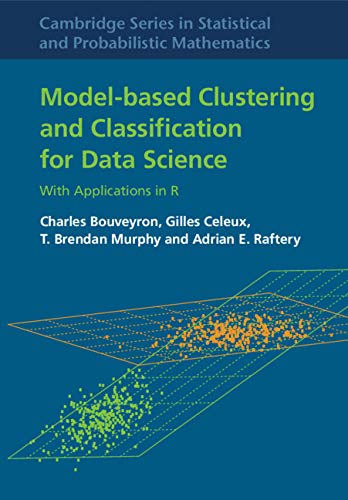
Charles Bouveyron is a Full Professor of Statistics at Université Côte d'Azur and holds the Chair of Excellence in Data Science at INRIA Rocquencourt. His extensive research on model-based clustering, especially for networks and high-dimensional data, uniquely qualifies him to lead this detailed exploration of clustering and classification. This book reflects his deep expertise, providing you with statistically grounded frameworks and practical tools to master complex clustering challenges in data science.
Charles Bouveyron, Gilles Celeux, T. Brendan Murphy, Adrian E. Raftery(you?)·
About the Author
Charles Bouveyron is Full Professor of Statistics at Université Côte d'Azur and the Chair of Excellence in Data Science at Institut National de Recherche en Informatique et en Automatique (INRIA), Rocquencourt. He has published extensively on model-based clustering, particularly for networks and high-dimensional data.
After analyzing numerous data clustering cases, Charles Bouveyron and his co-authors offer a rigorous statistical approach to cluster analysis and classification that moves beyond heuristics. You’ll gain clear answers to complex questions like determining the number of clusters, handling outliers, and tuning parameters for robust classification. The book delves into modern challenges such as high-dimensional data, network clustering, and semi-supervised methods, with practical R code to apply concepts directly. If you’re comfortable with basic multivariate calculus and statistics, this work equips you to tackle real-world data grouping problems with principled, model-based techniques.
This AI-created book on clustering techniques is tailored to your skill level and goals. It’s designed to focus on the clustering methods and applications that matter most to you, based on your background and interests. By creating a custom learning path, this personalized AI book helps you avoid extraneous material and zero in on what will truly expand your understanding and skills in clustering. It’s like having a mentor guide you through the complexities of clustering with precision and clarity.
TailoredRead AI creates personalized nonfiction books that adapt to your unique background, goals, and interests. Instead of reading generic content, you get a custom book written specifically for your profession, experience level, and learning objectives. Whether you're a beginner looking for fundamentals or an expert seeking advanced insights, TailoredRead crafts a book that speaks directly to you. Learn more.
This tailored book explores clustering methods with a focus perfectly matched to your background and goals. It examines a wide range of clustering techniques—from foundational concepts to advanced algorithms—presented through an approach that aligns closely with your skill level and learning interests. By synthesizing key principles and practical examples, it reveals the inner workings of clustering, helping you grasp nuances that matter most to your specific objectives. This personalized guide facilitates a deeper understanding by addressing the clustering topics you find most relevant, enabling you to navigate complex data structures effectively and confidently.
Mr. Alboukadel Kassambara is a recognized expert in data science and machine learning, specializing in statistical analysis and visualization. He has authored several influential books and guides on R programming and data analysis, contributing significantly to the field through his practical approach and clear explanations. This background uniquely qualifies him to write a practical guide that helps you navigate the complexities of cluster analysis with R, offering clear methods and visualization techniques to deepen your understanding.
Mr. Alboukadel Kassambara is a recognized expert in data science and machine learning, specializing in statistical analysis and visualization. He has authored several influential books and guides on R programming and data analysis, contributing significantly to the field through his practical approach and clear explanations.
Unlike most clustering books that lean heavily on theory, Alboukadel Kassambara’s guide offers a hands-on approach centered on R programming for unsupervised machine learning. You’ll learn how to implement and interpret various clustering algorithms, from K-means to hierarchical and fuzzy clustering, with visual tools like dendrograms to help make sense of your data structure. The book dives into evaluating cluster quality and choosing the right method for your dataset, catering well to analysts who want to move beyond formulas and get practical with real-world data. If you’re comfortable with R and seek actionable insights into cluster analysis, this book fits the bill; it’s less suited for those wanting purely conceptual discussions.
Philip D. Waggoner is a recognized expert in quantitative and computational methods, focusing on machine learning's role in social sciences. His book reflects a commitment to equipping researchers with data-driven tools to decode complex social phenomena, backed by practical R examples and clear explanations. This makes it a valuable resource for anyone looking to deepen their understanding of clustering in political and social contexts.
Philip D. Waggoner is a recognized expert in quantitative and computational methods, focusing on the application of machine learning techniques in social sciences. His work emphasizes the importance of data-driven approaches in understanding complex social phenomena.
Philip D. Waggoner brings his expertise in quantitative and computational methods to the forefront with this focused exploration of clustering techniques in political and social research. You’ll gain practical knowledge of several unsupervised machine learning algorithms, including hierarchical clustering, k-means, Gaussian mixture models, and advanced methods like fuzzy C-means and DBSCAN. The book emphasizes hands-on application with R code and real datasets, making abstract concepts tangible. This is particularly useful for social scientists and researchers aiming to uncover hidden structures in complex data, rather than for those seeking purely theoretical coverage or deep technical derivations.
Elizabeth Ann Maharaj, an associate professor at Monash University with a Ph.D. focused on time series pattern recognition, brings her extensive expertise to this text. Her research spans multiple applied fields, including climatology and finance, grounding the book's content in real-world challenges. This background informs a thorough overview of clustering and classification methods for time series data, enriched by practical examples and code resources that connect theory to practice in data science.
Elizabeth Ann Maharaj, Pierpaolo D'Urso, Jorge Caiado(you?)·
About the Author
Elizabeth Ann Maharaj is an Associate Professor in the Department of Econometrics and Business Statistics at Monash University, Australia. She has a Ph.D. from Monash University on the Pattern Recognition of Time Series. Ann is an elected member of the International Statistical Institute (ISI), a member of the International Association of Statistical Computing (IASC) and of the Statistical Society of Australia (SSA). She is also an accredited statistician with the SSA. Ann’s main research interests are in time series classification, wavelets analysis, fuzzy classification and interval time series analysis. She has also worked on research projects in climatology, environmental science, labour markets, human mobility and finance.
When Elizabeth Ann Maharaj, a seasoned associate professor specializing in econometrics and business statistics, wrote this book, she aimed to bridge complex theoretical concepts and practical applications in time series data analysis. You’ll find detailed explorations of clustering and classification techniques tailored to different data types, including fuzzy and model-based approaches, supported by real examples from fields like medicine and finance. The inclusion of R and MATLAB code allows you to directly apply these methods, making it useful whether you’re a researcher or a student seeking hands-on experience. This book suits those ready to deepen their understanding of pattern recognition in time series, though it may be dense if you’re just starting out.
This AI-created book on clustering skills is crafted based on your current experience and learning goals. By sharing what aspects of clustering you want to focus on and your background, you receive a tailored guide that walks you through improving your clustering proficiency step by step. This personalized approach helps you cut through generic content and zero in on what will advance your understanding most effectively.
TailoredRead AI creates personalized nonfiction books that adapt to your unique background, goals, and interests. Instead of reading generic content, you get a custom book written specifically for your profession, experience level, and learning objectives. Whether you're a beginner looking for fundamentals or an expert seeking advanced insights, TailoredRead crafts a book that speaks directly to you. Learn more.
This tailored book offers a focused, step-by-step guide designed to accelerate your clustering skills within 30 days. It explores core clustering concepts and progressively deepens your understanding through practical exercises tailored to your background and goals. By matching content to your specific interests, it navigates complex clustering techniques such as hierarchical methods, k-means, and density-based approaches at a pace suited to your experience. This personalized journey reveals the connections between theory and application, helping you develop proficiency efficiently and confidently.
Paolo Giordani, a faculty member at Sapienza University's Department of Statistical Sciences, brings his expertise in statistical methodologies and their applications in social sciences and psychology to this book. Alongside Maria Brigida Ferraro and Francesca Martella, he provides a detailed guide to clustering techniques with practical implementations in R. Their combined academic experience ensures the book is both authoritative and accessible, offering you a thorough preparation for applied research in clustering with carefully chosen real-life datasets and extensive code examples.
Paolo Giordani, Maria Brigida Ferraro, Francesca Martella(you?)·
About the Author
Paolo Giordani is a faculty member at the Department of Statistical Sciences at Sapienza University of Rome. He specializes in statistical methodologies and their applications in various fields, including social sciences and psychology. His work focuses on clustering techniques and their practical implementations using statistical software. Alongside him, Maria Brigida Ferraro and Francesca Martella, also from the same department, contribute their expertise in statistical analysis and research methodologies.
After analyzing numerous clustering techniques and their real-world applications, Paolo Giordani and his co-authors developed this introduction to bridge theory with practice using R software. You learn how to classify multivariate data into meaningful groups through both traditional hard clustering and the more nuanced soft clustering methods, supported by detailed, step-by-step R code examples. Chapters cover everything from foundational concepts to advanced applications in social sciences and psychology, making it accessible whether you’re new to clustering or seeking to deepen your applied skills. This book suits researchers and professionals aiming to confidently implement clustering techniques in empirical studies with real datasets.
Vivian Siahaan is an independent learner with broad expertise in Java, Android, JavaScript, and Python, bringing a practical programming perspective to data science challenges. Her experience creating numerous programming ebooks informs her approachable yet thorough coverage of RFM analysis and K-means clustering. She wrote this book to guide those interested in retail customer analytics through hands-on data processing, clustering, and prediction using Python and PyQt, making complex concepts accessible through real-world application.
Vivian Siahaan is an independent learner who likes to do new things. She has expertise in Java, Android, JavaScript, Python, and more. She has written numerous ebooks on programming topics.
2022·391 pages·Clustering, Customer Segmentation, Data Preprocessing, Machine Learning, Python Programming
Vivian Siahaan draws on her programming expertise to dissect customer behavior through the lens of RFM analysis combined with K-means clustering. This book takes you through transforming raw retail transaction data into actionable customer segments by evaluating recency, frequency, and monetary value metrics, then applying clustering to reveal distinct purchasing patterns. You'll learn to preprocess data, select optimal cluster numbers using the elbow method, and interpret cluster characteristics to inform marketing strategies. The inclusion of Python code and a PyQt GUI adds practical depth, making this especially useful if you're keen on implementing clustering in a retail or data science context.
The best Clustering books and more, in your inbox each week. No account needed.
Conclusion
Together, these seven books reveal clustering’s many faces: from robust statistical models and practical R implementations to specialized applications in text mining and social research. If you’re focused on mastering model-based methods, Model-Based Clustering and Classification for Data Science offers depth and precision. For rapid hands-on learning, Practical Guide to Cluster Analysis in R and An Introduction to Clustering with R provide accessible code-driven guidance.
Facing challenges in social data or retail analytics? Combine Unsupervised Machine Learning for Clustering in Political and Social Research with RFM ANALYSIS AND K-MEANS CLUSTERING for targeted insights. Alternatively, you can create a personalized Clustering book to bridge the gap between general principles and your specific situation.
These books will help you accelerate your learning journey and confidently navigate the complexities of clustering, whether you’re an aspiring data scientist, analyst, or researcher.
Frequently Asked Questions
I'm overwhelmed by choice – which book should I start with?
Start with Practical Guide to Cluster Analysis in R if you want hands-on experience, or Model-Based Clustering and Classification for Data Science for a strong theoretical foundation. Both balance clarity and depth effectively.
Are these books too advanced for someone new to Clustering?
Not at all. Titles like An Introduction to Clustering with R are designed for beginners, while others provide deeper dives once you’re comfortable with basics.
What’s the best order to read these books?
Begin with introductory texts focusing on practical applications, then progress to specialized topics like social research or time series clustering to build expertise.
Do these books focus more on theory or practical application?
They strike a balance. For example, Text Mining offers theoretical insights with practical algorithms, whereas Practical Guide to Cluster Analysis in R emphasizes hands-on coding.
Are there any conflicting approaches among these books?
While methodologies differ, such as model-based versus heuristic clustering, these differences reflect the field’s richness and provide complementary perspectives.
Can I get clustering insights tailored to my specific needs without reading all these books?
Yes! While these expert books offer solid foundations, you can also create a personalized Clustering book tailored to your background and goals, bridging expert knowledge with your unique context.
📚 Love this book list?
Help fellow book lovers discover great books, share this curated list with others!