7 Domain Driven Design Books That Separate Experts from Amateurs
Recommended by David Heinemeier Hansson, creator of Ruby on Rails, and Grady Booch, scientist and storyteller, these Domain Driven Design books offer proven strategies for mastering complex software domains.
What if the key to mastering complex software systems lies not just in code, but in deeply understanding the business domain? Domain Driven Design (DDD) challenges the conventional divide between developers and domain experts, offering a roadmap to build software that truly mirrors real-world complexities. As organizations grapple with scaling software while keeping it aligned to business goals, DDD's relevance has surged.
David Heinemeier Hansson, creator of Ruby on Rails and founder of Basecamp, emphasizes pragmatic design that connects code to business value. Meanwhile, Grady Booch, a scientist known for his storytelling and software architecture expertise, highlights DDD's role in simplifying complexity through shared language and clear models. Their endorsements underscore the importance of these books in shaping modern software practices.
While these expert-curated books provide proven frameworks, readers seeking content tailored to their specific experience, industry, or learning goals might consider creating a personalized Domain Driven Design book that builds on these insights.
1. Domain-Driven Design
Recommended by Grady Booch in
scientist, storyteller, philosopher
“I absolutely love this book. I was surprised, in my research, to find a very early use of the phrase "domain-driven design" in a paper from 2003 by Bedir Tekinerdogan and Mehmet Aksit from @utwenteEN” (from X)

Domain-Driven Design: Tackling Complexity in the Heart of Software focuses on managing complexity at the core of software through domain-driven design. Grady Booch recommends Domain-Driven Design: Tackling Complexity in the Heart of Software. David Heinemeier Hansson recommends Domain-Driven Design: Tackling Complexity in the Heart of Software.
2. Implementing Domain-Driven Design

Implementing Domain-Driven Design presents a top-down approach that connects strategic patterns to tactical programming tools. Its realistic Java examples also apply to C# developers, and a single case study ties the content together. It covers Bounded Context, Context Maps and the Ubiquitous Language.
DDD Mastery Blueprint

This tailored book offers a deep exploration of Domain Driven Design (DDD), crafted to align with your unique background and goals. It examines the core concepts of domain modeling and strategic design, revealing how to navigate complex software domains with precision. By focusing on your specific interests, it unpacks essential DDD principles, tactical patterns, and architectural decisions that resonate with your experience level. This personalized guide bridges expert knowledge with your personal learning journey, enabling a richer understanding of how to connect software design to business value effectively. It provides a clear pathway through intricate DDD concepts, ensuring you gain practical insights relevant to your projects and ambitions.
3. Learning Domain-Driven Design

Learning Domain-Driven Design: Aligning Software Architecture and Business Strategy offers patterns, principles and practices for analyzing business domains and aligning software design with business needs. It covers decomposing systems into bounded contexts, coordinating multiple teams and gradually introducing DDD to brownfield projects.
4. Hands-On Domain Driven Design with .NET

Hands-On Domain Driven Design with .NET moves from domain complexity and EventStorming to a .NET Core project written in C#. It shows how aggregates handle commands and produce events, and it covers Bounded Contexts, Context Map, Event Sourcing and CQRS.
5. Domain Modeling Made Functional
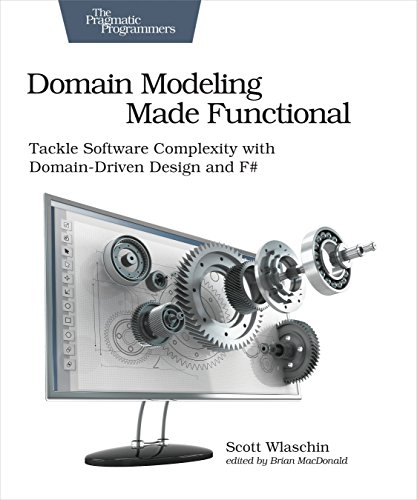
Scott Wlaschin, a recognized authority in F# and functional programming, authored this book to address the complexities software developers face when modeling domains. By merging domain-driven design principles with functional programming techniques, you learn to create software that mirrors real-world business requirements with clarity and precision, using F# as a practical example. The book guides you through encoding business rules directly into types, effectively turning the compiler into a safeguard against invalid states, and demonstrates how to compose small, testable functions into comprehensive domain models. This approach benefits software developers eager to improve domain accuracy, reduce bugs, and embrace a flexible, service-oriented architecture.
30-Day DDD Transformation

This personalized book offers a focused 30-day journey to applying Domain-Driven Design (DDD) principles and patterns tailored specifically to your background and goals. It explores foundational concepts such as ubiquitous language, bounded contexts, and aggregates, then progressively examines tactical patterns and strategic design choices. By matching your interests and experience, it reveals how to bridge theory with practice, guiding you through hands-on actions that develop deep domain insight and improve software alignment with business needs. This tailored approach ensures you focus on relevant topics and accelerate your mastery of DDD, avoiding generic or overwhelming content by concentrating on your unique learning path.
6. Domain-Driven Design with Java

Domain-Driven Design with Java - A Practitioner's Guide applies DDD across the software development life cycle, including lightweight modeling techniques. It covers the ubiquitous language, context maps, bounded contexts, aggregates and domain events, and it addresses cloud-native, event-driven microservices.
7. Patterns, Principles, and Practices of Domain-Driven Design

Patterns, Principles, and Practices of Domain-Driven Design is written for experienced developers building applications for complex domains. It uses C# code examples and covers tactical and strategic patterns, along with CQRS, Messaging, REST, Event Sourcing and Event-Driven Architectures.
Enjoying these picks?
The best Domain Driven Design books and more, in your inbox each week. No account needed.
Conclusion
These seven Domain Driven Design books converge on a few clear themes: bridging the gap between technical and business teams, applying tactical and strategic patterns to manage complexity, and adapting DDD principles to modern architectures and languages. If you're just starting out, "Learning Domain-Driven Design" offers a solid foundation linking software architecture with business strategy. For those ready to implement, pairing "Implementing Domain-Driven Design" with "Hands-On Domain Driven Design with .NET" or "Domain-Driven Design with Java" provides actionable guidance tailored to your technology stack.
For developers inclined towards functional programming, "Domain Modeling Made Functional" offers a fresh perspective integrating DDD with F#. Alternatively, if you're seeking a comprehensive, pattern-oriented approach, "Patterns, Principles, and Practices of Domain-Driven Design" rounds out your toolkit.
Alternatively, you can create a personalized Domain Driven Design book to bridge the gap between general principles and your specific situation. These books can help you accelerate your learning journey and deepen your impact in software design.
Frequently Asked Questions
I'm overwhelmed by choice – which book should I start with?
Start with "Learning Domain-Driven Design" by Vlad Khononov. It bridges software architecture and business strategy, providing a clear introduction that helps you grasp the core concepts before diving deeper.
Are these books too advanced for someone new to Domain Driven Design?
Not at all. While some books like Eric Evans' "Domain-Driven Design" dive deep, others such as Vlad Khononov's offer accessible entry points. You can build up your knowledge progressively.
What's the best order to read these books?
Begin with foundational theory in "Learning Domain-Driven Design" and Eric Evans' classic. Then explore practical implementation with Vaughn Vernon's and Alexey Zimarev's books, tailored to your tech stack.
Do these books focus more on theory or practical application?
They cover both. Evans' book emphasizes theory and modeling, while Vernon’s and Zimarev's works provide hands-on strategies. Choose based on whether you want conceptual depth or implementation tactics.
Can I skip some books or do I need to read them all?
You can pick based on your goals. For example, if you work in Java, focus on Chandrasekaran's book. For functional programming, Wlaschin’s is ideal. Quality matters more than quantity.
How can I get Domain Driven Design advice tailored specifically to my experience and projects?
While these expert books offer a strong foundation, personalized content can bridge general principles with your unique context. Consider creating a personalized Domain Driven Design book for targeted strategies and faster results.
Help fellow book lovers discover great books, share this curated list with others!
Related Articles You May Like
Explore more curated book recommendations