19 Learning Algorithms Books That Separate Experts from Amateurs
Recommended by Kirk Borne, Francois Chollet, and Alex Martelli for mastering Learning Algorithms
Updated on June 24, 2025·We may earn commissions for purchases made via this page
2 of 19 books have Audiobook versions
We're launchingLaunching on Product Hunt today 🎉We just launchedJust launched on Product Hunt 🎉
Modelpeers, from the BookAuthority teamFrom the BookAuthority team: Modelpeers, a free way to follow AI models and agents like you follow people. We'd love your support.
What if you could unlock the core of machine intelligence from some of the most trusted voices in the field? Learning algorithms are the engines behind AI's rapid evolution, yet mastering them requires more than just curiosity—it demands guidance from those who have shaped the discipline. Today, as these algorithms touch nearly every industry, understanding their nuances isn’t optional; it’s critical.
Consider Kirk Borne, Principal Data Scientist at Booz Allen Hamilton, who continuously highlights books like "Hands-On Machine Learning with Scikit-Learn, Keras, and TensorFlow" for their practical balance of theory and coding. Meanwhile, Francois Chollet, creator of Keras, praises works that blend conceptual clarity with hands-on examples, empowering Python developers to build effective deep learning models. Their endorsements echo a broader consensus: the right book can accelerate your learning from theory to application.
While these expert-curated books provide proven frameworks, readers seeking content tailored to their specific background, experience level, or industry focus might consider creating a personalized Learning Algorithms book that builds on these insights, delivering custom strategies and examples that fit your journey.
Kirk Borne, principal data scientist at Booz Allen and a top influencer in data science, highlights this book for its clear Jupyter notebooks covering fundamentals of machine learning and deep learning. His endorsement reflects his extensive experience in big data and AI, recommending it as a brilliant resource for those coding with Python and exploring TensorFlow and Keras. Mark Tabladillo, an Azure AI expert at Microsoft, also praises this book as an excellent starting point, noting each edition builds on previous strengths to deepen practical learning. Together, their insights emphasize the book’s value in transforming theoretical concepts into hands-on skills.
Aurélien Géron is a Machine Learning consultant. A former Googler, he led YouTube's video classification team from 2013 to 2016. He was also a founder and CTO of Wifirst from 2002 to 2012, a leading Wireless ISP in France, and a founder and CTO of Polyconseil in 2001, a telecom consulting firm. Before this he worked as an engineer in a variety of domains: finance (JP Morgan and Société Générale), defense (Canada’s DOD), and healthcare (blood transfusion). He published a few technical books (on C++, WiFi, and Internet architectures), and was a Computer Science lecturer in a French engineering school. A few fun facts: he taught his 3 children to count in binary with their fingers (up to 1023), he studied microbiology and evolutionary genetics before going into software engineering, and his parachute didn’t open on the 2nd jump.
When Aurélien Géron first realized how accessible machine learning could become with the right tools, he crafted this book to bridge theory and practice for programmers at any level. You dive into a range of techniques from linear regression to deep neural networks, using Python frameworks like Scikit-Learn, Keras, and TensorFlow to build intelligent systems. The chapters move you through models including support vector machines, ensemble methods, and transformers, with plenty of code examples and exercises to solidify your grasp. This book suits you if you want to go beyond concepts and actually implement machine learning projects, especially if you're comfortable with programming but new to AI.
Francois Chollet, the creator of Keras, brings a unique perspective to this book, valuing its approachable tone and balanced coverage of theory and practice. His endorsement highlights how the book serves as a very enjoyable introduction to machine learning for software developers, bridging conceptual understanding with practical coding examples. This endorsement carries weight given Chollet’s role in developing Keras, a key deep learning API featured in the book. Similarly, Alex Martelli, a Fellow of the Python Software Foundation, praises the book’s focus on practical implementations of neural networks and appreciates the clear, readable Python code that serves as a strong foundation for further customization and optimization in real projects.
“Approachable, well-written, with a great balance between theory and practice. A very enjoyable introduction to machine learning for software developers.”
Amita Kapoor taught and supervised research in neural networks and artificial intelligence for 20+ years as Associate Professor in SRCASW, University of Delhi. She now provides her expertise in AI and EduTech to various organizations and companies. Antonio Gulli has a passion for establishing and managing global technological talent for innovation and execution. His core expertise is in cloud computing, deep learning, and search engines. Currently, Antonio works for Google in the Cloud Office of the CTO in Zurich, working on Search, Cloud Infra, Sovereignty, and Conversational AI. Sujit Pal is a Technology Research Director at Elsevier Labs, an advanced technology group within the Reed-Elsevier Group of companies. His interests include semantic search, natural language processing, machine learning, and deep learning. At Elsevier, he has worked on several initiatives involving search quality measurement and improvement, image classification and duplicate detection, and annotation and ontology development for medical and scientific corpora.
Drawing from the combined decades of experience in neural networks, AI research, and cloud computing, the authors deliver a detailed guide to mastering TensorFlow and Keras for deep learning applications. You'll explore a broad spectrum of models, including convolutional neural networks, transformers, graph neural networks, and reinforcement learning, all illustrated with practical Python code that balances simplicity and depth. The book doesn’t just teach you how to build models; it also guides you through deploying them in diverse environments from cloud to mobile. Whether you're a Python developer or data scientist looking to deepen your hands-on skills in machine learning frameworks, this book offers a thorough pathway without assuming prior TensorFlow knowledge.
This AI-created book on learning algorithms is crafted based on your current knowledge and specific interests. You share which algorithms and applications matter most to you, your skill level, and your goals. The result is a custom book focused on the areas you want to master, avoiding one-size-fits-all content. It’s designed to help you move efficiently through complex topics with tailored explanations and examples that suit your learning journey.
TailoredRead AI creates personalized nonfiction books that adapt to your unique background, goals, and interests. Instead of reading generic content, you get a custom book written specifically for your profession, experience level, and learning objectives. Whether you're a beginner looking for fundamentals or an expert seeking advanced insights, TailoredRead crafts a book that speaks directly to you. Learn more.
This tailored book explores core learning algorithms with a focus matched precisely to your background and goals. It reveals fundamental concepts, common applications, and nuanced algorithmic behaviors, providing a clear path through complex material. By concentrating on your interests, it offers a personalized examination of supervised, unsupervised, and reinforcement learning techniques. You’ll gain insight into algorithmic strengths and limitations, practical implementation considerations, and how these algorithms interconnect in real-world scenarios. This approach helps you navigate advanced topics without unnecessary detours, making the learning process engaging and efficient.
Pratham Prasoon, a self-taught programmer deeply involved with modular blockchains and machine learning, found this book indispensable during a demanding research internship. He highlights how it offers clear, concise theory paired with practical insights into both classical and deep learning methods. "This book was a lifesaver during my research internship! You'll learn about deep and classical machine learning with great to-the-point theory explanations," he shares. Alongside Santiago, who praises its depth and substantial content across 530 pages, these endorsements underline the book’s value for those ready to move beyond basics into serious machine learning development with Python.
“Last but not least, we have Machine Learning with PyTorch and Scikit-Learn. This book was a lifesaver during my research internship! You'll learn about deep and classical machine learning with great to-the-point theory explanations. Suitable for slightly more advanced readers.” (from X)
Sebastian Raschka, Yuxi (Hayden) Liu, Vahid Mirjalili(you?)·
About the Author
Sebastian Raschka is an Assistant Professor of Statistics at the University of Wisconsin-Madison focusing on machine learning and deep learning research. As Lead AI Educator at Grid AI, Sebastian plans to continue following his passion for helping people get into machine learning and artificial intelligence. Yuxi (Hayden) Liu is a Software Engineer, Machine Learning at Google. He is developing and improving machine learning models and systems for ads optimization on the largest search engine in the world. Vahid Mirjalili is a deep learning researcher focusing on CV applications. Vahid received a Ph.D. degree in both Mechanical Engineering and Computer Science from Michigan State University.
After years teaching and researching at the University of Wisconsin-Madison, Sebastian Raschka teamed with machine learning engineers Yuxi Liu and Vahid Mirjalili to create a detailed guide that bridges theory with practical Python implementations. You’ll gain hands-on skills in building models using PyTorch and scikit-learn, exploring everything from classical classifiers to deep learning architectures like transformers and graph neural networks. The book dives into data preprocessing, model evaluation, and advanced topics such as GANs and reinforcement learning, making it ideal if you want a thorough understanding of how to develop and tune machine learning systems yourself. If you’re comfortable with Python and math basics, this book will deepen your expertise rather than just skim concepts.
Kirk Borne, Principal Data Scientist at Booz Allen Hamilton and a leading voice in data science, highlights this book as a go-to resource for mastering machine learning in a condensed timeframe. Reflecting on his extensive experience in big data and AI, Borne points to this book's clear tutorials and Python-centered approach as invaluable for those eager to upskill quickly. He calls it a must-see for anyone serious about Python coding in machine learning. Complementing this, Sebastian Thrun, CEO of Kitty Hawk Corporation and co-founder of Udacity, praises the book's hands-on nature and comprehensive scope, recommending it to anyone aiming to deepen their practical expertise. Together, their endorsements underscore the book's balance of theory and practice, making it a cornerstone for your machine learning journey.
Sebastian Raschka is an Assistant Professor of Statistics at the University of Wisconsin-Madison focusing on machine learning and deep learning research. Some of his recent research methods have been applied to solving problems in the field of biometrics for imparting privacy to face images. Other research focus areas include the development of methods related to model evaluation in machine learning, deep learning for ordinal targets, and applications of machine learning to computational biology. Vahid Mirjalili obtained his Ph.D. in mechanical engineering working on novel methods for large-scale, computational simulations of molecular structures. Currently, he is focusing his research efforts on applications of machine learning in various computer vision projects at the Department of Computer Science and Engineering at Michigan State University. He recently joined 3M Company as a research scientist, where he uses his expertise and applies state-of-the-art machine learning and deep learning techniques to solve real-world problems in various applications to make life better.
What started as a deep dive by Sebastian Raschka, an assistant professor with a focus on machine learning and biometrics, and Vahid Mirjalili, a mechanical engineer turned computer vision researcher, became a practical yet theoretically grounded resource. This book teaches you to harness Python’s scikit-learn and TensorFlow 2 to build and fine-tune models ranging from simple classifiers to complex GANs and reinforcement learning agents. You’ll learn not just to run code but to understand model evaluation, hyperparameter tuning, and sentiment analysis techniques, with chapters dedicated to embedding models into web applications and handling unlabeled data. If you’re a Python developer or data scientist committed to mastering machine learning’s evolving toolkit, this book offers the depth and examples to advance your skills.
Dj Patil, former U.S. Chief Data Scientist, highlights this book’s practical edge, urging you to get it because Chris Albon himself is modest about promotion. Patil appreciates how it builds on Albon’s well-known flash cards, making it a strong start for anyone diving into machine learning with Python. This endorsement comes from someone who’s shaped national data science policy, underscoring the book’s relevance and utility. Additionally, Kirk Borne, Principal Data Scientist at Booz Allen, points to this as an essential resource in Python data science, reinforcing its status among experts.
“Because Chris Albon is too humble to promote his book, I'm going to step in and say you should really go out and get it. Built on top of his awesome flash cards, it's a great way to get going on machine learning.” (from X)
Chris Albon is a data scientist with a Ph.D. in quantitative political science and a decade of experience working in statistical learning, artificial intelligence, and software engineering. He founded New Knowledge, an artificial intelligence company, and previously worked for the crisis and humanitarian non-profit, Ushahidi. Chris also founded and co-hosts the data science podcast, Partially Derivative.
When Chris Albon decided to write this book, his decade of experience in data science and AI shaped a resource that goes beyond theory to hands-on solutions. You’ll find nearly 200 self-contained Python recipes addressing common machine learning challenges like data preprocessing, model selection, and feature extraction, with ready-to-run code snippets you can adapt immediately. The chapters on handling text, images, and numerical data stand out, making it easier to tackle diverse datasets. If you work regularly with Python libraries like pandas or scikit-learn and want concrete tools rather than abstract concepts, this book speaks directly to your daily needs.
This AI-created book on learning algorithms is designed based on your background, experience, and specific goals in mastering algorithmic skills. You share what aspects of learning algorithms you want to focus on and your current level, and the book is crafted to match exactly what you need to progress rapidly. By focusing on daily, actionable steps, this personalized AI book helps you bridge expert knowledge with your personal learning journey, making complex concepts approachable and practical.
TailoredRead AI creates personalized nonfiction books that adapt to your unique background, goals, and interests. Instead of reading generic content, you get a custom book written specifically for your profession, experience level, and learning objectives. Whether you're a beginner looking for fundamentals or an expert seeking advanced insights, TailoredRead crafts a book that speaks directly to you. Learn more.
This tailored book explores the core principles and practical applications of learning algorithms through a focused, daily approach designed to match your background and interests. It covers foundational concepts, algorithmic techniques, and hands-on examples that bring complex ideas into clear focus. By tailoring content specifically to your goals and skill level, the book reveals a personalized pathway that accelerates the acquisition of vital skills in learning algorithms. Each chapter builds progressively, ensuring you grasp key lessons while applying them effectively in real-world scenarios. This personalized guide bridges expert knowledge with your unique learning needs, making advanced algorithms accessible and actionable.
Miguel Morales is a Senior Staff Research Engineer at Lockheed Martin and a faculty member at Georgia Institute of Technology, where he teaches advanced reinforcement learning courses. His deep industry experience and academic involvement uniquely position him to guide you through building deep reinforcement learning systems. This book reflects his commitment to clear instruction and practical exercises, making complex algorithms accessible to developers ready to expand their skillset.
Miguel Morales is a Senior Staff Research Engineer at Lockheed Martin, Aeronautics-Advanced Development Programs (Skunk Works). He is also a faculty member at Georgia Institute of Technology where he works as an Instructional Associate for the Reinforcement Learning and Decision Making graduate course. Miguel has worked for numerous other educational and technology companies including Udacity, AT&T, Cisco, and HPE.
Drawing from his extensive experience at Lockheed Martin and as an instructor at Georgia Tech, Miguel Morales offers a hands-on approach to mastering deep reinforcement learning. You’ll gain practical skills by working through annotated Python code and exercises that clarify complex concepts like evaluative feedback and agent behavior improvement. For example, chapters on value-based methods and actor-critic algorithms walk you through how to balance immediate versus long-term rewards in learning agents. This book suits developers familiar with deep learning who want to expand into reinforcement learning and build their own intelligent systems.
Bernhard Scholkopf, director at the Max Planck Institute for Intelligent Systems, found this book invaluable for its rare combination of rigorous theory and practical machine learning methods. He highlights that "This elegant book covers both rigorous theory and practical methods of machine learning. This makes it a rather unique resource, ideal for all those who want to understand how to find structure in data." Scholkopf appreciates how the book deepened his understanding of underlying data structures. Similarly, Avrim Blum, a professor at Carnegie Mellon University, praises its breadth and depth, noting it blends rigorous mathematics with insightful intuition, making it a key reference for those exploring learning algorithms' foundations.
Director at Max Planck Institute for Intelligent Systems
“This elegant book covers both rigorous theory and practical methods of machine learning. This makes it a rather unique resource, ideal for all those who want to understand how to find structure in data.”
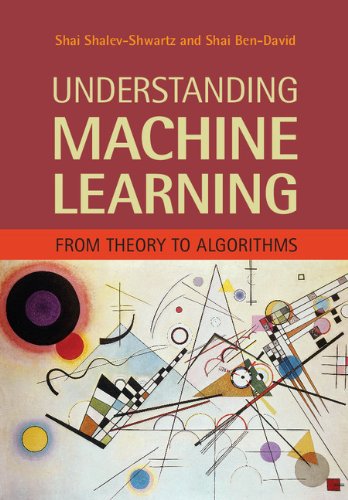
Shai Shalev-Shwartz is an Associate Professor at the School of Computer Science and Engineering at the Hebrew University of Jerusalem, Israel. He has made significant contributions to the field of machine learning, focusing on the theoretical foundations and algorithmic approaches that underpin this rapidly evolving discipline.
Shai Shalev-Shwartz's experience as an associate professor deeply informs this textbook, which rigorously bridges machine learning theory with algorithmic practice. You learn not only foundational concepts like convexity and stability, but also advanced topics such as the PAC-Bayes approach and compression-based bounds, giving you a thorough mathematical grounding. The text walks you through key algorithmic paradigms including stochastic gradient descent and neural networks, supported by detailed derivations that clarify how theory translates into code. If you're tackling machine learning from a computational or statistical perspective, this book equips you with the tools to understand and implement diverse algorithms with confidence. However, casual readers without some technical background may find its depth challenging but rewarding.
Kirk Borne, principal data scientist at Booz Allen and PhD astrophysicist, recommends this 1100-page tome for anyone serious about machine learning. He highlights its depth across 28 chapters covering big data, statistics, and deep learning, praising the clarity and breadth of the probabilistic approach. This book helped him deepen his understanding of statistical literacy and algorithmic foundations, reshaping how he approaches complex data science challenges. Adam Gabriel Top Influencer, an AI expert at IBM Watson, also endorses the book, emphasizing its comprehensive treatment of machine learning fundamentals and advanced topics.
Kevin Patrick Murphy was born in Ireland, grew up in England (BA from Cambridge), and went to graduate school in the USA (MEng from U. Penn, PhD from UC Berkeley, Postdoc at MIT). In 2004, he became a professor of computer science and statistics at the University of British Columbia in Vancouver, Canada. In 2011, he went to Google in Mountain View, California for his sabbatical. In 2012, he converted to a full-time research scientist position at Google. Kevin has published over 50 papers in refereed conferences and journals related to machine learning and graphical models. He has recently published an 1100-page textbook called 'Machine Learning: a Probabilistic Perspective' (MIT Press, 2012).
Kevin P. Murphy, a computer scientist and statistician with deep roots at institutions like UC Berkeley and Google, crafted this book to unify machine learning through a probabilistic lens. You’ll gain a solid grasp of core concepts like probabilistic models, inference, and graphical models, all presented alongside practical pseudo-code and vibrant examples from fields such as robotics and biology. The book doesn’t just list algorithms—it explains why they work, emphasizing a principled approach that connects theory with application. If you’re comfortable with college-level math and want to move beyond heuristic methods to a more rigorous understanding, this book offers a dense but rewarding path.
Kirk Borne, Principal Data Scientist at Booz Allen and a leading voice in data science, highlights how this book illuminates why machine learning engineering is crucial today, emphasizing its role beyond traditional development or data science. His endorsement stems from witnessing the book's clear explanation of building intelligent systems that handle vast user interactions effectively. This perspective helped him appreciate the distinct challenges and impact of machine learning roles. Alongside him, Adam Gabriel, an AI expert and machine learning engineer, echoes the value of this guide, reinforcing its relevance to professionals passionate about deep learning and AI engineering.
“@AlisonDeNisco Why #MachineLearning Engineer is the best job in America, not developer or #DataScientist: by @macybayern #BigData #DataScience #DeepLearning #AI #DataEngineering” (from X)
Geoff Hulten is a Machine Learning Scientist with a PhD in machine learning. He has managed applied machine learning teams for over a decade, building Internet-scale Intelligent Systems with hundreds of millions of user interactions per day.
Geoff Hulten draws on over a decade of experience managing applied machine learning teams to guide you through building Intelligent Systems that learn and improve from massive user interaction data. This book breaks down how to design, implement, and orchestrate these systems end to end, integrating software engineering, data science, and management skills. You’ll explore concrete topics like crafting intelligent user experiences and measuring system performance, with insights into applying machine learning approaches in real-world, large-scale environments. If you’re a software engineer, machine learning practitioner, or technical manager aiming to develop impactful intelligent systems, this book offers a grounded framework without fluff.
Kirk Borne, Principal Data Scientist at BoozAllen and a leading voice in data science, recommended this book as a valuable resource for data scientist interviews. His extensive expertise in machine learning and algorithms lends weight to his endorsement, highlighting the book's relevance beyond pure programming contests. Borne's insight underscores how mastering competitive programming techniques can sharpen your algorithmic thinking, a skill crucial in data science roles.
Dr. Antti Laaksonen has worked as a teacher and researcher at the University of Helsinki and Aalto University, Finland. He has served as one of the organizers of the Finnish Olympiad in Informatics since 2008, and as the Scientific Chair of the Baltic Olympiad in Informatics in 2016. He has also coached and led the Finnish team at several international programming contests, including the International Olympiad in Informatics 2009–2016, and has established experience in teaching programming and algorithms.
Dr. Antti Laaksonen draws from his extensive experience coaching Finland's top programming teams to deliver a guide that blends algorithm theory with competitive contest practice. You'll explore a broad range of algorithmic techniques, from dynamic programming to graph flows and advanced string algorithms, all contextualized through competitive programming challenges. The book balances foundational skills with deep dives into topics like automata and Fourier transforms, making it suitable whether you're new to algorithms or seeking to sharpen contest performance. If you're aiming to build computational thinking alongside programming agility, this book offers a clear path, though its contest focus means it's less about pure theory and more about practical application.
Zachary Lipton, assistant professor at Carnegie Mellon University and machine learning expert, highlights this book for its thorough treatment of bandit algorithms and causality in reinforcement learning. His endorsement reflects his deep engagement with foundational AI techniques and causal inference, areas critical for advancing machine learning research. Lipton’s recommendation points to the book’s value in providing both theoretical insights and practical understanding, making it a pivotal resource for those immersed in AI who want to deepen their mastery of reinforcement learning methods.
“@innerproduct 1. Tor Lattimore
Great book work on bandits ( and work on causality + bandits (
2. Caroline Uhler — Interesting work on causal inference + discovery, causal inference under measurement error etc (” (from X)
Richard S. Sutton is Professor of Computing Science and AITF Chair in Reinforcement Learning and Artificial Intelligence at the University of Alberta, and also Distinguished Research Scientist at DeepMind. Andrew G. Barto is Professor Emeritus in the College of Computer and Information Sciences at the University of Massachusetts Amherst.
Drawing from their deep expertise in artificial intelligence, Richard Sutton and Andrew Barto crafted this second edition to address the rapidly evolving field of reinforcement learning. You get a detailed exploration of core algorithms like UCB, Expected Sarsa, and Double Learning, alongside new insights into function approximation with neural networks and policy-gradient methods. Chapters extend beyond theory, connecting reinforcement learning to psychology and neuroscience, and showcasing practical case studies such as AlphaGo and IBM Watson. This book serves those who want a rigorous yet accessible understanding of reinforcement learning’s algorithms and applications, especially if you have some background in machine learning.
Francesco Marconi, R&D Chief at The Wall Street Journal, highlights the rising importance of Python in machine learning development, especially in building tools for journalism. He recommends this book as an excellent starting point, underscoring how it helped him appreciate Python’s momentum and practical applications in machine learning. "Top programming languages ranked by its annual search engine popularity. Python has gained momentum because of its importance to machine learning development. At The Wall Street Journal we are using it to build tools for journalists. Tip: this is a great book for anyone who wants to get started!" This endorsement reflects how the book bridges the gap between programming and real-world machine learning use cases.
“Top programming languages ranked by its annual search engine popularity. Python has gained momentum because of its importance to machine learning development. At The Wall Street Journal we are using it to build tools for journalists. Tip: this is a great book for anyone who wants to get started!” (from X)
Andreas Müller received his PhD in machine learning from the University of Bonn. After working as a machine learning researcher on computer vision applications at Amazon for a year, he recently joined the Center for Data Science at New York University. In the last four years, he has been maintainer and one of the core contributors of scikit-learn, a machine learning toolkit widely used in industry and academia, and author and contributor to several other widely used machine learning packages. His mission is to create open tools to lower the barrier of entry for machine learning applications, promote reproducible science and democratize the access to high-quality machine learning algorithms.
Drawing from his extensive background as a machine learning researcher and core contributor to the scikit-learn library, Andreas C. Müller crafted this guide to make machine learning accessible to Python users beyond just experts. You’ll learn how to implement machine learning algorithms practically, focusing on data representation, model evaluation, and pipeline construction, rather than abstract mathematics. For example, the chapters on text-specific processing techniques and parameter tuning offer concrete methods you can apply immediately. If you work with Python and want to build your own machine learning applications with a strong foundation, this book aligns well with your goals.
Kirk Borne, Principal Data Scientist at BoozAllen and a PhD Astrophysicist, brings significant authority to his endorsement of this book. Known for his influence in data science and big data, Kirk recently shared his enthusiasm: "New book, I now have my copy and I love it! 'Mastering Machine Learning Algorithms' (Second Edition) by Giuseppe Bonaccorso." His recommendation reflects the book’s practical value in navigating complex machine learning topics with Python and deep learning, making it a trusted guide for professionals aiming to deepen their expertise.
Principal Data Scientist at BoozAllen, PhD Astrophysicist
“New book, I now have my copy and I love it! "Mastering Machine Learning Algorithms" (Second Edition) by Giuseppe Bonaccorso is an excellent resource covering Python, Deep Learning, AI, and Big Data.” (from X)
Giuseppe Bonaccorso is Head of Data Science in a large multinational company. He received his M.Sc.Eng. in Electronics in 2005 from University of Catania, Italy, and continued his studies at University of Rome Tor Vergata, and University of Essex, UK. His main interests include machine/deep learning, reinforcement learning, big data, and bio-inspired adaptive systems. He is author of several publications including Machine Learning Algorithms and Hands-On Unsupervised Learning with Python, published by Packt.
The breakthrough moment came when Giuseppe Bonaccorso, drawing from his extensive experience as Head of Data Science at a multinational firm, developed an updated guide that dives deep into the core algorithms powering modern machine learning. You'll explore a wide range of models, from Bayesian networks to deep neural networks, with practical Python examples using libraries like scikit-learn and TensorFlow 2.x. The book takes you through advanced topics like semi-supervised learning, time series regression, and reinforcement learning, making it ideal if you want to build a solid grasp of algorithm fundamentals and their applications. If you're comfortable with Python and looking to tackle complex machine learning challenges, this book offers a detailed path without fluff.
Alex Martelli, Fellow of the Python Software Foundation, values practical learning approaches for mastering machine learning. He recommends "Python Machine Learning by Example, Third Edition is ideal for those who learn best by doing. I think for the ML beginner, this book may be a better starting point than one with much more about theory and less focus on the practical aspects of ML." This endorsement highlights how the book bridges theoretical gaps through hands-on examples, making complex topics accessible and directly applicable.
“Python Machine Learning by Example, Third Edition is ideal for those who learn best by doing. I think for the ML beginner, this book may be a better starting point than one with much more about theory and less focus on the practical aspects of ML.”
Yuxi (Hayden) Liu was a Machine Learning Software Engineer at Google. With a wealth of experience from his tenure as a machine learning scientist, he has applied his expertise across data-driven domains and applied his ML expertise in computational advertising, cybersecurity, and information retrieval. He is the author of a series of influential machine learning books and an education enthusiast. His debut book, also the first edition of Python Machine Learning by Example, ranked the #1 bestseller in Amazon and has been translated into many different languages.
What sets this book apart is Yuxi (Hayden) Liu's blend of hands-on engineering experience from Google with a clear focus on practical machine learning implementation. You’ll get more than theory here: specific guidance on building and fine-tuning models like neural networks, transformers, and computer vision applications using PyTorch and TensorFlow. Chapters such as the one on natural language processing transformers and another dedicated to best practices give concrete examples that sharpen your skills. This book suits you if you want to go beyond basics and apply advanced techniques to real-world data challenges with Python.
Oliver Theobald, based in Tokyo, is an experienced technical writer who’s contributed to companies like TikTok for Business, Alibaba Cloud, and Ant Finance. His bestselling machine learning series for novices breaks down complex AI and data concepts into plain English, aiming to help non-technical readers grasp the essentials of machine learning, Python, and statistics through clear explanations and engaging examples.
Oliver Theobald, based in Tokyo, is an experienced technical writer specializing in the technology sector, with full-time experience at TikTok for Business, Alibaba Cloud, and Ant Finance, and freelancer experience with Qualcomm and Hitachi. His bestselling machine learning book series for absolute beginners has helped thousands of readers from non-technical backgrounds grasp core concepts in machine learning, AI, Python, data analytics, and statistics through engaging and accessible explanations written in plain English.
Oliver Theobald, drawing from his extensive experience writing for tech giants like TikTok for Business and Alibaba Cloud, crafted this book to demystify machine learning for those without a programming background. You’ll explore foundational concepts like data scrubbing, regression analysis, k-means clustering, and decision trees, all explained in plain English with visual aids and practical Python examples in later chapters. The book specifically guides you through building your first machine learning model to predict house values, making abstract ideas tangible. If you're just stepping into AI and machine learning, this book offers a gentle but clear introduction, though those with prior coding experience might find it elementary.
Pedro Domingos, a professor of computer science at the University of Washington and winner of the SIGKDD Innovation Award, brings authoritative expertise to this exploration of machine learning. His research standing and AI fellowship underpin his insightful examination of the "Master Algorithm" concept. Domingos' background equips him to guide you through the complexities of learning machines that influence major technology companies, enriching your understanding of their future potential.
Pedro Domingos is a professor of computer science at the University of Washington. He is a winner of the SIGKDD Innovation Award, the highest honor in data science. A fellow of the Association for the Advancement of Artificial Intelligence, he lives near Seattle.
Pedro Domingos, a University of Washington computer science professor and recipient of the SIGKDD Innovation Award, offers a deep dive into the quest for a universal learning algorithm. You explore the foundations and differences between five major machine learning paradigms, gaining insight into how these approaches power technologies from Google to Amazon. The book outlines the concept of a "Master Algorithm"—a single learner that could unify all patterns of knowledge discovery—while considering the societal impacts of such advancements. This is ideal if you seek to understand the core methods behind modern machine learning and their potential future convergence, rather than just surface-level applications.
John D. Kelleher, Academic Leader at Technological University Dublin and author of several MIT Press titles, brings deep academic expertise to this book. His role leading the Information, Communication, and Entertainment Research Institute informs the practical focus on predictive data analytics. This background ensures the book offers both theoretical rigor and accessible insights, making it a solid choice for those aiming to master machine learning applications in business contexts.
John D. Kelleher, Brian Mac Namee, Aoife D'Arcy(you?)·
About the Author
John D. Kelleher is Academic Leader of the Information, Communication, and Entertainment Research Institute at Technological University Dublin. He is the coauthor of Data Science and the author of Deep Learning, both in the MIT Press Essential Knowledge series.
Unlike most machine learning books that dive into theory alone, this volume bridges the gap between mathematical foundations and practical applications in predictive data analytics. John D. Kelleher and his coauthors guide you through core algorithms, reinforced by worked examples and detailed case studies that illustrate real-world business challenges, such as risk assessment and customer behavior prediction. The addition of new chapters on deep learning, unsupervised learning, and reinforcement learning expands your toolkit beyond traditional predictive models. If you seek a resource that balances accessible explanation with technical depth, especially useful for applying learning algorithms in industry contexts, this book fits well; however, it might be dense for casual readers or those outside of data science fields.
Tarek Amr brings eight years of data science and machine learning experience to this practical guide, drawing from his postgraduate studies at the University of East Anglia and roles in startups across Egypt and the Netherlands. His deep knowledge of machine learning and passion for explaining complex computer science concepts shine through, making this book a valuable resource for anyone ready to implement supervised and unsupervised algorithms using Python's scientific toolkits. Amr’s approachable style invites you to engage directly with machine learning challenges, backed by his hands-on expertise and clear communication.
Tarek Amr has 8 years of experience in data science and machine learning. After finishing his postgraduate degree at the University of East Anglia, he worked in a number of startups and scale-up companies in Egypt and the Netherlands. This is his second data-related book. His previous book covered data visualization using D3.js. He enjoys giving talks and writing about different computer science and business concepts and explaining them to a wider audience. He can be reached on Twitter at @gr33ndata. He is happy to respond to all questions related to this book. Feel free to get in touch with him if any parts of the book need clarification or if you would like to discuss any of the concepts here in more detail.
The breakthrough moment came when Tarek Amr distilled his extensive experience across startups and scale-ups into this hands-on manual for machine learning with Python. You’ll move beyond theory to applying scikit-learn alongside essential Python toolkits like NumPy and pandas, tackling real data challenges such as imbalanced datasets and model deployment. The book methodically walks you through algorithms ranging from instance-based to neural networks, showing not just how they work but when to use them, with clear examples in each chapter. If you're comfortable with Python and want to deepen your practical and theoretical grasp of supervised and unsupervised learning, this book offers a solid, focused path without fluff or unnecessary jargon.
Brett Lantz, a sociologist turned data scientist with over 10 years' experience, wrote this book after discovering machine learning’s potential while analyzing social network data. As a DataCamp instructor and speaker at global machine learning events, Brett combines practical coding know-how with deep domain insight, making this edition a solid bridge between theory and hands-on application in R.
Brett Lantz (DataSpelunking) has spent more than 10 years using innovative data methods to understand human behavior. A sociologist by training, Brett was first captivated by machine learning during research on a large database of teenagers' social network profiles. Brett is a DataCamp instructor and a frequent speaker at machine learning conferences and workshops around the world. He is known to geek out about data science applications for sports, autonomous vehicles, foreign language learning, and fashion, among many other subjects, and hopes to one day blog about these subjects at Data Spelunking, a website dedicated to sharing knowledge about the search for insight in data.
Brett Lantz brings a distinct perspective to machine learning by blending his sociological background with over a decade of experience in data science. You’ll explore how to harness R and the tidyverse for data preparation, visualization, and complex model building without needing prior R expertise. This book walks you through classification methods like nearest neighbor and Naive Bayes, dives into neural networks, support vector machines, and tackles big data challenges using Spark and Hadoop. If you want to deepen your grasp on model evaluation and ensemble techniques, especially from a practical coding standpoint, this resource offers clear guidance. It’s best suited for data scientists and analysts ready to strengthen their machine learning toolset with R’s ecosystem.
The best Learning Algorithms books and more, in your inbox each week. No account needed.
Conclusion
Together, these 19 books weave a rich tapestry of learning algorithms knowledge—from foundational theory to practical implementation and cutting-edge reinforcement learning. If you're just starting out, titles like "Introduction to Machine Learning with Python" and "Machine Learning for Absolute Beginners" offer a gentle yet thorough launchpad. For those ready to dive deeper, "Understanding Machine Learning" and "Mastering Machine Learning Algorithms" provide the rigor and detail needed to elevate your expertise.
For practical application, combining "Hands-On Machine Learning with Scikit-Learn, Keras, and TensorFlow" with "Machine Learning with Python Cookbook" can fast-track your coding capabilities. Meanwhile, if your focus is on building scalable intelligent systems, "Building Intelligent Systems" offers indispensable insights.
Alternatively, you can create a personalized Learning Algorithms book to bridge the gap between general principles and your specific situation. These books, and tailored reading options, can help you accelerate your learning journey and distinguish yourself in the evolving landscape of machine learning.
Frequently Asked Questions
I'm overwhelmed by choice – which book should I start with?
Starting with "Introduction to Machine Learning with Python" offers a gentle introduction, especially if you have Python experience. For absolute beginners, "Machine Learning for Absolute Beginners" breaks down concepts in plain English. These books prepare you well before tackling more advanced titles.
Are these books too advanced for someone new to Learning Algorithms?
Not at all. Several books like "Machine Learning for Absolute Beginners" and "Introduction to Machine Learning with Python" are designed for newcomers. They build foundational knowledge that makes advanced books more accessible later on.
Which books focus more on theory vs. practical application?
"Understanding Machine Learning" dives deep into theory and algorithmic foundations, while "Hands-On Machine Learning with Scikit-Learn, Keras, and TensorFlow" emphasizes practical coding and implementation. Choose based on whether you want conceptual depth or hands-on skills.
Are any of these books outdated given how fast Learning Algorithms changes?
Most books listed have recent editions or are timeless classics. For example, "Hands-On Machine Learning with Scikit-Learn, Keras, and TensorFlow" is in its 3rd edition (2022), ensuring up-to-date content aligned with current tools and techniques.
How do I know if a book is actually worth my time?
Look at endorsements from experts like Kirk Borne, Francois Chollet, and Alex Martelli who have vetted these books. Their practical experience and deep knowledge validate the books' relevance and quality.
Can I get a Learning Algorithms book tailored to my specific goals and experience?
Yes! While these expert books provide solid frameworks, you can also create a personalized Learning Algorithms book that matches your background, focus areas, and pace, blending expert knowledge with your unique needs.
📚 Love this book list?
Help fellow book lovers discover great books, share this curated list with others!