"Fundamentals of Nuclear Science and Engineering" by J. Kenneth Shultis, Richard E. Faw made it to BookAuthority's Best Nuclear Chemistry Audiobooks of All Time!
Chris Anderson, James Fallows, and John Hofmeister recommend these Nuclear Chemistry books for serious learners and professionals.
Updated on June 24, 2025·We may earn commissions for purchases made via this page
0 of 7 books have Audiobook versions
We're launchingLaunching on Product Hunt today 🎉We just launchedJust launched on Product Hunt 🎉
Modelpeers, from the BookAuthority teamFrom the BookAuthority team: Modelpeers, a free way to follow AI models and agents like you follow people. We'd love your support.
What if the key to unlocking cleaner, safer energy lies in understanding the intricate world of nuclear chemistry? As global energy demands soar and environmental concerns mount, nuclear chemistry stands at a crucial crossroads. It’s not just about atoms and reactions; it’s about shaping the future of energy and technology in a way that could redefine global sustainability.
Chris Anderson, the CEO of 3DRobotics and former Wired editor, unearthed the overlooked potential of thorium in "SuperFuel," revealing a promising alternative to uranium that could transform energy security. James Fallows, an accomplished author and former White House speechwriter, praises the clarity and engaging approach of these works, emphasizing their vital relevance to energy and climate policy. Meanwhile, John Hofmeister, author of "Why We Hate the Oil Companies," highlights how understanding nuclear chemistry is essential to navigating the complex energy landscape today.
While these expert-curated books provide proven frameworks and deep knowledge, readers seeking content tailored to their specific background, skill level, or nuclear chemistry interests might consider creating a personalized Nuclear Chemistry book that builds on these insights for a focused learning experience.
Chris Anderson, CEO of 3DRobotics and former Wired editor, highlights this book as a revival of a vital but forgotten technology. He calls it a "fascinating and important biography of thorium" that brings hope to energy and climate discussions. Anderson’s extensive background in technology and innovation lends weight to his endorsement, especially as he navigated energy challenges in his ventures. Alongside him, James Fallows, author and former White House speechwriter, praises Richard Martin’s clear, engaging style in tackling a complex subject that has major implications for energy security and climate change. Their combined perspectives underscore the book’s relevance for anyone interested in the future of clean energy and nuclear chemistry.
“Bringing back to light a long-lost technology that should never have been lost, this fascinating and important biography of thorium also brings us a commodity that's rare in discussions of energy and climate change: hope.”
Richard Martin is an award-winning science writer whose work has appeared in Wired, Time, Fortune, The Atlantic, and The Best Science Writing of 2004. He is the author of SuperFuel: Thorium, the Green Energy Source for the Future. He is the editorial director of Pike Research, a leading clean energy firm. He lives in Boulder, Colorado.
Richard Martin, a seasoned science writer and editorial director at Pike Research, explores the overlooked promise of thorium as a nuclear fuel alternative. You’ll gain a nuanced understanding of thorium's advantages over uranium, such as its abundance and reduced weaponization risk, alongside the geopolitical and scientific reasons it was sidelined during the Cold War. The book walks you through the technical basics and the historical context, including profiles of advocates working to revive thorium-based energy. If you want to grasp a potential future energy source beyond the usual nuclear debate, Martin’s thorough yet readable narrative offers valuable insights, though it’s best suited for those with some background in energy issues or nuclear science.
J. Kenneth Shultis, a distinguished professor of Mechanical & Nuclear Engineering at Kansas State University and recipient of the Rockwell Lifetime Achievement Award, authored this text drawing on his extensive academic and research background. His academic journey through top institutions and fellowship in the American Nuclear Society position him uniquely to present nuclear science with clarity and authority. This book reflects his commitment to educating future engineers, offering updated insights into nuclear reactor designs and radiation safety, making it a reliable resource for those pursuing careers in nuclear science.
J. Kenneth Shultis is a professor of Mechanical & Nuclear Engineering at Kansas State University in Manhattan, Kansas, where he holds the Black and Veatch Distinguished Professorship. Dr. Shultis received his BASC degree from the University of Toronto, and his MS and PhD degrees in Nuclear Science and Engineering from the University of Michigan. Prior to joining the faculty at Kansas State University he spent a year at the Mathematics Institute of the University of Groningen, the Netherlands. He is the author of five books in the areas of radiation protection and nuclear science and engineering, a Fellow of the American Nuclear Society, and recipient of the ASC’s Rockwell Lifetime Achievement Award.
J. Kenneth Shultis and Richard E. Faw bring decades of nuclear engineering expertise to this textbook, aiming to demystify complex nuclear science concepts for students and professionals alike. You’ll explore nuclear physics fundamentals, reactor design, radiation detection, and the latest advances like fusion reactors, with clear examples and updated chapters on health risks and reactor physics. This book is tailored for nuclear engineering majors but remains accessible to learners in related fields seeking a solid grounding. The inclusion of a solutions manual and lecture slides further supports educators and self-learners who want to deepen their understanding of nuclear phenomena.
This AI-created book on nuclear chemistry is crafted based on your background, skill level, and specific interests in the field. You share which aspects you want to explore—whether foundational concepts or advanced applications—and your goals for mastering the subject. The book then focuses on delivering content that matches your experience and learning objectives, making your path through nuclear chemistry more efficient and meaningful.
TailoredRead AI creates personalized nonfiction books that adapt to your unique background, goals, and interests. Instead of reading generic content, you get a custom book written specifically for your profession, experience level, and learning objectives. Whether you're a beginner looking for fundamentals or an expert seeking advanced insights, TailoredRead crafts a book that speaks directly to you. Learn more.
This tailored book explores nuclear chemistry in a way that matches your unique background and learning goals. It covers fundamental principles—from atomic structure to nuclear reactions—while delving into advanced topics like radioactive decay and nuclear energy applications. The content is carefully tailored to focus on what interests you most, making complex ideas accessible without oversimplification.
By synthesizing core knowledge and current scientific concepts, this book provides a personalized pathway through the intricacies of nuclear chemistry. It reveals connections between theory and practice, helping you grasp essential mechanisms and their implications in energy, medicine, and research.
Elmer E. Lewis Ph.D. is a recognized expert in nuclear engineering, with extensive experience in the design and operation of nuclear reactors. His work focuses on applying nuclear physics principles to solve engineering challenges, making him a valuable resource for students and professionals. This book reflects his authoritative background and aims to provide a clear, application-driven understanding of how nuclear reactors function, why neutron behavior matters, and how safety and efficiency are achieved in practice.
Elmer E. Lewis Ph.D. is a recognized expert in nuclear engineering, with extensive experience in the design and operation of nuclear reactors. His work focuses on the application of nuclear physics principles to engineering challenges, making him a valuable resource for students and professionals in the field.
Elmer E. Lewis Ph.D., a seasoned nuclear engineer, brings his deep expertise in reactor design and operation to this focused introduction on nuclear reactor physics. You learn the core principles behind fission reactions, neutron behavior, and how these underpin reactor functionality and safety. The book’s engineering-oriented approach, filled with worked examples and practical problems, makes complex physics accessible, especially if you're aiming to grasp how theory translates to actual nuclear power generation. Chapters on neutron kinetics and spatial distribution offer concrete insights that benefit aspiring nuclear engineers and technically inclined readers looking to strengthen their foundation.
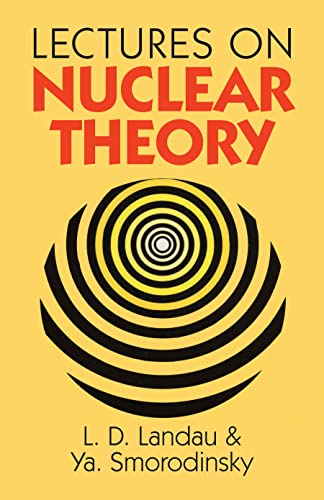
Soviet physicist Lev Davidovich Landau, awarded the 1962 Nobel Prize in Physics for his work on superfluidity, brings unparalleled theoretical insight to this collection of lectures. Alongside Yakov Abramovich Smorodinsky, known for his contributions to algebraic and geometric approaches in nuclear physics, Landau offers a compact guide through the core principles of nuclear theory. Their combined expertise shapes a resource tailored for those delving into the mathematical and conceptual underpinnings of nuclear chemistry and physics.
Soviet physicist Lev Davidovich Landau (1908–68) made many contributions to theoretical physics, including the co-discovery of the density matrix method in quantum mechanics. He received the 1962 Nobel Prize in Physics for his development of a mathematical theory of super fluidity. Prominent theorist Yakov Abramovich Smorodinsky (1917–92) worked at Moscow's Kurchatov Institute and the Joint Institute of Nuclear Research, Dubna. His chief interests involved the application of ideas from algebra and geometry to nuclear and particle physics.
Drawing from his profound expertise in theoretical physics, Lev Landau crafted this concise volume to illuminate fundamental nuclear theory concepts for advanced students. You explore critical topics like nuclear forces, nuclear structure, and pi-meson interactions, gaining a structured understanding grounded in rigorous mathematics. The book distills complex ideas into focused lectures, making it especially useful if you seek a compact yet deep dive into nuclear reactions and particle interactions. While its graduate-level depth suits those with solid physics backgrounds, anyone aiming to strengthen their grasp of nuclear chemistry's theoretical foundations will find this work instructive.
Steven B. Krivit is an investigative science journalist and international speaker specializing in low-energy nuclear reaction research. As the leading author of encyclopedia chapters and review articles on LENRs, and editor-in-chief of the Wiley Nuclear Energy Encyclopedia, he brings authoritative expertise to this volume. His extensive background provides a rare, insider perspective on the science and controversies that shaped this emerging field, making it a valuable resource for anyone interested in nuclear chemistry's evolving frontiers.
Steven B Krivit, Michael J Ravnitzky, Cynthia Goldstein, Mat Nieuwenhoven, Lucien G. Frisch(you?)·
About the Author
Steven B. Krivit is an author, investigative science journalist, and international speaker who specializes in low-energy nuclear reaction (LENR) research. He is the leading author of review articles and encyclopedia chapters about LENRs, including invited papers for the Royal Society of Chemistry, Elsevier, and John Wiley & Sons. He was an editor for the American Chemical Society 2008 and 2009 technical reference books on LENRs and editor-in-chief for the 2011 Wiley Nuclear Energy Encyclopedia.
Steven B. Krivit brings decades of investigative journalism and deep engagement with low-energy nuclear reactions (LENRs) to this detailed exploration of a controversial and evolving science. You’ll gain insight into the history and experimental evidence of LENRs, including the Widom-Larsen theory which challenges traditional nuclear physics without breaking its laws. The book walks you through the unexpected behaviors of researchers and the social dynamics that slowed acceptance, offering a nuanced perspective on nuclear chemistry’s frontier. Whether you’re a scientist or curious non-specialist, this volume equips you with a clear chronology and scientific context for understanding LENRs’ potential and challenges.
This AI-created book on nuclear chemistry is tailored to your skill level and learning goals. It focuses on the specific concepts and applications you want to master quickly and effectively. Because nuclear chemistry can be complex, having a custom pathway helps you avoid unnecessary topics and concentrate on what you need. This personalized approach makes your study time more productive and engaging.
TailoredRead AI creates personalized nonfiction books that adapt to your unique background, goals, and interests. Instead of reading generic content, you get a custom book written specifically for your profession, experience level, and learning objectives. Whether you're a beginner looking for fundamentals or an expert seeking advanced insights, TailoredRead crafts a book that speaks directly to you. Learn more.
This tailored book explores nuclear chemistry with a focus on rapid progress and practical application. It covers core concepts and complex topics, carefully matched to your background and interests, so you can engage deeply without feeling overwhelmed. Through a personalized approach, it reveals how nuclear reactions, isotopic behavior, and energy applications interconnect, making challenging material accessible and relevant. It examines key nuclear chemistry principles alongside current uses in energy and research, providing a clear pathway for understanding and mastery. This tailored content ensures you focus on what matters most to your learning goals, creating a coherent and efficient study experience.
D C Tayal is a renowned physicist recognized for his significant contributions to nuclear physics education. With a strong academic background and years of teaching experience, he has authored influential textbooks that simplify complex physics concepts. This book reflects his commitment to making nuclear physics accessible to students and professionals, drawing on his expertise to provide clear explanations and structured learning.
D C Tayal is a renowned physicist and author known for his contributions to the field of nuclear physics. With a strong academic background and extensive teaching experience, he has authored several influential textbooks that are widely used in universities. His work has helped shape the understanding of complex concepts in physics, making them accessible to students and professionals alike.
D C Tayal is a physicist whose extensive teaching experience and academic background inform this textbook, designed to clarify nuclear physics concepts for students and professionals. You can expect detailed explorations of nuclear interactions, decay processes, and reaction mechanisms, often supported by mathematical treatments and examples that illustrate fundamental principles. It’s particularly suited for those seeking a deeper grasp of how nuclear phenomena underpin nuclear chemistry and related fields. Not every chapter is light reading, but if you’re aiming to build a solid foundation in nuclear physics theory and applications, this book offers a focused and authoritative resource.
Kenneth S. Krane, professor of physics at Oregon State University with decades of research and teaching experience, brings unmatched expertise to this text. With a Ph.D. from Purdue and postdoctoral work at Los Alamos and Lawrence Berkeley National Laboratories, Krane’s background in nuclear structure and spectroscopy shapes the book’s content. His commitment to education and curriculum development is evident throughout, making complex nuclear physics approachable for students and educators alike. This book reflects his blend of rigorous research and teaching excellence, offering readers a thorough grounding in nuclear physics.
Kenneth S. Krane is Professor of Physics at Oregon State University, where he has served on the faculty since 1974, including 14 years as Department Chair. He received the Ph.D. in nuclear physics from Purdue University in 1970 and held postdoctoral research positions at the Los Alamos National Laboratory and the Lawrence Berkeley National Laboratory before joining the faculty at Oregon State. His research involves nuclear structure and nuclear spectroscopy, and has led to more than 100 papers in refereed journals and 30 years of funding in experimental nuclear physics from NSF and DOE. He was selected to be a Fellow of the American Physical Society by the Division of Nuclear Physics. He is also involved in education research and curriculum development and has held numerous NSF grants supporting those activities. He has served as chair of the APS Committee on Education, the APS Forum on Education, and the AIP Advisory Committee on Physics Education. From 1995-2006 he was the director of the Workshop for New Faculty in Physics and Astronomy, a national mentoring program for college and university faculty. In 2004 he was awarded the Millikan Medal of the American Association of Physics Teachers in recognition of his contributions to physics teaching.
When Kenneth S. Krane first shaped this text, his deep immersion in nuclear physics and education clearly guided its approach. You’ll explore nuclear decays, reactions, and structure with an emphasis on experimental results rather than abstract theory alone, which helps ground complex ideas. The book breaks down challenging topics like quantum theory in accessible ways, making it suitable if you’re starting with limited math background but eager to understand nuclear phenomena. Chapters often reinforce theory through practical examples, aiding your ability to analyze current research literature. If you seek a solid foundation in nuclear physics with real experimental context, this book offers that without oversimplifying the subject matter.
The best Nuclear Chemistry books and more, in your inbox each week. No account needed.
Conclusion
The collection of these seven books reveals three clear themes in nuclear chemistry: the evolving landscape of nuclear energy sources, the balance between theoretical foundations and practical applications, and the frontier research pushing boundaries in low-energy nuclear reactions. If you're tackling energy policy and sustainability questions, start with "SuperFuel" to understand thorium's potential. For those diving into reactor design and safety, combining "Fundamentals of Nuclear Science and Engineering" with "Fundamentals of Nuclear Reactor Physics" offers a solid technical base.
Beginners and experimentalists will benefit from "Introductory Nuclear Physics," which grounds you in experimental approaches without overwhelming complexity. Alternatively, you can create a personalized Nuclear Chemistry book to bridge the gap between these general principles and your unique learning goals. These books can help you accelerate your learning journey and deepen your understanding of nuclear chemistry's vital role in energy and science today.
Frequently Asked Questions
I'm overwhelmed by choice – which book should I start with?
Start with "Introductory Nuclear Physics" by Kenneth S. Krane if you're new, as it offers clear experimental context. If your focus is energy policy, "SuperFuel" provides an engaging entry into thorium's promise.
Are these books too advanced for someone new to Nuclear Chemistry?
Not all. "Introductory Nuclear Physics" is accessible to beginners, while "Lectures on Nuclear Theory" targets advanced readers. Choose based on your current background.
What's the best order to read these books?
Begin with foundational texts like "Introductory Nuclear Physics," then proceed to applied works such as "Fundamentals of Nuclear Reactor Physics." Follow with specialized topics like "Hacking the Atom."
Do these books assume I already have experience in Nuclear Chemistry?
Some do, particularly "Lectures on Nuclear Theory" and "Fundamentals of Nuclear Reactor Physics." Others like "SuperFuel" and "Introductory Nuclear Physics" cater to broader audiences.
Which books focus more on theory vs. practical application?
"Lectures on Nuclear Theory" emphasizes theory, while "Fundamentals of Nuclear Reactor Physics" and "Fundamentals of Nuclear Science and Engineering" lean toward practical engineering and applications.
Can personalized Nuclear Chemistry books complement these expert recommendations?
Yes! While these books provide authoritative insights, personalized Nuclear Chemistry books tailor content to your background and goals, bridging expert knowledge with your specific needs. Explore more here.
📚 Love this book list?
Help fellow book lovers discover great books, share this curated list with others!