7 Nuclear Physics Books That Separate Experts from Amateurs
Discover 7 authoritative Nuclear Physics books written by leading experts such as J. Kenneth Shultis, Frank Close, and Brian R. Martin, carefully curated to deepen your understanding.
Updated on June 25, 2025·We may earn commissions for purchases made via this page
We're launchingLaunching on Product Hunt today 🎉We just launchedJust launched on Product Hunt 🎉
Modelpeers, from the BookAuthority teamFrom the BookAuthority team: Modelpeers, a free way to follow AI models and agents like you follow people. We'd love your support.
What if the secrets of the atomic nucleus could unlock not just energy, but a deeper understanding of the universe itself? Nuclear physics remains a cornerstone of modern science, influencing everything from energy production to medical technologies. As the field evolves, the need for clear, authoritative guidance grows sharper than ever.
These seven books are authored by accomplished physicists and engineers who have dedicated their careers to unraveling the complexities of nuclear science. Their works range from foundational principles to advanced theoretical frameworks, ensuring you gain reliable knowledge directly from those shaping the discipline.
While these expert-curated titles provide proven frameworks, readers seeking content tailored to their specific background, skill level, or focus within nuclear physics might consider creating a personalized Nuclear Physics book that builds on these insights, adapting to your unique learning journey.
J. Kenneth Shultis is a distinguished professor of Mechanical and Nuclear Engineering at Kansas State University, holding the Black and Veatch Distinguished Professorship. With advanced degrees from the University of Michigan and international research experience, he has authored multiple influential books in nuclear science and engineering. His deep expertise and recognition as a Fellow of the American Nuclear Society and recipient of the Rockwell Lifetime Achievement Award lend significant authority to this textbook, which reflects his commitment to educating the next generation of nuclear professionals.
J. Kenneth Shultis is a professor of Mechanical & Nuclear Engineering at Kansas State University in Manhattan, Kansas, where he holds the Black and Veatch Distinguished Professorship. Dr. Shultis received his BASC degree from the University of Toronto, and his MS and PhD degrees in Nuclear Science and Engineering from the University of Michigan. Prior to joining the faculty at Kansas State University he spent a year at the Mathematics Institute of the University of Groningen, the Netherlands. He is the author of five books in the areas of radiation protection and nuclear science and engineering, a Fellow of the American Nuclear Society, and recipient of the ASC’s Rockwell Lifetime Achievement Award.
J. Kenneth Shultis, with decades of academic and practical expertise in nuclear engineering, crafted this book to clarify complex nuclear science topics for students and professionals alike. You gain a thorough understanding of nuclear physics fundamentals alongside applied areas such as reactor design, radiation detection, and nuclear medicine, supported by updated real-world examples. Chapters on advanced reactor physics and fusion technology deepen your grasp of cutting-edge developments, while the book's modular structure suits diverse learning needs. This text serves those pursuing nuclear engineering careers or anyone seeking a solid scientific foundation in nuclear phenomena without overwhelming technical jargon.
Elmer E. Lewis Ph.D. is a recognized expert in nuclear engineering, with extensive experience in the design and operation of nuclear reactors. His work focuses on the application of nuclear physics principles to engineering challenges, making him a valuable resource for students and professionals in the field. This book reflects his deep expertise and practical insight, offering a focused guide to how nuclear reactors function and are safely managed.
Elmer E. Lewis Ph.D. is a recognized expert in nuclear engineering, with extensive experience in the design and operation of nuclear reactors. His work focuses on the application of nuclear physics principles to engineering challenges, making him a valuable resource for students and professionals in the field.
What started as Elmer E. Lewis's hands-on work in nuclear engineering evolved into this focused exploration of how nuclear reactors operate, emphasizing practical physics behind reactor design and safety. You’ll gain a thorough understanding of neutron behavior, from kinetics to energy spectra, and see these principles applied through numerous worked examples and end-of-chapter problems. This book serves as a bridge connecting theoretical nuclear physics with the engineering realities of power generation, making it particularly useful for engineering students aiming to master reactor functionality. If you want to grasp the core processes that drive nuclear reactors and how to apply this knowledge safely and efficiently, this book delivers a clear, methodical approach without unnecessary complexity.
This AI-created book on nuclear physics is crafted based on your current knowledge and specific learning goals. By sharing what areas you want to focus on and your expertise level, the book is tailored to guide you through the complexities of nuclear science in a way that fits your needs. This personalized approach helps you concentrate on the topics that interest you most, making your study more effective and engaging.
TailoredRead AI creates personalized nonfiction books that adapt to your unique background, goals, and interests. Instead of reading generic content, you get a custom book written specifically for your profession, experience level, and learning objectives. Whether you're a beginner looking for fundamentals or an expert seeking advanced insights, TailoredRead crafts a book that speaks directly to you. Learn more.
This personalized book explores nuclear physics with a focus tailored to your unique expertise and learning objectives. It covers fundamental concepts such as nuclear structure, forces, and reactions, while also examining advanced topics like particle behavior and reactor applications. By matching your background and specific goals, the content reveals intricate details of both theoretical frameworks and practical uses, providing a rich and targeted learning experience. This tailored approach ensures you engage deeply with the material that matters most to you, making complex ideas accessible and relevant. Whether you aim to master core principles or explore specialized areas, this book facilitates a clear and meaningful journey through nuclear physics.
Frank Close, a physics professor at Oxford with leadership experience at CERN and the Rutherford Appleton Laboratory, brings unmatched expertise to this book. His award-winning work in communicating science informs this approachable yet authoritative introduction to nuclear physics. Close’s background ensures you get a clear look at how fundamental particles and forces shape the atomic nucleus and the stars, making complex physics accessible and relevant.
Frank Close is Professor of Physics at Oxford University and a Fellow of Exeter College. He was formerly the Head of the Theoretical Physics Division at the Rutherford Appleton Laboratory, and Head of Communications and Public Education at CERN. He is the author of several books, including the best-selling Lucifer's Legacy (OUP, 2000), and was the winner of the Kelvin Medal of the Institute of Physics for his 'outstanding contributions to the public understanding of physics'. His other books include The Cosmic Onion (1983), The Particle Explosion (1987), End (1988), Too Hot to Handle (1991), and The Particle Odyssey (OUP, 2002). In 2013 Professor Close was awarded the Royal Society Michael Faraday Prize for Communication of Science.
Frank Close's decades as a physics professor and his leadership roles at CERN and Rutherford Appleton Laboratory shaped this concise guide to nuclear physics. You’ll explore how the discovery of the electron led to understanding atomic structure and dive into the role of quarks, gluons, and quantum chromodynamics in building heavy nuclei, especially in stars and supernovae. The book also explains why certain proton-neutron arrangements are stable and connects these insights to practical advances like medical applications. If you’re eager to grasp the fundamental forces shaping matter and the universe's stellar processes, this book offers a clear, focused entry point without assuming deep prior knowledge.
Victor F. Blatt was a prominent physicist known for his contributions to nuclear physics. Along with John M. Weisskopf, he authored this comprehensive text that has become a classic in the field. Blatt's work has been influential in shaping the understanding of nuclear forces and reactions, making this book a vital resource for both students and professionals in physics.
Victor F. Blatt was a prominent physicist known for his contributions to nuclear physics. Along with John M. Weisskopf, he authored this comprehensive text that has become a classic in the field. Blatt's work has been influential in shaping the understanding of nuclear forces and reactions, making this book a vital resource for both students and professionals in physics.
Victor F. Blatt's deep expertise in nuclear forces and reactions clearly informs this detailed examination of theoretical nuclear physics. Co-authored with John M. Weisskopf, the book methodically covers topics from nuclear spectroscopy to complex multi-body problems, balancing rigorous theory with practical insights for experimental physicists and advanced students. You’ll find thorough explanations of nuclear shell structures and beta decay, supported by 112 illustrations that clarify challenging concepts. While dense, the book suits those ready to engage with advanced nuclear physics, providing a solid foundation for research or applied study in the field.
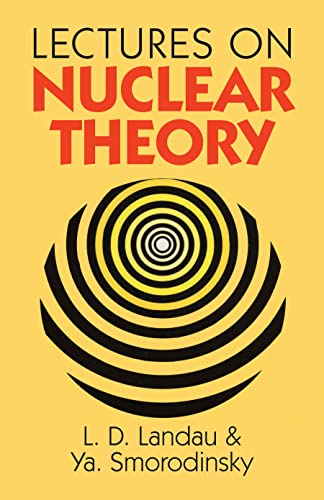
Soviet physicist Lev Davidovich Landau, Nobel laureate recognized for his work on superfluidity, partnered with Yakov Abramovich Smorodinsky, a noted theorist at Moscow's Kurchatov Institute, to produce this focused lecture series. Their combined expertise in theoretical and mathematical physics shapes a text that has guided generations of nuclear physicists through complex concepts. This work is rooted in their extensive research and reflects a deep commitment to advancing nuclear theory understanding.
Soviet physicist Lev Davidovich Landau (1908–68) made many contributions to theoretical physics, including the co-discovery of the density matrix method in quantum mechanics. He received the 1962 Nobel Prize in Physics for his development of a mathematical theory of super fluidity. Prominent theorist Yakov Abramovich Smorodinsky (1917–92) worked at Moscow's Kurchatov Institute and the Joint Institute of Nuclear Research, Dubna. His chief interests involved the application of ideas from algebra and geometry to nuclear and particle physics.
Lev Landau's decades of pioneering work in theoretical physics culminate in this concise graduate-level guide that distills complex nuclear theory into accessible lectures. Co-authored with Yakov Smorodinsky, the book delves into nuclear forces, structures, reactions, and pi-meson interactions, offering precise mathematical treatments alongside insightful physical interpretations. You’ll find detailed discussions on nuclear interactions and structure that are especially valuable for those seeking to deepen their grasp of fundamental nuclear phenomena. This text suits graduate students and researchers aiming to build a solid theoretical foundation rather than casual readers or experimentalists.
This AI-created book on reactor physics is tailored to your existing knowledge and specific learning goals. By sharing your background and interests, you receive a custom guide that focuses on the aspects of reactor operations and safety most relevant to you. This approach helps you navigate complex technical subjects efficiently, concentrating your study on what truly matters for your understanding and application. It’s a practical way to build confidence in nuclear reactor fundamentals without wading through unrelated material.
TailoredRead AI creates personalized nonfiction books that adapt to your unique background, goals, and interests. Instead of reading generic content, you get a custom book written specifically for your profession, experience level, and learning objectives. Whether you're a beginner looking for fundamentals or an expert seeking advanced insights, TailoredRead crafts a book that speaks directly to you. Learn more.
This tailored book explores the fundamental principles and operational aspects of nuclear reactors through a focused, step-by-step approach designed to match your background and learning goals. It covers key topics such as reactor physics, neutron behavior, and safety systems, emphasizing how these elements interconnect within practical reactor operation. By concentrating on your specific interests, it offers a streamlined pathway through complex concepts, enabling you to build a solid understanding of reactor systems within a month. This personalized guide reveals the intricate balance of physics and engineering essential to safe and efficient reactor function.
Steven B. Krivit is an investigative science journalist and international speaker with a focus on low-energy nuclear reactions (LENRs). As a leading author of numerous review articles and encyclopedia chapters on LENRs, and editor-in-chief for the 2011 Wiley Nuclear Energy Encyclopedia, Krivit brings unmatched expertise to this subject. His work demystifies a complex and often misunderstood field, offering readers a unique perspective grounded in both scientific rigor and historical context.
Steven B Krivit, Michael J Ravnitzky, Cynthia Goldstein, Mat Nieuwenhoven, Lucien G. Frisch(you?)·
About the Author
Steven B. Krivit is an author, investigative science journalist, and international speaker who specializes in low-energy nuclear reaction (LENR) research. He is the leading author of review articles and encyclopedia chapters about LENRs, including invited papers for the Royal Society of Chemistry, Elsevier, and John Wiley & Sons. He was an editor for the American Chemical Society 2008 and 2009 technical reference books on LENRs and editor-in-chief for the 2011 Wiley Nuclear Energy Encyclopedia.
Steven B. Krivit’s deep dive into low-energy nuclear reactions (LENRs) stems from his extensive background as an investigative science journalist specializing in this controversial area bridging chemistry and physics. In "Hacking the Atom," you gain a clear understanding of how LENRs differ fundamentally from traditional nuclear reactions, including explanations of isotopic shifts, elemental transmutations, and the Widom-Larsen theory that accounts for these phenomena without violating physics laws. The book also unpacks the scientific and social obstacles that slowed progress and shares compelling case studies of the personalities shaping the field. This detailed narrative suits anyone curious about the evolving scientific landscape beyond conventional nuclear physics.
Brian R. Martin and Graham Shaw have built their careers researching and teaching physics at top institutions like University College London and the University of Manchester. Their extensive experience at places including Brookhaven National Laboratory and the Niels Bohr Institute informs this text, which serves as a thorough introduction to nuclear and particle physics. Their motivation to write this book arises from a commitment to provide undergraduates with a balanced, accessible overview that bridges theoretical foundations and experimental data interpretation, enriching your grasp of the field's current landscape.
Brian R. Martin and Graham Shaw have researched and taught for many years in the Physics and Astronomy departments at University College London and the University of Manchester, respectively. Prior to that they have held positions at various institutes, including Brookhaven National Laboratory and Niels Bohr Institute (Martin), Columbia University and Rutherford Laboratory (Shaw). They have previously collaborated on other successful textbooks, including Particle Physics (4th edn. 2017) and Mathematics for Physicists (2015), both published by Wiley. Brian has also published books on statistics and a Beginner's Guide to Particle Physics, while Graham is the co-author with Franz Mandl of the well-known postgraduate text, Quantum Field Theory (2nd. edn. 2010), also published by Wiley.
2019·528 pages·Physics, Nuclear Physics, Particle Physics, Experimental Methods, Standard Model
The authoritative expertise behind this book stems from Brian R. Martin and Graham Shaw, who bring decades of research and teaching experience from institutions like University College London and the University of Manchester. You’ll find a structured progression from fundamental nuclear and particle physics concepts to detailed phenomenological models, such as the standard model and liquid drop framework, which help interpret experimental data. This edition notably expands discussions on discoveries like the Higgs boson and neutrino physics, alongside practical applications in medical imaging and energy production. If you seek a solid foundation that balances theory with experimental insights, especially suited for advanced undergraduates, this text offers clear explanations and problem sets to deepen your understanding.
The best Nuclear Physics books and more, in your inbox each week. No account needed.
Conclusion
Together, these seven books weave a rich tapestry of nuclear physics knowledge, blending engineering principles, theoretical depth, and cutting-edge research. Whether you're grappling with reactor mechanics or the subtleties of nuclear forces, this collection offers dependable perspectives.
If you're tackling practical reactor challenges, consider starting with "Fundamentals of Nuclear Reactor Physics" alongside "Fundamentals of Nuclear Science and Engineering" for a grounded approach. For those drawn to theory and particle interactions, "Theoretical Nuclear Physics" and "Nuclear and Particle Physics" provide rigorous exploration.
Alternatively, you can create a personalized Nuclear Physics book to bridge the gap between general principles and your specific situation. These resources can help accelerate your learning journey and deepen your expertise in this fascinating field.
Frequently Asked Questions
I'm overwhelmed by choice – which book should I start with?
Start with "Fundamentals of Nuclear Science and Engineering" by J. Kenneth Shultis. It offers a clear foundation across nuclear physics and engineering concepts, perfect for building your base before diving into specialized topics.
Are these books too advanced for someone new to Nuclear Physics?
Not necessarily. Books like Frank Close's "Nuclear Physics" provide accessible introductions, while others, such as "Theoretical Nuclear Physics," suit more advanced learners. Choose based on your current understanding and goals.
What's the best order to read these books?
Begin with broad overviews like "Fundamentals of Nuclear Science and Engineering" and "Nuclear Physics." Then progress to focused studies such as "Fundamentals of Nuclear Reactor Physics" and finish with advanced texts like "Theoretical Nuclear Physics."
Which books focus more on theory vs. practical application?
"Theoretical Nuclear Physics" and "Lectures on Nuclear Theory" emphasize theory and mathematical frameworks. Meanwhile, "Fundamentals of Nuclear Reactor Physics" and "Fundamentals of Nuclear Science and Engineering" blend theory with practical engineering applications.
Are any of these books outdated given how fast Nuclear Physics changes?
These books remain relevant due to their foundational nature and author expertise. For the latest developments, "Hacking the Atom" explores emerging low-energy nuclear reactions, complementing traditional texts.
Can I get a Nuclear Physics book tailored to my specific interests and background?
Yes! While these authoritative books offer broad insights, you can create a personalized Nuclear Physics book that adapts expert knowledge to your unique needs and goals. Learn more here.
📚 Love this book list?
Help fellow book lovers discover great books, share this curated list with others!