15 Best-Selling Future of Technology Books Millions Love
Satya Nadella, Mark Cuban, and Eric Schmidt recommend these best-selling Future of Technology books to understand AI, automation, and innovation impacts.
Updated on June 28, 2025·We may earn commissions for purchases made via this page
13 of 15 books have Audiobook versions
We're launchingLaunching on Product Hunt today 🎉We just launchedJust launched on Product Hunt 🎉
Modelpeers, from the BookAuthority teamFrom the BookAuthority team: Modelpeers, a free way to follow AI models and agents like you follow people. We'd love your support.
There's something special about books that both critics and crowds love—especially in the Future of Technology, where rapid innovation shapes our world daily. These 15 titles have won acclaim not just for their ideas but for their proven impact, helping you grasp AI, automation, and emerging tech with clarity and insight.
Leading voices like Satya Nadella, CEO of Microsoft, and Mark Cuban, investor and entrepreneur, have publicly endorsed these works. Nadella highlights how AI 2041 blends storytelling with technical insight, while Cuban praises its practical business applications. Meanwhile, Eric Schmidt, former Google CEO, finds The Kill Chain invaluable for understanding technology's role in national defense.
While these popular books provide proven frameworks, readers seeking content tailored to their specific Future of Technology needs might consider creating a personalized Future of Technology book that combines these validated approaches with your unique goals and background.
Satya Nadella, CEO of Microsoft, offers a unique perspective on this book, blending his leadership in tech with a deep understanding of AI's future. He highlights how the authors merge storytelling with technical insight, addressing both curiosity and fears about artificial intelligence. "By blending imaginative storytelling and technical expertise, Kai-Fu Lee and Chen Qiufan bring to life a vision for AI that addresses both our curiosity and our fears," he says. This endorsement aligns with the widespread reader interest, making it clear why this book resonates with so many. Following him, Mark Cuban praises its entertaining yet clear approach to AI's business applications, reinforcing its broad appeal.
“By blending imaginative storytelling and technical expertise, Kai-Fu Lee and Chen Qiufan bring to life a vision for AI that addresses both our curiosity and our fears. Read this captivating book to better understand how and when certain technologies are likely to mature, and what that could mean for all of us.” (from Amazon)
Kai-Fu Lee is the CEO of Sinovation Ventures and New York Times bestselling author of AI Superpowers. Lee was formerly the president of Google China and a senior executive at Microsoft, SGI, and Apple. Co-chair of the Artificial Intelligence Council at the World Economic Forum, he has a bachelor’s degree from Columbia and a PhD from Carnegie Mellon. Lee’s numerous honors include being named to the Time 100 and Wired 25 Icons lists. He is based in Beijing.
When Kai-Fu Lee first realized the scope of artificial intelligence's impact, he teamed up with novelist Chen Qiufan to paint a vivid picture of our near future. Through ten imaginative short stories paired with insightful commentary, you explore how AI technologies like deep learning, robotics, and autonomous systems might reshape daily life by 2041. You’ll gain a nuanced understanding of AI's potential benefits and risks, from economic shifts to ethical dilemmas, grounded in real technological trends. This book suits anyone curious about AI's trajectory, especially those seeking to grasp how these advances could affect society and business in concrete ways.
New York Times Bestseller
Named Best Book of the Year by The Wall Street Journal
Named Best Book of the Year by The Washington Post
Satya Nadella, CEO of Microsoft, emphasizes the importance of this book for anyone intrigued by AI's impact. He highlights how Iansiti and Lakhani outline what's needed to rethink firms as AI-first companies, reflecting both his personal experience steering Microsoft through AI transformation and the broader industry shift. His endorsement aligns with widespread reader interest, making this book a trusted guide for leaders facing technological upheaval. Additionally, Clayton Christensen, Harvard Business School professor and author of The Innovator's Dilemma, calls it a mandatory read for navigating disruption in the digital economy, reinforcing its relevance for business leaders adapting to future technology.
“Iansiti and Lakhani have written an important book that explains what's required to rethink the firm and become an AI-first company. Anyone interested in the impact of AI should read this book.” (from Amazon)
Marco Iansiti is a Professor at Harvard Business School and a leading expert in the field of technology and business strategy. He has published extensively on the impact of digital technologies on business and has consulted for numerous organizations on how to leverage technology for competitive advantage. His work focuses on the intersection of technology and management, particularly in the context of artificial intelligence and digital transformation.
Marco Iansiti, a Harvard Business School professor, teams up with Karim R. Lakhani to explore how AI reshapes business strategy and leadership. You’ll learn why traditional constraints on scale and scope no longer apply when firms harness AI, with vivid examples from companies like Airbnb and Microsoft illustrating these shifts. The book details a new operating architecture driven by data and algorithms, showing you how to rethink your firm’s structure to stay competitive. If you're involved in strategy, leadership, or digital transformation, this book delivers a framework to navigate the AI-driven economy without unnecessary hype.
This AI-created book on future technologies is crafted specifically around your background, skill level, and the unique challenges you face. By sharing your interests and goals, you receive a tailored exploration that focuses on the proven methods shaping tomorrow's tech landscape. This personalized approach ensures you engage deeply with the topics most relevant to you, making learning efficient and meaningful without wading through unrelated content.
TailoredRead AI creates personalized nonfiction books that adapt to your unique background, goals, and interests. Instead of reading generic content, you get a custom book written specifically for your profession, experience level, and learning objectives. Whether you're a beginner looking for fundamentals or an expert seeking advanced insights, TailoredRead crafts a book that speaks directly to you. Learn more.
This tailored book explores the evolving landscape of future technologies by integrating battle-tested approaches with your unique challenges and interests. It reveals how emerging tech trends intersect with real-world applications, offering a personalized dive into crucial concepts like AI advancements, automation, and innovation ecosystems. By focusing on your background and goals, the content matches your specific needs, making complex topics accessible and engaging. The book examines how proven methods have impacted diverse industries and how you can apply these insights to navigate the technological future confidently. This personalized guide promises a focused, insightful experience to deepen your understanding of transformative technologies.
Mustafa Suleyman, co-founder of DeepMind and CEO of Inflection AI, brings unmatched expertise from the forefront of artificial intelligence development. His leadership roles at Google and DeepMind give him a unique vantage point on the rapid technological changes shaping the 21st century. Driven by the urgent need to address how powerful technologies like AI could disrupt global order, Suleyman's insights help you grapple with the pressing dilemma of balancing innovation and control in an uncertain future.
Mustafa Suleyman is the co-founder and CEO of Inflection AI. Previously he co-founded DeepMind, one of the world’s leading artificial intelligence companies. After a decade at DeepMind, Suleyman became vice president of AI product management and AI policy at Google. When he was an undergraduate at Oxford, Suleyman dropped out to help start a non-profit telephone counseling service. He lives in Palo Alto, California.
Mustafa Suleyman leverages his deep experience co-founding DeepMind and leading AI initiatives at Google to explore the seismic shifts that fast-advancing technologies like AI, quantum computing, and synthetic biology will bring to society. You’ll gain an understanding of the complex balance between technological progress and the risks it poses to global governance, privacy, and security, particularly through the lens of what Suleyman calls “the containment problem.” Chapters dissect how governments and institutions might navigate these challenges before it's too late. This book is particularly insightful if you're concerned about the future of AI regulation, ethical dilemmas in tech, or the broader societal impacts of innovation.
New York Times Bestseller
Winner of Inc. Non-Obvious Book Award
Finalist for Financial Times Business Book of the Year
Lawrence Summers, President Emeritus and Charles W. Eliot University Professor at Harvard University and former U.S. Secretary of the Treasury, highlights the urgent relevance of this book in understanding technology's economic impact. He notes, "Robots, and their like, are on the rise. Their impact will be an important question in the next decade and beyond. Martin Ford has been thinking in this area before most others, so this book deserves very careful consideration." Summers’ perspective, shaped by decades in economic policy, underscores why this book resonates with a wide audience concerned about employment futures. Similarly, Marginal Revolution praises Ford as the pioneering voice on automation and joblessness, reinforcing the book’s influence among economists and technologists alike.
Harvard University Professor; Former U.S. Treasury Secretary
“Robots, and their like, are on the rise. Their impact will be an important question in the next decade and beyond. Martin Ford has been thinking in this area before most others, so this book deserves very careful consideration.” (from Amazon)
Martin Ford is a prominent futurist, leading expert on artificial intelligence and robotics, and the author of the award-winning book 'Rise of the Robots: Technology and the Threat of a Jobless Future.' Ford holds a degree in computer engineering and a graduate degree in business.
What if everything you knew about employment in the age of automation was wrong? Martin Ford, a seasoned futurist with deep expertise in AI and robotics, challenges the assumption that new technology will always create jobs to replace those it destroys. In this book, you’ll explore detailed analyses of how artificial intelligence and robotics threaten roles from paralegals to programmers, backed by examples like the disruption in healthcare and education sectors. Ford also scrutinizes proposed solutions such as retraining programs and introduces social policy ideas, including guaranteed income, making this a critical read if you want to understand the economic shifts shaping your career and society.
New York Times Bestseller
Winner of 2015 FT & McKinsey Business Book of the Year Award
Eric Schmidt, the Executive Chairman of Alphabet and former CEO of Google, brings a unique lens to this book's value, especially given his leadership during transformative tech breakthroughs. He highlights how "Abundance showed us where our world can be in 20 years. BOLD is a roadmap for entrepreneurs to help us get there." This perspective underscores the book’s alignment with real-world innovation and the aspirations of forward-thinking entrepreneurs. Alongside Tony Robbins, whose coaching empowers business leaders, their endorsements frame this book as both visionary and practical — a guide for anyone serious about scaling impact through emerging technologies.
Peter H. Diamandis is a New York Times bestselling author, and the founder of more than fifteen high-tech companies. He is the CEO of the XPRIZE (XPrize.org), Exec. Chairman of the Singularity University (SingularityU.org). He is Cochairman of Planetary Resources, Inc. and the Cofounder of Human Longevity, Inc. In 2014 he was named one of “The World’s 50 Greatest Leaders” by Fortune Magazine.
Unlike most technology books that dwell on incremental change, this one dives into how exponential technologies like AI, 3D printing, and synthetic biology are rapidly reshaping industries. The authors, drawing from their experience founding ventures such as Singularity University and XPRIZE, offer insights into the mindset and psychology behind bold entrepreneurship, illustrated through stories of innovators like Elon Musk and Jeff Bezos. You'll also learn practical ways to harness crowd-powered tools and incentive competitions to accelerate growth and impact. This book suits entrepreneurs and innovators ready to leverage cutting-edge tech and scale their ideas globally, though it's less suited for those seeking purely theoretical futurism.
This AI-created book on future technology is crafted to fit your unique background, experience level, and goals. You share which aspects of future tech intrigue you most and your objectives, and the book focuses on delivering content tailored exactly to those areas. Personalizing your learning this way helps you absorb essential trends and tools much faster than one-size-fits-all guides. It’s designed to help you grasp complex innovations with clarity, making the rapidly changing tech landscape more accessible and relevant to your journey.
TailoredRead AI creates personalized nonfiction books that adapt to your unique background, goals, and interests. Instead of reading generic content, you get a custom book written specifically for your profession, experience level, and learning objectives. Whether you're a beginner looking for fundamentals or an expert seeking advanced insights, TailoredRead crafts a book that speaks directly to you. Learn more.
This tailored book explores the rapidly evolving landscape of future technology, focusing on delivering personalized insights aligned with your background and objectives. It examines key trends and emerging tools that are reshaping industries and daily life, offering a clear path through complex topics. By concentrating on your specific interests, it reveals how advances in AI, automation, quantum computing, and more might impact your personal and professional future. The tailored content ensures you engage deeply with the subjects most relevant to you, empowering you to grasp essential concepts and practical implications within just 30 days.
Tony Robbins, a renowned business and life coach, spotlights this book as a beacon of optimism in the future of technology, sharing a vision that aligns closely with his focus on human potential and transformation. His endorsement carries weight because he understands how technology can empower individuals and communities to overcome scarcity and improve lives. Alongside Robbins, Tim Ferriss, author and angel investor, also champions this work, reinforcing its relevance for those interested in innovation and exponential change. Their combined perspectives underscore why this title is a trusted guide for anyone looking to understand how emerging technologies will shape tomorrow.
“This brilliant must-read book provides the key to the coming era of abundance replacing eons of scarcity, a powerful antidote to today’s malaise and pessimism.” (from Amazon)
Peter H. Diamandis is a New York Times bestselling author and the founder of more than fifteen high-tech companies. He is the CEO of the XPRIZE and executive chairman of Singularity University, a Silicon Valley-based institution backed by Google, 3D Systems, and NASA. He is cochairman of Planetary Resources, Inc. and the cofounder of Human Longevity, Inc. Diamandis attended MIT, where he received his degrees in molecular genetics and aerospace engineering, and Harvard Medical School, where he received his MD. In 2014 he was named one of “The World’s 50 Greatest Leaders” by Fortune magazine.
2012·400 pages·Future of Technology, Innovation, Exponential Technologies, Philanthropy, Global Development
What if everything you knew about scarcity was wrong? Peter H. Diamandis, a molecular geneticist and aerospace engineer with ties to MIT and Harvard Medical School, teams up with science writer Steven Kotler to argue that exponential technologies are rapidly closing the gap between haves and have-nots. You’ll explore how innovations in energy, healthcare, and education, among others, are reshaping the future, with chapters spotlighting pioneers like Elon Musk and Craig Venter. This book suits anyone curious about how technology and human ingenuity could realistically address global challenges and create abundance, though it may feel overly optimistic if you prefer a more cautious outlook.
George Gilder's TELECOSM offers a forward-looking examination of how expanding network capacities—beyond the limits of traditional PCs—promise to reshape our digital world. This book stands as a significant contribution to the future of technology literature, providing a detailed forecast of high-speed, high-powered networks that will revolutionize information exchange. Gilder's perspective is invaluable for anyone interested in the technological and economic shifts poised to redefine telecommunications, making it a vital read for industry insiders and technology observers alike.
What if everything you knew about bandwidth and connectivity was outdated? George Gilder, a longtime technology analyst and publisher of the Gilder Technology Report, explores a future transformed by networks with virtually unlimited speed and capacity. He breaks down how this "infinite bandwidth" will upend current technologies and open doors to innovations that radically change data transmission, computing, and communication. You’ll gain insight into the technical and economic forces behind this shift, ideal for anyone curious about how telecommunications infrastructure will evolve and impact industries. While the book delves into complex network theories, it’s accessible enough for tech enthusiasts and professionals eager to understand the trajectory of digital connectivity.
K Ken Nakamura, a science enthusiast with a deep interest in physics and math, found this book essential enough to suggest its early chapters be required reading in high school. His recommendation highlights how the book connects broad audiences to the critical conversation on AI's influence, reinforcing its relevance beyond specialists. He notes, "I read this great book by @tegmark Highly recommended for all future generation, for everyone should think about AI." This reflects how the book reshaped his understanding of AI’s societal role. Similarly, Debra Ruh, a CEO dedicated to accessibility and human potential, endorses it as a vital read for anyone intrigued by the human side of artificial intelligence.
“I read this great book by @tegmark Highly recommended for all future generation, for everyone should think about AI. Thus in my opinion, since everyone should know about AI, the first half of the book should be required reading in high school.” (from X)
Max Tegmark is an MIT professor who has authored more than 200 technical papers on topics from cosmology to artificial intelligence. As president of the Future of Life Institute, he worked with Elon Musk to launch the first-ever grants program for AI safety research. He has been featured in dozens of science documentaries. His passion for ideas, adventure, and entrepreneurship is infectious.
Max Tegmark challenges the conventional wisdom that artificial intelligence is only a distant concern, bringing it into sharp focus with insights drawn from his MIT expertise and leadership at the Future of Life Institute. You’ll explore how AI might transform crime, war, jobs, and society, with chapters dissecting automation’s impact on income and purpose, and the ethical dilemmas of autonomous weapons. This book suits anyone curious about the intersection of technology and humanity, offering you frameworks to navigate debates on superintelligence and consciousness without glossing over their complexities. Tegmark’s approach encourages you to engage critically with AI’s promise and perils in shaping our future.
Eric Schmidt, Executive Chairman of Alphabet and former CEO of Google, brings a unique perspective to the future of technology and national defense. He praises The Kill Chain as "a tour-de-force," highlighting Christian Brose’s rare expertise in merging emerging technology with military strategy. Schmidt’s endorsement reflects how this book reshaped his understanding of defense challenges, especially in the face of China’s growing military power. Alongside Schmidt, Michael Mcfaul, a former US Ambassador and professor, acknowledges the book’s sharp analysis and Brose's skillful writing, reinforcing why The Kill Chain resonates with both experts and general readers interested in the future of warfare and technology.
Executive Chairman of Alphabet, Former CEO of Google
“The Kill Chain is a tour-de-force. Few people are as knowledgeable and experienced as Christian Brose in thinking about the intersection of emerging technology and national defense. He pulls it all together in this compelling, unsettling, and outstanding book.” (from Amazon)
Christian Brose is currently Chief Strategy Officer of Anduril Industries, a technology start-up that develops national defense capabilities, and Senior Fellow at the Carnegie Endowment for International Peace. He served as Staff Director of the Senate Armed Services Committee (2015-2018), where he was the youngest person to hold the position in the committee's history. Before that, he served as Senator John McCain's senior policy advisor (2009-2015). Brose was previously a speechwriter to two secretaries of state, Colin Powell and Condoleezza Rice, and a member of the State Department Policy Planning Staff.
2020·320 pages·Future of Technology, Warfare, Artificial Intelligence, Military Strategy, Autonomous Systems
When Christian Brose, a former senior advisor to Senator John McCain and now Chief Strategy Officer at Anduril Industries, wrote The Kill Chain, he aimed to expose how emerging technologies are reshaping military power and threatening America’s defense dominance. You’ll gain insight into the evolving nature of warfare driven by artificial intelligence, autonomous systems, and rapid decision-making networks that together form the "kill chain." Brose examines specific geopolitical threats from China and Russia, offering a clear-eyed analysis of how the US must adapt its military approach and technology integration. This book suits anyone keen on understanding the intersection of technology and national security, especially policy makers and defense strategists.
Fareed Zakaria, author of Ten Lessons for a Post-Pandemic World, offers a sharp endorsement of this book, calling it "Absolutely masterful." His perspective as a global affairs analyst lends weight to the book’s examination of AI’s role in shaping political and social landscapes. Zakaria’s appreciation reflects how the authors' exploration helped him rethink the complexities of AI governance and societal change. If you’ve been seeking a guide to understand AI’s disruptive power amidst the flood of misinformation and shifting realities, this recommendation aligns well with your quest. Also noted by Kirkus Reviews, this book aids readers trying to navigate the complexities of today’s altered information environment.
Henry A Kissinger, Eric Schmidt, Daniel Huttenlocher·
About the Author
Henry A. Kissinger served as the 56th Secretary of State from September 1973 until January 1977. He also served as the Assistant to the President for National Security Affairs from January 1969 until November 1975. He received the Nobel Peace Prize in 1973, the Presidential Medal of Freedom in 1977, and the Medal of Liberty in 1986. Until his passing in 2023, he was Chairman of Kissinger Associates, Inc., an international consulting firm.
When Henry Kissinger, Eric Schmidt, and Daniel Huttenlocher teamed up to write this book, they brought decades of political, technological, and academic insight to examine how AI is reshaping society. You’ll explore how artificial intelligence challenges our understanding of knowledge, alters political dynamics, and affects social structures, with reflections on generative AI’s impact on media and jobs. Chapters delve into AI-driven military strategies and ethical dilemmas, offering you a nuanced view of control and governance in this new era. If you’re curious about the intersection of technology and humanity’s future, this book offers thoughtful analysis rather than simplistic predictions.
The New York Times, a leading authority in literary and cultural criticism, highlights how Michio Kaku’s book takes you through the history of computing, linking the invention of transistors to the dawn of quantum supremacy. Their review praises Kaku's lucid writing for making a complex subject approachable, reflecting why so many readers view this as a defining book about future technology. This aligns with the enthusiastic endorsement from Science, which appreciates Kaku’s skill in clarifying misconceptions and delivering accessible metaphors for quantum mechanics. If you’re intrigued by the transformative potential of technology and want a guide that connects foundational ideas with future possibilities, this book deserves your attention.
“Kaku spends much of [Quantum Supremacy] recounting the history of computing, bringing listeners back to the Turing machine and the invention of transistors as crucial foundations. That mind-blowing future is the focus. . . . [Kaku's] lucid prose and thought process make abundant sense of this technological turning point.” (from Amazon)
Michio Kaku is a professor of physics at the City University of New York, cofounder of string field theory, and the author of several widely acclaimed science books, including Hyperspace, Beyond Einstein, Physics of the Impossible, and Physics of the Future. He is the science correspondent for CBS’s This Morning and host of the radio programs Science Fantastic and Explorations in Science.
What if everything you thought you knew about computing was about to change? Michio Kaku, a physicist deeply involved with quantum theory, unpacks the emerging power of quantum computers and their potential to reshape industries from medicine to energy. You’ll explore how these machines work at the atomic level and why they’re poised to solve problems classical computers cannot, such as protein folding and climate modeling. Chapters detail the practical impacts on fields like renewable energy and disease research, making it clear this book suits anyone curious about the next wave of technological breakthroughs. While it’s accessible, the material demands your attention to grasp the full scope of this revolution.
Tony Robbins, a renowned business and life coach, recognizes the profound influence of Ray Kurzweil’s vision on the future of technology. His endorsement speaks to the book's alignment with the interests of those seeking to understand AI's role in shaping our world. Robbins’ expertise in human potential and transformation highlights why this book is a crucial read for anyone aiming to navigate and harness the coming technological revolution. Alongside him, Bill Gates, co-founder of Microsoft, praises Kurzweil's unmatched ability to foresee AI's trajectory, reinforcing the book’s credibility and relevance for aspiring futurists and technologists.
Ray Kurzweil is a world class inventor, thinker, and futurist, with a thirty-five-year track record of accurate predictions. He has been a leading developer in artificial intelligence for 61 years – longer than any other living person. He was the principal inventor of the first CCD flat-bed scanner, omni-font optical character recognition, print-to-speech reading machine for the blind, text-to-speech synthesizer, music synthesizer capable of recreating the grand piano and other orchestral instruments, and commercially marketed large-vocabulary speech recognition software. Ray received a GRAMMY® Award for outstanding achievement in music technology; he is the recipient of the National Medal of Technology and was inducted into the National Inventors Hall of Fame. He has written five best-selling books including The Singularity Is Near and How to Create a Mind. He is a Principal Researcher and AI Visionary at Google.
Ray Kurzweil's decades-long journey as a pioneering inventor and AI visionary culminates in this detailed exploration of humanity's impending merger with intelligent machines. You’ll gain insight into the exponential growth of technology, from nanobots rebuilding matter atom by atom to radical life extension and brain-cloud interfaces. Kurzweil examines both the optimistic prospects and the complex challenges of AI integration, including impacts on employment and ethical dilemmas. This book suits those deeply curious about how future technologies might reshape human identity and society, especially if you want a data-driven, nuanced perspective grounded in decades of research and keen foresight.
Sheryl Sandberg, former COO of Facebook and founder of LeanIn.Org, emphasizes how this book provides a thoughtful framework for leaders to navigate the monumental technological, social, and economic shifts redefining society. Her endorsement highlights Schwab’s decades of experience convening governments and industry, underscoring how the book helped her grasp the importance of guiding these changes toward progress for humanity. Sandberg’s perspective echoes the widespread admiration this book has earned among experts seeking to understand and shape technology’s future. Alongside her, Marc Benioff, chairman and CEO of Salesforce, stresses the importance of values-driven leadership in harnessing this revolution, recommending it as essential reading for leadership teams.
“In The Fourth Industrial Revolution, Professor Klaus Schwab puts forth a thoughtful framework for leaders to meet the challenge of maximizing the benefits of the profound technological, social and economic transformation reshaping society. Drawing on over four decades of bringing together governments, private sector and other parts of civil society, Schwab starts a wide-ranging discussion on how we can help to ensure that the Fourth Industrial Revolution drives progress for humankind.” (from Amazon)
Professor Klaus Schwab is the Founder and Executive Chairman of the World Economic Forum, the International Organization for Public-Private Cooperation. He holds doctorates in economics and engineering, and a Master in Public Administration from Harvard University. Schwab has received numerous international and national honors, including 17 honorary doctorates. His latest works include The Great Narrative, Stakeholder Capitalism, and The Great Reset.
What happens when an economist and engineer with decades leading the World Economic Forum examines technology's rapid evolution? Klaus Schwab presents a framework that goes beyond tech trends to explore how the fusion of digital, biological, and physical worlds will reshape societies, economies, and governments. You’ll gain insight into emerging technologies like AI, 3D printing, and nanomaterials, alongside their ethical and societal implications. This book suits anyone interested in understanding not just the innovations themselves but their profound impact on humanity and how you might influence this transformation.
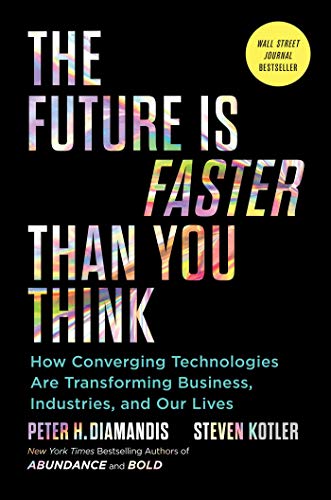
Tony Robbins, a renowned business coach and motivational speaker, discovered this book amid the whirlwind of rapid technological change affecting industries worldwide. He praises it as a "powerful and beautiful masterpiece outlining a compelling future for humanity," highlighting its clear vision for CEOs and entrepreneurs navigating a transforming landscape. Robbins’s endorsement aligns with the broad reader enthusiasm, reflecting how the book helped him grasp the tsunami of change ahead. Alongside him, Ray Kurzweil, a leading computer scientist, views it as an essential guide mapping the convergence of exponential technologies reshaping society, strengthening the case for why you should consider this insightful roadmap too.
“Diamandis and Kotler have written a powerful and beautiful masterpiece outlining a compelling future for humanity. The Future is Faster Than You Think offers CEOs and entrepreneurs a clear vision on the transformation of every major industry this decade. Required reading for anyone who wants to surf above the tsunami of change.” (from Amazon)
Peter H. Diamandis, MD, is a New York Times bestselling author and the cofounder of Singularity University, Human Longevity, Inc., Celularity, Inc., and founder of Bold Capital Partners. He is the founder and Executive Chairman of XPRIZE. Diamandis has degrees in molecular genetics and aerospace engineering from MIT and an MD from Harvard Medical School. Steven Kotler is a New York Times bestselling author, award-winning journalist, and the founder and executive director of the Flow Research Collective. His books include Stealing Fire, Bold, The Rise of Superman, Abundance, A Small Furry Prayer, Tomorrowland, West of Jesus, and Last Tango in Cyberspace. His work has been nominated for two Pulitzer Prizes, has been translated into more than forty languages, and has appeared in over a hundred publications, including The New York Times Magazine, The Atlantic, Wired, Forbes, and Time.
What makes this book different is how Peter Diamandis and Steven Kotler map the collision of multiple accelerating technologies and their collective impact on industries and society. You learn how AI, robotics, VR, and blockchain converge to reshape everything from healthcare to transportation, with chapters illustrating these transformations with clear examples. Diamandis’s background in aerospace and innovation, combined with Kotler’s expertise in peak performance, offers you a lens to anticipate and navigate rapid technological shifts. This book suits entrepreneurs, executives, and anyone curious about the near future’s disruptive forces and opportunities.
Robin Sloan, a novelist known for exploring technology and culture, discovered this book while exploring 1980s business literature time capsules. He found it "beautifully written and dizzyingly interesting," a testament to its enduring relevance. Sloan’s appreciation highlights how the book transcends eras to offer sharp insights into manufacturing's evolution. His experience aligns with widespread acclaim, including from Business Week, which calls it "the best current book on the changes reshaping manufacturing," and The New York Times, which emphasizes its global and societal impact. Together, these endorsements underscore why this book remains a key reference for understanding manufacturing's future and its ripple effects on technology and business.
“I got this book because I am lately into 1980s "business book" time capsules , but in fact it is beautifully written and dizzyingly interesting, even in 2019!!” (from X)
James P. Womack is the president and founder of the Lean Enterprise Institute, a nonprofit organization dedicated to promoting lean production principles. He has a Ph.D. from MIT and has directed significant research on manufacturing practices globally.
James P. Womack, drawing from his deep research leadership at MIT and as founder of the Lean Enterprise Institute, developed this book to challenge the prevailing manufacturing norms of the late 20th century. You discover how lean production, a method pioneered by Japanese automakers, fundamentally reshapes manufacturing by integrating every level of a company—from management to suppliers—to improve quality, reduce costs, and respond swiftly to customer demand. The book includes detailed case studies and frameworks explaining lean principles, helping you grasp how this approach disrupted traditional mass production. If you’re involved in manufacturing, operations, or interested in industrial evolution, this book gives you concrete insights into a system that has influenced industries beyond automobiles.
The best Future of Technology books and more, in your inbox each week. No account needed.
Conclusion
These 15 Future of Technology books present three clear themes: the transformative power of AI, the convergence of rapidly evolving technologies, and the societal impacts of automation and digital innovation. If you prefer proven methods for understanding AI's business and societal role, start with Competing in the Age of AI and AI 2041. For strategic insights on governance and ethical dilemmas, The Coming Wave and Life 3.0 offer invaluable perspectives.
Entrepreneurs and innovators will find Bold and Abundance inspiring roadmaps for leveraging exponential technologies, while technologists fascinated by network and computing revolutions should explore TELECOSM and Quantum Supremacy. Alternatively, you can create a personalized Future of Technology book to combine proven methods with your unique needs.
These widely-adopted approaches have helped many readers succeed in navigating complex technological changes and preparing for the future.
Frequently Asked Questions
I'm overwhelmed by choice – which book should I start with?
Start with AI 2041 for an engaging mix of storytelling and AI insight, praised by Satya Nadella and Mark Cuban. It's accessible and offers a broad view of AI's future impact, perfect for getting your bearings in this fast-evolving field.
Are these books too advanced for someone new to Future of Technology?
Not at all. Titles like The Future Is Faster Than You Think and Abundance provide approachable insights into technology trends without requiring prior expertise, making them great entry points.
Do I really need to read all of these, or can I just pick one?
You can pick based on your interests. For business strategy, try Competing in the Age of AI; for ethical concerns, Life 3.0 is ideal. Each offers distinct perspectives tailored to different facets of future tech.
Are any of these books outdated given how fast Future of Technology changes?
These selections have stood the test of time or offer up-to-date analysis, with recent releases like The Coming Wave addressing cutting-edge AI governance challenges alongside classics like The Machine That Changed the World.
Which book gives the most actionable advice I can use right away?
Competing in the Age of AI provides practical frameworks for reshaping business strategy in an AI-driven world, making it highly actionable for leaders and innovators.
Can personalized books complement these expert recommendations?
Yes! While these expert books offer proven insights, a personalized Future of Technology book can tailor content specifically to your goals and background, combining popular methods with your unique needs. Learn more here.
📚 Love this book list?
Help fellow book lovers discover great books, share this curated list with others!