Discover Space Books endorsed by Satya Nadella, Ali S. Raja, and Sean Carroll with proven reader acclaim
Updated on June 28, 2025·We may earn commissions for purchases made via this page
We're launchingLaunching on Product Hunt today 🎉We just launchedJust launched on Product Hunt 🎉
Modelpeers, from the BookAuthority teamFrom the BookAuthority team: Modelpeers, a free way to follow AI models and agents like you follow people. We'd love your support.
There's something special about books that both critics and crowds love—especially when it comes to the mysteries of Space. From the big bang to black holes, these books have shaped how millions understand the cosmos, blending scientific rigor with inspiring storytelling. Space matters now more than ever, as curiosity and exploration push humanity further beyond our world.
Experts like Satya Nadella, CEO of Microsoft, find value in lessons from astronauts like Chris Hadfield, highlighting the connection between space exploration and leadership. Ali S. Raja, Harvard professor and emergency physician, praises firsthand astronaut accounts for their insights on crisis management. Meanwhile, physicist Sean Carroll shares enthusiasm for books that clarify complex cosmological endings, showing how expert voices help broaden our cosmic perspective.
While these popular books provide proven frameworks for understanding Space, readers seeking content tailored to their specific interests might consider creating a personalized Space book that combines these validated approaches with your unique goals and background.
Anthony Wassano, known for his expertise as an Ethereum educator and investor, recently shared how reading Stephen Hawking’s book deepened his understanding of cosmology despite its density. He describes the book as introducing many unfamiliar concepts but ultimately providing a solid grasp of physics and the cosmos. His appreciation for the book’s thoroughness reflects why so many turn to it for insight into space and time. If you want a thoughtful, challenging dive into the universe’s secrets, Anthony’s experience suggests this book is a worthy choice.
“Recently read 'A Brief History of Time' by Stephen Hawking. The book is *dense* and introduces a lot of concepts that I had never heard of before but it was still an amazing read to get a nice understanding of cosmology and physics. Recommended read of course :)” (from X)
Stephen Hawking was the Lucasian Professor of Mathematics at the University of Cambridge for thirty years and the recipient of numerous awards and honors including the Presidential Medal of Freedom. His books for the general reader include My Brief History, the classic A Brief History of Time, the essay collection Black Holes and Baby Universes, The Universe in a Nutshell, and, with Leonard Mlodinow, A Briefer History of Time and The Grand Design. Stephen Hawking died in 2018.
Stephen Hawking's decades as Lucasian Professor of Mathematics at Cambridge led to this exploration of some of the universe's most profound mysteries. You’ll gain insight into complex ideas like black holes, the big bang, and the nature of time itself, explained in accessible language that challenges you to rethink how space and time function. Chapters dive into concepts such as antimatter and extra dimensions, offering a conceptual framework that bridges physics and cosmology. This book suits anyone curious about the fundamental workings of the cosmos rather than those seeking mathematical rigor or detailed technical explanations.
Goodreads, a well-known book review community, highlights "Engaging and illuminating." Their endorsement speaks volumes given their broad readership interested in science. This book helped many grasp complex astrophysics ideas succinctly, making space accessible during hectic days. Their experience aligns with why you might find this book both insightful and manageable. Additionally, Hackernoon, a respected tech publication, praises it as mind-blowing, reinforcing its appeal beyond just science buffs.
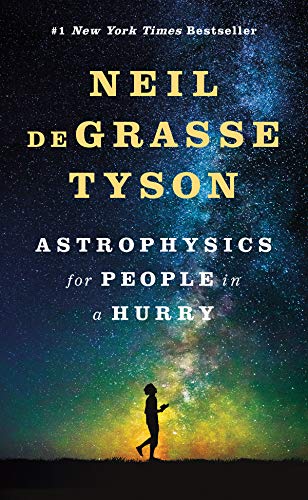
Neil deGrasse Tyson is an astrophysicist with the American Museum of Natural History and the New York Times best-selling author of Astrophysics for People in a Hurry. He lives in New York City. Tyson was born in New York City the same week NASA was founded. His interest in the universe traces back to age 9, after a first visit to the Hayden Planetarium of the American Museum of Natural History. He was educated in the public schools of New York City through his graduation from the Bronx High School of Science. After earning a BA in Physics from Harvard and a PhD in Astrophysics from Columbia, he became the Frederick P. Rose Director of the Hayden Planetarium, where he has served since 1996.
Neil deGrasse Tyson's decades of astrophysics research and public science communication culminate in this approachable guide to the cosmos. You learn to grasp complex concepts like the Big Bang, black holes, and quantum mechanics in digestible chapters designed for busy schedules. The book breaks down how the universe operates and our place within it, making it ideal if you want a solid foundation in astrophysics without heavy jargon. For example, Tyson's chapter on dark matter clarifies a topic that often confuses newcomers. If you crave a clear, witty overview of space fundamentals, this book fits well, though those seeking deep technical detail might look elsewhere.
This AI-created book on space concepts is written based on your background and unique interests. You share the specific areas of space science you're curious about and your current understanding, and the book is crafted to focus solely on what you want to learn. This tailored approach makes exploring such a vast topic more manageable and engaging, ensuring you get the cosmic insights that matter most to you.
TailoredRead AI creates personalized nonfiction books that adapt to your unique background, goals, and interests. Instead of reading generic content, you get a custom book written specifically for your profession, experience level, and learning objectives. Whether you're a beginner looking for fundamentals or an expert seeking advanced insights, TailoredRead crafts a book that speaks directly to you. Learn more.
2026·50-300 pages·Space, Space Science, Astrophysics, Cosmology, Astronomy
This personalized book explores the vast universe of space science, focusing on your specific interests and goals to provide a uniquely tailored learning experience. It covers foundational topics such as astrophysics and cosmology, advancing to specialized subjects like space exploration and astronautics, matching your background and desired depth of understanding. By integrating reader-validated knowledge with your personal objectives, the book reveals key cosmic concepts in a way that resonates with you. Whether you're curious about black holes, the origins of the universe, or the future of space travel, this tailored guide examines these subjects with clarity and enthusiasm, inviting you to embark on a customized journey through the cosmos.
Michio Kaku’s Parallel Worlds offers a compelling exploration of the universe’s deepest questions through the lens of cutting-edge cosmology and physics. Drawing on recent satellite data and breakthroughs in theoretical physics, the book discusses inflationary universe theory, M-theory, and the tantalizing possibility of multiple universes coexisting. This work appeals to anyone fascinated by the cosmos, providing a thorough look at how scientists today are reshaping our understanding of space and its ultimate destiny.
Michio Kaku, a theoretical physicist known for making complex ideas accessible, explores the frontiers of cosmology in this book. You’ll navigate through the latest developments in inflationary universe theory, M-theory, and the possibility of multiverses, with concrete examples like data from the WMAP satellite and the Hubble telescope shaping the narrative. The book invites you to rethink the origins and fate of the cosmos, touching on topics such as parallel universes and the potential future of advanced civilizations escaping a dying universe. If you’re curious about cutting-edge physics and the broader implications of space’s mysteries, this book provides a deep yet understandable dive.
Carl Sagan’s Cosmos stands as a singular exploration of the universe’s vast history and humanity’s emerging role within it. The book’s ability to traverse topics from the birth of galaxies to the intricacies of the human brain has captivated countless readers, inspiring a deeper appreciation for space and science. Its blend of storytelling and scientific explanation, enriched by Ann Druyan’s introduction and Neil deGrasse Tyson’s foreword, offers a lens through which you can understand our cosmic surroundings and the scientific endeavors that reveal them. Anyone looking to connect with the grandeur and detail of space will find this work a rewarding companion.
When Carl Sagan first shared his vision in Cosmos, he transformed how many of us perceive the universe by weaving together science, history, and philosophy. This book takes you on a journey through fourteen billion years of cosmic evolution, explaining complex topics like the origin of life, the workings of the human brain, and the vastness of galaxies in a way that feels both expansive and intimate. With contributions from Ann Druyan and Neil deGrasse Tyson, it offers insights into scientific discoveries and the individuals behind them, making it ideal for anyone curious about humanity's place in the cosmos. You'll come away with a richer understanding of space's vastness and the delicate thread of life within it.
Stephen Hawking’s "A Briefer History of Time" revisits and clarifies his groundbreaking ideas about the nature of space, time, and the universe. This special edition caters to those seeking a more accessible explanation of complex physics topics, enriched with colorful illustrations and updated developments like string theory. It’s a book that continues to attract readers eager to deepen their understanding of space and cosmology without requiring a specialist background.
What sets this book apart is its ability to revisit complex scientific ideas with renewed clarity and accessibility. Stephen Hawking and Leonard Mlodinow refine and expand on key themes like the nature of space and time, the role of God in creation, and the universe's history and future, making these concepts approachable without oversimplifying. For example, the book introduces string theory and the quest for a unified physics theory with engaging explanations and vivid illustrations. If you’re curious about the grand questions of cosmology but felt overwhelmed by dense texts before, this edition offers a clearer path. It’s especially suited for those keen to grasp modern physics’ essentials without requiring advanced scientific training.
This personalized AI book about space science is created based on your interests, background, and goals. Using AI, it tailors content specifically to help you quickly build understanding in areas you find most intriguing, whether it's astrophysics, cosmology, or space missions. Instead of a one-size-fits-all approach, this book focuses on what you want to learn, making the vast topic of space much more approachable and relevant to your journey.
TailoredRead AI creates personalized nonfiction books that adapt to your unique background, goals, and interests. Instead of reading generic content, you get a custom book written specifically for your profession, experience level, and learning objectives. Whether you're a beginner looking for fundamentals or an expert seeking advanced insights, TailoredRead crafts a book that speaks directly to you. Learn more.
2026·50-300 pages·Space, Space Science, Cosmology, Astrophysics, Astronomy Basics
This tailored book offers a focused, step-by-step plan designed to rapidly build your knowledge of space science, matching your unique background and goals. It explores essential concepts from cosmology and astrophysics to space exploration, blending widely appreciated insights with content that resonates specifically with your interests. By concentrating on the topics you care about most, it provides a personalized learning journey that reveals the wonders of the cosmos without overwhelming you with unrelated details. This approach ensures you gain a solid, enthusiastic grasp of space topics efficiently, making the vast universe accessible and engaging. Embrace a tailored guide that navigates you through the complexities of space with clarity and excitement.
Satya Nadella, CEO of Microsoft, brings a unique perspective to space literature, endorsing a book that marries the rigor of astronaut training with practical life lessons. His recommendation signals the book’s relevance not only to space enthusiasts but also to leaders who face complex challenges requiring ingenuity and calm preparation. This endorsement aligns with broader expert praise, such as from Ali S. Raja, a Harvard professor and emergency physician, who highlights the detailed depiction of NASA's CapCom role that resonates deeply with mission-critical leadership. Together, their insights spotlight the book as a valuable guide for those seeking to navigate high-stakes environments with the mindset of an astronaut.
Emergency Physician, Harvard Professor, USAF Veteran
“Awesome! Cmdr Hadfield described the importance of the CapCom role so well in his book - I’m so glad you’re filling it for this mission! Congrats to you and the rest of the team, and Godspeed to Astro Raja, Astro Marshburn, Astro Matthias and Astronaut Barron!” (from X)
Chris Hadfield, one of the world's most seasoned and accomplished astronauts, is the author of the #1 international bestseller An Astronaut's Guide to Life on Earth. The top graduate of the U.S. Air Force Test Pilot School in 1988 and the U.S. Navy Test Pilot of the Year in 1991, Hadfield was selected to be an astronaut in 1992. He was Chief CAPCOM at NASA for twenty-five shuttle missions and served as Director of Operations for NASA in Star City, Russia, from 2001 to 2003; Chief of Robotics for the NASA Astronaut Office in Houston from 2003 to 2006; and Chief of International Space Station Operations for the NASA Astronaut Office from 2006 to 2008. Hadfield most recently served as Commander of the International Space Station, where, while conducting a record-setting number of scientific experiments and overseeing an emergency spacewalk, he gained worldwide acclaim for his breathtaking photographs and educational videos about life in space. His online videos, including a zero-gravity version of David Bowie's 'Space Oddity,' have collectively received more than fifty million views.
Chris Hadfield, drawing from decades as an astronaut and leader at NASA, reveals lessons from his extraordinary space missions that reshape how you handle challenges on Earth. His book offers concrete insights into preparation, crisis management, and mindset by sharing vivid episodes like breaking into a space station with a Swiss army knife and managing emergencies in zero gravity. You'll learn why sweating the small stuff matters and how conventional wisdom can sometimes mislead you. This book is especially useful if you're interested in leadership under pressure or want to rethink your approach to obstacles through the lens of space exploration. It's not about becoming an astronaut but about adopting an astronaut's mindset for everyday life.
Mary Roach takes you on a uniquely entertaining journey through the quirks and challenges of living in space. Highlighting the strange realities astronauts face—from weightlessness to the lack of privacy—she reveals how space travel pushes human limits in unexpected ways. This book resonates with anyone drawn to the human story behind space exploration, combining scientific inquiry with humor and vivid storytelling to illuminate what life in the void truly entails.
Mary Roach's decades of science writing led her to explore the peculiar challenges of human life beyond Earth. In "Packing for Mars," you get an inside look at how space travel strips away everyday comforts—gravity, fresh food, privacy—and what that means for the human body and psyche. You'll learn about the bizarre training and tests astronauts endure, from space shuttle toilets to crash tests with cadavers, all detailed with Roach's signature wit and curiosity. This book suits anyone fascinated by the human side of space exploration, offering both humor and insight without glossing over the strange realities astronauts face.
The New Scientist, a respected science publication, highlights this book’s ability to tackle complex cosmic questions with engaging style and clear illustrations, noting it "may just have produced the best book about the universe in the universe." Their praise reflects a wider acclaim from readers seeking to understand the cosmos deeply yet accessibly. This recommendation aligns with The Washington Post's view that the authors communicate vast ideas without oversimplifying them. Together, these endorsements underscore why this astrophysical tour remains a favored choice for those eager to expand their cosmic knowledge.
“Riveting questions fielded by three top astrophysicists in engaging style, with great illustrations and just a handful of equations. They may just have produced the best book about the universe in the universe.” (from Amazon)
Neil deGrasse Tyson, Michael A. Strauss, J. Richard Gott·
About the Author
Neil deGrasse Tyson is director of the Hayden Planetarium at the American Museum of Natural History. He is the author of many books, including Space Chronicles: Facing the Ultimate Frontier, and the host of the Emmy Award–winning documentary Cosmos: A Spacetime Odyssey. Michael A. Strauss is professor of astrophysics at Princeton University. J. Richard Gott is professor of astrophysics at Princeton University. His books include The Cosmic Web: Mysterious Architecture of the Universe (Princeton).
When Neil deGrasse Tyson, Michael A. Strauss, and J. Richard Gott combined their expertise to create this book, they transformed a popular Princeton course into an accessible voyage through the cosmos. You’ll explore the lifecycle of stars, the mystery behind Pluto’s reclassification, and the mind-bending concepts of multiverses and time travel, all explained with illustrations and minimal equations. The chapters unravel complex astrophysical phenomena with clarity, making it approachable without diluting the science. If your curiosity stretches beyond stargazing to understanding how the universe truly works, this book offers the kind of insights that can reshape your perspective.
Richard Signorelli, a former Assistant U.S. Attorney and activist, highlights Carl Sagan's work as both brilliant and wise. His recommendation reflects how Sagan's insights on humanity's place in the cosmos resonate beyond scientific circles. Signorelli’s endorsement aligns with widespread admiration for this book, suggesting it offers profound perspectives that can deepen your understanding of space exploration and our future among the stars.
Carl Sagan was Professor of Astronomy and Space Sciences and Director of the Laboratory for Planetary Studies at Cornell University. He played a leading role in the Mariner, Viking, and Voyager spacecraft expeditions to the planets, for which he received the NASA medals for Exceptional Scientific Achievement. Dr. Sagan received the Pulitzer Prize and the highest awards of both the National Academy of Sciences and the National Science Foundation, and many other awards, for his contributions to science, literature, education, and the preservation of the environment. His book Cosmos was the bestselling science book ever published in the English language, and his bestselling novel, Contact, was turned into a major motion picture.
Carl Sagan, a distinguished astronomer and space scientist with a pedigree including leadership in NASA's Mariner, Viking, and Voyager missions, crafted this book to explore humanity's trajectory beyond Earth. You’ll uncover a detailed narrative of our cosmic journey, from early space exploration to the urgent need for settling other worlds as a survival imperative. Sagan’s reflections range from the history of spaceflight to the philosophical and practical implications of our place in the universe, making the book a thoughtful guide for those curious about humanity’s future among the stars. If you’re fascinated by astronomy and the big questions of existence, this book offers a rich, grounded perspective without drifting into fantasy.
This book offers a detailed chronicle of SpaceX’s rise from a fledgling startup to a dominant force in modern spaceflight, led by entrepreneur Elon Musk. Eric Berger, a Pulitzer Prize–nominated journalist, guides you through the company’s most daring engineering feats and management challenges, highlighting how reusable rockets and audacious vision have redefined space exploration. The narrative reveals the grit behind breakthroughs like Falcon Heavy and the quest to send humans to Mars, making it an essential read for anyone interested in the evolving space industry and its future.
What started as an exploration of SpaceX's turbulent early days became an intricate look at how a daring team led by Elon Musk reshaped the spaceflight industry. Eric Berger takes you behind the scenes, revealing technical challenges like rocket landings and engine failures, and the gritty determination that pushed the company forward. You’ll gain insights into aerospace innovation, startup resilience, and Musk’s demanding leadership style, with vivid examples such as the Falcon Heavy launch and the search for a rocket lost at sea. This book suits anyone fascinated by modern space exploration or the gritty details of pioneering technology ventures.
Isaac Asimov's Guide to Earth and Space offers a unique entry point into the cosmos by presenting complex topics in a question-and-answer style that invites curiosity. This 1991 edition, published by Random House, reflects Asimov’s signature clarity and wit, making it accessible for anyone eager to understand both familiar earthly phenomena and distant celestial mechanics. Covering subjects from wind dynamics to moon formation, the book serves those fascinated by space who prefer a broad, engaging overview to technical detail. Its enduring appeal lies in translating scientific theory into straightforward explanations that enrich your grasp of our universe.
Isaac Asimov's extensive background as a biochemistry professor and prolific science writer shaped this engaging guide, which invites you to explore the universe through a lively question-and-answer format. You’ll find clear explanations of phenomena ranging from the mechanics of the wind to the moon’s origin, illustrating scientific concepts without overwhelming jargon. The book’s accessible style makes complex astronomical theories approachable, especially in chapters dealing with planetary formation and cosmic phenomena. If you’re curious about how familiar forces and celestial events connect, this book offers a thoughtful introduction that balances depth with readability. It’s best suited for those who want a broad yet digestible overview rather than a technical textbook.
John Scalzi, a well-known science fiction author, describes the book as "Weird science, explained beautifully." His appreciation for accessible scientific narratives aligns with the book’s broad appeal among space enthusiasts. Scalzi’s recommendation highlights how Katie Mack’s engaging style makes complex cosmological theories approachable, allowing you to explore the universe’s possible endings with clarity and wit. Alongside him, Alexandra Petri, a Washington Post columnist, praises the book’s wit and lucidity, making it a thoughtful yet enjoyable read. Their endorsements reflect why this book resonates so deeply with readers curious about space’s grandest questions.
Dr. Katie Mack is a theoretical astrophysicist, exploring a range of questions in cosmology, the study of the universe from beginning to end. She is currently an assistant professor of physics at North Carolina State University, where she is also a member of the Leadership in Public Science Cluster. She has been published in a number of popular publications, such as Scientific American, Slate, Sky & Telescope, Time, and Cosmos magazine, where she is a columnist. She can be found on Twitter as @AstroKatie.
When Katie Mack first grappled with the unsettling idea that the universe might end at any moment, it set her on a path to deeply explore astrophysical endings. This book takes you through five possible cosmic finales, like the Big Crunch and Heat Death, unpacking complex concepts in quantum mechanics and cosmology with wit and clarity. You'll gain a solid understanding of how the universe's fate connects to fundamental physics, informed by Mack’s role as a theoretical astrophysicist and educator. If you’re curious about the ultimate fate of everything around us, this book offers an approachable yet thought-provoking journey into space science’s biggest questions.
New York Times Notable Book
NPR Science Friday Book Club Selection
Named Best Book of the Year by multiple publications
Neil Degrasse Tyson is a renowned astrophysicist celebrated for making complex science accessible and engaging. Known for hosting popular science programs and authoring multiple books, he brings wit and wisdom to this work. His expertise drives a fresh look at humanity's deepest cosmic questions, blending cutting-edge research with approachable storytelling. Tyson's reputation and ability to communicate science invite you to explore the universe with confidence and curiosity.
Neil Degrasse Tyson is a renowned astrophysicist known for his wit, wisdom, and cutting-edge science. He has authored several books and hosted popular science programs.
2021·312 pages·Space, Science, Astrophysics, Cosmology, Life Origins
What if the biggest questions about the universe had answers grounded in the latest scientific discoveries? Neil Degrasse Tyson, a renowned astrophysicist, explores fundamental cosmic mysteries—like the origins of life and humanity's place in the universe—with clarity and humor. Drawing from his StarTalk podcast and enriched by vivid illustrations, the book breaks down complex astrophysics concepts and current data with a conversational tone. You'll find chapters that tackle whether we are alone in the cosmos and how cosmic phenomena shape our existence, making it ideal if you seek to deepen your understanding of space and your connection to it. This book suits anyone curious about science's role in explaining the universe, though those wanting exhaustive technical detail might look elsewhere.
Brian Greene, a professor of physics and mathematics at Columbia University, appreciates how Massimino’s candid storytelling brings you on a gripping journey beyond Earth’s atmosphere. Greene was captivated by how "Massimino's incredible journeys, filled with grit, courage, suspense and thrills, are told with such candor and delight, that for a brief moment I felt I’d finally made it to space too." This perspective helps you grasp the human side of astronaut life, not just the science. Fellow astronaut John Glenn echoes this, highlighting Massimino’s blend of precision and passion for space exploration, making this a book that resonates with those curious about humanity’s future beyond our planet.
Professor of physics and mathematics, Columbia University
“Massimino's incredible journeys, filled with grit, courage, suspense and thrills, are told with such candor and delight, that for a brief moment I felt I’d finally made it to space too. Read this book and be inspired to reach for the impossible.” (from Amazon)
Mike Massimino served as a NASA Astronaut from 1996 until 2014 and flew in space twice: STS-109 on space shuttle Columbia in March 2002 and STS-125 on space shuttle Atlantis in May 2009 – the final two Hubble Space Telescope servicing missions. Mike became the first human to tweet from space, was the last human to work inside of Hubble, and set a team record with his crewmates for the most cumulative spacewalking time in a single space shuttle mission. He has a recurring role as himself on The Big Bang Theory; appears regularly on late night talk shows, news programs, and documentaries; and is a much sought after inspirational speaker. He received his BS from the Columbia University School of Engineering, and his two MS’s and Ph.D. from the Massachusetts Institute of Technology (MIT). He currently lives in New York City where he is an engineering professor at Columbia and an advisor at the Intrepid Sea, Air, and Space Museum.
Drawing from Mike Massimino's extensive NASA experience and engineering expertise, this book offers a rare, insider look at what it really means to be an astronaut. You get more than just thrilling spacewalk stories; you learn the persistence behind his journey—from multiple NASA rejections to fixing the Hubble Space Telescope on his final mission. Chapters vividly detail the surreal sensation of microgravity and the technical challenges of space repairs, making it clear this is for those who want to understand both the human and scientific sides of space exploration. If you're looking for inspiration grounded in genuine astronaut challenges, this book delivers without glossing over the hard realities.
The best Space books and more, in your inbox each week. No account needed.
Conclusion
These 14 books collectively offer tested approaches and widely validated insights into Space—from foundational cosmology to the gritty realities of astronaut life and the cutting-edge innovations of SpaceX. If you prefer proven methods, start with classics like "A Brief History of Time" and "Cosmos." For validated approaches blending science and personal stories, combine "An Astronaut's Guide to Life on Earth" with "Packing for Mars."
For a comprehensive astrophysics overview, "Welcome to the Universe" and "Astrophysics for People in a Hurry" provide accessible yet substantial content. Alternatively, you can create a personalized Space book to combine proven methods with your unique needs.
These widely-adopted approaches have helped countless readers succeed in grasping the vast, fascinating subject of Space, offering you a reliable path to deepen your cosmic understanding and curiosity.
Frequently Asked Questions
I'm overwhelmed by choice – which book should I start with?
Start with "A Brief History of Time" if you're new to cosmology or "Astrophysics for People in a Hurry" for a quick, clear overview. Both books provide solid foundations without overwhelming detail.
Are these books too advanced for someone new to Space?
Not at all. Many, like Carl Sagan’s "Cosmos" and Stephen Hawking’s "A Briefer History of Time," are written to be accessible, inviting curious beginners into complex topics with friendly explanations.
What's the best order to read these books?
Begin with broad introductions like "Cosmos," then explore more specialized works such as "Parallel Worlds" or "The End of Everything." Mix in astronaut accounts like "Spaceman" for varied perspectives.
Should I start with the newest book or a classic?
Both have value. Classics like "Pale Blue Dot" provide timeless insights, while newer books like "Reentry" offer fresh views on recent space developments. Choose based on your interest in history or current space industry.
Do I really need to read all of these, or can I just pick one?
You can certainly pick one that matches your interest. Each book stands strong on its own, but exploring several will give you a richer, multifaceted understanding of Space.
How can I get insights tailored to my specific Space interests or experience level?
While these expert-recommended books cover broad and proven topics, you might benefit from creating a personalized Space book that tailors popular methods and insights to your unique goals and background for efficient, focused learning.
📚 Love this book list?
Help fellow book lovers discover great books, share this curated list with others!