Explore Spacetime Books recommended by Ezra Klein, Priyamvada Natarajan, and Scott Aaronson—experts in physics and cosmology sharing proven insights.
Updated on June 25, 2025·We may earn commissions for purchases made via this page
2 of 7 books have Audiobook versions
We're launchingLaunching on Product Hunt today 🎉We just launchedJust launched on Product Hunt 🎉
Modelpeers, from the BookAuthority teamFrom the BookAuthority team: Modelpeers, a free way to follow AI models and agents like you follow people. We'd love your support.
There's something special about books that both critics and crowds love—especially in a field as complex as spacetime. These seven best-selling books have captivated millions by unraveling the mysteries of time, space, and the quantum fabric of reality. Their enduring popularity reflects proven value, offering you a chance to explore spacetime concepts with trusted voices guiding the way.
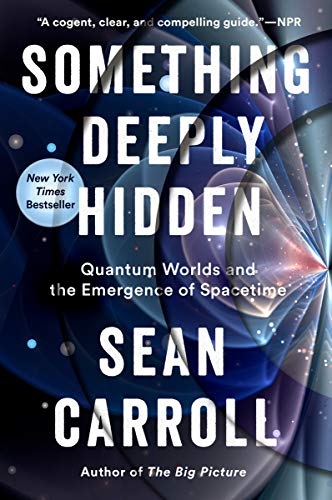
Experts like Ezra Klein, founder and editor at Vox Media, have praised Sean Carroll's Something Deeply Hidden for pushing the boundaries of how we understand reality's deepest layers. Astrophysicist Priyamvada Natarajan admires Carroll's skill in making profound quantum mysteries accessible, while computer scientist Scott Aaronson regards the same work as one of the finest explanations of quantum mechanics available. Such endorsements underscore the blend of rigorous science and compelling narrative these books deliver.
While these popular books provide proven frameworks, readers seeking content tailored to their specific spacetime needs might consider creating a personalized Spacetime book that combines these validated approaches. This way, you can delve into spacetime concepts that matter most to you, guided by expert-approved foundations.
Ezra Klein, founder and editor-at-large at Vox Media, highlights this book as a perplexing yet rewarding exploration of reality's nature. He admits to embracing the confusion that Sean Carroll’s "Something Deeply Hidden" stirs, reflecting how this book challenges conventional understandings of the universe. Klein's recommendation aligns with the widespread acclaim from physics experts and enthusiasts alike, marking it as a significant work that reshapes how you might perceive spacetime and quantum mechanics. Similarly, Priyamvada Natarajan, an astrophysicist and author, praises Carroll for making the deepest mysteries of physics accessible while weaving in metaphysical insights that help you make sense of reality's hidden layers.
“This is a good place to recommend Sean Carroll's new book "Something Deeply Hidden," which is great if you like feeling very confused about the nature of reality, which I guess I do” (from X)
Sean Carroll is a theoretical physicist at the California Institute of Technology, host of the Mindscape podcast, and author of From Eternity to Here, The Particle at the End of the Universe, and The Big Picture. He has been awarded prizes and fellowships by the National Science Foundation, NASA, the American Institute of Physics, and the Royal Society of London, among many others. He lives in Los Angeles with his wife, writer Jennifer Ouellette.
Sean Carroll, a theoretical physicist at Caltech, challenges how you understand the fabric of reality by tackling the persistent puzzles of quantum mechanics and spacetime. His book dives into the Many Worlds Interpretation, arguing that every quantum event spawns countless parallel versions of you, reshaping the way you think about existence. You’ll gain insights into the intersection of quantum theory and relativity, with chapters that methodically address common objections and illuminate this complex topic with clarity. This book suits those curious about the deepest questions in physics and metaphysics, though it demands patience with abstract, mind-bending ideas rather than straightforward narratives.
Richard P. Feynman, the 1965 Nobel laureate and celebrated Caltech professor, crafted these lectures to illuminate one of physics’ most profound revolutions: Einstein’s Theory of Relativity. His reputation as an accessible yet brilliant teacher shines through as he unpacks challenging ideas about time, mass, and light. This book draws directly from his acclaimed Lectures on Physics, offering you a chance to engage with complex concepts explained by one of the field’s most charismatic minds.
Richard P. Feynman (1918-1988) was the Richard Chace Tolman Professor of Theoretical Physics at the California Institute of Technology. He was awarded the 1965 Nobel Prize for his work on the development of quantum field theory. He was also one of the most famous and beloved figures of the twentieth century, both in physics and in the public arena.
What if everything you knew about relativity and spacetime was reconsidered through the lens of Richard P. Feynman’s engaging lectures? Drawing from his role as a Nobel Prize-winning physicist and renowned Caltech professor, Feynman guides you through Einstein’s Theory of Relativity with clarity and enthusiasm. You’ll explore how time’s flow varies, mass depends on velocity, and the speed of light remains constant regardless of observation — concepts that once shocked the scientific community. The book’s focus on six more challenging lectures from his classic series offers you a deep dive into symmetry and spacetime, making it ideal for curious learners ready to push beyond basics.
This AI-created book on relativity and spacetime is tailored to your knowledge and interests. You share your background and specific spacetime topics you want to explore, and the book focuses on those areas, making complex ideas approachable. By combining proven concepts with your unique goals, it offers a clear path through challenging physics, crafted just for you.
TailoredRead AI creates personalized nonfiction books that adapt to your unique background, goals, and interests. Instead of reading generic content, you get a custom book written specifically for your profession, experience level, and learning objectives. Whether you're a beginner looking for fundamentals or an expert seeking advanced insights, TailoredRead crafts a book that speaks directly to you. Learn more.
2026·50-300 pages·Spacetime, Spacetime Basics, Relativity Principles, Time Dilation, Mass-Energy
This tailored book explores battle-tested approaches for understanding relativity and spacetime, blending popular, reader-validated knowledge with your specific interests. It dives into essential concepts such as the nature of spacetime, relativity principles, and their practical implications in physics. By focusing on your background and goals, this personalized guide reveals insights millions have found valuable, making complex theories more accessible and relevant to your learning journey. You’ll engage with topics ranging from the fundamentals of time dilation to the geometry of the fourth dimension, all tailored to enhance your grasp of spacetime with clarity and precision.
John Archibald Wheeler, a leading figure in theoretical physics renowned for coining the term 'black hole' and advancing understanding of gravitational waves and spacetime, brings his extensive expertise to this work. As a Princeton University professor who mentored many influential physicists, Wheeler's deep knowledge shapes the book’s thorough treatment of relativity and cosmology. His background equips you to grasp complex physics topics presented in accessible form, making this book a valuable resource for those seeking a deeper dive into spacetime physics.
John Archibald Wheeler was a prominent American theoretical physicist known for his work in general relativity and quantum mechanics. He coined the term 'black hole' and contributed significantly to the understanding of gravitational waves and the nature of spacetime. He was a professor at Princeton University and mentored many notable physicists, influencing the field of theoretical physics profoundly.
1966·208 pages·Relativity, Spacetime, Physics, General Relativity, Gravity Waves
What happens when deep expertise meets the mysteries of spacetime? In this book, John Archibald Wheeler and Edwin F. Taylor, pioneers in theoretical physics, take you beyond basic relativity to explore topics from microgravity environments to cutting-edge cosmology. You gain insights into phenomena like collider accelerators, pulsars, and gravity waves, with dedicated chapters clarifying general relativity's complexities, including black holes. If you're curious about how Einstein's theories apply to both the very small and the cosmic scale, this book offers clear explanations that bridge classroom learning with advanced concepts.
Rudolf v.B. Rucker, a mathematics professor at the State University of New York in Geneseo, brings his deep expertise in math and computer science to this book. Known for blending rigorous mathematical ideas with accessible storytelling, Rucker offers a unique lens on spacetime and the fourth dimension. His background in both academia and science fiction enriches this exploration, making complex concepts approachable and engaging for a broad audience interested in the structure of the universe.
Rudolf v.B. Rucker is a professor of mathematics at the State University of New York in Geneseo. He is known for his work in the fields of mathematics and computer science, as well as for his contributions to science fiction. Rucker's writings often explore complex mathematical concepts and their implications in a way that is accessible to a general audience. His unique ability to blend rigorous mathematical theory with imaginative storytelling has made him a prominent figure in both academia and literature.
Rudolf v.B. Rucker challenges the conventional wisdom that discussions of the fourth dimension must be abstract and inaccessible. Drawing from his expertise as a mathematics professor, he invites you into a visual journey that links the geometry of Flatland to the complexities of our three-dimensional universe extended into a fourth dimension. You’ll explore non-Euclidean geometry, curved space, and the nature of time as another dimension, all supported by 141 illustrations that bring these concepts to life. This book suits anyone curious about spacetime’s structure, whether you’re comfortable with math or prefer to skip denser sections and still grasp the core ideas.
Hans Reichenbach was a prominent philosopher of science and a key figure in logical positivism. His extensive work in the philosophy of physics, especially concerning relativity and geometry, grounds this book’s exploration of spacetime. Driven by a commitment to empirical observation and logical rigor, Reichenbach offers readers a uniquely structured perspective on how space and time intertwine, making complex ideas accessible to those willing to engage deeply with both philosophy and mathematics.
Hans Reichenbach was a prominent philosopher of science and a key figure in the development of logical positivism. He made significant contributions to the philosophy of physics, particularly in relation to the theory of relativity and the foundations of geometry. His work emphasizes the importance of empirical observation and the logical structure of scientific theories.
Hans Reichenbach's decades of philosophical inquiry into physics culminate in this detailed examination of space and time's foundations. You gain insight into the interplay between geometry and physical reality, exploring topics like non-Euclidean spaces, simultaneity, and Einstein's relativity, all presented with a clarity that balances mathematical rigor and philosophical depth. For instance, his analysis of the space-time metric and gravitational theory challenges you to reconsider how these concepts shape our understanding of the universe. This book suits those comfortable with intermediate mathematics and philosophy, aiming to deepen their grasp of spacetime's conceptual underpinnings rather than casual science readers.
This personalized AI book about quantum spacetime is crafted from your unique interests and existing knowledge. Using AI, it focuses on the specific topics within quantum mechanics and spacetime that you want to understand more deeply. By tailoring the content to your goals and background, it helps you cut through complexity and build insights that resonate personally. It’s like having a guide that knows exactly what parts of this challenging subject you need to explore.
TailoredRead AI creates personalized nonfiction books that adapt to your unique background, goals, and interests. Instead of reading generic content, you get a custom book written specifically for your profession, experience level, and learning objectives. Whether you're a beginner looking for fundamentals or an expert seeking advanced insights, TailoredRead crafts a book that speaks directly to you. Learn more.
This tailored book explores the fascinating intersection of quantum mechanics and spacetime, offering a focused journey into some of physics’ most intriguing mysteries. It examines how quantum phenomena weave into the fabric of spacetime, revealing complex concepts in a way that matches your background and interests. By concentrating on the aspects you find most compelling, this personalized guide helps clarify challenging subjects such as quantum entanglement, spacetime curvature, and the nature of reality at microscopic scales. This approach ensures that you engage deeply with material that matters to you, accelerating your understanding of quantum spacetime concepts without unnecessary detours.
This book offers a distinctive exploration of quantum field theory applied to curved spacetime, a subject that bridges fundamental physics and advanced mathematics. Stephen A. Fulling’s approach, rooted in his graduate course experience, provides a resource that’s been widely adopted for self-study and advanced classes alike. Its informal style and inclusion of necessary background material make it invaluable to mathematicians and physicists seeking to understand aspects of quantum theory seldom emphasized elsewhere. If you’re working within relativity or quantum field theory, this text addresses complex challenges with clarity, enriching your understanding of spacetime's quantum structure.
1989·328 pages·Spacetime, Quantum Field Theory, General Relativity, Differential Geometry, Functional Analysis
Drawing from his expertise in mathematical physics and teaching experience, Stephen A. Fulling presents a focused look at quantum field theory within curved spacetime. The book offers you an informal yet rigorous guide, assuming some background in general relativity and differential geometry while filling in essential gaps on functional analysis and quantum theory. You’ll explore topics often overlooked in typical reviews, gaining a nuanced understanding of how quantum fields behave in non-flat geometries. This work suits mathematicians and physicists aiming to deepen their grasp of relativistic quantum theory rather than casual learners or those new to the fundamentals.
What makes this book distinctive in the field of spacetime studies is its thorough mathematical exploration of how gravitation, described by curved spacetime, affects wave propagation. Originally published in 1975, this text has maintained its relevance by rigorously developing techniques essential for understanding dynamic gravitational fields within Einstein's framework. Its focus on both four-dimensional and n-dimensional cases provides a versatile resource for mathematicians and physicists tackling complex problems in gravitational theory and partial differential equations. If you seek a detailed and methodical approach to wave equations in a curved spacetime context, this work offers foundational insights that continue to influence contemporary research.
F. G. Friedlander's work stems from a deep engagement with mathematical physics, particularly the interplay between gravity and wave phenomena in curved spacetimes. You explore how gravitational curvature influences wave propagation, gaining insights into the rigorous mathematical treatment of these effects within Einstein's General Theory of Relativity. The book delves into the foundational techniques originally developed by Hadamard and Riesz, providing you with tools applicable to broader problems where gravity itself evolves dynamically. While primarily focused on four-dimensional spacetime, it also touches on n-dimensional cases, making it a rich resource for those interested in partial differential equations and gravitational physics alike.
The best Spacetime books and more, in your inbox each week. No account needed.
Conclusion
This collection highlights key themes in spacetime studies: rigorous theoretical frameworks, philosophical depth, and mathematical precision. If you prefer proven methods grounded in relativity and quantum theory, start with Six Not-so-easy Pieces and Spacetime Physics. For validated approaches blending philosophy and science, The Philosophy of Space and Time offers rich insights.
Combining these readings provides a well-rounded grasp of spacetime's many facets. Alternatively, you can create a personalized Spacetime book to merge proven methods with your unique interests. These widely-adopted approaches have helped countless readers uncover the universe’s deepest secrets.
Frequently Asked Questions
I'm overwhelmed by choice – which book should I start with?
Start with Six Not-so-easy Pieces for a solid foundation in relativity and spacetime concepts. It's accessible yet deep, providing a strong base before moving to more specialized titles.
Are these books too advanced for someone new to Spacetime?
Some books like Spacetime Physics balance clarity with complexity, making them suitable for motivated beginners. Others, such as Aspects of Quantum Field Theory in Curved Spacetime, are more advanced and better for experienced readers.
What's the best order to read these books?
Begin with Feynman's Six Not-so-easy Pieces, then explore Carroll's Something Deeply Hidden for quantum perspectives. Follow with Spacetime Physics and Geometry, Relativity and the Fourth Dimension for applied and visual insights.
Should I start with the newest book or a classic?
Combining classics like The Philosophy of Space and Time with newer works like Something Deeply Hidden offers a balanced view of spacetime’s evolving understanding.
Do I really need to read all of these, or can I just pick one?
You can start with one book that matches your interest, but reading multiple titles enriches your perspective by covering different dimensions of spacetime—from theory to philosophy.
Can personalized books complement these expert recommendations?
Yes! These expert titles provide solid foundations, while personalized books tailor insights to your background and goals. Combining both ensures efficient, relevant learning. Learn more here.
📚 Love this book list?
Help fellow book lovers discover great books, share this curated list with others!