7 Speech Recognition Books That Separate Experts from Amateurs
Al Sweigart, best-selling Python author, and other thought leaders recommend these Speech Recognition books for practical and technical mastery.
Updated on June 28, 2025·We may earn commissions for purchases made via this page
0 of 7 books have Audiobook versions
We're launchingLaunching on Product Hunt today 🎉We just launchedJust launched on Product Hunt 🎉
Modelpeers, from the BookAuthority teamFrom the BookAuthority team: Modelpeers, a free way to follow AI models and agents like you follow people. We'd love your support.
What if your computer could truly understand your voice? Speech recognition technology has quietly revolutionized how we interact with devices, from virtual assistants to real-time transcription. But mastering this field means navigating complex algorithms, models, and applications that continue evolving rapidly.
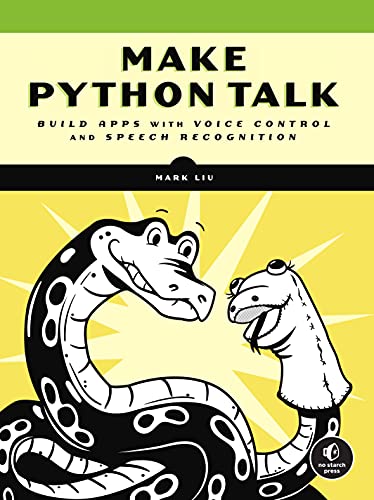
Al Sweigart, known for his best-selling Python programming books, endorses Make Python Talk for its clear, practical approach to voice-controlled apps. His work bridges the gap between coding fundamentals and interactive speech projects, helping beginners build confidence in this dynamic domain.
While these expert-curated books provide proven frameworks, readers seeking content tailored to their specific experience level, goals, or industry focus might consider creating a personalized Speech Recognition book that builds on these insights with customized learning paths and targeted examples.
Al Sweigart, the best-selling author of Automate the Boring Stuff with Python, brings expert insight to this book. He highlights how it clearly presents speech software libraries, making it approachable for anyone eager to add voice functionality to their Python projects. His endorsement underscores that after exploring this book, you’ll be equipped to harness Python’s capabilities for speech recognition with confidence, moving from theory to practical voice-controlled applications with clarity.
“A solid book for anyone who wants to leverage the power of the Python programming language to add speech capabilities to their programs . . . Make Python Talk presents these speech software libraries with clarity and ease.” (from Amazon)
Dr. Mark H. Liu is the founding director of Master of Science in Finance program at the University of Kentucky, U.S.A., where he holds the title of associate professor of finance with tenure. Dr. Liu obtained his Ph.D. in finance from Boston College and his M.A. in economics from Western University in Canada. He has more than 20 years of coding experience in C++, SAS, Stata, and Python, and his research has been published in many top finance journals.
What makes this book different from others in the programming space is how Mark Liu blends Python fundamentals with practical voice control applications, transforming basic coding into interactive, voice-activated experiences. You’ll learn to build Python modules from scratch, implement animations, and integrate live data, all through projects like voice-controlled games and a virtual personal assistant that can manage emails and news. Liu’s background in finance and extensive coding experience shines through in the way complex speech recognition concepts are broken down for beginners to grasp and apply. If you want to move beyond simple scripts and create apps that respond to your voice commands, this book guides you step-by-step without overwhelming jargon.
Lawrence R. Rabiner is a leading authority in speech recognition, known for pioneering work on hidden Markov models that underpin much of today’s technology. His expertise in both theory and practical applications uniquely positions him to guide you through the complexities of speech processing. This book reflects his commitment to making advanced concepts accessible to engineers, scientists, and linguists seeking a solid technical foundation in automatic speech recognition.
Lawrence R. Rabiner is a prominent figure in the field of speech recognition, known for his contributions to hidden Markov models (HMMs) and their applications in speech processing. His work has significantly influenced the development of modern speech recognition systems, making complex concepts accessible to practitioners and researchers alike.
Drawing from decades of research in speech processing, Lawrence Rabiner and Biing-Hwang Juang offer a detailed exploration of machine-based speech recognition that goes beyond surface-level concepts. You’ll gain insight into everything from acoustic-phonetic properties of speech to the implementation of hidden Markov models, a key technology in the field. The book meticulously covers system design, continuous speech recognition, and task-specific applications, making it especially useful if you’re engaged in engineering or linguistics related to speech technology. However, if you’re new to the topic, the technical depth might demand patience and dedication to fully absorb.
This custom AI book on voice applications is created based on your programming background, experience with speech technology, and the specific areas you want to focus on. By sharing your goals and skill level, you get a book that guides you through the particular challenges and techniques relevant to you. Unlike generic guides, this tailored approach helps you learn efficiently by concentrating on what matters most in building voice-controlled apps.
TailoredRead AI creates personalized nonfiction books that adapt to your unique background, goals, and interests. Instead of reading generic content, you get a custom book written specifically for your profession, experience level, and learning objectives. Whether you're a beginner looking for fundamentals or an expert seeking advanced insights, TailoredRead crafts a book that speaks directly to you. Learn more.
This tailored book explores step-by-step methods for creating voice-controlled applications using speech recognition technology. It covers the foundational concepts of speech input processing and guides you through designing, developing, and refining voice apps that respond accurately to user commands. The content is personalized to match your programming background, skill level, and specific goals, ensuring a focused learning path that emphasizes practical application and deep understanding.
By synthesizing expert knowledge with your unique interests, the book reveals how to integrate speech recognition libraries, manage voice data, and troubleshoot common challenges. This customized approach helps you build engaging, responsive voice applications that align precisely with what you want to achieve.
Josué Batista, a digital strategist and solution architect with experience at Meta's Reality Research Labs and Harvard Business School, brings a specialized focus on generative AI and large language models to this book. His extensive background in technology introduction and leadership informs a practical guide to mastering OpenAI's Whisper. Drawing from his academic and professional experiences, Batista equips you with the knowledge to navigate and implement advanced speech processing solutions effectively.
Josué Batista, a Digital Strategist and Solution Architect, has drawn on his rich blend of academic prowess and industry experience while writing this book. With an MBA and a Master's in Information Systems Management, he has excelled in various roles, including as a technical programmatic leader at PPG Industries, Meta's Reality Research Labs, and Harvard Business School, where he focused on generative AI and large language models. His book draws on his extensive experience in new technology introduction, offering readers a comprehensive guide to mastering OpenAI's Whisper for practical applications. Originally from Ciudad Bolivar, Venezuela, Josué resides in Pittsburgh, PA, with his wife and feline companions.
Josué R Batista, with his unique blend of academic rigor and industry leadership at firms like Meta and Harvard Business School, offers a deep dive into OpenAI's Whisper technology. You’ll explore the transformer model's architecture, multilingual capabilities, and how to fine-tune Whisper for varied applications, from transcription to voice synthesis. The book dedicates chapters to applying Python code for real-world scenarios, including voice assistants and real-time translation, making it a practical manual for tech professionals. If you’re aiming to build or enhance speech recognition systems with a solid grounding in generative AI, this book provides the detailed insight to get there.
Roberto Pieraccini, Director of the International Computer Science Institute in Berkeley, has over thirty years of experience leading speech research teams at IBM and AT&T Bell Laboratories. His book narrates six decades of advances and setbacks in computer speech technology, reflecting his deep expertise and firsthand involvement. Pieraccini offers readers an accessible yet technically rich account of how speech recognition evolved and what challenges remain to achieve truly conversational machines.
Roberto Pieraccini, Director of ICSI, the International Computer Science Institute in Berkeley, California, has been active for more than thirty years in speech research and technology. He has led teams at various prestigious institutions, including IBM and AT&T Bell Laboratories, and has authored around 150 scientific papers. His first book, 'The Voice in the Machine', published by MIT Press in 2012, narrates the story of 60 years of computer speech technology evolution in an accessible manner.
Roberto Pieraccini's decades of leadership in speech research and technology at institutions like IBM and AT&T Bell Laboratories shape this detailed exploration of machine understanding of human speech. The book walks you through the evolution from early waveform methods to advanced mathematical models like Hidden Markov Models, offering insights into the challenges behind creating conversational computers. You gain a nuanced view of speech recognition development, dialog systems, and market-ready talking machines, including thoughtful reflections on why fully conversational AI remains elusive. This book suits anyone aiming to grasp the technical and historical journey of speech recognition and its future possibilities.
Alan Wee-Chung Liew brings a wealth of expertise in electrical and electronic engineering, computer vision, and pattern recognition to this work. His academic journey from the University of Auckland to Griffith University, coupled with extensive research fellowships, grounds this book firmly in authoritative scholarship. Driven by his research interests and experience reviewing for IEEE and other journals, Liew offers deep insights into lip segmentation and mapping to support speech recognition advancements.
Alan Wee-Chung Liew received his bachelors degree in engineering with first class honors in electrical and electronic engineering from the University of Auckland, New Zealand, in 1993, and a Ph.D. in Electronic Engineering from the University of Tasmania, Australia, in 1997. He worked as a Research Fellow and later a Senior Research Fellow at the Department of Electronic Engineering at the City University of Hong Kong. From 2004 to 2007, he was with the Department of Computer Science and Engineering, The Chinese University of Hong Kong as an Assistant Professor. In 2007, he joined the School of Information and Communication Technology, Griffith University as a Senior Lecturer. His current research interests include computer vision, medical imaging, pattern recognition and bioinformatics. He serves as a technical reviewer for many international conferences and journals such as IEEE Transactions, IEE proceedings, bioinformatics and computational biology. Dr. Liew is a senior member of the Institute of Electrical and Electronic Engineers (IEEE) since 2005, and his biography is listed in the Marquis Who's Who in the World and Marquis Who's Who in Science and Engineering.
Alan Wee-Chung Liew and Shilin Wang explore a niche yet crucial facet of speech recognition by focusing on the role of lip movements in enhancing audio-visual speech recognition systems. The book delves into lip segmentation techniques and mapping strategies, offering detailed insights into visual speaker authentication and lip modeling, which are particularly valuable in noisy environments where traditional audio recognition struggles. If your work involves improving speech recognition accuracy or you're researching biometric speaker verification, this book provides a solid foundation of current methodologies and evaluation frameworks. However, it’s tailored more to specialists and researchers than casual learners or general tech enthusiasts.
This AI-created book on speech recognition is designed specifically for you, based on your current knowledge, interests, and goals. By tailoring the learning path to your unique needs, it focuses on the areas that matter most to your speech recognition journey. Instead of generic coverage, you receive a custom guide that makes mastering complex topics more approachable and aligned with what you want to achieve. It’s like having a personal coach who understands exactly where you are and where you want to go.
TailoredRead AI creates personalized nonfiction books that adapt to your unique background, goals, and interests. Instead of reading generic content, you get a custom book written specifically for your profession, experience level, and learning objectives. Whether you're a beginner looking for fundamentals or an expert seeking advanced insights, TailoredRead crafts a book that speaks directly to you. Learn more.
This tailored book explores speech recognition with a focus on your individual goals and background, guiding you through an accelerated 90-day learning journey. It covers foundational topics such as acoustic modeling and signal processing, progressing to advanced areas like neural networks and real-time applications. By tailoring content to your interests, it reveals how speech recognition systems function and evolve, making complex concepts accessible and relevant to your ambitions. This personalized approach ensures you engage with material that matches your skill level and desired outcomes, helping you build mastery efficiently without wading through unrelated content.
Dr. Mingkuan Liu is a seasoned AI and machine learning expert with over 20 years leading teams at companies like eBay and Microsoft. Currently Vice President of Data Science and Machine Learning at Appen, he wrote this book to share hands-on AI/ML development knowledge across industries. His extensive background in speech recognition and natural language processing uniquely qualifies him to guide you through building a voice assistant that understands dozens of languages and connects with ChatGPT, making the complex accessible for newcomers and professionals alike.
Dr. Mingkuan Liu is a seasoned AI and machine learning expert with over 20 years of industry research and development experience. He has led several machine learning teams for renowned companies like eBay, Microsoft, and Garmin, working in the fields of speech recognition, natural language processing, search, and recommendation. Dr. Liu currently serves as the Vice President of Data Science and Machine Learning at Appen, spearheading the development of large scalable AI/ML automation solutions to drive business operations for growth and efficiency. His passion for sharing his knowledge and expertise with a broader audience led him to create the How-To-Do-AI book series. His aim is to provide readers with a practical, hands-on approach that can be applied across various industries and organizations. Whether you are a seasoned professional, a newcomer to the field, or a business leader looking to leverage the power of machine learning, Dr. Liu's book series offers valuable insights and guidance.
Drawing from over two decades of experience in AI and machine learning, Dr. Mingkuan Liu presents a clear, approachable guide to building AI/ML web applications with a focus on speech and voice technology. You’ll walk through foundational concepts, setting up your environment, and coding with Python and Streamlit, culminating in creating a voice assistant that understands 97 languages and interacts with ChatGPT. Notably, chapters 3 and 4 provide detailed tutorials on Streamlit app development and integrating Whisper ASR for transcription. This book is well-suited if you want a practical introduction to AI-powered voice apps without heavy prior coding experience, especially if you’re a student, hobbyist, or part of a hackathon team.
Pablo Romero Fresco is Honorary Professor of Translation and Filmmaking at the University of Roehampton, UK. His academic expertise in translation studies and practical experience in filmmaking uniquely position him to author this detailed examination of subtitling through speech recognition. Drawing on rigorous research and hands-on knowledge, he crafted this book to offer both classroom and self-learners a thorough guide to respeaking, highlighting its importance for accessibility and media professionals.
Pablo Romero-Fresco draws from his extensive academic career in translation and filmmaking to explore subtitling through speech recognition, focusing on the innovative technique of respeaking. This book delves into the historical context of subtitling for the deaf and hard of hearing, while providing an in-depth course on the skills required before, during, and after the respeaking process. You’ll find detailed insights into live subtitle production methods and the reception of subtitles, supported by eye-tracking studies that reveal viewer preferences and comprehension. Ideal for language professionals, students, and accessibility advocates, it offers concrete examples and downloadable resources to strengthen your practical understanding.
The best Speech Recognition books and more, in your inbox each week. No account needed.
Conclusion
These seven books collectively trace the arc of speech recognition, from foundational theory and historical context to cutting-edge AI applications and accessibility innovations. If you're grappling with technical depth, Fundamentals of Speech Recognition offers rigorous insight, while Make Python Talk and AI/ML Web App Development for Everyone provide hands-on guides to building voice-enabled projects.
For those focused on emerging AI models, Learn OpenAI Whisper dives into generative speech technologies, and Visual Speech Recognition opens doors to combining visual cues with audio input. Meanwhile, Subtitling Through Speech Recognition emphasizes practical applications in accessibility and media.
Alternatively, you can create a personalized Speech Recognition book to bridge the gap between general principles and your specific situation. These books can help you accelerate your learning journey with expert-validated knowledge and real-world applications.
Frequently Asked Questions
I'm overwhelmed by choice – which book should I start with?
Start with Make Python Talk if you want practical, approachable projects using Python. It’s endorsed by Al Sweigart for clarity and hands-on learning, perfect for beginners eager to build voice apps.
Are these books too advanced for someone new to Speech Recognition?
Not all. While Fundamentals of Speech Recognition is technical and suited for those with a strong background, books like Make Python Talk and AI/ML Web App Development for Everyone cater to newcomers with step-by-step guidance.
What's the best order to read these books?
Begin with practical guides like Make Python Talk or AI/ML Web App Development for Everyone to grasp application basics. Then explore deeper theory in Fundamentals of Speech Recognition and historical context in The Voice in the Machine.
Should I start with the newest book or a classic?
Both have value. Newer titles like Learn OpenAI Whisper cover cutting-edge AI models, while classics like Fundamentals of Speech Recognition provide foundational knowledge essential for understanding modern advances.
Which books focus more on theory vs. practical application?
Fundamentals of Speech Recognition and The Voice in the Machine focus on theory and system design. Make Python Talk and AI/ML Web App Development for Everyone emphasize hands-on development and app building.
Can personalized books complement these expert recommendations?
Yes! Expert books offer broad frameworks, but personalized Speech Recognition books tailor content to your experience, goals, and interests, making learning more efficient and relevant. Explore your options here.
📚 Love this book list?
Help fellow book lovers discover great books, share this curated list with others!