20 Theoretical Physics Books That Separate Experts from Amateurs
Recommended by Sean Carroll (Caltech physicist), Kirk Borne (Principal Data Scientist), and Frank Petriello (Northwestern University) to accelerate your mastery of Theoretical Physics
Updated on June 24, 2025·We may earn commissions for purchases made via this page
17 of 20 books have Kindle versions
We're launchingLaunching on Product Hunt today 🎉We just launchedJust launched on Product Hunt 🎉
Modelpeers, from the BookAuthority teamFrom the BookAuthority team: Modelpeers, a free way to follow AI models and agents like you follow people. We'd love your support.
What if I told you that the secrets of the universe are hidden in equations and concepts most people find daunting? Theoretical physics stands at the frontier of human knowledge, offering explanations for everything from the birth of the cosmos to the behavior of the tiniest particles. Understanding these ideas can feel overwhelming, but the right books open doors to this profound world.
Physicists like Sean Carroll, a Caltech professor known for clear communication of complex ideas, and Kirk Borne, a Principal Data Scientist and PhD astrophysicist, have long relied on certain texts to navigate these challenges. Carroll credits Special Relativity and Classical Field Theory for grounding his mathematical grasp, while Borne highlights Gravitation as pivotal in understanding gravity’s mysteries. Their endorsements come from years immersed in research and teaching, making their recommendations a trustworthy compass.
These 20 books, carefully selected for their expert validation and impact, cover foundational theories and cutting-edge developments. While these expert-curated books provide proven frameworks, readers seeking content tailored to their specific background, interests, and goals might consider creating a personalized Theoretical Physics book that builds on these insights, helping you accelerate your learning journey.
Smithsonian Magazine, a trusted science publication, highlights Michio Kaku's ability to write about complex science in "clean, concise language," calling the book "a clear and engaging story of a difficult scientific quest." Their endorsement carries weight given their broad coverage of scientific topics and their appreciation for Kaku's accessible style. This perspective complements The Wall Street Journal's praise of Kaku as a "masterful science communicator" who demystifies string theory's complex mathematics, making the book a compelling primer for those ready to engage with cutting-edge theoretical physics.
Michio Kaku is a professor of theoretical physics at the City University of New York, co-founder of string field theory, and the author of several widely acclaimed science books, including Beyond Einstein, The Future of Humanity, The Future of the Mind, Hyperspace, Physics of the Future, and Physics of the Impossible. He is the science correspondent for CBS This Morning, the host of the radio programs Science Fantastic and Exploration, and a host of several science TV specials for the BBC and the Discovery and Science Channels.
Michio Kaku's decades as a theoretical physicist and co-founder of string field theory shape this exploration of the elusive "theory of everything." You’ll encounter detailed discussions on how relativity and quantum mechanics might merge into a single framework, with specific chapters tackling mysteries like what came before the Big Bang and the nature of black holes. The book benefits anyone curious about the cutting edge of physics, especially those wanting an accessible yet substantive grasp of complex concepts without oversimplification.
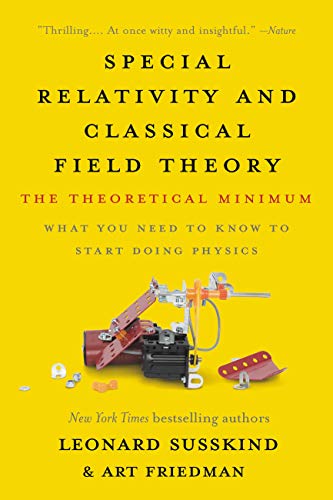
Sean Carroll, a physicist at Caltech and Santa Fe Institute, highlights how this book brings special relativity and field theory to life with sharp insight and wit, emphasizing that it covers "physics the way it's really done, in all its glory, nothing swept under the rug." His endorsement carries weight given his deep expertise in theoretical physics and public science communication. This volume helped him appreciate the rigorous mathematical foundations behind these central concepts, challenging simplified views. Publisher's Weekly also praises the book's clarity and humor, noting its well-paced, concise exploration of complex math, while Nature acknowledges Susskind's methodical, historical approach that eases novices into demanding material with wit and insight.
“Relativity and field theory are absolutely central to modern physics. Here they are explained masterfully, with insight and wit. This is physics the way it's really done, in all its glory, nothing swept under the rug.”
Leonard Susskind is the Felix Bloch Professor in Theoretical Physics at Stanford University. He is the author of Quantum Mechanics (with Art Friedman) and The Theoretical Minimum (with George Hrabovsky), among other books. He lives in Palo Alto, California. Art Friedman is a data consultant and the author of Quantum Mechanics (with Leonard Susskind). A lifelong student of physics, he lives in Murphys, California.
Leonard Susskind, a leading theoretical physicist at Stanford, teams up with Art Friedman to unpack the complexities of special relativity and classical field theory through a mathematically rigorous yet accessible approach. You’ll dive into Einstein’s groundbreaking ideas alongside Maxwell’s electromagnetism, learning how waves, forces, and particles interconnect, supported by clear diagrams and a touch of humor. The book challenges you to engage directly with the math behind the theories, making it ideal if you want to move beyond popular science and grasp the foundational physics at a technical level. While demanding, it rewards those curious about the core principles shaping modern physics.
This AI-created book on theoretical physics is crafted based on your specific background, interests, and goals. By sharing which physics subtopics intrigue you and your current understanding, the book focuses on delivering content that matches your needs. This personalized approach helps you navigate complex theories and concepts efficiently, ensuring you get exactly what you want from your study of physics.
TailoredRead AI creates personalized nonfiction books that adapt to your unique background, goals, and interests. Instead of reading generic content, you get a custom book written specifically for your profession, experience level, and learning objectives. Whether you're a beginner looking for fundamentals or an expert seeking advanced insights, TailoredRead crafts a book that speaks directly to you. Learn more.
This tailored book offers a deep dive into fundamental and advanced theoretical physics concepts, carefully aligned with your background and goals. It explores key areas such as quantum mechanics, relativity, field theory, and particle physics, synthesizing complex ideas into a coherent and accessible journey. By focusing on your interests and skill level, this personalized guide navigates the challenging terrain of theoretical physics with clarity and precision, helping you build a robust understanding of the subject.
Designed to bridge expert knowledge and your unique learning path, the book examines core principles and emerging topics in a way that matches your pace and ambitions. It reveals connections across theories and provides a custom pathway through the fascinating world of physics.
Eugene Demler, a Harvard physicist with deep expertise in quantum many-body systems, praises this book for its clear presentation, a crucial factor when grappling with abstract group theory concepts. He highlights how it helped clarify the mathematical structures underlying fundamental forces, reshaping his teaching approach. Also, Barry Simon from Caltech notes its comprehensive treatment of group representations, bridging mathematical rigor and physical intuition, making it a preferred graduate-level text for theoretical physics students.
A. Zee is professor of physics at the Kavli Institute for Theoretical Physics at the University of California, Santa Barbara. His books include Quantum Field Theory in a Nutshell, Einstein Gravity in a Nutshell, and Fearful Symmetry: The Search for Beauty in Modern Physics (all Princeton).
Drawing from his extensive experience at the Kavli Institute for Theoretical Physics, Anthony Zee offers a focused exploration of group theory tailored specifically to physicists. You’ll find a thorough yet approachable journey from foundational concepts to advanced applications such as gauge theories unifying fundamental forces. The book dives into topics like finite groups, character tables, and the role of group theory across particle physics, relativity, and condensed matter, even including a refresher on linear algebra to support your understanding. If you want to deepen your grasp of mathematical structures central to modern theoretical physics, this text provides both clarity and depth without unnecessary complexity.
David Tong, a professor at the University of Cambridge known for his deep expertise in theoretical physics, highlights how little quantum field theory is understood outside expert circles. He calls this book a corrective to that gap, emphasizing its importance in grasping modern physics. His endorsement reflects the clarity and accessibility Anthony Zee brings to complex topics, making them approachable without oversimplification. Alongside Tong, Frank Petriello praises the book’s balance between analogy, accurate mathematics, and historical context, marking it as a top recommendation for newcomers eager to understand quantum field theory.
“Quantum field theory is largely unknown to nonexperts, though it underlies vast swathes of modern physics. This book is a corrective to this extraordinary state of affairs.”
Anthony Zee is a professor of physics at the Kavli Institute for Theoretical Physics at the University of California, Santa Barbara. His many books include Top Ten Ideas of Physics, Fly by Night Physics, On Gravity, Group Theory in a Nutshell for Physicists, Einstein Gravity in a Nutshell, Quantum Field Theory in a Nutshell, and Fearful Symmetry (all Princeton).
Drawing from decades at the Kavli Institute for Theoretical Physics, Anthony Zee offers a refreshingly clear take on quantum field theory, a topic that often intimidates even seasoned physicists. You’ll explore the conceptual foundations behind phenomena like antimatter, Feynman diagrams, and quantum gravity without getting lost in heavy formalism. Chapters weave historical insights with accessible explanations, such as how electroweak unification reshaped our understanding of forces. This book suits you if you seek a conceptual grasp of quantum field theory’s core ideas rather than a purely mathematical treatment.
Kirk Borne, Principal Data Scientist and PhD Astrophysicist, points to this hefty volume as essential for understanding gravity—the one fundamental force still without a quantum explanation. He highlights how the book traces the evolution of gravitational theory from Newton to Einstein, deepening his grasp of the subject during his scientific explorations. "#Gravity is the only one of the four fundamental forces of #Physics that doesn’t (yet) have a quantum explanation — learn how our understanding of Gravity has evolved, from Newton’s great insight to Einstein’s," he notes. Alongside him, Seamus Blackley, physicist and CEO known for pioneering the Xbox, reflects on a personal connection to the book, underscoring its lasting significance.
“#Gravity is the only one of the four fundamental forces of #Physics that doesn’t (yet) have a quantum explanation — learn how our understanding of Gravity has evolved, from Newton’s great insight to Einstein’s:
👇See this gravitationally heavy 3-kg book👇” (from X)
Charles W. Misner, Kip S. Thorne, John Archibald Wheeler, David I. Kaiser(you?)·
About the Author
Charles W. Misner is professor emeritus of physics at the University of Maryland. Kip S. Thorne, co-winner of the 2017 Nobel Prize in physics, is the Feynman Professor Emeritus of Theoretical Physics at the California Institute of Technology. His books include Modern Classical Physics (Princeton), Black Holes and Time Warps, and The Science of Interstellar. John Archibald Wheeler (1911–2008) was professor of physics at Princeton University and later at the University of Texas, Austin. His books include Spacetime Physics and Geons, Black Holes, and Quantum Foam.
When physicists Charles W. Misner, Kip S. Thorne, and John Archibald Wheeler teamed up to write this extensive tome, they brought decades of research and teaching expertise to the complex topic of gravitation. You’ll gain a deep understanding of Einstein’s general theory of relativity through a unique two-track approach: one that grounds you in core physical concepts and another that explores advanced topics like black holes and gravitational waves. The book doesn’t just explain theory; it equips you to calculate and predict phenomena in curved spacetime, making it ideal if you want to master the geometric framework underpinning modern physics. While dense, its detailed chapters on neutron stars and cosmology offer invaluable insights for anyone serious about theoretical physics.
Published by Princeton University Press
New preface by David Kaiser
Includes introduction by Charles Misner and Kip Thorne
This AI-created book on quantum physics is crafted based on your background and specific learning goals. You share which quantum topics intrigue you and your current understanding, and it builds a personalized 30-day plan that covers exactly what you need. This approach helps you navigate complex concepts step-by-step without feeling overwhelmed, making your learning journey focused and engaging.
TailoredRead AI creates personalized nonfiction books that adapt to your unique background, goals, and interests. Instead of reading generic content, you get a custom book written specifically for your profession, experience level, and learning objectives. Whether you're a beginner looking for fundamentals or an expert seeking advanced insights, TailoredRead crafts a book that speaks directly to you. Learn more.
This tailored book offers a dynamic exploration of quantum theory, designed specifically to match your background and learning goals. It focuses on delivering a personalized pathway through complex quantum concepts, providing daily lessons that build your understanding progressively. The content covers foundational principles, wave-particle duality, superposition, entanglement, and measurement theory, all synthesized to resonate with your interests and pace. By concentrating on topics most relevant to you, it reveals the intricate beauty and profound implications of quantum physics without unnecessary detours. This approach ensures you efficiently grasp essential insights and develop a deep appreciation for the quantum world.
Sean Carroll, a physicist at Caltech and the Santa Fe Institute, recalls Sidney Coleman's quantum field theory lectures as among his most memorable educational experiences. He highlights Coleman's meticulous and insightful teaching style, describing these compiled notes as invaluable to anyone tackling modern physics' cornerstone topics. This volume helped deepen Carroll's understanding of the subject's complexities and remains a touchstone in his physics journey. Nobel Laureate Hugh David Politzer echoes this sentiment, praising the lectures’ clarity and enduring relevance, calling the book a treasure for frontier physics practitioners.
Physicist at Caltech and SFI, science communicator
“Sidney Coleman's course on quantum field theory was one of the most memorable and enjoyable experiences of my physics education. Uniquely meticulous and insightful, these notes from his lectures will be invaluable to anyone interested in the cornerstone topic of modern physics.”
Yuan-Sen Ting, Bryan Gin-ge Chen, Richard Sohn, David Derbes(you?)·
About the Author
Yuan-Sen Ting is an editor and physicist known for his contributions to the field of quantum field theory. He has collaborated with notable physicists to compile and present the teachings of Sidney Coleman, a revered figure in theoretical physics. Coleman's lectures at Harvard have influenced generations of physicists, and Ting's work in editing these lectures aims to preserve and disseminate this knowledge to future students and scholars.
What happens when a physicist’s physicist meets the intricate world of quantum field theory? Yuan-Sen Ting, alongside collaborators, meticulously compiles Sidney Coleman's legendary Harvard lectures—renowned for their wit and clarity—into a volume that balances rigor with accessibility. You’ll gain deep insight into quantum field theory’s foundational concepts, illustrated with Coleman's unique ability to simplify without diluting complexity, especially evident in chapters that unravel gauge theories and renormalization. This book suits graduate students and academics who want a direct line to Coleman's teaching legacy, but it’s less suited for casual readers without a solid physics background.
Sean Carroll, a Caltech physicist and author renowned for his expertise in spacetime and geometry, highlights this book as a concise yet comprehensive introduction to General Relativity. His admiration stems from the book's ability to capture the elegance and central importance of the theory in modern physics. Carroll notes, "General relativity is the most beautiful physical theory we have," and credits Rovelli's masterful exposition for making such profound concepts accessible, enriching his own understanding and inspiring newcomers.
“General relativity is the most beautiful physical theory we have, and plays an increasingly central role in modern physics. Carlo Rovelli’s introduction is both concise and comprehensive, written by a master of exposition as well as of the material. I envy anyone encountering these ideas for the first time.”
Carlo Rovelli is Director of the Quantum Gravity group at the Centre de Physique Théorique of Aix-Marseille University; he also holds positions at the University of Western Ontario and the Perimeter Institute in Canada. Among his academic contributions in theoretical physics, he is best known as one of the formulators of Loop Quantum Gravity. He has written two monographs for Cambridge University Press, Quantum Gravity (2004) and (with Francesca Vidotto) Covariant Loop Quantum Gravity (2014). He is also the author of several international bestsellers in popular science such as Seven Brief Lessons on Physics (2016) and The Order of Time (2019).
Carlo Rovelli challenges the common complexity surrounding Einstein's General Relativity by delivering a clear, concept-driven introduction that strips the subject to its core principles. You gain a solid grasp of gravitational theory through lucid explanations paired with accessible mathematical derivations, covering key phenomena like black holes, gravitational waves, and cosmology. The book also ventures briefly into quantum gravity, offering a glimpse into ongoing theoretical debates. It's an ideal choice if you're a university student or an intellectually curious reader wanting more than just popular science but less than a dense textbook.
The New Scientist, a respected authority in physics, highlights this book as a definitive guide from one of the most influential theoreticians of the last half-century. Their praise reflects how Weinberg’s detailed and unflinching treatment reshaped their understanding of quantum field theory’s scope and depth. This recommendation carries weight for anyone serious about theoretical physics. Alongside, Nature commends the book’s clarity and insightful perspective, reinforcing its status as a foundational resource that challenges and enriches established viewpoints.
“Steven Weinberg, one of the greatest theoreticians in the past 50 years, has written a magisterial, no-holds-barred account of the theory in all its glory...a definitive text for succeeding generations.”
Steven Weinberg (born May 3, 1933) is an American theoretical physicist and Nobel laureate in Physics for his contributions with Abdus Salam and Sheldon Glashow to the unification of the weak force and electromagnetic interaction between elementary particles. He holds the Josey Regental Chair in Science at the University of Texas at Austin, where he is a member of the Physics and Astronomy Departments. His research on elementary particles and cosmology has been honored with numerous prizes and awards, including in 1979 the Nobel Prize in Physics and in 1991 the National Medal of Science. In 2004 he received the Benjamin Franklin Medal of the American Philosophical Society, with a citation that said he is considered by many to be the preeminent theoretical physicist alive in the world today. He has been elected to the US National Academy of Sciences and Britain's Royal Society, as well as to the American Philosophical Society and the American Academy of Arts and Sciences.
Steven Weinberg, a Nobel laureate renowned for unifying fundamental forces in physics, offers an extensive exploration of quantum field theory through these three volumes. You’ll gain a deep understanding of the theory’s foundations, modern applications, and cutting-edge topics like supersymmetry, each presented with careful logical progression and mathematical rigor. Chapters interlace abstract concepts with tangible examples from particle and condensed matter physics, reflecting Weinberg's own research leadership. This book is ideal if you want a thorough, mathematically sophisticated grasp of quantum field theory, though it demands serious commitment and prior physics background.
Thomas Appelquist, a professor at Yale University known for his expertise in theoretical physics, highlights this book's unique approach that carefully transitions from classical physics to complex gauge field theories. He notes, "This new and very welcome introduction to quantum field theory takes the reader from the basics of classical physics and the beauty of group theory to the intricacies and elegance of gauge field theories." His endorsement reflects how the book reshaped his appreciation for foundational concepts and modern theoretical frameworks.
“This new and very welcome introduction to quantum field theory takes the reader from the basics of classical physics and the beauty of group theory to the intricacies and elegance of gauge field theories. Students and researchers alike will treasure this fresh approach to one of the foundation stones of modern physics.”
Anthony G. Williams is Professor in Physics at the University of Adelaide, Australia. He has worked extensively in the areas of hadronic physics and computational physics, studying quark and gluon substructure. For this work, he was awarded the Walter Boas Medal by the Australian Institute of Physics in 2001 and elected Fellow of the American Physical Society in 2002. In 2020, he became the Deputy Director of the Australian Research Council Centre of Excellence for Dark Matter Particle Physics, where he studies the direct detection of dark matter and extensions of the Standard Model.
Drawing from decades of research in hadronic and computational physics, Anthony G. Williams crafted this textbook to bridge foundational classical mechanics with the complexities of quantum and gauge field theories. The book methodically guides you through advanced dynamics and special relativity before unpacking relativistic quantum mechanics and classical field theory, laying a solid groundwork for understanding modern theoretical physics frameworks. Williams includes full derivations and worked examples, making challenging concepts like gauge symmetries more accessible, while end-of-chapter problems reinforce comprehension. If you want a rigorous yet pedagogically clear path from classical physics to the forefront of quantum field theory, this book delivers precisely that.
Melvin Schwartz, Nobel Laureate and Columbia University physicist, praises this book for its rare combination of scientific rigor and human insight. He recalls how reading it transported him back to the exhilarating days of groundbreaking particle discoveries, remarking, "I must congratulate you! The book you have written is truly a masterpiece." His endorsement reflects the book’s ability to engage both students and intelligent laypeople. Nobel Laureate Sheldon Glashow also highlights Veltman’s sweeping coverage of particle physics history and the vivid portrayal of its eccentric scientists, making this a compelling read for anyone drawn to the subatomic world.
“I must congratulate you! The book you have written is truly a masterpiece. Not only have you explained the physics of the world of elementary particles to the young aspiring student, but you have made it available to the intelligent layman. On top of that you gave it the humanity it deserves; reading this book brought me back to the most exciting period of my life in which every day brought a new discovery and we all fought for recognition. I can truly say that there is no book like this.”
Martinus Veltman, born in 1931 in Waalwijk, the Netherlands, studied at the University of Utrecht. He started as a fellow at CERN, Geneva, Switzerland, and later became Professor of Theoretical Physics in Utrecht. Together with his then student 't Hooft he developed the mathematical implementation of gauge theories. In 1977 he deduced an equation that allowed a prediction of the mass of the top quark. In 1981 he accepted a position at the University of Michigan. After retirement he moved back to the Netherlands. The top quark with a mass as predicted was found at Fermilab in 1995, and in 1999 't Hooft and Veltman were awarded the Nobel Prize in Physics, "for elucidating the quantum structure of electroweak interactions in physics".
Unlike most theoretical physics books that dive straight into complex mathematics, Martinus Veltman offers a narrative shaped by his own pioneering journey through particle physics. You’ll gain a clear understanding of quantum mechanics and relativity as he connects these foundations to real-world experiments at CERN and Fermilab. The book balances technical insight with personal anecdotes about key discoveries and the scientists behind them, making abstract concepts more relatable. This makes it ideal if you want to grasp how theory and experiment intertwine in uncovering the universe’s smallest building blocks.
Michael Peskin, a physicist at SLAC National Accelerator Laboratory and Stanford University, highlights the unique place this book holds in theoretical physics education. His deep experience with quantum field theory makes his endorsement especially meaningful. Peskin notes, "There is a need for a book on Quantum Field Theory that is not directed at specialists but, rather, sets out the concepts underlying this subject for a broader scientific audience and conveys joy in their beauty." This text helped clarify complex ideas for him by focusing on conceptual understanding alongside mathematical rigor, making it a valuable guide for anyone moving beyond undergraduate physics.
“There is a need for a book on Quantum Field Theory that is not directed at specialists but, rather, sets out the concepts underlying this subject for a broader scientific audience and conveys joy in their beauty. Lancaster and Blundell have written with this goal in mind, and they have succeeded admirably.”
Tom Lancaster is a Lecturer in Physics at the University of Durham, having previously been a Research Fellow in Physics at the University of Oxford. Stephen J. Blundell is a Professor of Physics at the University of Oxford and a Fellow of Mansfield College, Oxford.
This book opens up quantum field theory to those with a solid grounding in undergraduate physics but who aren't specialists, written by two experimental physicists deeply embedded in academia. Lancaster and Blundell focus on bridging the gap by using clear physical intuition, worked examples, and diagrams to make sense of the subject's challenging mathematics and unusual diagrammatic language. You'll explore the revolutionary interpretation of particles and fields that quantum field theory offers, gaining insights into its precision-tested concepts beyond standard quantum mechanics. This is ideal if you're intellectually curious and want an engaging, mathematically detailed, yet accessible narrative rather than a professional textbook.
Sean Carroll, a physicist at Caltech known for his work on fundamental physics and popular science communication, highlights this book as a clear and rigorous introduction to quantum mechanics. After engaging deeply with the subject himself, he found this volume captures "the good stuff, the most mysterious aspects of how reality works," presenting them with remarkable clarity. Carroll emphasizes that if you want to grasp how physicists truly think about quantum phenomena, this text is a solid starting point. Similarly, Publisher's Weekly notes its value for university students and amateur physicists alike, praising it as a fitting companion to Susskind's lectures.
“This is quantum mechanics for real. This is the good stuff, the most mysterious aspects of how reality works, set out with crystalline clarity. If you want to know how physicists really think about the world, this book is the place to start.”
Leonard Susskind has been the Felix Bloch Professor in Theoretical Physics at Stanford University since 1978. He is the author (with George Hrabovsky) of The Theoretical Minimum, as well as The Black Hole War and The Cosmic Landscape. He lives in Palo Alto, California. Art Friedman is a data consultant who previously spent fifteen years at Hewlett-Packard as a software engineer. A lifelong student of physics, he lives in Mountain View, California.
Leonard Susskind, a longstanding professor of theoretical physics at Stanford, teams up with data engineer Art Friedman to tackle the notoriously challenging subject of quantum mechanics. You’ll explore the mathematical foundations behind quantum states, entanglement, and uncertainty, guided by clear explanations and exercises that deepen understanding chapter by chapter. This book doesn’t shy away from quantum mechanics’ oddities but embraces them, offering a direct line into how physicists conceptualize the subatomic world. If you’re eager to move beyond popular science simplifications and want a rigorous yet accessible introduction, this volume provides a solid toolkit for self-paced learning, especially useful if you’re familiar with Susskind’s Stanford lectures or previous work.
The New Yorker, a respected American magazine with deep roots in literary and cultural criticism, praises this book as "Charming and lucid—gives the general reader an opportunity to learn some deep science directly from the source—[A book of] sunny brilliance." This endorsement reflects the book's ability to make dense theoretical physics accessible and engaging, a rare feat that has influenced countless enthusiasts. Following closely, The New York Times highlights Hawking's natural teaching talent and humor, emphasizing how complex scientific ideas become relatable through everyday analogies. These perspectives reveal how the book bridges expert knowledge and public curiosity, inviting you to explore the universe's mysteries with clarity and wit.
Stephen Hawking was the Lucasian Professor of Mathematics at the University of Cambridge for thirty years and the recipient of numerous awards and honors including the Presidential Medal of Freedom. His books for the general reader include My Brief History, the classic A Brief History of Time, the essay collection Black Holes and Baby Universes, The Universe in a Nutshell, and, with Leonard Mlodinow, A Briefer History of Time and The Grand Design. Stephen Hawking died in 2018.
Stephen Hawking, the Lucasian Professor of Mathematics at Cambridge, wrote this updated edition to reflect remarkable advances in cosmology and physics since his original 1988 publication. You’ll explore complex ideas like black holes, cosmic background radiation, wormholes, and time travel, all illuminated by over 240 color illustrations that clarify difficult concepts. The new chapter on wormholes offers a fresh perspective on potential time travel, while the integration of satellite imagery and computer-generated visuals helps bridge abstract theory with tangible understanding. If you’re fascinated by the universe’s deepest mysteries and want a scientifically grounded yet accessible explanation, this book offers a solid intellectual journey.
Kirkus Reviews, a respected voice in literary criticism, highlights this book’s ability to make quantum mechanics approachable and entertaining. Their recommendation comes from a place of deep familiarity with science writing, noting it as "a lucid and humorous layman’s guide to quantum mechanics." This endorsement reflects how the book breaks down complex ideas into digestible insights, helping you build a working understanding even if you’re new to physics. It’s a resource that changes how you think about the universe’s fundamental workings, blending humor with science history and discovery.
“A lucid and humorous layman’s guide to quantum mechanics. Even first-time physics readers will come away with a working knowledge of one of the universe’s most enigmatic subjects.”
Tim James, the author of Fundamental and Elemental, is a science teacher, YouTuber, blogger, and Instagrammer. Raised by missionaries in Nigeria, he fell in love with science at the age of fifteen. After graduating with a master’s degree in chemistry, specializing in computational quantum mechanics, he decided to get straight into the classroom. He lives in England.
Tim James, a science teacher with a master's in computational quantum mechanics, brings his deep expertise and passion to this engaging exploration of quantum and particle physics. You discover the fascinating experiments and mind-bending phenomena—from particles being in two places at once to time travel concepts—that underpin modern physics, all explained without heavy math but with plenty of wit. The book also highlights the eccentric scientists behind these breakthroughs and how their work led to technologies like microchips and particle accelerators. If you want a solid, accessible introduction that connects complex theories to real scientific progress, this is tailored for you, though those seeking rigorous mathematics might look elsewhere.
Andrew J. Larkoski is a Visiting Assistant Professor at Reed College with a Ph.D. from Stanford University and postdoctoral work at MIT and Harvard. His expertise in quantum chromodynamics and contributions to particle physics theory underpin this book, which offers you a thorough introduction to particle physics grounded in contemporary research and experimental results. Larkoski's background at leading institutions and involvement with the Large Hadron Collider provide a unique foundation for readers seeking to understand both the theoretical and practical aspects of modern particle physics.
Andrew J. Larkoski is a Visiting Assistant Professor at Reed College, Oregon. He earned his Ph.D. from Stanford University working at SLAC National Accelerator Laboratory and has held postdoctoral research appointments at Massachusetts Institute of Technology and Harvard University. Andrew is a leading expert on the theory of quantum chromodynamics (QCD) and has won the LHC Theory Initiative Fellowship and the Wu-Ki Tung Award for Early-Career Research on QCD.
Andrew J. Larkoski, drawing from his extensive research at Stanford, MIT, and Harvard, crafted this text to bridge the gap between abstract theory and experimental data in particle physics. You’ll gain a solid grasp of fundamental concepts like the strong and weak nuclear forces, illuminated by detailed discussions of CERN experiments and the Large Hadron Collider’s discoveries, such as the Higgs boson. The book’s intuitive approach demystifies complex equations by tying them to physical interpretations and real-world datasets, making it especially useful if you’re an advanced undergraduate or early graduate student aiming to understand both the theoretical framework and experimental techniques shaping modern particle physics. However, it’s best suited for those ready to engage deeply with technical material rather than casual enthusiasts.
Natan Andrei, a Rutgers University physicist recognized for his expertise in theoretical physics, praises this book for its blend of mathematical rigor and physical insight. He highlights how Fradkin’s dual command of condensed-matter and particle physics reshapes quantum field theory as a versatile tool across disciplines. "This superb textbook combines mathematical accuracy with keen physical intuition and a style that is precise yet friendly and easy to read," Andrei notes, emphasizing the book's accessibility despite its complexity. His endorsement reflects the book’s ability to clarify challenging concepts, a sentiment echoed by Juan Maldacena of the Institute for Advanced Study, who appreciates its modern synthesis of theory and experiment.
“This superb textbook combines mathematical accuracy with keen physical intuition and a style that is precise yet friendly and easy to read. With his deep grasp of both condensed-matter physics and elementary-particle physics, Fradkin presents quantum field theory as a versatile and multifaceted tool to explore a wide range of physical phenomena.”
Eduardo Fradkin is the Donald Biggar Willett Professor of Physics at the University of Illinois, Urbana-Champaign. An internationally recognized leader in theoretical physics and a member of the National Academy of Sciences, he is the author of Field Theories of Condensed Matter Physics.
Eduardo Fradkin draws from decades as a theoretical physicist and professor to offer a textbook that bridges quantum field theory across high-energy, condensed-matter, and statistical physics. You’ll encounter a unique integration of perspectives that few resources provide, including focused discussions on renormalization, scale invariance, and phase transitions, supported by detailed examples and problem sets. This book is tailored for graduate students and researchers seeking to unify disparate quantum field approaches into a coherent framework, not just to learn isolated techniques but to grasp their interconnectedness. If you’re aiming to master advanced quantum theory with an eye toward applications in multiple physics domains, this book delivers that intellectual depth and breadth.
Anthony Wassano, an independent Ethereum educator and angel investor, recently shared his experience reading this dense yet insightful book. He found it introduced many unfamiliar concepts, enriching his grasp of cosmology and theoretical physics. His recommendation highlights how the book offers a solid foundation for those eager to understand the universe's complexities beyond everyday knowledge.
“Recently read 'A Brief History of Time' by Stephen Hawking. The book is *dense* and introduces many new concepts but provides a great understanding of cosmology and physics. Recommended read of course :)” (from X)
Stephen Hawking was the Lucasian Professor of Mathematics at the University of Cambridge for thirty years and the recipient of numerous awards and honors including the Presidential Medal of Freedom. His books for the general reader include My Brief History, the classic A Brief History of Time, the essay collection Black Holes and Baby Universes, The Universe in a Nutshell, and, with Leonard Mlodinow, A Briefer History of Time and The Grand Design. Stephen Hawking died in 2018.
Stephen Hawking, renowned Lucasian Professor of Mathematics at Cambridge, wrote this book to tackle some of the most profound questions about the universe's origin, structure, and fate. You'll explore concepts like black holes, quarks, and the nature of time itself, all explained in accessible language that bridges complex physics with your curiosity. Chapters on the big bang, antimatter, and the possibility of other dimensions offer fresh perspectives that challenge everyday assumptions about reality. This book suits anyone seeking a deeper understanding of cosmology and theoretical physics without requiring advanced math background.
Robert D. Klauber is a renowned physicist and educator, known for his clear and accessible writing style in complex subjects like quantum field theory. His works are widely used in academic settings, helping students grasp intricate concepts with ease. This second volume, focusing on the Standard Model, builds on his commitment to clarity and depth, making challenging topics more approachable for graduate students and researchers alike.
Robert D. Klauber is a renowned physicist and educator, known for his clear and accessible writing style in complex subjects like quantum field theory. His works are widely used in academic settings, helping students grasp intricate concepts with ease.
After establishing a solid foundation in quantum electrodynamics in his first volume, Robert D. Klauber advances into the depths of the Standard Model, guiding you through the subtleties of electroweak and strong interactions. His methodical approach breaks down complex derivations into small, digestible steps, making concepts like the path integral formulation accessible without sacrificing rigor. You’ll find this book particularly helpful if you’re a graduate student or early-career researcher aiming to thoroughly understand particle physics frameworks. Chapters offer perspectives and insights seldom seen in other texts, bridging gaps between abstract theory and practical comprehension.
Peter Woit is a Senior Lecturer of Mathematics at Columbia University whose research focuses on the intersection of mathematics and fundamental physics, especially quantum field theories like the Standard Model. His expertise drives this book’s detailed treatment of the mathematical structures underlying quantum mechanics, making it a valuable resource for those seeking to understand the deep connections between abstract math and physical theories.
Peter Woit is a Senior Lecturer of Mathematics at Columbia University. His general area of research interest is the relationship between mathematics, especially representation theory, and fundamental physics, especially quantum field theories like the Standard Model.
What happens when an expert in mathematics with a deep interest in fundamental physics tackles quantum mechanics? Peter Woit, a Senior Lecturer of Mathematics at Columbia University, wrote this book to bridge the gap between abstract mathematical representation theory and the physical world of quantum theory. You’ll find a thorough exploration of Lie groups, Lie algebras, and their role in quantum mechanics, with a clear distinction from standard physics courses, making it ideal if you want a mathematical lens on quantum phenomena. The latter chapters connect these ideas to the Standard Model of particle physics, offering insight into how abstract math underpins the universe’s fundamental forces. This book suits those comfortable with multivariable calculus and linear algebra who want to deepen their grasp of the mathematics behind quantum physics.
David J. Griffiths is a Professor of Physics known for his clear and accessible writing style. He has authored several influential textbooks, including 'Introduction to Electrodynamics' and this book, which are widely used in undergraduate courses. His work emphasizes conceptual understanding combined with mathematical rigor, making complex quantum mechanics approachable for students seeking to grasp foundational theories.
David J. Griffiths is a Professor of Physics known for his clear and accessible writing style. He has authored several influential textbooks in physics, including 'Introduction to Electrodynamics' and 'Introduction to Quantum Mechanics', which are widely used in undergraduate courses. His work is characterized by a strong emphasis on conceptual understanding and mathematical rigor, making complex topics approachable for students.
David J. Griffiths, a physics professor celebrated for his lucid and methodical teaching style, brings his expertise to this textbook that explores the fundamentals of quantum mechanics with mathematical precision and clarity. You’ll find thorough explanations of core concepts like wave functions, operators, and symmetries, alongside new chapters addressing time-dependent potentials and solid state physics applications, making abstract ideas tangible. The book’s carefully designed problems encourage deep engagement, especially the numerical exercises suited for computer work, which sharpen your practical skills. This text is best suited for physics students and early researchers who want a solid grounding in quantum mechanics without being overwhelmed, as it balances rigor with accessibility.
The best Theoretical Physics books and more, in your inbox each week. No account needed.
Conclusion
This collection reveals a few clear themes: a strong foundation in relativity and quantum mechanics is indispensable; understanding mathematical tools like group theory enriches theoretical insight; and bridging theory with experimental results sharpens comprehension. If you're grappling with core physics concepts, start with Quantum Mechanics and Special Relativity and Classical Field Theory to build your base.
For rapid advancement into modern research, pair Quantum Field Theory, as Simply as Possible with LECTURES OF SIDNEY COLEMAN ON QUANTUM FIELD THEORY to deepen your grasp of particle physics and gauge theories. Meanwhile, enthusiasts of cosmology and the universe's origins will find The Illustrated Brief History of Time and A Brief History of Time illuminating.
Alternatively, you can create a personalized Theoretical Physics book to bridge the gap between general principles and your specific situation. These books can help you accelerate your learning journey and confidently explore the mysteries of the cosmos and matter.
Frequently Asked Questions
I'm overwhelmed by choice – which book should I start with?
Start with Quantum Mechanics: The Theoretical Minimum for a solid introduction to quantum concepts with clear explanations. It builds a foundation that makes advanced topics more approachable.
Are these books too advanced for someone new to Theoretical Physics?
Several books like Fundamental and Quantum Field Theory, as Simply as Possible are designed to be accessible while still rigorous, making them suitable for motivated beginners.
What's the best order to read these books?
Begin with foundational topics like relativity and quantum mechanics, then move to quantum field theory and particle physics, finishing with specialized subjects like gravitation and group theory.
Should I start with the newest book or a classic?
Both have value. Classics like Gravitation provide depth and context, while newer books offer updated perspectives and clarity. Combining both enriches understanding.
Do these books assume I already have experience in Theoretical Physics?
Some, like LECTURES OF SIDNEY COLEMAN ON QUANTUM FIELD THEORY, are aimed at graduate students, while others such as The God Equation and Fundamental welcome curious learners without deep prior knowledge.
How can I get personalized Theoretical Physics content tailored to my needs?
Expert-recommended books offer solid foundations, but to apply concepts to your unique goals and background, consider creating a personalized Theoretical Physics book. It bridges expert insights with your specific learning path for efficient mastery.
📚 Love this book list?
Help fellow book lovers discover great books, share this curated list with others!