Alan Lightman
author of Einstein's Dreams and The Accidental Universe
Book Recommendations:
Recommended by Alan Lightman
“Highly original. . . . Chapter by chapter, Rovelli shows how modern physics has annihilated common understandings of time. . . . the many other excellent explanations of science, the heart and humanity of the book, its poetry and its gentle tone raise it to the level and style of such great scientist-writers as Lewis Thomas and Rachel Carson.” (from Amazon)

One of TIME’s Ten Best Nonfiction Books of the Decade "Meet the new Stephen Hawking . . . The Order of Time is a dazzling book." --The Sunday Times From the bestselling author of Seven Brief Lessons on Physics, Reality Is Not What It Seems, Helgoland, and Anaximander comes a concise, elegant exploration of time. Why do we remember the past and not the future? What does it mean for time to "flow"? Do we exist in time or does time exist in us? In lyric, accessible prose, Carlo Rovelli invites us to consider questions about the nature of time that continue to puzzle physicists and philosophers alike. For most readers this is unfamiliar terrain. We all experience time, but the more scientists learn about it, the more mysterious it remains. We think of it as uniform and universal, moving steadily from past to future, measured by clocks. Rovelli tears down these assumptions one by one, revealing a strange universe where at the most fundamental level time disappears. He explains how the theory of quantum gravity attempts to understand and give meaning to the resulting extreme landscape of this timeless world. Weaving together ideas from philosophy, science and literature, he suggests that our perception of the flow of time depends on our perspective, better understood starting from the structure of our brain and emotions than from the physical universe. Already a bestseller in Italy, and written with the poetic vitality that made Seven Brief Lessons on Physics so appealing, The Order of Time offers a profoundly intelligent, culturally rich, novel appreciation of the mysteries of time.
Recommended by Alan Lightman
“[A] penetrating, accessible, and beautifully written book.” (from Amazon)
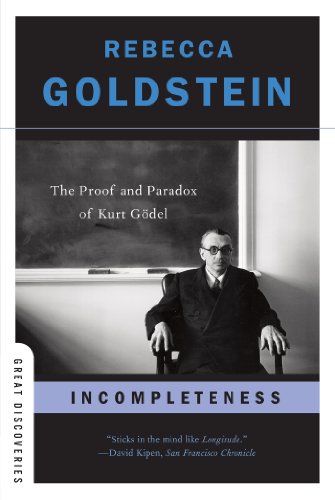
A fiction writer and professor of physics, Goldstein explains for general readers the nature, context, and significant of logician Gödel's (1906-78) incompleteness theorems. She says they belong to a branch of mathematics known as formal logic or mathematical logic, which was considered mathematically suspect until his achievement; and have far reaching implications for the understanding of the nature of truth, knowledge, and certainty. Annotation ©2004 Book News, Inc., Portland, OR (booknews.com)
Recommended by Alan Lightman
“Bartusiak's new book is thoroughly researched, beautifully written, and full of insights about the nature of the scientific enterprise. Aficionados of black holes will love this book.” (from Amazon)

The contentious history of the idea of the black hole—the most fascinating and bizarre celestial object in the heavens For more than half a century, physicists and astronomers engaged in heated dispute over the possibility of black holes in the universe. The weirdly alien notion of a space-time abyss from which nothing escapes—not even light—seemed to confound all logic. This engrossing book tells the story of the fierce black hole debates and the contributions of Einstein and Hawking and other leading thinkers who completely altered our view of the universe. Renowned science writer Marcia Bartusiak shows how the black hole helped revive Einstein’s greatest achievement, the general theory of relativity, after decades during which it had been pushed into the shadows. Not until astronomers discovered such surprising new phenomena as neutron stars and black holes did the once-sedate universe transform into an Einsteinian cosmos, filled with sources of titanic energy that can be understood only in the light of relativity. This book celebrates the hundredth anniversary of general relativity, uncovers how the black hole really got its name, and recounts the scientists’ frustrating, exhilarating, and at times humorous battles over the acceptance of one of history’s most dazzling ideas.
Get a weekly reading digest
New expert-recommended books every week. No account needed.