Dan Hicks
Professor of Contemporary Archaeology @UniofOxford • Curator @Pitt_Rivers • Tutor in Anthropology+Art History • Fellow @StCrossCollege • Trustee @MOLArchaeology
Book Recommendations:
“a uncharacteristically cheerful thought from Mick Taussig in his book The Devil and Commodity Fetishism that in some cultures the final days of the year may be unlucky, but this will be "joyfully spurned with the arrival of the new year" all the very best for 2022 one and all✨ https://t.co/PF5XVN4KBZ” (from X)

Book by Taussig, Michael T.

'THE history book for now. This is why and how historians do what they do. And why they need to' Dan Snow 'What is History, Now? demonstrates how our constructs of the past are woven into our modern world and culture, and offers us an illuminating handbook to understanding this dynamic and shape-shifting subject. A thought-provoking, insightful and necessary re-examination of the subject' Hallie Rubenhold, author of The Five 'The importance of history is becoming more evident every day, and this humane book is an essential navigation tool. Urgent and utterly compelling' Sathnam Sanghera, author of Empireland 'Important and exciting' Kate Williams, author of Rival Queens Inspired by the influential text WHAT IS HISTORY? authored by Helen Carr's great-grandfather, E.H. Carr, and published on the 60th anniversary of that book, this is a groundbreaking new collection addressing the burning issue of how we interpret history today. What stories are told, and by whom, who should be celebrated, and what rewritten, are questions that have been asked recently not just within the history world, but by all of us. Featuring a diverse mix of writers, both bestselling names and emerging voices, this is the history book we need NOW. WHAT IS HISTORY, NOW? covers topics such as the history of racism and anti-racism, queer history, the history of faith, the history of disability, environmental history, escaping imperial nostalgia, hearing women's voices and 'rewriting' the past. The list of contributors includes: Justin Bengry, Leila K Blackbird, Emily Brand, Gus Casely-Hayford, Sarah Churchwell, Caroline Dodds Pennock, Peter Frankopan, Bettany Hughes, Dan Hicks, Onyeka Nubia, Islam Issa, Maya Jasanoff, Rana Mitter, Charlotte Riley, Miri Rubin, Simon Schama, Alex von Tunzelmann and Jaipreet Virdi.

In this powerful and passionate critique of the 'war on terror' in Afghanistan and its extensions into Palestine and Iraq, Derek Gregory traces the long history of British and American involvements in the Middle East and shows how colonial power continues to cast long shadows over our own present. Argues the attacks on the World Trade Center and the Pentagon on September 11 activated a series of political and cultural responses that were profoundly colonial in nature. The first analysis of the “war on terror” to connect events in Afghanistan, Palestine, and Iraq. Traces the connections between geopolitics and the lives of ordinary people. Richly illustrated and packed with empirical detail.
“@Purplephlebas There’s a growing number of people working on that theme — it’s a fascinating field. Take a look at Caitlin DeSilvey’s work in cultural geography, especially her new(ish) book Curated Decay. Also the more archaeological Ruin Memories project at Tromsø, + Tim Edinsor’s work too.” (from X)
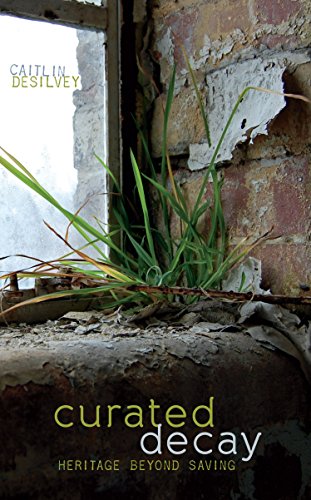
Transporting readers from derelict homesteads to imperiled harbors, postindustrial ruins to Cold War test sites, Curated Decay presents an unparalleled provocation to conventional thinking on the conservation of cultural heritage. Caitlin DeSilvey proposes rethinking the care of certain vulnerable sites in terms of ecology and entropy, and explains how we must adopt an ethical stance that allows us to collaborate with—rather than defend against—natural processes. Curated Decay chronicles DeSilvey’s travels to places where experiments in curated ruination and creative collapse are under way, or under consideration. It uses case studies from the United States, Europe, and elsewhere to explore how objects and structures produce meaning not only in their preservation and persistence, but also in their decay and disintegration. Through accessible and engaging discussion of specific places and their stories, it traces how cultural memory is generated in encounters with ephemeral artifacts and architectures. An interdisciplinary reframing of the concept of the ruin that combines historical and philosophical depth with attentive storytelling, Curated Decay represents the first attempt to apply new theories of materiality and ecology to the concerns of critical heritage studies.
Get a weekly reading digest
New expert-recommended books every week. No account needed.