David Blight
The New York Review of Books
Book Recommendations:
Recommended by David Blight
“Eric Foner has done it again: his concise, superbly researched, beautifully written history of the Civil War amendments chronicles a revolution in law and moral sensibility.” (from Amazon)

From the Pulitzer Prize–winning scholar, a timely history of the constitutional changes that built equality into the nation’s foundation and how those guarantees have been shaken over time. The Declaration of Independence announced equality as an American ideal, but it took the Civil War and the subsequent adoption of three constitutional amendments to establish that ideal as American law. The Reconstruction amendments abolished slavery, guaranteed all persons due process and equal protection of the law, and equipped black men with the right to vote. They established the principle of birthright citizenship and guaranteed the privileges and immunities of all citizens. The federal government, not the states, was charged with enforcement, reversing the priority of the original Constitution and the Bill of Rights. In grafting the principle of equality onto the Constitution, these revolutionary changes marked the second founding of the United States. Eric Foner’s compact, insightful history traces the arc of these pivotal amendments from their dramatic origins in pre–Civil War mass meetings of African-American “colored citizens” and in Republican party politics to their virtual nullification in the late nineteenth century. A series of momentous decisions by the Supreme Court narrowed the rights guaranteed in the amendments, while the states actively undermined them. The Jim Crow system was the result. Again today there are serious political challenges to birthright citizenship, voting rights, due process, and equal protection of the law. Like all great works of history, this one informs our understanding of the present as well as the past: knowledge and vigilance are always necessary to secure our basic rights.
Recommended by David Blight
“Carefully researched and written with sizzling and persuasive prose, Miller has found the way to write both military and emancipation history in one profound package. Never have headquarters, slave quarters, and the ultimate purpose of the war been so seamlessly and brilliantly demonstrated.” (from Amazon)

Winner of the Civil War Round Table of New York’s Fletcher Pratt Literary Award Winner of the Austin Civil War Round Table’s Daniel M. & Marilyn W. Laney Book Prize Winner of an Army Historical Foundation Distinguished Writing Award “A superb account” (The Wall Street Journal) of the longest and most decisive military campaign of the Civil War in Vicksburg, Mississippi, which opened the Mississippi River, split the Confederacy, freed tens of thousands of slaves, and made Ulysses S. Grant the most important general of the war. Vicksburg, Mississippi, was the last stronghold of the Confederacy on the Mississippi River. It prevented the Union from using the river for shipping between the Union-controlled Midwest and New Orleans and the Gulf of Mexico. The Union navy tried to take Vicksburg, which sat on a high bluff overlooking the river, but couldn’t do it. It took Grant’s army and Admiral David Porter’s navy to successfully invade Mississippi and lay siege to Vicksburg, forcing the city to surrender. In this “elegant…enlightening…well-researched and well-told” (Publishers Weekly) work, Donald L. Miller tells the full story of this year-long campaign to win the city “with probing intelligence and irresistible passion” (Booklist). He brings to life all the drama, characters, and significance of Vicksburg, a historic moment that rivals any war story in history. In the course of the campaign, tens of thousands of slaves fled to the Union lines, where more than twenty thousand became soldiers, while others seized the plantations they had been forced to work on, destroying the economy of a large part of Mississippi and creating a social revolution. With Vicksburg “Miller has produced a model work that ties together military and social history” (Civil War Times). Vicksburg solidified Grant’s reputation as the Union’s most capable general. Today no general would ever be permitted to fail as often as Grant did, but ultimately he succeeded in what he himself called the most important battle of the war—the one that all but sealed the fate of the Confederacy.
Recommended by David Blight
“Ron Chernow . . . has written an expansive new life of Grant. It is a work of striking anecdotes, skillful pacing, and poignant judgments.” (from Amazon)
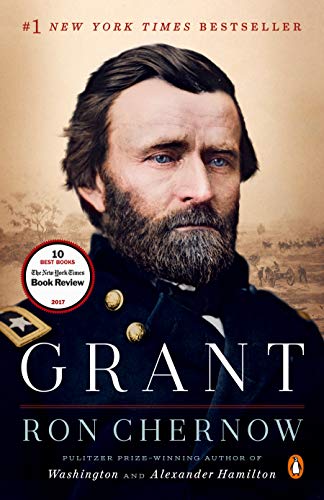
The #1 New York Times bestseller and New York Times Book Review 10 Best Books of 2017 “Eminently readable but thick with import . . . Grant hits like a Mack truck of knowledge.” —Ta-Nehisi Coates, The Atlantic Pulitzer Prize winner Ron Chernow returns with a sweeping and dramatic portrait of one of our most compelling generals and presidents, Ulysses S. Grant. Ulysses S. Grant's life has typically been misunderstood. All too often he is caricatured as a chronic loser and an inept businessman, or as the triumphant but brutal Union general of the Civil War. But these stereotypes don't come close to capturing him, as Chernow shows in his masterful biography, the first to provide a complete understanding of the general and president whose fortunes rose and fell with dizzying speed and frequency. Before the Civil War, Grant was flailing. His business ventures had ended dismally, and despite distinguished service in the Mexican War he ended up resigning from the army in disgrace amid recurring accusations of drunkenness. But in war, Grant began to realize his remarkable potential, soaring through the ranks of the Union army, prevailing at the battle of Shiloh and in the Vicksburg campaign, and ultimately defeating the legendary Confederate general Robert E. Lee. Along the way, Grant endeared himself to President Lincoln and became his most trusted general and the strategic genius of the war effort. Grant’s military fame translated into a two-term presidency, but one plagued by corruption scandals involving his closest staff members. More important, he sought freedom and justice for black Americans, working to crush the Ku Klux Klan and earning the admiration of Frederick Douglass, who called him “the vigilant, firm, impartial, and wise protector of my race.” After his presidency, he was again brought low by a dashing young swindler on Wall Street, only to resuscitate his image by working with Mark Twain to publish his memoirs, which are recognized as a masterpiece of the genre. With lucidity, breadth, and meticulousness, Chernow finds the threads that bind these disparate stories together, shedding new light on the man whom Walt Whitman described as “nothing heroic... and yet the greatest hero.” Chernow’s probing portrait of Grant's lifelong struggle with alcoholism transforms our understanding of the man at the deepest level. This is America's greatest biographer, bringing movingly to life one of our finest but most underappreciated presidents. The definitive biography, Grant is a grand synthesis of painstaking research and literary brilliance that makes sense of all sides of Grant's life, explaining how this simple Midwesterner could at once be so ordinary and so extraordinary. Named one of the best books of the year by Goodreads •Amazon • The New York Times • Newsday • BookPage • Barnes and Noble • Wall Street Journal
Recommended by David Blight
“Douglass emerges here out of photographic technology's earliest years, with majestic beauty, and through the power of his own self-creations. The book is the result of intrepid research and brilliant analysis; it charts Douglass's life visually, allowing him to look back at us wryly, wistfully, wrathfully.” (from Amazon)

A landmark and collectible volume―beautifully produced in duotone―that canonizes Frederick Douglass through historic photography. Picturing Frederick Douglass is a work that promises to revolutionize our knowledge of race and photography in nineteenth-century America. Teeming with historical detail, it is filled with surprises, chief among them the fact that neither George Custer nor Walt Whitman, and not even Abraham Lincoln, was the most photographed American of that century. In fact, it was Frederick Douglass (1818–1895), the ex-slave turned leading abolitionist, eloquent orator, and seminal writer whose fiery speeches transformed him into one of the most renowned and popular agitators of his age. Now, as a result of the groundbreaking research of John Stauffer, Zoe Trodd, and Celeste-Marie Bernier, Douglass emerges as a leading pioneer in photography, both as a stately subject and as a prescient theorist who believed in the explosive social power of what was then just a nascent art form. Indeed, Frederick Douglass was in love with photography. During the four years of Civil War, he wrote more extensively on the subject than any other American, even while recognizing that his audiences were "riveted" by the war and wanted a speech only on "this mighty struggle." He frequented photographers’ studios regularly and sat for his portrait whenever he could. To Douglass, photography was the great "democratic art" that would finally assert black humanity in place of the slave "thing" and at the same time counter the blackface minstrelsy caricatures that had come to define the public perception of what it meant to be black. As a result, his legacy is inseparable from his portrait gallery, which contains 160 separate photographs. At last, all of these photographs have been collected into a single volume, giving us an incomparable visual biography of a man whose prophetic vision and creative genius knew no bounds. Chronologically arranged and generously captioned, from the first picture taken in around 1841 to the last in 1895, each of the images―many published here for the first time―emphasizes Douglass's evolution as a man, artist, and leader. Also included are other representations of Douglass during his lifetime and after―such as paintings, statues, and satirical cartoons―as well as Douglass’s own writings on visual aesthetics, which have never before been transcribed from his own handwritten drafts. The comprehensive introduction by the authors, along with headnotes for each section, an essay by Henry Louis Gates, Jr., and an afterword by Kenneth B. Morris, Jr.―a direct Douglass descendent―provide the definitive examination of Douglass's intellectual, philosophical, and political relationships to aesthetics. Taken together, this landmark work canonizes Frederick Douglass through a form he appreciated the most: photography. Featuring: Contributions from Henry Louis Gates, Jr., and Kenneth B. Morris, Jr. (a direct Douglass descendent)160 separate photographs of Douglass―many of which have never been publicly seen and were long lost to historyA collection of contemporaneous artwork that shows how powerful Douglass’s photographic legacy remains today, over a century after his deathAll Douglass’s previously unpublished writings and speeches on visual aesthetics 317 illustrations
Recommended by David Blight
“Kate Masur’s Until Justice Be Done is a masterpiece of scope, insight, and graceful writing about the central question in the making, unmaking, and remaking of an American democracy. This is a book we will read and conjure with for a long time.” (from Amazon)

Finalist for the 2022 Pulitzer Prize in History Finalist for the 2022 Lincoln Prize Winner of the 2022 John Nau Book Prize in American Civil War Era History One of NPR's Best Books of 2021 and a New York Times Critics' Top Book of 2021 A groundbreaking history of the movement for equal rights that courageously battled racist laws and institutions, Northern and Southern, in the decades before the Civil War. The half-century before the Civil War was beset with conflict over equality as well as freedom. Beginning in 1803, many free states enacted laws that discouraged free African Americans from settling within their boundaries and restricted their rights to testify in court, move freely from place to place, work, vote, and attend public school. But over time, African American activists and their white allies, often facing mob violence, courageously built a movement to fight these racist laws. They countered the states’ insistences that states were merely trying to maintain the domestic peace with the equal-rights promises they found in the Declaration of Independence and the Constitution. They were pastors, editors, lawyers, politicians, ship captains, and countless ordinary men and women, and they fought in the press, the courts, the state legislatures, and Congress, through petitioning, lobbying, party politics, and elections. Long stymied by hostile white majorities and unfavorable court decisions, the movement’s ideals became increasingly mainstream in the 1850s, particularly among supporters of the new Republican party. When Congress began rebuilding the nation after the Civil War, Republicans installed this vision of racial equality in the 1866 Civil Rights Act and the Fourteenth Amendment. These were the landmark achievements of the first civil rights movement. Kate Masur’s magisterial history delivers this pathbreaking movement in vivid detail. Activists such as John Jones, a free Black tailor from North Carolina whose opposition to the Illinois “black laws” helped make the case for racial equality, demonstrate the indispensable role of African Americans in shaping the American ideal of equality before the law. Without enforcement, promises of legal equality were not enough. But the antebellum movement laid the foundation for a racial justice tradition that remains vital to this day. 15 illustrations
Get a weekly reading digest
New expert-recommended books every week. No account needed.