David Pogue
Author of Pogue's Basics and Founder of Yahootech.com
Book Recommendations:
Recommended by David Pogue
“In the tech industry, they say that you learn more from a failure than from a hit. Well, if that's true, Losing the Signal will give you a post-doctoral education. Reading the inside story of the BlackBerry's helpless flameout is like watching any other train wreck: You're horrified, but you can't look away.” (from Amazon)
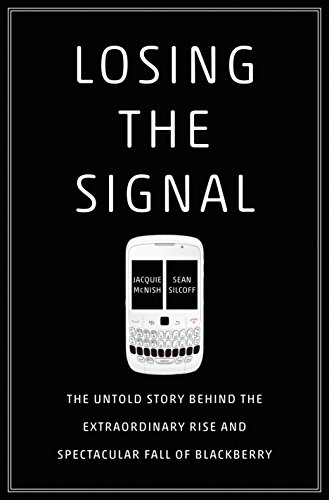
Short-listed for the 2015 Financial Times and McKinsey Business Book of the Year A Wall Street Journal Best Business Book of 2015 A Best Business Book of the Year, Forbes Magazine A Times of London Book of the Week Best Narrative Business Book of 2015 by Strategy+Business In 2009, BlackBerry controlled half of the smartphone market. Today that number is less than one percent. What went so wrong? Losing the Signal is a riveting story of a company that toppled global giants before succumbing to the ruthlessly competitive forces of Silicon Valley. This is not a conventional tale of modern business failure by fraud and greed. The rise and fall of BlackBerry reveals the dangerous speed at which innovators race along the information superhighway. With unprecedented access to key players, senior executives, directors and competitors, Losing the Signal unveils the remarkable rise of a company that started above a bagel store in Ontario. At the heart of the story is an unlikely partnership between a visionary engineer, Mike Lazaridis, and an abrasive Harvard Business school grad, Jim Balsillie. Together, they engineered a pioneering pocket email device that became the tool of choice for presidents and CEOs. The partnership enjoyed only a brief moment on top of the world, however. At the very moment BlackBerry was ranked the world's fastest growing company internal feuds and chaotic growth crippled the company as it faced its gravest test: Apple and Google's entry in to mobile phones. Expertly told by acclaimed journalists, Jacquie McNish and Sean Silcoff, this is an entertaining, whirlwind narrative that goes behind the scenes to reveal one of the most compelling business stories of the new century.
Recommended by David Pogue
“Anyone can claim to be a prophet, a fortune teller, or a futurist, and plenty of people do. What makes Kevin Kelly different is that he's right. In this book, you're swept along by his clear prose and unassailable arguments until it finally hits you: The technological, cultural, and societal changes he’s foreseeing really are inevitable. It’s like having a crystal ball, only without the risk of shattering.” (from Amazon)

“A quintessential work of technological futurism.” – James Surowiecki, strategy + business, “Best Business Books 2017 – Innovation” From one of our leading technology thinkers and writers, a guide through the twelve technological imperatives that will shape the next thirty years and transform our lives Much of what will happen in the next thirty years is inevitable, driven by technological trends that are already in motion. In this fascinating, provocative new book, Kevin Kelly provides an optimistic road map for the future, showing how the coming changes in our lives—from virtual reality in the home to an on-demand economy to artificial intelligence embedded in everything we manufacture—can be understood as the result of a few long-term, accelerating forces. Kelly both describes these deep trends—interacting, cognifying, flowing, screening, accessing, sharing, filtering, remixing, tracking, and questioning—and demonstrates how they overlap and are codependent on one another. These larger forces will completely revolutionize the way we buy, work, learn, and communicate with each other. By understanding and embracing them, says Kelly, it will be easier for us to remain on top of the coming wave of changes and to arrange our day-to-day relationships with technology in ways that bring forth maximum benefits. Kelly’s bright, hopeful book will be indispensable to anyone who seeks guidance on where their business, industry, or life is heading—what to invent, where to work, in what to invest, how to better reach customers, and what to begin to put into place—as this new world emerges.
Get a weekly reading digest
New expert-recommended books every week. No account needed.