Douglas Brinkley
Katherine Tsanoff Brown Professor in Humanities and Professor of History at Rice University
Book Recommendations:
Recommended by Douglas Brinkley
“Mark Bailey's Nine Irish Lives is a string of illuminating prose meditations about an unsung club of sustainable heroes with St. Patrick on their side. Much forgotten history is brought to life in this riveting narrative. Highly recommended!!” (from Amazon)

“These are not just nine Irish lives but nine extraordinary lives, their struggles universal, their causes never more important than today. As the saying goes, the best stories belong to those who can tell them. And these are well told, by some of our best storytellers.” —Timothy Egan, New York Times bestselling author of The Immortal Irishman In this entertaining and timely anthology, nine contemporary Irish Americans present the stories of nine inspiring Irish immigrants whose compassion, creativity, and indefatigable spirit helped shape America. The authors here bring to bear their own life experiences as they reflect on their subjects, in each essay telling a unique and surprisingly intimate story. Rosie O’Donnell, an adoptive mother of five, writes about Margaret Haughery, the Mother of Orphans. Poet Jill McDonough recounts the story of a particularly brave Civil War soldier, and filmmaker and activist Michael Moore presents the original muckraking journalist, Samuel McClure. Novelist Kathleen Hill reflects on famed New Yorker writer Maeve Brennan, and historian Terry Golway examines the life of pivotal labor leader Mother Jones. In his final written work, activist and politician Tom Hayden explores his own namesake, Thomas Addis Emmet. Nonprofit executive Mark Shriver writes about the priest who founded Boys Town, and celebrated actor Pierce Brosnan—himself a painter in his spare time—writes about silent film director Rex Ingram, also a sculptor. And a pair of Pulitzer Prize–winning journalists, Mary Jordan and Kevin Sullivan, take on the story of Niall O’Dowd, the news publisher who brokered peace in Northern Ireland. Each of these remarkable stories serves as a reflection—and celebration—of our nation’s shared values, ever more meaningful as we debate the issue of immigration today. Through the battles they fought, the cases they argued, the words they wrote, and the lives they touched, the nine Irish men and women profiled in these pages left behind something greater than their individual accomplishments—our America.
Recommended by Douglas Brinkley
“A marvelous survey of how the electric guitar has rocked its way into the hearts and minds of millions of music lovers. This is a rich trove of unforgettable anecdotes and vignettes. Highly recommended!” (from Amazon)

The inspiration for the Play It Loud exhibition at the Metropolitan Museum of Art "Every guitar player will want to read this book twice. And even the casual music fan will find a thrilling narrative that weaves together cultural history, musical history, race, politics, business case studies, advertising, and technological discovery." —Daniel Levitin, Wall Street Journal For generations the electric guitar has been an international symbol of freedom, danger, rebellion, and hedonism. In Play It Loud, veteran music journalists Brad Tolinski and Alan di Perna bring the history of this iconic instrument to roaring life. It's a story of inventors and iconoclasts, of scam artists, prodigies, and mythologizers as varied and original as the instruments they spawned. Play It Loud uses twelve landmark guitars—each of them artistic milestones in their own right—to illustrate the conflict and passion the instruments have inspired. It introduces Leo Fender, a man who couldn't play a note but whose innovations helped transform the guitar into the explosive sound machine it is today. Some of the most significant social movements of the twentieth century are indebted to the guitar: It was an essential element in the fight for racial equality in the entertainment industry; a mirror to the rise of the teenager as social force; a linchpin of punk's sound and ethos. And today the guitar has come full circle, with contemporary titans such as Jack White of The White Stripes, Annie Clark (aka St. Vincent), and Dan Auerbach of The Black Keys bringing some of the earliest electric guitar forms back to the limelight. Featuring interviews with Les Paul, Keith Richards, Carlos Santana, Eddie Van Halen, Steve Vai, and dozens more players and creators, Play It Loud is the story of how a band of innovators transformed an idea into a revolution.
Recommended by Douglas Brinkley
“Rock Me On The Water documents the high-octane storybook world of Los Angeles in 1974 with masterful intimacy and fearless cultural analysis. His well-rendered portraits of Jackson Browne, Linda Ronstadt, Joni Mitchell, David Geffen and other luminaries of the time are sublime. This is an extremely kinetic historical document, and a testament to Brownstein's lasting importance as both a fact-driven journalist and elegant prose-stylist. A must read!” (from Amazon)

"An electric story filled with gripping personalities, compelling backstage histories, and a clear message for the divided America of today: the forces that fear change can win for a time, but in America the future always gets the last word. A lyrical recreation of a magical moment.”—Jake Tapper Now in paperback, an exceptional cultural history from Atlantic Senior Editor Ronald Brownstein—“one of America's best political journalists” (The Economist)—tells the kaleidoscopic story of one monumental year that marked the city of Los Angeles’ creative peak, a glittering moment when popular culture was ahead of politics in predicting what America would become. Los Angeles in 1974 exerted more influence over popular culture than any other city in America. Los Angeles that year, in fact, dominated popular culture more than it ever had before, or would again. Working in film, recording, and television studios around Sunset Boulevard, living in Brentwood and Beverly Hills or amid the flickering lights of the Hollywood Hills, a cluster of transformative talents produced an explosion in popular culture which reflected the demographic, social, and cultural realities of a changing America. At a time when Richard Nixon won two presidential elections with a message of backlash against the social changes unleashed by the sixties, popular culture was ahead of politics in predicting what America would become. The early 1970s in Los Angeles was the time and the place where conservatives definitively lost the battle to control popular culture. Rock Me on the Water traces the confluence of movies, music, television, and politics in Los Angeles month by month through that transformative, magical year. Ronald Brownstein reveals how 1974 represented a confrontation between a massive younger generation intent on change, and a political order rooted in the status quo. Today, we are again witnessing a generational cultural divide. Brownstein shows how the voices resistant to change may win the political battle for a time, but they cannot hold back the future.
Recommended by Douglas Brinkley
“Nothing less than the fate of America is at stake in this riveting and utterly fascinating Civil War–era narrative. Highly recommended!” (from Amazon)

NEW YORK TIMES BESTSELLER The New York Times bestselling author of George Washington's Secret Six and Thomas Jefferson and the Tripoli Pirates turns to two other heroes of the nation: Abraham Lincoln and Frederick Douglass. In The President and the Freedom Fighter, Brian Kilmeade tells the little-known story of how two American heroes moved from strong disagreement to friendship, and in the process changed the entire course of history. Abraham Lincoln was White, born impoverished on a frontier farm. Frederick Douglass was Black, a child of slavery who had risked his life escaping to freedom in the North. Neither man had a formal education, and neither had had an easy path to influence. No one would have expected them to become friends—or to transform the country. But Lincoln and Douglass believed in their nation’s greatness. They were determined to make the grand democratic experiment live up to its ideals. Lincoln’s problem: he knew it was time for slavery to go, but how fast could the country change without being torn apart? And would it be possible to get rid of slavery while keeping America’s Constitution intact? Douglass said no, that the Constitution was irredeemably corrupted by slavery—and he wanted Lincoln to move quickly. Sharing little more than the conviction that slavery was wrong, the two men’s paths eventually converged. Over the course of the Civil War, they’d endure bloodthirsty mobs, feverish conspiracies, devastating losses on the battlefield, and a growing firestorm of unrest that would culminate on the fields of Gettysburg. As he did in George Washington's Secret Six, Kilmeade has transformed this nearly forgotten slice of history into a dramatic story that will keep you turning the pages to find out how these two heroes, through their principles and patience, not only changed each other, but made America truly free for all.
Recommended by Douglas Brinkley
“A complex, accomplished life recounted with confidence and candor . . . Every page sparkles with directness and grace.” (from Amazon)

An intimate, powerful, and inspiring memoir by the former First Lady of the United States #1 NEW YORK TIMES BESTSELLER • WATCH THE EMMY-NOMINATED NETFLIX ORIGINAL DOCUMENTARY • OPRAH’S BOOK CLUB PICK • NAACP IMAGE AWARD WINNER • ONE OF ESSENCE’S 50 MOST IMPACTFUL BLACK BOOKS OF THE PAST 50 YEARS In a life filled with meaning and accomplishment, Michelle Obama has emerged as one of the most iconic and compelling women of our era. As First Lady of the United States of America—the first African American to serve in that role—she helped create the most welcoming and inclusive White House in history, while also establishing herself as a powerful advocate for women and girls in the U.S. and around the world, dramatically changing the ways that families pursue healthier and more active lives, and standing with her husband as he led America through some of its most harrowing moments. Along the way, she showed us a few dance moves, crushed Carpool Karaoke, and raised two down-to-earth daughters under an unforgiving media glare. In her memoir, a work of deep reflection and mesmerizing storytelling, Michelle Obama invites readers into her world, chronicling the experiences that have shaped her—from her childhood on the South Side of Chicago to her years as an executive balancing the demands of motherhood and work, to her time spent at the world’s most famous address. With unerring honesty and lively wit, she describes her triumphs and her disappointments, both public and private, telling her full story as she has lived it—in her own words and on her own terms. Warm, wise, and revelatory, Becoming is the deeply personal reckoning of a woman of soul and substance who has steadily defied expectations—and whose story inspires us to do the same.
Recommended by Douglas Brinkley
“John U. Bacon’s Overtime is a brilliant look into the wild and wonderful world of U.S. college football. While Bacon’s intense focus is on the Michigan Wolverines, his first-rate storytelling transcends Ann Arbor. This is one of the best insider-football books ever written. Highly recommended!” (from Amazon)

NATIONAL BESTSELLER From the “poet laureate of Michigan football," a riveting inside chronicle of the Jim Harbaugh era, and "an unprecedented look at the inner workings" (Sporting News) of a big-time college football program John U. Bacon received rare access to Head Coach Jim Harbaugh’s University of Michigan football team: coaches, players, and staffers, in closed-door meetings, locker rooms, meals, and classes. Overtime captures this storied program at the crossroads, as the sport’s winningest team battles to reclaim its former glory. But what if the price of success today comes at the cost of your soul? Do you pay it, or compete without compromising? In the spirit of HBO’s Hardknocks, Overtime delivers a deeply reported human portrait that follows the Wolverine coaches, players, and staffers. Above all, thisis a human story. In Overtime we not only discover what these public figures are like behind the scenes, we learn what the experience means to them as they go through it – the trials, the triumphs, and the unexpected answers to a central question: Is it worth it? From the “poet laureate of Michigan football” (according to New York Times’s Joe Drape), and one of the keenest observers of college football, Overtime offers a window into a legendary program and the sport itself that only John U. Bacon could deliver.
Recommended by Douglas Brinkley
“Hampton Sides' On Desperate Ground is a heart-pounding, fiercely written account of the brutal Chosin Reservoir Campaign during the Korean War. Every page pulsates with drama. Sides, an American master of nonfiction, has written one of the finest battle books ever.” (from Amazon)
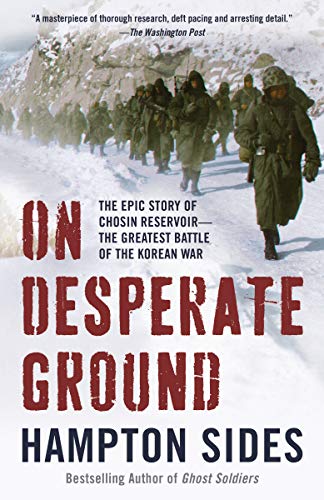
From the New York Times bestselling author of Blood and Thunder and Ghost Soldiers, a chronicle of the extraordinary feats of heroism by Marines called on to do the impossible during the greatest battle of the Korean War. "Superb ... A masterpiece of thorough research, deft pacing and arresting detail...This war story—the fight to break out of a frozen hell near the Chosin Reservoir—has been told many times before. But Sides tells it exceedingly well, with fresh research, gritty scenes and cinematic sweep." —The Washington Post On October 15, 1950, General Douglas MacArthur, Supreme Commander of UN troops in Korea, convinced President Harry Truman that the Communist forces of Kim Il-sung would be utterly defeated by Thanksgiving. The Chinese, he said with near certainty, would not intervene in the war. As he was speaking, 300,000 Red Chinese soldiers began secretly crossing the Manchurian border. Led by some 20,000 men of the First Marine Division, the Americans moved deep into the snowy mountains of North Korea, toward the trap Mao had set for the vainglorious MacArthur along the frozen shores of the Chosin Reservoir. What followed was one of the most heroic--and harrowing--operations in American military history, and one of the classic battles of all time. Faced with probable annihilation, and temperatures plunging to 20 degrees below zero, the surrounded, and hugely outnumbered, Marines fought through the enemy forces with ferocity, ingenuity, and nearly unimaginable courage as they marched their way to the sea. Hampton Sides' superb account of this epic clash relies on years of archival research, unpublished letters, declassified documents, and interviews with scores of Marines and Koreans who survived the siege. While expertly detailing the follies of the American leaders, On Desperate Ground is an immediate, grunt's-eye view of history, enthralling in its narrative pace and powerful in its portrayal of what ordinary men are capable of in the most extreme circumstances. Hampton Sides has been hailed by critics as one of the best nonfiction writers of his generation. As the Miami Herald wrote, "Sides has a novelist's eye for the propulsive elements that lend momentum and dramatic pace to the best nonfiction narratives."
Recommended by Douglas Brinkley
“Riveting. With characteristic intellectual verve and brilliant analysis, Bret Baier allows readers to freshly understand how the Tehran Conference shaped world history. Essential reading by a first-rate storyteller!” (from Amazon)

The Instant New York Times Bestseller "I could not put this extraordinary book down. Three Days at the Brink is a masterpiece: elegantly written, brilliantly conceived, and impeccably researched. This book not only sparkles but is destined to be a classic!” —Jay Winik, bestselling author From the #1 bestselling author and award-winning anchor of Special Report with Bret Baier, comes the gripping lost history of the Tehran Conference, where FDR, Churchill, and Stalin plotted D-Day and the Second World War’s endgame. With the fate of World War II in doubt and rumors of a Nazi assassination plot swirling, Franklin Roosevelt risked everything at a clandestine meeting that would change the course of history. November 1943: The Nazis and their Axis allies controlled nearly the entire European continent. Japan dominated the Pacific. Allied successes at Sicily and Guadalcanal had gained them modest ground but at an extraordinary cost. On the Eastern Front, the Soviet Red Army had been bled white. The path of history walked a knife’s edge. That same month a daring gambit was hatched that would alter everything. The "Big Three"—Franklin D. Roosevelt, Winston Churchill, and Joseph Stalin—secretly met for the first time to chart a strategy for defeating Adolf Hitler. Over three days in Tehran, Iran, this trio—strange bedfellows united by their mutual responsibility as heads of the Allied powers—made essential decisions that would direct the final years of the war and its aftermath. Meanwhile, looming over the covert meeting was the possible threat of a Nazi assassination plot, code-named Operation Long Jump. Before they left Tehran, the three leaders agreed to open a second front in the West, spearheaded by Operation Overload and the D-Day invasion of France at Normandy the following June. They also discussed what might come after the war, including dividing Germany and establishing the United Nations—plans that laid the groundwork for the postwar world order and the Cold War. Bestselling author and Fox News Channel anchor Bret Baier’s new epic history, Three Days at the Brink, centers on these crucial days in Tehran, the medieval Persian city on the edge of the desert. Baier makes clear the importance of Roosevelt, who stood apart as the sole leader of a democracy, recognizing him as the lead strategist for the globe’s future—the one man who could ultimately allow or deny the others their place in history. With new details discovered in rarely seen transcripts, oral histories, and declassified State Department and presidential documents from the Franklin D. Roosevelt Library, Baier illuminates the complex character of Roosevelt, revealing a man who grew into his role and accepted the greatest challenge any American president since Lincoln had faced.
Recommended by Douglas Brinkley
“John U. Bacon’s The Great Halifax Explosion is the seminal account of one of the bloodiest man-made disasters in world history, which killed some 2,000 people. This is a riveting, well-written and researched World War I book. Highly recommended!” (from Amazon)

NATIONAL BESTSELLER The "riveting" (National Post) tick-tock account of the largest manmade explosion in history prior to the atomic bomb, and the equally astonishing tales of survival and heroism that emerged from the ashes “Enthralling. ... Gripping. ... A captivating and emotionally investing journey.” —Pittsburgh Post-Gazette After steaming out of New York City on December 1, 1917, laden with a staggering three thousand tons of TNT and other explosives, the munitions ship Mont-Blanc fought its way up the Atlantic coast, through waters prowled by enemy U-boats. As it approached the lively port city of Halifax, Mont-Blanc's deadly cargo erupted with the force of 2.9 kilotons of TNT—the most powerful explosion ever visited on a human population, save for HIroshima and Nagasaki. Mont-Blanc was vaporized in one fifteenth of a second; a shockwave leveled the surrounding city. Next came a thirty-five-foot tsunami. Most astounding of all, however, were the incredible tales of survival and heroism that soon emerged from the rubble. This is the unforgettable story told in John U. Bacon's The Great Halifax Explosion: a ticktock account of fateful decisions that led to doom, the human faces of the blast's 11,000 casualties, and the equally moving individual stories of those who lived and selflessly threw themselves into urgent rescue work that saved thousands. The shocking scale of the disaster stunned the world, dominating global headlines even amid the calamity of the First World War. Hours after the blast, Boston sent trains and ships filled with doctors, medicine, and money. The explosion would revolutionize pediatric medicine; transform U.S.-Canadian relations; and provide physicist J. Robert Oppenheimer, who studied the Halifax explosion closely when developing the atomic bomb, with history's only real-world case study demonstrating the lethal power of a weapon of mass destruction. Mesmerizing and inspiring, Bacon's deeply-researched narrative brings to life the tragedy, bravery, and surprising afterlife of one of the most dramatic events of modern times.
Get a weekly reading digest
New expert-recommended books every week. No account needed.