Edward Wilson
University Research Professor Emeritus, Harvard University
Book Recommendations:
Recommended by Edward Wilson
“No scientist brings more experience from the laboratory and field, none thinks more deeply about social issues or addresses them with greater clarity, than Jared Diamond as illustrated by Guns, Germs, and Steel. In this remarkably readable book he shows how history and biology can enrich one another to produce a deeper understanding of the human condition.” (from Amazon)

"Fascinating.... Lays a foundation for understanding human history."―Bill Gates Winner of the Pulitzer Prize, Guns, Germs, and Steel is a brilliant work answering the question of why the peoples of certain continents succeeded in invading other continents and conquering or displacing their peoples. This edition includes a new chapter on Japan and all-new illustrations drawn from the television series. Until around 11,000 BC, all peoples were still Stone Age hunter/gatherers. At that point, a great divide occurred in the rates that human societies evolved. In Eurasia, parts of the Americas, and Africa, farming became the prevailing mode of existence when indigenous wild plants and animals were domesticated by prehistoric planters and herders. As Jared Diamond vividly reveals, the very people who gained a head start in producing food would collide with preliterate cultures, shaping the modern world through conquest, displacement, and genocide.The paths that lead from scattered centers of food to broad bands of settlement had a great deal to do with climate and geography. But how did differences in societies arise? Why weren't native Australians, Americans, or Africans the ones to colonize Europe? Diamond dismantles pernicious racial theories tracing societal differences to biological differences. He assembles convincing evidence linking germs to domestication of animals, germs that Eurasians then spread in epidemic proportions in their voyages of discovery. In its sweep, Guns, Germs and Steel encompasses the rise of agriculture, technology, writing, government, and religion, providing a unifying theory of human history as intriguing as the histories of dinosaurs and glaciers. 32 illustrations
Recommended by Edward Wilson
“This is a remarkable book by a remarkable scientist. Drawing on a growing body of research including his own, de Waal shows that animals, from elephants and chimpanzees to the lowly invertebrates, are not only smarter than we thought, but also engaged in forms of thought we have only begun to understand.” (from Amazon)

A New York Times Bestseller From world-renowned biologist and primatologist Frans de Waal, a groundbreaking work on animal intelligence destined to become a classic. What separates your mind from an animal’s? Maybe you think it’s your ability to design tools, your sense of self, or your grasp of past and future―all traits that have helped us define ourselves as the planet’s preeminent species. But in recent decades, these claims have eroded, or even been disproven outright, by a revolution in the study of animal cognition. Take the way octopuses use coconut shells as tools; elephants that classify humans by age, gender, and language; or Ayumu, the young male chimpanzee at Kyoto University whose flash memory puts that of humans to shame. Based on research involving crows, dolphins, parrots, sheep, wasps, bats, whales, and of course chimpanzees and bonobos, Frans de Waal explores both the scope and the depth of animal intelligence. He offers a firsthand account of how science has stood traditional behaviorism on its head by revealing how smart animals really are, and how we’ve underestimated their abilities for too long. People often assume a cognitive ladder, from lower to higher forms, with our own intelligence at the top. But what if it is more like a bush, with cognition taking different forms that are often incomparable to ours? Would you presume yourself dumber than a squirrel because you’re less adept at recalling the locations of hundreds of buried acorns? Or would you judge your perception of your surroundings as more sophisticated than that of a echolocating bat? De Waal reviews the rise and fall of the mechanistic view of animals and opens our minds to the idea that animal minds are far more intricate and complex than we have assumed. De Waal’s landmark work will convince you to rethink everything you thought you knew about animal―and human―intelligence. 32 illlustrations
Recommended by Edward Wilson
“Wondrously perceptive and exceptionally well written, The Dream of Enlightenment not only provides a key account of the Enlightenment philosophers but also inspires us to consider a new enlightenment that could fundamentally transform our own world as much as it did theirs.” (from Amazon)

The author of the classic The Dream of Reason vividly explains the rise of modern thought. Western philosophy is now two and a half millennia old, but much of it came in just two staccato bursts, each lasting only about 150 years. In his landmark survey of Western philosophy from the Greeks to the Renaissance, The Dream of Reason, Anthony Gottlieb documented the first burst, which came in the Athens of Socrates, Plato, and Aristotle. Now, in his sequel, The Dream of Enlightenment, Gottlieb expertly navigates a second great explosion of thought, taking us to northern Europe in the wake of its wars of religion and the rise of Galilean science. In a relatively short period―from the early 1640s to the eve of the French Revolution―Descartes, Hobbes, Spinoza, Locke, Leibniz, and Hume all made their mark. The Dream of Enlightenment tells their story and that of the birth of modern philosophy. As Gottlieb explains, all these men were amateurs: none had much to do with any university. They tried to fathom the implications of the new science and of religious upheaval, which led them to question traditional teachings and attitudes. What does the advance of science entail for our understanding of ourselves and for our ideas of God? How should a government deal with religious diversity―and what, actually, is government for? Such questions remain our questions, which is why Descartes, Hobbes, and the others are still pondered today. Yet it is because we still want to hear them that we can easily get these philosophers wrong. It is tempting to think they speak our language and live in our world; but to understand them properly, we must step back into their shoes. Gottlieb puts readers in the minds of these frequently misinterpreted figures, elucidating the history of their times and the development of scientific ideas while engagingly explaining their arguments and assessing their legacy in lively prose. With chapters focusing on Descartes, Hobbes, Spinoza, Locke, Pierre Bayle, Leibniz, Hume, Rousseau, and Voltaire―and many walk-on parts―The Dream of Enlightenment creates a sweeping account of what the Enlightenment amounted to, and why we are still in its debt.
Recommended by Edward Wilson
“A remarkable and original synthesis of social psychology, political analysis, and moral reasoning that reflects the best of sciences in these fields and adds evidence that we are innately capable of the decency and righteousness needed for societies to survive.” (from Amazon)
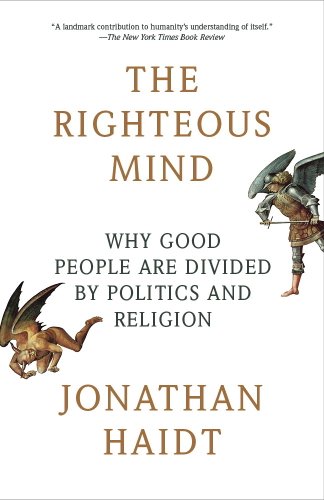
NEW YORK TIMES BESTSELLER • The #1 bestselling author of The Anxious Generation and acclaimed social psychologist challenges conventional thinking about morality, politics, and religion in a way that speaks to conservatives and liberals alike—a “landmark contribution to humanity’s understanding of itself” (The New York Times Book Review). Drawing on his twenty-five years of groundbreaking research on moral psychology, Jonathan Haidt shows how moral judgments arise not from reason but from gut feelings. He shows why liberals, conservatives, and libertarians have such different intuitions about right and wrong, and he shows why each side is actually right about many of its central concerns. In this subtle yet accessible book, Haidt gives you the key to understanding the miracle of human cooperation, as well as the curse of our eternal divisions and conflicts. If you’re ready to trade in anger for understanding, read The Righteous Mind.
Get a weekly reading digest
New expert-recommended books every week. No account needed.