Homer Hickam
#1 New York Times Bestselling Author of Rocket Boys
Book Recommendations:
Recommended by Homer Hickam
“The Case for Nukes is absolutely a work of genius. It takes the vast complexities of the workings of and history behind nuclear energy and explains it all in a most interesting, page-turning manner. It is rare when I learn something new on every page, but I did in Zubrin's The Case for Nukes. This Providence-given energy source can allow our civilization to not only survive but go on to a wonderful and most marvelous expansion while maintaining our beautiful planet. I thoroughly endorse this book.” (from Amazon)

The Case for Nukes is a unique book. In it, world-renowned nuclear and aerospace engineer Dr. Robert Zubrin explains how nuclear power works and how much it has to offer humanity. He debunks the toxic falsehoods that have been spread to dissuade us from using it by variously the ignorant, the fearful, the fanatical, and by cynical political operatives bought and paid for by competing interests. He tells about revolutionary developments in the field, including new reactor types that can be cheaply mass produced, that cannot be made to melt down no matter how hard their operators try, that use a new fuel called thorium far more plentiful than uranium, and still more advanced systems, employing thermonuclear fusion - the power that lights the sun - to extract more energy from a gallon of water than can be obtained from 300 gallons of gasoline. He tells about the bold entrepreneurs - a totally different breed from the government officials who created the existing types of nuclear reactors - who are leading this revolution in power technology. But there are broader issues involved in the nuclear debate than technology alone, and Zubrin is not shy about addressing them. He makes clear the critical difference between practical environmentalism, which seeks to improve the environment for the benefit of humanity, and ideological environmentalism, which seeks to use instances of human insult to natural environment as evidence for a prosecutorial case against human liberty. He shows how the latter school of thought is wrong, not only with respect to the catastrophic harm it would do to humanity, but to nature as well. He also exposes the masters of mercenary environmentalism, who deploy troops of dupes to shut down companies or whole industries in order to eliminate competition in return for being suitably rewarded by the beneficiaries of such efforts. He shows that when it comes to environmental improvement, freedom is not the problem; freedom is the solution. He makes clear both the possibility and necessity of a nuclear-power-enabled revolution in the human condition by putting it in a broader historical context of the overall process of development of civilization, whereby new technologies create new resources and new knowledge, which in turn make possible still more technological advance. Finally, Zubrin brings all this to bear to address the greatest threat facing humanity today - which is the possibility that we will turn on each other, as we did in the 20 th century, under the spell of the false idea that resources are finite. Only in a world of unlimited resources can all men and women be brothers and sisters. Only in a world of freedom can resources be unlimited. That is the world we can, and must, create. In The Case for Nukes, Zubrin shows us how.
Recommended by Homer Hickam
“Liftoff reads like something out of the golden age of Science Fiction but this isn’t a novel by Robert Heinlein or Arthur C. Clarke. This is the true, astounding story of the men and women who spun those sci-fi dreams into reality.” (from Amazon)
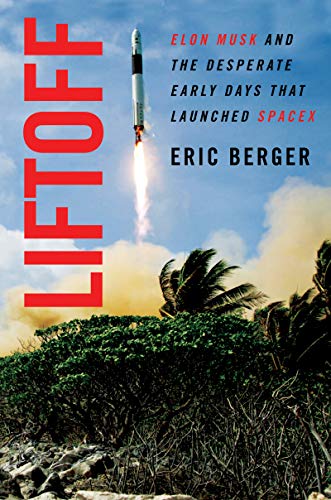
‘Just read it.’ Elon MuskThe dramatic inside story of the first four historic flights that launched SpaceX—and Elon Musk—from a shaky startup into the world's leading edge rocket company.SpaceX has enjoyed a miraculous decade. Less than 20 years after its founding, it boasts the largest constellation of commercial satellites in orbit, has pioneered reusable rockets, and in 2020 became the first private company to launch human beings into orbit. Half a century after the space race SpaceX is pushing forward into the cosmos, laying the foundation for our exploration of other worlds.But before it became one of the most powerful players in the aerospace industry, SpaceX was a fledgling startup, scrambling to develop a single workable rocket before the money ran dry. The engineering challenge was immense; numerous other private companies had failed similar attempts. And even if SpaceX succeeded, they would then have to compete for government contracts with titans such as Lockheed Martin and Boeing, who had tens of thousands of employees and tens of billions of dollars in annual revenue. SpaceX had fewer than 200 employees and the relative pittance of $100 million in the bank.In Liftoff, Eric Berger takes readers inside the wild early days that made SpaceX. Focusing on the company’s first four launches of the Falcon 1 rocket, he charts the bumpy journey from scrappy underdog to aerospace pioneer. drawing upon exclusive interviews with dozens of former and current engineers, designers, mechanics, and executives, including Elon Musk. The enigmatic Musk, who founded the company with the dream of one day settling Mars, is the fuel that propels the book, with his daring vision for the future of space.
Get a weekly reading digest
New expert-recommended books every week. No account needed.