Ilona Kickbusch
Professor Ilona Kickbusch PhD contributes to innovation in global health and health diplomacy. Now engaging in digital health. Always a feminist.
Book Recommendations:
Recommended by Ilona Kickbusch
“Great book @SojiAdeyi https://t.co/4VMRpByUyJ” (from X)
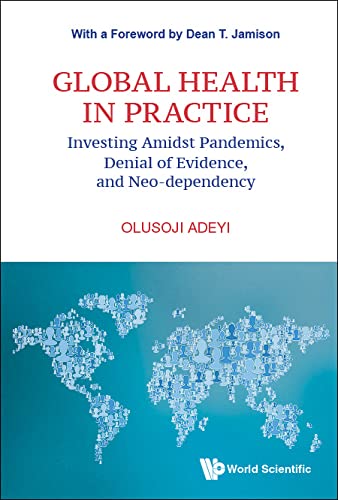
The COVID-19 pandemic has laid bare the world's vulnerabilities to health and economic ruin from disease outbreaks. But the pandemic merely reveals fundamental weaknesses and contradictions in global health. What are the roots of discontents in global health? How do geo-politics, power dynamics, knowledge gaps, racism, and corruption affect global health? Is foreign aid for health due for a radical overhaul? This book is an incisive guide to the practice of global health in real life. Global health policy is at a crossroads. It is on trial at the interface between the Global North and the Global South. There has been remarkable progress in health outcomes over the past century. Yet, countries face a complex landscape of lofty ambitions in the form of political commitments to Universal Health Coverage, Human Capital, and Global Health Security. These ambitions are tempered by multiple constraints. Investors in global health must navigate a minefield of uneven progress, great expectations, and denials of scientific evidence by entrenched interests. That terrain is further complicated by the hegemonic suppression of innovation that threatens the status quo and by self-perpetuating cycles of dependency of the Global South on the Global North. This book is an unflinching scrutiny of concepts and cases by a veteran of global health policy and practice. It holds a mirror to the world and lays out pathways to a better future. The book is a must-have GPS for policy makers and practitioners as they navigate the maze of global health.
Recommended by Ilona Kickbusch
“A must read book #HumanRight #HealthForAll https://t.co/6MbM8bDA7n” (from X)

NEW YORK TIMES BESTSELLER • From the author of the #1 New York Times bestseller On Tyranny comes an impassioned condemnation of America's pandemic response and an urgent call to rethink health and freedom. On December 29, 2019, historian Timothy Snyder fell gravely ill. Unable to stand, barely able to think, he waited for hours in an emergency room before being correctly diagnosed and rushed into surgery. Over the next few days, as he clung to life and the first light of a new year came through his window, he found himself reflecting on the fragility of health, not recognized in America as a human right but without which all rights and freedoms have no meaning. And that was before the pandemic. We have since watched American hospitals, long understaffed and undersupplied, buckling under waves of ill patients. The federal government made matters worse through willful ignorance, misinformation, and profiteering. Our system of commercial medicine failed the ultimate test, and thousands of Americans died. In this eye-opening cri de coeur, Snyder traces the societal forces that led us here and outlines the lessons we must learn to survive. In examining some of the darkest moments of recent history and of his own life, Snyder finds glimmers of hope and principles that could lead us out of our current malaise. Only by enshrining healthcare as a human right, elevating the authority of doctors and medical knowledge, and planning for our children’s future can we create an America where everyone is truly free.
Recommended by Ilona Kickbusch
“Great book ! https://t.co/pSl2SHFVQG” (from X)

Environmental degradation in China has not only brought a wider range of diseases and other health consequences than previously understood, it has also taken a heavy toll on Chinese society, the economy, and the legitimacy of the party-state. In Toxic Politics, Yanzhong Huang presents new evidence of China's deepening health crisis and challenges the widespread view that China is winning the war on pollution. Although government leaders are learning, stricter and more centralized policy enforcement measures have not been able to substantially reduce pollution or improve public health. Huang connects this failure to pathologies inherent in the institutional structure of the Chinese party-state, which embeds conflicting incentives for officials and limits the capacity of the state to deliver public goods. Toxic Politics reveals a political system that is remarkably resilient but fundamentally flawed. Huang examines the implications for China's future, both domestically and internationally.
Get a weekly reading digest
New expert-recommended books every week. No account needed.