Janna Levin
Author of Black Hole Blues and Other Songs from Outer Space
Book Recommendations:
Recommended by Janna Levin
“Sean Carroll is always lucid and funny, gratifyingly readable, while still excavating depths. He advocates an acceptance of quantum mechanics at its most minimal, its most austere – appealing to the allure of the pristine. The consequence is an annihilation of our conventional notions of reality in favor of an utterly surreal world of Many Worlds. Sean includes us in the battle between a simple reality versus a multitude of realities that feels barely on the periphery of human comprehension. He includes us in the ideas, the philosophy, and the foment of revolution. A fascinating and important book.” (from Amazon)
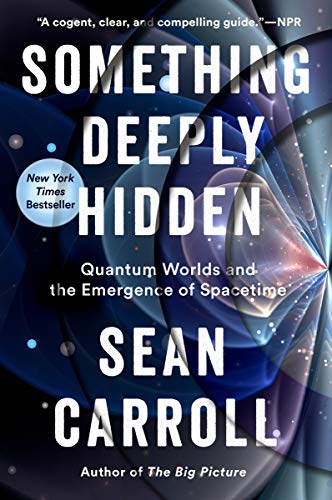
INSTANT NEW YORK TIMES BESTSELLER As you read these words, copies of you are being created. Sean Carroll, theoretical physicist and one of this world’s most celebrated writers on science, rewrites the history of 20th century physics. Already hailed as a masterpiece, Something Deeply Hidden shows for the first time that facing up to the essential puzzle of quantum mechanics utterly transforms how we think about space and time. His reconciling of quantum mechanics with Einstein’s theory of relativity changes, well, everything. Most physicists haven’t even recognized the uncomfortable truth: physics has been in crisis since 1927. Quantum mechanics has always had obvious gaps—which have come to be simply ignored. Science popularizers keep telling us how weird it is, how impossible it is to understand. Academics discourage students from working on the "dead end" of quantum foundations. Putting his professional reputation on the line with this audacious yet entirely reasonable book, Carroll says that the crisis can now come to an end. We just have to accept that there is more than one of us in the universe. There are many, many Sean Carrolls. Many of every one of us. Copies of you are generated thousands of times per second. The Many Worlds Theory of quantum behavior says that every time there is a quantum event, a world splits off with everything in it the same, except in that other world the quantum event didn't happen. Step-by-step in Carroll's uniquely lucid way, he tackles the major objections to this otherworldly revelation until his case is inescapably established. Rarely does a book so fully reorganize how we think about our place in the universe. We are on the threshold of a new understanding—of where we are in the cosmos, and what we are made of.
Recommended by Janna Levin
“Peebles is universally admired among cosmologists as one of the true greats of our time, able to navigate between the abstractions of relativity and the realism of astronomy. As only Peebles could, he carries us from the discovery of a big bang to the precipice of a far future of continued exploration in an enthralling yet knowable cosmos.” (from Amazon)

From Nobel Prize–winning physicist P. J. E. Peebles, the story of cosmology from Einstein to today Modern cosmology began a century ago with Albert Einstein's general theory of relativity and his notion of a homogenous, philosophically satisfying cosmos. Cosmology's Century is the story of how generations of scientists built on these thoughts and many new measurements to arrive at a well-tested physical theory of the structure and evolution of our expanding universe. In this landmark book, one of the world's most esteemed theoretical cosmologists offers an unparalleled personal perspective on how the field developed. P. J. E. Peebles was at the forefront of many of the greatest discoveries of the past century, making fundamental contributions to our understanding of the presence of helium and microwave radiation from the hot big bang, the measures of the distribution and motion of ordinary matter, and the new kind of dark matter that allows us to make sense of these results. Taking readers from the field's beginnings, Peebles describes how scientists working in independent directions found themselves converging on a theory of cosmic evolution interesting enough to warrant the rigorous testing it passes so well. He explores the major advances―some inspired by remarkable insights or perhaps just lucky guesses―as well as the wrong turns taken and the roads not explored. He shares recollections from major players in this story and provides a rare, inside look at how science is really done. A monumental work, Cosmology's Century also emphasizes where the present theory is incomplete, suggesting exciting directions for continuing research.
Get a weekly reading digest
New expert-recommended books every week. No account needed.