Jeff Chang
author of Can’t Stop Won’t Stop
Book Recommendations:
Recommended by Jeff Chang
“Ermias Asghedom’s all-too-short life was a pure epic run—from child prodigy, teenage baller, and young G to worldly rapper, hood builder, and global superstar. Rob Kenner’s thorough, definitive, and powerful telling of his story captures all of his heart, courage, and commitment. Read it and be inspired.” (from Amazon)
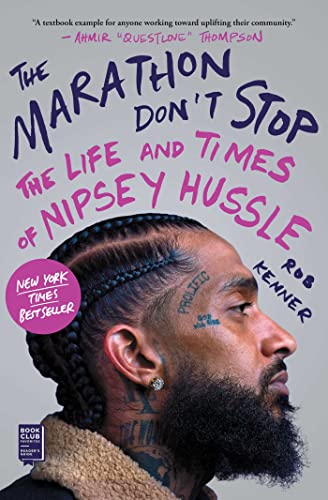
A NEW YORK TIMES BESTSELLER This “beautiful tribute to a legendary artist” (Quincy Jones) is the first in-depth biography of Nipsey Hussle, the hip-hop mogul, artist, and activist whose transformative legacy inspired a generation with his motivational lyrics and visionary business savvy—before he was tragically shot down in the very neighborhood he was dedicated to building up. For Nipsey Hussle, “The Marathon” was more than a mixtape title or the name of a clothing store; it was a way of life, a metaphor for the relentless pursuit of excellence and the willpower required to overcome adversity day after day. Hussle was determined to win the race to success on his own terms, and he wanted to see his whole community in the winner’s circle with him. A moving and powerful exploration of an extraordinary artist, The Marathon Don’t Stop places Hussle in historical context and unpacks his complex legacy. Combining on-the-ground reporting and candid interviews, “Rob Kenner has given us the book the world—and hip-hop and pop culture—has been waiting for…one that should be celebrated alongside the best biographies ever about iconic figures we have loved—and lost” (Kevin Powell, author of When We Free the World).
Recommended by Jeff Chang
“One of the most compelling curators and thinkers in the arts today turns his discerning eye to the new politics of the culture war. Roaming widely from Hollywood to Washington D.C., Madison Avenue to Mosul, while unpacking 'creative city' boosterism, the new 'corporate sociability,' and the 21st century charity complex, his provocative argument is that the powerful have learned from artists the tools and tactics of the counterculture—and we are not the better for it. A powerful, bracing, important read.” (from Amazon)

One of the country's leading activist curators explores how corporations and governments have used art and culture to mystify and manipulate us. The production of culture was once the domain of artists, but beginning in the early 1900s, the emerging fields of public relations, advertising and marketing transformed the way the powerful communicate with the rest of us. A century later, the tools are more sophisticated than ever, the onslaught more relentless. In Culture as Weapon, acclaimed curator and critic Nato Thompson reveals how institutions use art and culture to ensure profits and constrain dissent--and shows us that there are alternatives. An eye-opening account of the way advertising, media, and politics work today, Culture as Weapon offers a radically new way of looking at our world.
Recommended by Jeff Chang
“This book tells why we all share the responsibility to move those three words from an aspiration into a new reality.” (from Amazon)

THE INSTANT NEW YORK TIMES BESTSELLER. New York Times Editor’s Pick. Library Journal Best Books of 2019. TIME Magazine's "Best Memoirs of 2018 So Far." O, Oprah’s Magazine’s “10 Titles to Pick Up Now.” Politics & Current Events 2018 O.W.L. Book Awards Winner The Root Best of 2018 "This remarkable book reveals what inspired Patrisse's visionary and courageous activism and forces us to face the consequence of the choices our nation made when we criminalized a generation. This book is a must-read for all of us." - Michelle Alexander, New York Times bestselling author of The New Jim Crow A poetic and powerful memoir about what it means to be a Black woman in America―and the co-founding of a movement that demands justice for all in the land of the free. Raised by a single mother in an impoverished neighborhood in Los Angeles, Patrisse Khan-Cullors experienced firsthand the prejudice and persecution Black Americans endure at the hands of law enforcement. For Patrisse, the most vulnerable people in the country are Black people. Deliberately and ruthlessly targeted by a criminal justice system serving a white privilege agenda, Black people are subjected to unjustifiable racial profiling and police brutality. In 2013, when Trayvon Martin’s killer went free, Patrisse’s outrage led her to co-found Black Lives Matter with Alicia Garza and Opal Tometi. Condemned as terrorists and as a threat to America, these loving women founded a hashtag that birthed the movement to demand accountability from the authorities who continually turn a blind eye to the injustices inflicted upon people of Black and Brown skin. Championing human rights in the face of violent racism, Patrisse is a survivor. She transformed her personal pain into political power, giving voice to a people suffering inequality and a movement fueled by her strength and love to tell the country―and the world―that Black Lives Matter. When They Call You a Terrorist is Patrisse Khan-Cullors and asha bandele’s reflection on humanity. It is an empowering account of survival, strength and resilience and a call to action to change the culture that declares innocent Black life expendable.
Recommended by Jeff Chang
“In the way that J Dilla’s music was a portal for us to hear our world and feel the pulse of life anew, Charnas has made a portal through which to understand our time―historical time, musical time, and James Yancey’s own time―in a new way. Dilla Time is a book that will be read and reread with as much pleasure as we have listened and relistened to Dilla’s music. A masterpiece.” (from Amazon)

WINNER OF THE PEN/JACQUELINE BOGRAD WELD AWARD FOR BIOGRAPHY NEW YORK TIMES BESTSELLER “This book is a must for everyone interested in illuminating the idea of unexplainable genius.” ―QUESTLOVE Equal parts biography, musicology, and cultural history, Dilla Time chronicles the life and legacy of J Dilla, a musical genius who transformed the sound of popular music for the twenty-first century. He wasn’t known to mainstream audiences, even though he worked with renowned acts like D’Angelo and Erykah Badu and influenced the music of superstars like Michael Jackson and Janet Jackson. He died at the age of thirty-two, and in his lifetime he never had a pop hit. Yet since his death, J Dilla has become a demigod: revered by jazz musicians and rap icons from Robert Glasper to Kendrick Lamar; memorialized in symphonies and taught at universities. And at the core of this adulation is innovation: a new kind of musical time-feel that he created on a drum machine, but one that changed the way “traditional” musicians play. In Dilla Time, Dan Charnas chronicles the life of James DeWitt Yancey, from his gifted childhood in Detroit, to his rise as a Grammy-nominated hip-hop producer, to the rare blood disease that caused his premature death; and follows the people who kept him and his ideas alive. He also rewinds the histories of American rhythms: from the birth of soul in Dilla’s own “Motown,” to funk, techno, and disco. Here, music is a story of Black culture in America and of what happens when human and machine times are synthesized into something new. Dilla Time is a different kind of book about music, a visual experience with graphics that build those concepts step by step for fans and novices alike, teaching us to “see” and feel rhythm in a unique and enjoyable way. Dilla’s beats, startling some people with their seeming “sloppiness,” were actually the work of a perfectionist almost spiritually devoted to his music. This is the story of the man and his machines, his family, friends, partners, and celebrity collaborators. Culled from more than 150 interviews about one of the most important and influential musical figures of the past hundred years, Dilla Time is a book as delightfully detail-oriented and unique as J Dilla’s music itself.
Recommended by Jeff Chang
“Hip-hop is a story machine, and Jonathan Abrams is unsurpassed in capturing the best of them. What Please Kill Me did for punk rock, The Come Up has done for hip-hop. These are the tales that made a movement.” (from Amazon)

The essential oral history of hip-hop, from its origins on the playgrounds of the Bronx to its reign as the most powerful force in pop culture—from the award-winning journalist behind All the Pieces Matter, the New York Times bestselling oral history of The Wire “The Come Up is Abrams at his sharpest, at his most observant, at his most insightful.”—Shea Serrano, #1 New York Times bestselling author of Hip-Hop (And Other Things) ONE OF THE BEST BOOKS OF THE YEAR: The Boston Globe, The Guardian, Spin The music that would come to be known as hip-hop was born at a party in the Bronx in the summer of 1973. Now, fifty years later, it’s the most popular music genre in America. Just as jazz did in the first half of the twentieth century, hip-hop and its groundbreaking DJs and artists—nearly all of them people of color from some of America’s most overlooked communities—pushed the boundaries of music to new frontiers, while transfixing the country’s youth and reshaping fashion, art, and even language. And yet, the stories of many hip-hop pioneers and their individual contributions in the pre-Internet days of mixtapes and word of mouth are rarely heard—and some are at risk of being lost forever. Now, in The Come Up, the New York Times bestselling author Jonathan Abrams offers the most comprehensive account so far of hip-hop’s rise, a multi-decade chronicle told in the voices of the people who made it happen. In more than three hundred interviews conducted over three years, Abrams has captured the stories of the DJs, executives, producers, and artists who both witnessed and themselves forged the history of hip-hop. Masterfully combining these voices into a seamless symphonic narrative, Abrams traces how the genre grew out of the resourcefulness of a neglected population in the South Bronx, and from there how it flowed into New York City’s other boroughs, and beyond—from electrifying live gatherings, then on to radio and vinyl, below to the Mason-Dixon Line, west to Los Angeles through gangster rap and G-funk, and then across generations. Abrams has on record Grandmaster Caz detailing hip-hop’s infancy, Edward “Duke Bootee” Fletcher describing the origins of “The Message,” DMC narrating his role in introducing hip-hop to the mainstream, Ice Cube recounting N.W.A’s breakthrough and breakup, Kool Moe Dee recalling his Grammys boycott, and countless more key players. Throughout, Abrams conveys with singular vividness the drive, the stakes, and the relentless creativity that ignited one of the greatest revolutions in modern music. The Come Up is an exhilarating behind-the-scenes account of how hip-hop came to rule the world—and an essential contribution to music history.
Get a weekly reading digest
New expert-recommended books every week. No account needed.