Katherine Milkman
Prof. @Wharton @Penn, behavioral economist, judgment & decision making scholar, @CharlesSchwab #Choiceology podcast host https://t.co/jzUo2oW8wr
Book Recommendations:
Recommended by Katherine Milkman
“I had a blast interviewing my colleague @AdamMGrant today about his brilliant new book "Think Again: The Power of Knowing What you Don't Know" for #Choiceology. The book is full of great #BehavioralScience, as was the conversation (pre-order a copy: https://t.co/wgaGH2McYa) https://t.co/4Fkmtimvf9” (from X)

#1 New York Times Bestseller “THIS. This is the right book for right now. Yes, learning requires focus. But, unlearning and relearning requires much more—it requires choosing courage over comfort. In Think Again, Adam Grant weaves together research and storytelling to help us build the intellectual and emotional muscle we need to stay curious enough about the world to actually change it. I’ve never felt so hopeful about what I don’t know.” —Brené Brown, Ph.D., #1 New York Times bestselling author of Dare to Lead The #1 New York Times bestselling author of Hidden Potential, Originals, and Give and Take examines the critical art of rethinking: learning to question your opinions and open other people's minds, which can position you for excellence at work and wisdom in life Intelligence is usually seen as the ability to think and learn, but in a rapidly changing world, there's another set of cognitive skills that might matter more: the ability to rethink and unlearn. In our daily lives, too many of us favor the comfort of conviction over the discomfort of doubt. We listen to opinions that make us feel good, instead of ideas that make us think hard. We see disagreement as a threat to our egos, rather than an opportunity to learn. We surround ourselves with people who agree with our conclusions, when we should be gravitating toward those who challenge our thought process. The result is that our beliefs get brittle long before our bones. We think too much like preachers defending our sacred beliefs, prosecutors proving the other side wrong, and politicians campaigning for approval--and too little like scientists searching for truth. Intelligence is no cure, and it can even be a curse: being good at thinking can make us worse at rethinking. The brighter we are, the blinder to our own limitations we can become. Organizational psychologist Adam Grant is an expert on opening other people's minds--and our own. As Wharton's top-rated professor and the bestselling author of Originals and Give and Take, he makes it one of his guiding principles to argue like he's right but listen like he's wrong. With bold ideas and rigorous evidence, he investigates how we can embrace the joy of being wrong, bring nuance to charged conversations, and build schools, workplaces, and communities of lifelong learners. You'll learn how an international debate champion wins arguments, a Black musician persuades white supremacists to abandon hate, a vaccine whisperer convinces concerned parents to immunize their children, and Adam has coaxed Yankees fans to root for the Red Sox. Think Again reveals that we don't have to believe everything we think or internalize everything we feel. It's an invitation to let go of views that are no longer serving us well and prize mental flexibility over foolish consistency. If knowledge is power, knowing what we don't know is wisdom.
Recommended by Katherine Milkman
“The highlight of my week was watching the amazing @DollyChugh discuss her book on holding ourselves to a higher ethical standard (by acknowledging we are biased and have room to grow) on the @TODAYshow! As always, I was so inspired by @DollyChugh’s message and grace. https://t.co/jzjP4ggbt5” (from X)
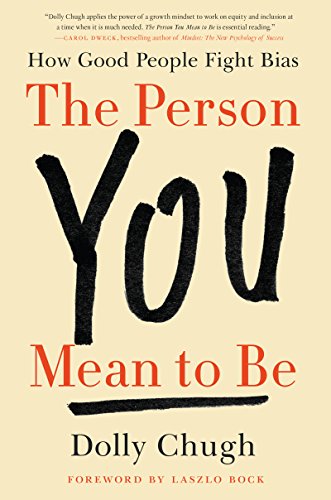
“Finally: an engaging, evidence-based book about how to battle biases, champion diversity and inclusion, and advocate for those who lack power and privilege. Dolly Chugh makes a convincing case that being an ally isn’t about being a good person—it’s about constantly striving to be a better person.” —Adam Grant, New York Times bestselling author of Give and Take, Originals, and Option B with Sheryl Sandberg Foreword by Laszlo Bock, the bestselling author of Work Rules! and former Senior Vice President of People Operations at Google An inspiring guide from Dolly Chugh, an award-winning social psychologist at the New York University Stern School of Business, on how to confront difficult issues including sexism, racism, inequality, and injustice so that you can make the world (and yourself) better. Many of us believe in equality, diversity, and inclusion. But how do we stand up for those values in our turbulent world? The Person You Mean to Be is the smart, "semi-bold" person’s guide to fighting for what you believe in. Dolly reveals the surprising causes of inequality, grounded in the "psychology of good people". Using her research findings in unconscious bias as well as work across psychology, sociology, economics, political science, and other disciplines, she offers practical tools to respectfully and effectively talk politics with family, to be a better colleague to people who don’t look like you, and to avoid being a well-intentioned barrier to equality. Being the person we mean to be starts with a look at ourselves. She argues that the only way to be on the right side of history is to be a good-ish— rather than good—person. Good-ish people are always growing. Second, she helps you find your "ordinary privilege"—the part of your everyday identity you take for granted, such as race for a white person, sexual orientation for a straight person, gender for a man, or education for a college graduate. This part of your identity may bring blind spots, but it is your best tool for influencing change. Third, Dolly introduces the psychological reasons that make it hard for us to see the bias in and around us. She leads you from willful ignorance to willful awareness. Finally, she guides you on how, when, and whom, to engage (and not engage) in your workplaces, homes, and communities. Her science-based approach is a method any of us can put to use in all parts of our life. Whether you are a long-time activist or new to the fight, you can start from where you are. Through the compelling stories Dolly shares and the surprising science she reports, Dolly guides each of us closer to being the person we mean to be.
Get a weekly reading digest
New expert-recommended books every week. No account needed.