Mark Williams
Emeritus Professor of Clinical Psychology, University of Oxford
Book Recommendations:
Recommended by Mark Williams
“Based on over 40 years of front-line research, this renowned book provides clinically proven strategies to help you manage your mind and the emotions that can so easily destroy your quality of life. Drs. Greenberger and Padesky show how your thoughts affect your feelings and teach step-by-step skills so you can free yourself from painful moods. The first edition of this book was a classic--the second edition is even better, and will be a trusted guide for even more people across the globe.” (from Amazon)

Discover simple yet powerful steps you can take to overcome emotional distress--and feel happier, calmer, and more confident. This life-changing book has already helped more than 1,300,000 readers use cognitive-behavioral therapy--one of today's most effective forms of psychotherapy--to conquer depression, anxiety, panic attacks, anger, guilt, shame, low self-esteem, eating disorders, substance abuse, and relationship problems. Revised and expanded to reflect significant scientific developments of the past 20 years, the second edition contains numerous new features: expanded content on anxiety; chapters on setting personal goals and maintaining progress; happiness rating scales; gratitude journals; innovative exercises focused on mindfulness, acceptance, and forgiveness; 25 new worksheets; and much more. Mind Over Mood will help you: *Learn proven, powerful, practical strategies to transform your life. *Follow step-by-step plans to overcome depression, anxiety, anger, guilt, and shame. *Set doable personal goals and track your progress (you can photocopy the worksheets from the book or download and print additional copies). *Practice your new skills until they become second nature. Cited as “The Most Influential Cognitive-Behavioral Therapy Publication” by the British Association for Behavioural and Cognitive Psychotherapies and included in the UK National Health Service Bibliotherapy Program. Winner (Second Place)--American Journal of Nursing Book of the Year Award, Consumer Health Category See also the Spanish-language edition: El control de tu estado de ánimo, Segunda edición. Plus, mental health professionals, see also The Clinician's Guide to CBT Using Mind Over Mood, Second Edition.
Recommended by Mark Williams
“The Way Out offers a wonderfully clear and compelling combination of personal experience and the latest breakthroughs in brain science to show how to reduce chronic pain.” (from Amazon)
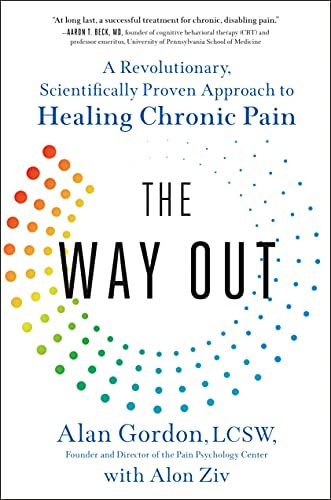
A groundbreaking mind-body protocol to heal chronic pain, backed by new research. Chronic pain is an epidemic. Fifty million Americans struggle with back pain, headaches, or some other pain that resists all treatment. Desperate pain sufferers are told again and again that there is no cure for chronic pain. Alan Gordon, a psychotherapist and the founder of the Pain Psychology Center in Los Angeles, was in grad school when he started experiencing chronic pain and it completely derailed his life. He saw multiple doctors and received many diagnoses, but none of the medical treatments helped. Frustrated with conventional pain management, he developed Pain Reprocessing Therapy (PRT), a mind-body protocol that eliminated his own chronic pain and has transformed the lives of thousands of his patients. PRT is rooted in neuroscience, which has shown that while chronic pain feels like it's coming from the body, in most cases it's generated by misfiring pain circuits in the brain. PRT is a system of psychological techniques that rewires the brain to break out of the cycle of chronic pain. The University of Colorado-Boulder recently conducted a large randomized controlled study on PRT, and the results are remarkable. By the end of the study, the majority of patients were pain-free or nearly pain-free. What's more, these dramatic changes held up over time. The Way Out brings PRT to readers. It combines accessible science with a concrete, step-by-step plan to teach sufferers how to heal their own chronic pain.
Recommended by Mark Williams
“This book provides a much-needed view of the lay of the land for mindfulness in the 21st century. Drawing on their many years of experience in practicing, investigating, and teaching within the Buddhist insight meditation tradition, on the one hand, and contemporary psychological science, on the other, Feldman and Kuyken offer a remarkably elegant and profound demonstration of what they name as the 'mutuality of learning and dialogue' between the two worlds. Their book shows clearly how and why such mutuality has transformative potential, and the conditions under which it may or may not flourish. This book is a 'must read' for students and teachers of mindfulness-based approaches.” (from Amazon)

How does mindfulness promote psychological well-being? What are its core mechanisms? What value do contemplative practices add to approaches that are already effective? From leading meditation teacher Christina Feldman and distinguished psychologist Willem Kuyken, this book provides a uniquely integrative perspective on mindfulness and its applications. The authors explore mindfulness from its roots in Buddhist psychology to its role in contemporary psychological science. In-depth case examples illustrate how and why mindfulness training can help people move from distress and suffering to resilience and flourishing. Readers are guided to consider mindfulness not only conceptually, but also experientially, through their own journey of mindfulness practice.
Get a weekly reading digest
New expert-recommended books every week. No account needed.