Martin Rees
University of Cambridge; author of Gravity’s Fatal Attraction
Book Recommendations:
Recommended by Martin Rees
“In this riveting personal account, Brian Keating writes frankly of his challenges, frustrations, and motivations during the years spent building and operating the instruments used to tackle one of the most fundamental problems in science: how our universe began.” (from Amazon)

A Forbes, Physics Today, Science News, and Science Friday Best Science Book Of 2018 The inside story of a quest to unlock one of cosmology’s biggest mysteries, derailed by the lure of the Nobel Prize. What would it have been like to be an eyewitness to the Big Bang? In 2014, astronomers wielding BICEP2, the most powerful cosmology telescope ever made, revealed that they’d glimpsed the spark that ignited the Big Bang. Millions around the world tuned in to the announcement broadcast live from Harvard University, immediately igniting rumors of an imminent Nobel Prize. But had these cosmologists truly read the cosmic prologue or, swept up in Nobel dreams, had they been deceived by a galactic mirage? In Losing the Nobel Prize, cosmologist and inventor of the BICEP (Background Imaging of Cosmic Extragalactic Polarization) experiment Brian Keating tells the inside story of BICEP2’s mesmerizing discovery and the scientific drama that ensued. In an adventure story that spans the globe from Rhode Island to the South Pole, from California to Chile, Keating takes us on a personal journey of revelation and discovery, bringing to vivid life the highly competitive, take-no-prisoners, publish-or-perish world of modern science. Along the way, he provocatively argues that the Nobel Prize, instead of advancing scientific progress, may actually hamper it, encouraging speed and greed while punishing collaboration and bold innovation. In a thoughtful reappraisal of the wishes of Alfred Nobel, Keating offers practical solutions for reforming the prize, providing a vision of a scientific future in which cosmologists may, finally, be able to see all the way back to the very beginning.
Recommended by Martin Rees
“Heino Falcke has produced a personal memoir of his key role in a scientific discovery that required boldness, persistence, technical expertise and complicated logistics involving hundreds of experts spread around the world. You don't need to be a scientist to enjoy this clearly written book--and it's a welcome bonus that the author offers a broader prospective on the motives that drive us to seek understanding of the cosmos and our place in it.” (from Amazon)

The International Bestseller On April 10, 2019, award-winning astrophysicist Heino Falcke presented the first image ever captured of a black hole at an international press conference—a turning point in astronomy that Science magazine called the scientific breakthrough of the year. That photo was captured with the unthinkable commitment of an intercontinental team of astronomers who transformed the world into a global telescope. While this image achieved Falcke’s goal in making a black hole “visible” for the first time, he recognizes that the photo itself asks more questions for humanity than it answers. Light in the Darkness takes us on Falcke’s extraordinary journey to the darkest corners of the universe. From the first humans looking up at the night sky to modern astrophysics, from the study of black holes to the still-unsolved mysteries of the universe, Falcke asks, in even the greatest triumphs of science, is there room for doubts, faith, and a God? A plea for curiosity and humility, Light in the Darkness sees one of the great minds shaping the world today as he ponders the big, pressing questions that present themselves when we look up at the stars.
Recommended by Martin Rees
“In recent years there’s been a real surge in our knowledge of black holes and their role in the cosmos.” (from Amazon)

The mystery of gravity has captivated us for centuries. But what is gravity and how does it work? This engaging book delves into the bizarre and often counter-intuitive world of gravitational physics. Join distinguished astrophysicist Professor Luciano Rezzolla on this virtual journey into Einstein's world of gravity, with each milestone presenting ever more fascinating aspects of gravitation. Through gentle exposure to concepts such as spacetime curvature and general relativity, you will discover some of the most curious consequences of gravitational physics, such as black holes, neutron stars and gravitational waves. The author presents and explains one of the most impressive scientific achievements of recent times: the first image of a supermassive black hole. Written by one of the key scientists involved in producing these results, you'll get a behind-the-scenes view of how the image was captured and discover what happens to matter and light near a black hole.
Recommended by Martin Rees
“Two brilliant theorists offer a true-to-life account of their quest to solve one of the deepest mysteries of the cosmos.” (from Amazon)

Two world-renowned scientists present an audacious new vision of the cosmos that “steals the thunder from the Big Bang theory.” —Wall Street Journal The Big Bang theory—widely regarded as the leading explanation for the origin of the universe—posits that space and time sprang into being about 14 billion years ago in a hot, expanding fireball of nearly infinite density. Over the last three decades the theory has been repeatedly revised to address such issues as how galaxies and stars first formed and why the expansion of the universe is speeding up today. Furthermore, an explanation has yet to be found for what caused the Big Bang in the first place. In Endless Universe, Paul J. Steinhardt and Neil Turok, both distinguished theoretical physicists, present a bold new cosmology. Steinhardt and Turok “contend that what we think of as the moment of creation was simply part of an infinite cycle of titanic collisions between our universe and a parallel world” (Discover). They recount the remarkable developments in astronomy, particle physics, and superstring theory that form the basis for their groundbreaking “Cyclic Universe” theory. According to this theory, the Big Bang was not the beginning of time but the bridge to a past filled with endlessly repeating cycles of evolution, each accompanied by the creation of new matter and the formation of new galaxies, stars, and planets. Endless Universe provides answers to longstanding problems with the Big Bang model, while offering a provocative new view of both the past and the future of the cosmos. It is a “theory that could solve the cosmic mystery” (USA Today).
Recommended by Martin Rees
“Those disposed to dismiss an 'AI takeover' as science fiction may think again after reading this original and well-argued book.” (from Amazon)
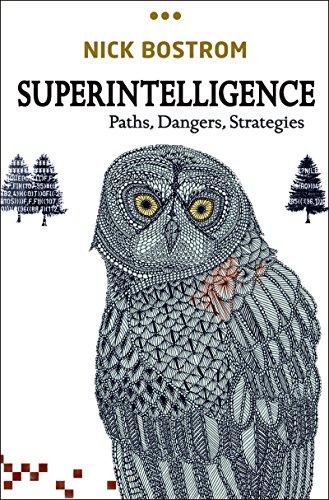
A New York Times bestseller Superintelligence asks the questions: What happens when machines surpass humans in general intelligence? Will artificial agents save or destroy us? Nick Bostrom lays the foundation for understanding the future of humanity and intelligent life. The human brain has some capabilities that the brains of other animals lack. It is to these distinctive capabilities that our species owes its dominant position. If machine brains surpassed human brains in general intelligence, then this new superintelligence could become extremely powerful - possibly beyond our control. As the fate of the gorillas now depends more on humans than on the species itself, so would the fate of humankind depend on the actions of the machine superintelligence. But we have one advantage: we get to make the first move. Will it be possible to construct a seed Artificial Intelligence, to engineer initial conditions so as to make an intelligence explosion survivable? How could one achieve a controlled detonation? This profoundly ambitious and original book breaks down a vast track of difficult intellectual terrain. After an utterly engrossing journey that takes us to the frontiers of thinking about the human condition and the future of intelligent life, we find in Nick Bostrom's work nothing less than a reconceptualization of the essential task of our time.
Get a weekly reading digest
New expert-recommended books every week. No account needed.