Max Tegmark
MIT
Book Recommendations:
Recommended by Max Tegmark
“World-renowned physicist Lisa Randall brings a fresh twist to one of the world’s oldest murder mysteries, the death of the dinos. With lively writing and wonderfully accessible explanations, she now convincingly implicates a new suspect as ultimately responsible for the hit: a novel kind of dark matter.” (from Amazon)

In this brilliant exploration of our cosmic environment, the renowned particle physicist and New York Times bestselling author of Warped Passages and Knocking on Heaven’s Door uses her research into dark matter to illuminate the startling connections between the furthest reaches of space and life here on Earth. Sixty-six million years ago, an object the size of a city descended from space to crash into Earth, creating a devastating cataclysm that killed off the dinosaurs, along with three-quarters of the other species on the planet. What was its origin? In Dark Matter and the Dinosaurs, Lisa Randall proposes it was a comet that was dislodged from its orbit as the Solar System passed through a disk of dark matter embedded in the Milky Way. In a sense, it might have been dark matter that killed the dinosaurs. Working through the background and consequences of this proposal, Randall shares with us the latest findings—established and speculative—regarding the nature and role of dark matter and the origin of the Universe, our galaxy, our Solar System, and life, along with the process by which scientists explore new concepts. In Dark Matter and the Dinosaurs, Randall tells a breathtaking story that weaves together the cosmos’ history and our own, illuminating the deep relationships that are critical to our world and the astonishing beauty inherent in the most familiar things.
Recommended by Max Tegmark
“The AI quest for artificial minds has transformed the mystery of consciousness into philosophy with a deadline. In this gem of a book, Annaka Harris tackles consciousness controversies with incisive rigor and clarity.” (from Amazon)

NEW YORK TIMES BESTSELLER "If you’ve ever wondered how you have the capacity to wonder, some fascinating insights await you in these pages.” --Adam Grant, New York Times bestselling author of Originals As concise and enlightening as Seven Brief Lessons on Physics and Astrophysics for People in a Hurry, this mind-expanding dive into the mystery of consciousness is an illuminating meditation on the self, free will, and felt experience. What is consciousness? How does it arise? And why does it exist? We take our experience of being in the world for granted. But the very existence of consciousness raises profound questions: Why would any collection of matter in the universe be conscious? How are we able to think about this? And why should we? In this wonderfully accessible book, Annaka Harris guides us through the evolving definitions, philosophies, and scientific findings that probe our limited understanding of consciousness. Where does it reside, and what gives rise to it? Could it be an illusion, or a universal property of all matter? As we try to understand consciousness, we must grapple with how to define it and, in the age of artificial intelligence, who or what might possess it. Conscious offers lively and challenging arguments that alter our ideas about consciousness—allowing us to think freely about it for ourselves, if indeed we can.
Recommended by Max Tegmark
“A must-read: this intellectual tour-de-force by one of AI's true pioneers not only explains the risks of ever more powerful artificial intelligence in a captivating and persuasive way, but also proposes a concrete and promising solution.” (from Amazon)
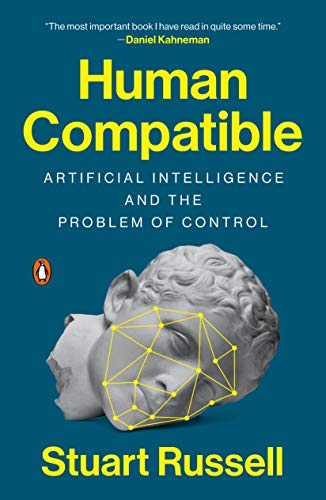
"The most important book on AI this year." --The Guardian "Mr. Russell's exciting book goes deep, while sparkling with dry witticisms." --The Wall Street Journal "The most important book I have read in quite some time" (Daniel Kahneman); "A must-read" (Max Tegmark); "The book we've all been waiting for" (Sam Harris) A leading artificial intelligence researcher lays out a new approach to AI that will enable us to coexist successfully with increasingly intelligent machines In the popular imagination, superhuman artificial intelligence is an approaching tidal wave that threatens not just jobs and human relationships, but civilization itself. Conflict between humans and machines is seen as inevitable and its outcome all too predictable. In this groundbreaking book, distinguished AI researcher Stuart Russell argues that this scenario can be avoided, but only if we rethink AI from the ground up. Russell begins by exploring the idea of intelligence in humans and in machines. He describes the near-term benefits we can expect, from intelligent personal assistants to vastly accelerated scientific research, and outlines the AI breakthroughs that still have to happen before we reach superhuman AI. He also spells out the ways humans are already finding to misuse AI, from lethal autonomous weapons to viral sabotage. If the predicted breakthroughs occur and superhuman AI emerges, we will have created entities far more powerful than ourselves. How can we ensure they never, ever, have power over us? Russell suggests that we can rebuild AI on a new foundation, according to which machines are designed to be inherently uncertain about the human preferences they are required to satisfy. Such machines would be humble, altruistic, and committed to pursue our objectives, not theirs. This new foundation would allow us to create machines that are provably deferential and provably beneficial.
Recommended by Max Tegmark
“In this riveting page-turner, one of the founding fathers of China’s AI industry tells the inside story of China’s rise as an AI superpower, and shares his inspiring recipe for us flourishing rather than floundering with AI.” (from Amazon)

THE NEW YORK TIMES, USA TODAY, AND WALL STREET JOURNAL BESTSELLER "Kai-Fu Lee believes China will be the next tech-innovation superpower and in AI Superpowers: China, Silicon Valley, and the New World Order, he explains why. Taiwan-born Lee is perfectly positioned for the task."—New York Magazine In this thought-provoking book, Lee argues powerfully that because of the unprecedented developments in AI, dramatic changes will be happening much sooner than many of us expected. Indeed, as the US-Sino AI competition begins to heat up, Lee urges the US and China to both accept and to embrace the great responsibilities that come with significant technological power. Most experts already say that AI will have a devastating impact on blue-collar jobs. But Lee predicts that Chinese and American AI will have a strong impact on white-collar jobs as well. Is universal basic income the solution? In Lee’s opinion, probably not. But he provides a clear description of which jobs will be affected and how soon, which jobs can be enhanced with AI, and most importantly, how we can provide solutions to some of the most profound changes in the future of human history.
Recommended by Max Tegmark
“This superb analysis by one of the world's clearest thinkers tackles one of humanity's greatest challenges: if future superhuman artificial intelligence becomes the biggest event in human history, then how can we ensure that it doesn't become the last?” (from Amazon)
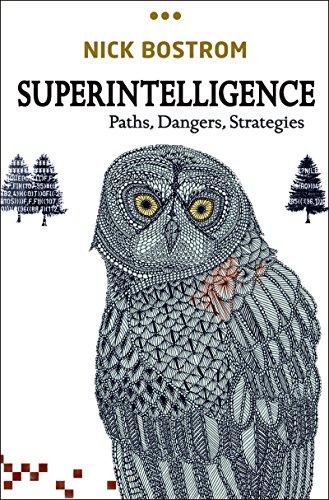
A New York Times bestseller Superintelligence asks the questions: What happens when machines surpass humans in general intelligence? Will artificial agents save or destroy us? Nick Bostrom lays the foundation for understanding the future of humanity and intelligent life. The human brain has some capabilities that the brains of other animals lack. It is to these distinctive capabilities that our species owes its dominant position. If machine brains surpassed human brains in general intelligence, then this new superintelligence could become extremely powerful - possibly beyond our control. As the fate of the gorillas now depends more on humans than on the species itself, so would the fate of humankind depend on the actions of the machine superintelligence. But we have one advantage: we get to make the first move. Will it be possible to construct a seed Artificial Intelligence, to engineer initial conditions so as to make an intelligence explosion survivable? How could one achieve a controlled detonation? This profoundly ambitious and original book breaks down a vast track of difficult intellectual terrain. After an utterly engrossing journey that takes us to the frontiers of thinking about the human condition and the future of intelligent life, we find in Nick Bostrom's work nothing less than a reconceptualization of the essential task of our time.
Get a weekly reading digest
New expert-recommended books every week. No account needed.