Orin Kerr
Law professor at @USCGouldLaw. Teaching criminal procedure & cybercrime law. Volokh/Lawfare blogger. Not your lawyer. Papers at https://t.co/pmyXHumr96
Book Recommendations:
“@kevinjonheller the opposite is true; it will seem like an uncomfortable place because it doesn't share your values, and so seems unappealing. The book makes a very good argument that this is the best explanation for academia's strong ideological tilt, going through the other common args, too.” (from X)

Some observers see American academia as a bastion of leftist groupthink that indoctrinates students and silences conservative voices. Others see a protected enclave that naturally produces free-thinking, progressive intellectuals. Both views are self-serving, says Neil Gross, but neither is correct. Why Are Professors Liberal and Why Do Conservatives Care? explains how academic liberalism became a self-reproducing phenomenon, and why Americans on both the left and right should take notice. Academia employs a higher percentage of liberals than nearly any other profession. But the usual explanations--hiring bias against conservatives, correlations of liberal ideology with high intelligence--do not hold up to scrutiny. Drawing on a range of original research, statistics, and interviews, Gross argues that "political typing" plays an overlooked role in shaping academic liberalism. For historical reasons, the professoriate developed a reputation for liberal politics early in the twentieth century. As this perception spread, it exerted a self-selecting influence on bright young liberals, while deterring equally promising conservatives. Most professors' political views formed well before they stepped behind the lectern for the first time. Why Are Professors Liberal and Why Do Conservatives Care? shows how studying the political sympathies of professors and their critics can shed light not only on academic life but on American politics, where the modern conservative movement was built in no small part around opposition to the "liberal elite" in higher education. This divide between academic liberals and nonacademic conservatives makes accord on issues as diverse as climate change, immigration, and foreign policy more difficult.

On the surface, law schools today are thriving. Enrollments are on the rise, and their resources are often the envy of every other university department. Law professors are among the highest paid and play key roles as public intellectuals, advisers, and government officials. Yet behind the flourishing facade, law schools are failing abjectly. Recent front-page stories have detailed widespread dubious practices, including false reporting of LSAT and GPA scores, misleading placement reports, and the fundamental failure to prepare graduates to enter the profession. Addressing all these problems and more in a ringing critique is renowned legal scholar Brian Z. Tamanaha. Piece by piece, Tamanaha lays out the how and why of the crisis and the likely consequences if the current trend continues. The out-of-pocket cost of obtaining a law degree at many schools now approaches $200,000. The average law school graduate’s debt is around $100,000—the highest it has ever been—while the legal job market is the worst in decades, with the scarce jobs offering starting salaries well below what is needed to handle such a debt load. At the heart of the problem, Tamanaha argues, are the economic demands and competitive pressures on law schools—driven by competition over U.S. News and World Report ranking. When paired with a lack of regulatory oversight, the work environment of professors, the limited information available to prospective students, and loan-based tuition financing, the result is a system that is fundamentally unsustainable. Growing concern with the crisis in legal education has led to high-profile coverage in the Wall Street Journal and the New York Times, and many observers expect it soon will be the focus of congressional scrutiny. Bringing to the table his years of experience from within the legal academy, Tamanaha has provided the perfect resource for assessing what’s wrong with law schools and figuring out how to fix them.
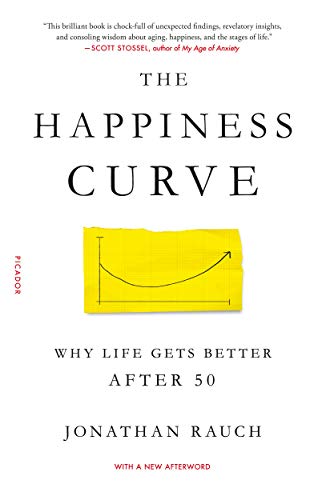
"In this warm, wise, and witty overview, Jonathan Rauch combines evidence and experience to show his fellow adults that the best is yet to come.” ―Steven Pinker, bestselling author of Enlightenment Now This book will change your life by showing you how life changes. Why does happiness get harder in your 40s? Why do you feel in a slump when you’re successful? Where does this malaise come from? And, most importantly, will it ever end? Drawing on cutting-edge research, award-winning journalist Jonathan Rauch answers all these questions. He shows that from our 20s into our 40s, happiness follows a U-shaped trajectory, a “happiness curve,” declining from the optimism of youth into what’s often a long, low slump in middle age, before starting to rise again in our 50s. This isn’t a midlife crisis, though. Rauch reveals that this slump is instead a natural stage of life―and an essential one. By shifting priorities away from competition and toward compassion, it equips you with new tools for wisdom and gratitude to win the third period of life. And Rauch can testify to this personally because it was his own slump, despite acclaim as a journalist and commentator that compelled him to investigate the happiness curve. His own story and the stories of many others from all walks of life―from a steelworker and a limo driver to a telecoms executive and a philanthropist―show how the ordeal of midlife malaise reboots our values and even our brains for a rebirth of gratitude. Full of insights and data and featuring many ways to endure the slump and avoid its perils and traps, The Happiness Curve doesn’t just show you the dark forest of midlife, it helps you find a path through the trees. It also demonstrates how we can―and why we must―do more to help each other through the woods. Midlife is a journey we mustn’t walk alone.
Get a weekly reading digest
New expert-recommended books every week. No account needed.