Robert Sutton
Organizational Psychologist, Stanford University Professor, and New York Times Bestselling Author of Good Boss, Bad Boss
Book Recommendations:
Recommended by Robert Sutton
“Whether you are the founder of a young startup or a leader in a big company, Matt and Pablo’s lessons on strategic speed, experimentation, esprit de corps, and much more will surprise you, spark your imagination, and help you grow your company.” (from Amazon)
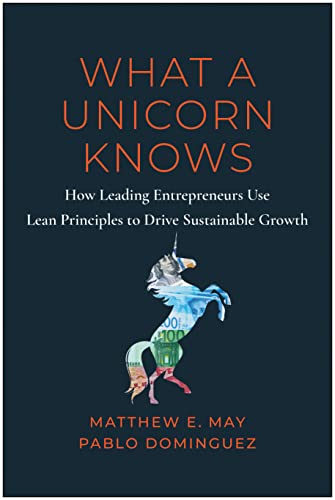
What a Unicorn Knows is your company’s best guide to becoming a well-oiled, high-velocity machine for growth on its way to billion-dollar valuation. Why do some young companies become unicorns, while others don’t? What a Unicorn Knows is a playbook that offers a field-tested approach to delivering superior customer value and reaching unicorn status by removing the potential inhibitors to organizational scale and speed. Drawing on a mastery of lean-based methods for achieving maximum effect with minimum means, private equity operators Matthew E. May and Pablo Dominguez provide readers with a powerful framework of universally applicable principles that enable any company to effectively accelerate its ability to scale and grow. Called The Unicorn Model™ and built on five foundational principles, the authors deliver a compelling narrative of stories and experiences in an easy-to-remember mnemonic: Strategic speedConstant experimentationAccelerated valueLean processEsprit de corps Drawn from the authors’ successful track record with a wide variety of unicorn-level companies, What a Unicorn Knows offers a necessary guide for rapid but lasting growth. As more companies than ever vie for unicorn status, your competitive edge will depend on learning from the best.
Recommended by Robert Sutton
“Barking Up The Wrong Tree is a masterpiece. Whether you are a connoisseur of self-help books, or despise them, you won't be able to resist this recipe for living a better life.” (from Amazon)

Wall Street Journal Bestseller Much of the advice we’ve been told about achievement is logical, earnest…and downright wrong. In Barking Up the Wrong Tree, Eric Barker reveals the extraordinary science behind what actually determines success and most importantly, how anyone can achieve it. You’ll learn: • Why valedictorians rarely become millionaires, and how your biggest weakness might actually be your greatest strength • Whether nice guys finish last and why the best lessons about cooperation come from gang members, pirates, and serial killers • Why trying to increase confidence fails and how Buddhist philosophy holds a superior solution • The secret ingredient to “grit” that Navy SEALs and disaster survivors leverage to keep going • How to find work-life balance using the strategy of Genghis Khan, the errors of Albert Einstein, and a little lesson from Spider-Man By looking at what separates the extremely successful from the rest of us, we learn what we can do to be more like them—and find out in some cases why it’s good that we aren’t. Barking Up the Wrong Tree draws on startling statistics and surprising anecdotes to help you understand what works and what doesn’t so you can stop guessing at success and start living the life you want.
Recommended by Robert Sutton
“Essentialism is a powerful antidote to the current craziness that plagues our organizations and our lives. Read Greg McKeown’s words slowly, stop and think about how to apply them to your life—you will do less, do it better, and begin to feel the insanity start to slip away.” (from Amazon)

THE LIFE-CHANGING NEW YORK TIMES BESTSELLER • MORE THAN TWO MILLION COPIES SOLD “Essentialism holds the keys to solving one of the great puzzles of life: How can we do less but accomplish more?”—Adam Grant, bestselling author of Think Again Essentialism isn’t about getting more done in less time. It’s about getting only the right things done. Have you ever found yourself stretched too thin? Are you often busy but not productive? Do you feel like your time is constantly being hijacked? If you answered yes to any of these, the way out is the Way of the Essentialist. Essentialism is more than a time-management technique. It is a systematic discipline for discerning what is absolutely essential, then eliminating everything that is not, so we can make the highest possible contribution toward the things that really matter. By forcing us to apply more selective criteria for where to spend our precious time and energy, the disciplined pursuit of less empowers us to reclaim control of our own choices, instead of giving others the implicit permission to choose for us. Essentialism is not one more thing to do. It’s a whole new way of doing less, but better, in every area of our lives. Join the millions of people who have used Essentialism to change their outlook on the world.
Recommended by Robert Sutton
“Influence is the only book I’ve assigned to my organizational behavior students at Stanford for the last twenty-five years. Students love it, and, years later, rave about how helpful it has been throughout their careers. The new version is even more useful and nuanced— and even more fun to read.” (from Amazon)

The widely adopted, now classic book on influence and persuasion—a major national and international bestseller with more than four million copies sold! In this highly acclaimed New York Times bestseller, Dr. Robert B. Cialdini—the seminal expert in the field of influence and persuasion—explains the psychology of why people say yes and how to apply these principles ethically in business and everyday situations. You’ll learn the six universal principles of influence and how to use them to become a skilled persuader—and, just as importantly, how to defend yourself against dishonest influence attempts: Reciprocation: The internal pull to repay what another person has provided us.Commitment and Consistency: Once we make a choice or take a stand, we work to behave consistently with that commitment in order to justify our decisions.Social Proof: When we are unsure, we look to similar others to provide us with the correct actions to take. And the more, people undertaking that action, the more we consider that action correct.Liking: The propensity to agree with people we like and, just as important, the propensity for others to agree with us, if we like them.Authority: We are more likely to say “yes” to others who are authorities, who carry greater knowledge, experience or expertise.Scarcity: We want more of what is less available or dwindling in availability.Understanding and applying the six principles ethically is cost-free and deceptively easy. Backed by Dr. Cialdini’s 35 years of evidence-based, peer-reviewed scientific research—as well as by a three-year field study on what moves people to change behavior—Influence is a comprehensive guide to using these principles effectively to amplify your ability to change the behavior of others.
Recommended by Robert Sutton
“This is the best book ever written on what it takes to build a creative organization.” (from Amazon)

The co-founder and longtime president of Pixar updates and expands his 2014 New York Times bestseller on creative leadership, reflecting on the management principles that built Pixar’s singularly successful culture, and on all he learned during the past nine years that allowed Pixar to retain its creative culture while continuing to evolve. “Might be the most thoughtful management book ever.”—Fast Company For nearly thirty years, Pixar has dominated the world of animation, producing such beloved films as the Toy Story trilogy, Finding Nemo, The Incredibles, Up, and WALL-E, which have gone on to set box-office records and garner eighteen Academy Awards. The joyous storytelling, the inventive plots, the emotional authenticity: In some ways, Pixar movies are an object lesson in what creativity really is. Here, Catmull reveals the ideals and techniques that have made Pixar so widely admired—and so profitable. As a young man, Ed Catmull had a dream: to make the first computer-animated movie. He nurtured that dream as a Ph.D. student, and then forged a partnership with George Lucas that led, indirectly, to his founding Pixar with Steve Jobs and John Lasseter in 1986. Nine years later, Toy Story was released, changing animation forever. The essential ingredient in that movie’s success—and in the twenty-five movies that followed—was the unique environment that Catmull and his colleagues built at Pixar, based on philosophies that protect the creative process and defy convention, such as: • Give a good idea to a mediocre team and they will screw it up. But give a mediocre idea to a great team and they will either fix it or come up with something better. • It’s not the manager’s job to prevent risks. It’s the manager’s job to make it safe for others to take them. • The cost of preventing errors is often far greater than the cost of fixing them. • A company’s communication structure should not mirror its organizational structure. Everybody should be able to talk to anybody. Creativity, Inc. has been significantly expanded to illuminate the continuing development of the unique culture at Pixar. It features a new introduction, two entirely new chapters, four new chapter postscripts, and changes and updates throughout. Pursuing excellence isn’t a one-off assignment but an ongoing, day-in, day-out, full-time job. And Creativity, Inc. explores how it is done.
Get a weekly reading digest
New expert-recommended books every week. No account needed.