Samir Arora
Book Recommendations:
Recommended by Samir Arora
“This book is so interesting that I plan to read it again in this break. Go get it and read. You will totally enjoy it. https://t.co/HZgBVCJK4U” (from X)

Amoral, cunning, ruthless, and instructive, this multi-million-copy New York Times bestseller is the definitive manual for anyone interested in gaining, observing, or defending against ultimate control – from the author of The Laws of Human Nature. In the book that People magazine proclaimed “beguiling” and “fascinating,” Robert Greene and Joost Elffers have distilled three thousand years of the history of power into 48 essential laws by drawing from the philosophies of Machiavelli, Sun Tzu, and Carl Von Clausewitz and also from the lives of figures ranging from Henry Kissinger to P.T. Barnum. Some laws teach the need for prudence (“Law 1: Never Outshine the Master”), others teach the value of confidence (“Law 28: Enter Action with Boldness”), and many recommend absolute self-preservation (“Law 15: Crush Your Enemy Totally”). Every law, though, has one thing in common: an interest in total domination. In a bold and arresting two-color package, The 48 Laws of Power is ideal whether your aim is conquest, self-defense, or simply to understand the rules of the game.
Recommended by Samir Arora
“I have tweeted extracts from it but never properly told you that ‘The Platform Delusion’ is a real super book. 👌👌 Go read it- u will enjoy it and learn from it.” (from X)
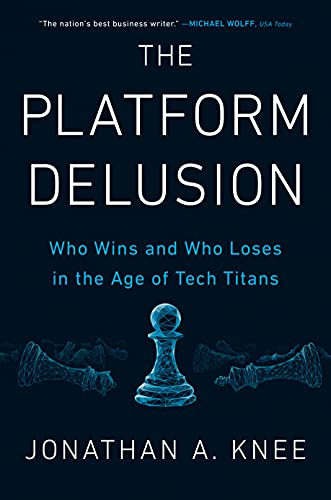
An investment banker and professor explains what really drives success in the tech economy Many think that they understand the secrets to the success of the biggest tech companies: Facebook, Amazon, Apple, Netflix, and Google. It's the platform economy, or network effects, or some other magical power that makes their ultimate world domination inevitable. Investment banker and professor Jonathan Knee argues that the truth is much more complicated--but entrepreneurs and investors can understand what makes the giants work, and learn the keys to lasting success in the digital economy. Knee explains what really makes the biggest tech companies work: a surprisingly disparate portfolio of structural advantages buttressed by shrewd acquisitions, strong management, lax regulation, and often, encouraging the myth that they are invincible to discourage competitors. By offering fresh insights into the true sources of strength and very real vulnerabilities of these companies, The Platform Delusion shows how investors, existing businesses, and startups might value them, compete with them, and imitate them. The Platform Delusion demystifies the success of the biggest digital companies in sectors from retail to media to software to hardware, offering readers what those companies don't want everyone else to know. Knee's insights are invaluable for entrepreneurs and investors in digital businesses seeking to understand what drives resilience and profitability for the long term.
Recommended by Samir Arora
“Finished a great book Americana: 400 yr history of American capitalism by @bhu_srinivasan Basically looks at US history through the eyes of business with easy to read chapters on topics like railroads, cotton,slavery, steel,auto, radio tv etc. Totally fascinating stories. Read” (from X)

An absorbing and original narrative history of American capitalism NAMED A BEST BOOK OF 2017 BY THE ECONOMIST From the days of the Mayflower and the Virginia Company, America has been a place for people to dream, invent, build, tinker, and bet the farm in pursuit of a better life. Americana takes us on a four-hundred-year journey of this spirit of innovation and ambition through a series of Next Big Things -- the inventions, techniques, and industries that drove American history forward: from the telegraph, the railroad, guns, radio, and banking to flight, suburbia, and sneakers, culminating with the Internet and mobile technology at the turn of the twenty-first century. The result is a thrilling alternative history of modern America that reframes events, trends, and people we thought we knew through the prism of the value that, for better or for worse, this nation holds dearest: capitalism. In a winning, accessible style, Bhu Srinivasan boldly takes on four centuries of American enterprise, revealing the unexpected connections that link them. We learn how Andrew Carnegie's early job as a telegraph messenger boy paved the way for his leadership of the steel empire that would make him one of the nation's richest men; how the gunmaker Remington reinvented itself in the postwar years to sell typewriters; how the inner workings of the Mafia mirrored the trend of consolidation and regulation in more traditional business; and how a 1950s infrastructure bill triggered a series of events that produced one of America's most enduring brands: KFC. Reliving the heady early days of Silicon Valley, we are reminded that the start-up is an idea as old as America itself. Entertaining, eye-opening, and sweeping in its reach, Americana is an exhilarating new work of narrative history.
Recommended by Samir Arora
“@SanaSecurities It is my all time favorite book.” (from X)

Challenges popular misconceptions about business success in today's world, explaining how experts mistakenly assume that money-making companies naturally prioritize strong leadership and clear strategies as well as high profits. 40,000 first printing.
Recommended by Samir Arora
“Finished Stephen Schwarzman's book "What it takes". Steve's success is amazing in its scope and scale. How comfortably govt and business interacts openly in US and China etc.- stories in the last few chapters- is very interesting to read.” (from X)

NEW YORK TIMES BESTSELLER From Blackstone chairman, CEO, and co-founder Stephen A. Schwarzman, a long-awaited book that uses impactful episodes from Schwarzman's life to show readers how to build, transform, and lead thriving organizations. Whether you are a student, entrepreneur, philanthropist, executive, or simply someone looking for ways to maximize your potential, the same lessons apply. People know who Stephen Schwarzman is—at least they think they do. He’s the man who took $400,000 and co-founded Blackstone, the investment firm that manages over $500 billion (as of January 2019). He’s the CEO whose views are sought by heads of state. He’s the billionaire philanthropist who founded Schwarzman Scholars, this century’s version of the Rhodes Scholarship, in China. But behind these achievements is a man who has spent his life learning and reflecting on what it takes to achieve excellence, make an impact, and live a life of consequence. Folding handkerchiefs in his father’s linen shop, Schwarzman dreamed of a larger life, filled with purpose and adventure. His grades and athleticism got him into Yale. After starting his career in finance with a short stint at a financial firm called DLJ, Schwarzman began working at Lehman Brothers where he ascended to run the mergers and acquisitions practice. He eventually partnered with his mentor and friend Pete Peterson to found Blackstone, vowing to create a new and different kind of financial institution. Building Blackstone into the leading global financial institution it is today didn’t come easy. Schwarzman focused intensely on culture, hiring great talent, and establishing processes that allow the firm to systematically analyze and evaluate risk. Schwarzman’s simple mantra “don’t lose money” has helped Blackstone become a leading private equity and real estate investor, and manager of alternative assets for institutional investors globally. Both he and the firm are known for the rigor of their investment process, their innovative approach to deal making, the diversification of their business lines, and a conviction to be the best at everything they do. Schwarzman is also an active philanthropist, having given away more than a billion dollars. In philanthropy, as in business, he is drawn to situations where his capital and energy can be applied to drive transformative solutions and change paradigms, notably in education. He uses the skills learned over a lifetime in finance to design, establish, and support impactful and innovative organizations and initiatives. His gifts have ranged from creating a new College of Computing at MIT for the study of artificial intelligence, to establishing a first-of-its-kind student and performing arts center at Yale, to enabling the renovation of the iconic New York Public Library, to founding the Schwarzman Scholars fellowship program at Tsinghua University in Beijing—the single largest philanthropic effort in China’s history from international donors. Schwarzman’s story is an empowering, entertaining, and informative guide for anyone striving for greater personal impact. From deal making to investing, leadership to entrepreneurship, philanthropy to diplomacy, Schwarzman has lessons for how to think about ambition and scale, risk and opportunities, and how to achieve success through the relentless pursuit of excellence. Schwarzman not only offers readers a thoughtful reflection on all his own experiences, but in doing so provides a practical blueprint for success.
Recommended by Samir Arora
“What a great book. Loonshots by @SafiBahcall is really well written and a delight to read. One of the contenders for Financial Times business book of the year, it is highly recommended. @safiranand has made up for his previous gift.” (from X)

PLEASE NOTE: This is a summary and analysis of the book and not the original book. ZIP Reads is wholly responsible for this content and is not associated with the original author in any way. If you are the author, publisher, or representative of the original work, please contact info@zipreads.co with any questions or concerns. If you'd like to purchase the original book, please paste this link in your browser: https://amzn.to/2PK1GgK In his thought-provoking book, Loonshots, physicist, and entrepreneur Safi Bahcall explains how the world we see around us is the culmination of crazy ideas by individuals who refused to accept the status quo and boldly chased after a greater vision. Click "Buy Now with 1-Click" to own your copy today! What does this ZIP Reads Summary Include? Synopsis of the original book Key takeaways from each chapter Specific examples of successful (and unsuccessful) loonshots Analysis of why certain loonshots fail while others succeed Editorial Review Background on Safi Bahcall About the Original Book: Loonshots is an intriguing blend of world history, science, technology, and business. Safi Bahcall takes his readers on a rollercoaster ride that reveals the power of nurturing crazy ideas and embracing audacious projects. Though we often feel comfortable maintaining the status quo, especially in a group setting, sometimes we must provide opportunities for daring ideas to flow. The truth is that the world as we know it today would not be what it is without loonshots. Bahcall shows us how we can create the right environment for nurturing and launching the kind of loonshots that save lives and change the world. DISCLAIMER: This book is intended as a companion to, not a replacement for, Loonshots. ZIP Reads is wholly responsible for this content and is not associated with the original author in any way. Please follow this link: https://amzn.to/2PK1GgK to purchase a copy of the original book. We are a participant in the Amazon Services LLC Associates Program, an affiliate advertising program designed to provide a means for us to earn fees by linking to Amazon.com and affiliated sites.
Recommended by Samir Arora
“What a great book. Loonshots by @SafiBahcall is really well written and a delight to read. One of the contenders for Financial Times business book of the year, it is highly recommended. @safiranand has made up for his previous gift.” (from X)

* Instant WSJ bestseller * Translated into 18 languages * #1 Most Recommended Book of the year (Bloomberg annual survey of CEOs and entrepreneurs) * An Amazon, Bloomberg, Financial Times, Forbes, Inc., Newsweek, Strategy + Business, Tech Crunch, Washington Post Best Business Book of the year * Recommended by Bill Gates, Daniel Kahneman, Malcolm Gladwell, Dan Pink, Adam Grant, Susan Cain, Sid Mukherjee, Tim Ferriss Why do good teams kill great ideas? Loonshots reveals a surprising new way of thinking about the mysteries of group behavior that challenges everything we thought we knew about nurturing radical breakthroughs. Bahcall, a physicist and entrepreneur, shows why teams, companies, or any group with a mission will suddenly change from embracing new ideas to rejecting them, just as flowing water will suddenly change into brittle ice. Mountains of print have been written about culture. Loonshots identifies the small shifts in structure that control this transition, the same way that temperature controls the change from water to ice. Using examples that range from the spread of fires in forests to the hunt for terrorists online, and stories of thieves and geniuses and kings, Bahcall shows how a new kind of science can help us become the initiators, rather than the victims, of innovative surprise. Over the past decade, researchers have been applying the tools and techniques of this new science―the science of phase transitions―to understand how birds flock, fish swim, brains work, people vote, diseases erupt, and ecosystems collapse. Loonshots is the first to apply this science to the spread of breakthrough ideas. Bahcall distills these insights into practical lessons creatives, entrepreneurs, and visionaries can use to change our world. Along the way, readers will learn how chickens saved millions of lives, what James Bond and Lipitor have in common, what the movie Imitation Game got wrong about WWII, and what really killed Pan Am, Polaroid, and the Qing Dynasty. “If The Da Vinci Code and Freakonomics had a child together, it would be called Loonshots.” ―Senator Bob Kerrey
Get a weekly reading digest
New expert-recommended books every week. No account needed.