Science
Book Recommendations:
Recommended by Science
“Barrow has produced something noteworthy--the definitive prehistory of conservation biology in America. The book is especially strong in its treatment of the underappreciated cohort of field biologists between William T. Hornaday and Aldo Leopold.” (from Amazon)

The rapid growth of the American environmental movement in recent decades obscures the fact that long before the first Earth Day and the passage of the Endangered Species Act, naturalists and concerned citizens recognized—and worried about—the problem of human-caused extinction. As Mark V. Barrow reveals in Nature’s Ghosts, the threat of species loss has haunted Americans since the early days of the republic. From Thomas Jefferson’s day—when the fossil remains of such fantastic lost animals as the mastodon and the woolly mammoth were first reconstructed—through the pioneering conservation efforts of early naturalists like John James Audubon and John Muir, Barrow shows how Americans came to understand that it was not only possible for entire species to die out, but that humans themselves could be responsible for their extinction. With the destruction of the passenger pigeon and the precipitous decline of the bison, professional scientists and wildlife enthusiasts alike began to understand that even very common species were not safe from the juggernaut of modern, industrial society. That realization spawned public education and legislative campaigns that laid the foundation for the modern environmental movement and the preservation of such iconic creatures as the bald eagle, the California condor, and the whooping crane. A sweeping, beautifully illustrated historical narrative that unites the fascinating stories of endangered animals and the dedicated individuals who have studied and struggled to protect them, Nature’s Ghosts offers an unprecedented view of what we’ve lost—and a stark reminder of the hard work of preservation still ahead.
Recommended by Science
“By focusing on the developments in Britain, Andrew Pickering's The Cybernetic Brain opens wide new vistas for exploring cybernetic practice and its legacy. For Pickering... cybernetics was primarily a science of the brain. As a protean science with connections to psychiatry, theater, music, politics, and counterculture, it was a lot more glamorous and fun than previous accounts of the field would have us believe.” (from Amazon)

Cybernetics is often thought of as a grim military or industrial science of control. But as Andrew Pickering reveals in this beguiling book, a much more lively and experimental strain of cybernetics can be traced from the 1940s to the present. The Cybernetic Brain explores a largely forgotten group of British thinkers, including Grey Walter, Ross Ashby, Gregory Bateson, R. D. Laing, Stafford Beer, and Gordon Pask, and their singular work in a dazzling array of fields. Psychiatry, engineering, management, politics, music, architecture, education, tantric yoga, the Beats, and the sixties counterculture all come into play as Pickering follows the history of cybernetics’ impact on the world, from contemporary robotics and complexity theory to the Chilean economy under Salvador Allende. What underpins this fascinating history, Pickering contends, is a shared but unconventional vision of the world as ultimately unknowable, a place where genuine novelty is always emerging. And thus, Pickering avers, the history of cybernetics provides us with an imaginative model of open-ended experimentation in stark opposition to the modern urge to achieve domination over nature and each other.
Recommended by Science
“rich source of information and indispensable reading for researchers investigating the biology of nucleic acids.” (from Amazon)

Recent studies on the activities of RNA in the cell have revolutionized our understanding of the many roles played by this molecule. The first two editions of The RNA World (1993, 1999) shed light on the pre-biotic era dominated by this versatile molecule, and provided an overview of the state of RNA research at the time. The new third edition of The RNA World updates this perspective, describing the vast array of newly discovered roles for RNA in the modern world. The updated original chapters are supplemented with new chapters on RNA-protein complexes, snRNPs and snoRNPs, telomerase RNA, RNAi, microRNAs, noncoding RNA, and many other subjects. This book is essential reading for anyone interested in the biology of nucleic acids and gene regulation and a valuable resource for teaching these concepts.
Recommended by Science
“anyone interested in the history, current constitution, and possible future development of a singular contemporary global phenomenon will be stimulated by this anniversary collection.” (from Amazon)

Wikipedia's first twenty years: how what began as an experiment in collaboration became the world's most popular reference work.We have been looking things up in Wikipedia for twenty years. What began almost by accident—a wiki attached to an nascent online encyclopedia—has become the world's most popular reference work. Regarded at first as the scholarly equivalent of a Big Mac, Wikipedia is now known for its reliable sourcing and as a bastion of (mostly) reasoned interaction. How has Wikipedia, built on a model of radical collaboration, remained true to its original mission of “free access to the sum of all human knowledge” when other tech phenomena have devolved into advertising platforms? In this book, scholars, activists, and volunteers reflect on Wikipedia's first twenty years, revealing connections across disciplines and borders, languages and data, the professional and personal. The contributors consider Wikipedia's history, the richness of the connections that underpin it, and its founding vision. Their essays look at, among other things, the shift from bewilderment to respect in press coverage of Wikipedia; Wikipedia as “the most important laboratory for social scientific and computing research in history”; and the acknowledgment that “free access” includes not just access to the material but freedom to contribute—that the summation of all human knowledge is biased by who documents it. Contributors Phoebe Ayers, Omer Benjakob, Yochai Benkler, William Beutler, Siko Bouterse, Rebecca Thorndike-Breeze, Amy Carleton, Robert Cummings, LiAnna L. Davis, Siân Evans, Heather Ford, Stephen Harrison, Heather Hart, Benjamin Mako Hill, Dariusz Jemielniak, Brian Keegan, Jackie Koerner, Alexandria Lockett, Jacqueline Mabey, Katherine Maher, Michael Mandiberg, Stephane Coillet-Matillon, Cecelia A. Musselman, Eliza Myrie, Jake Orlowitz, Ian A. Ramjohn, Joseph Reagle, Anasuya Sengupta, Aaron Shaw, Melissa Tamani, Jina Valentine, Matthew Vetter, Adele Vrana, Denny Vrandečić
Recommended by Science
“An important book with much to offer readers about the public recognition of PPMDs and the evolving categories of pathology and mental illness.” (from Amazon)

A powerful look at the changing cultural understanding of postpartum depression in America. New motherhood is often seen as a joyful moment in a woman’s life; for some women, it is also their lowest moment. For much of the twentieth century, popular and medical voices blamed women who had emotional and mental distress after childbirth for their own suffering. By the end of the century, though, women with postpartum mental illnesses sought to take charge of this narrative. In Blue: A History of Postpartum Depression in America, Rachel Louise Moran explores the history of the naming and mainstreaming of postpartum depression. Coalitions of maverick psychiatrists, psychologists, and women who themselves had survived substantial postpartum distress fought to legitimize and normalize women’s experiences. They argued that postpartum depression is an objective and real illness and fought to avoid it being politicized alongside other fraught medical and political battles over women’s health. Based on insightful oral histories and in-depth archival research, Blue reveals a secret history of American motherhood, women’s political activism, and the rise of postpartum depression advocacy amid an often-censorious conservative culture. By breaking new ground with the first book-length history of postpartum mental illness in the twentieth century, Moran brings mothers’ battles with postpartum depression out of the shadows and into the light.
Recommended by Science
“...by far the most accessible mathematical account available and therefore is an invaluable addition to the literature.” (from Amazon)

This book contains a rigorous mathematical treatment of the geometrical aspects of sets of both integral and fractional Hausdorff dimension. Questions of local density and the existence of tangents of such sets are studied, as well as the dimensional properties of their projections in various directions. In the case of sets of integral dimension the dramatic differences between regular 'curve-like' sets and irregular 'dust like' sets are exhibited. The theory is related by duality to Kayeka sets (sets of zero area containing lines in every direction). The final chapter includes diverse examples of sets to which the general theory is applicable: discussions of curves of fractional dimension, self-similar sets, strange attractors, and examples from number theory, convexity and so on. There is an emphasis on the basic tools of the subject such as the Vitali covering lemma, net measures and Fourier transform methods.
Recommended by Science
“The strength of this book lies in Muller’s experience as a lecturer and teacher, which has enabled him to describe and explain difficult concepts with simplicity.… [Now] provides a concise master class in understanding the essentials of physics.” (from Amazon)

“Now” is a simple yet elusive concept. You are reading the word “now” right now. But what does that mean? What makes the ephemeral moment “now” so special? Its enigmatic character has bedeviled philosophers, priests, and modern-day physicists from Augustine to Einstein and beyond. Einstein showed that the flow of time is affected by both velocity and gravity, yet he despaired at his failure to explain the meaning of “now.” Equally puzzling: why does time flow? Some physicists have given up trying to understand, and call the flow of time an illusion, but the eminent experimentalist physicist Richard A. Muller protests. He says physics should explain reality, not deny it. In Now, Muller does more than poke holes in past ideas; he crafts his own revolutionary theory, one that makes testable predictions. He begins by laying out―with the refreshing clarity that made Physics for Future Presidents so successful―a firm and remarkably clear explanation of the physics building blocks of his theory: relativity, entropy, entanglement, antimatter, and the Big Bang. With the stage then set, he reveals a startling way forward. Muller points out that the standard Big Bang theory explains the ongoing expansion of the universe as the continuous creation of new space. He argues that time is also expanding and that the leading edge of the new time is what we experience as “now.” This thought-provoking vision has remarkable implications for some of our biggest questions, not only in physics but also in philosophy―including the ongoing debate about the reality of free will. Moreover, his theory is testable. Muller’s monumental work will spark major debate about the most fundamental assumptions of our universe, and may crack one of physics’s longest-standing enigmas. 42 illustrations
Recommended by Science
“A wonderful read, with prose that flows like poetry in places and modern analogs that inspire creative thinking....This volume would make an excellent textbook and a splendid introduction to the world of the Vikings for any reader.” (from Amazon)

The definitive history of the Vikings -- from arts and culture to politics and cosmology -- by a distinguished archaeologist with decades of expertise The Viking Age -- from 750 to 1050 -- saw an unprecedented expansion of the Scandinavian peoples into the wider world. As traders and raiders, explorers and colonists, they ranged from eastern North America to the Asian steppe. But for centuries, the Vikings have been seen through the eyes of others, distorted to suit the tastes of medieval clerics and Elizabethan playwrights, Victorian imperialists, Nazis, and more. None of these appropriations capture the real Vikings, or the richness and sophistication of their culture. Based on the latest archaeological and textual evidence, Children of Ash and Elm tells the story of the Vikings on their own terms: their politics, their cosmology and religion, their material world. Known today for a stereotype of maritime violence, the Vikings exported new ideas, technologies, beliefs, and practices to the lands they discovered and the peoples they encountered, and in the process were themselves changed. From Eirík Bloodaxe, who fought his way to a kingdom, to Gudrid Thorbjarnardóttir, the most traveled woman in the world, Children of Ash and Elm is the definitive history of the Vikings and their time.
Recommended by Science
“Gives readers a firsthand look at both sides of the discourse [...] The book begins with heart-racing accounts of the law-breaking activities Lynas engaged in [...] By the end of chapter 7, science has won the debate.” (from Amazon)

In Seeds of Science, eco-activist Mark Lynas lifts the lid on the controversial story and misunderstood science of GMOs. In the mid-1990s, as the global media stirred up a panic about the risks of genetically modified crops, Lynas destroyed crop fields and spoke out in the press…until he realized he was wrong. This book explains why. Twenty years after GMO crops became a source of controversy, scientists are working hard to devise new farming methods that will meet the world's food requirements while causing the minimum amount of ecological harm. We're now discovering that the environmentalist mainstream might have misjudged the GMO issue completely, and as a consequence we have forfeited two decades' worth of scientific progress in perhaps the most vital area of human need: food. No one is more aware of this fact than Mark Lynas. Starting out as one of the leading activists in the fight against GMOs-from destroying experimental crop fields to leading the charge in the press-in 2013 Lynas famously admitted that he got it all wrong. Lynas takes us back to the origins of the technology, and examines the histories of the people and companies who pioneered it. He explains what lead him to question his assumptions on GMOs, and how he is currently tracking poverty by using genetic modification to encourage better harvests. Seeds of Science provides an explanation of the research that has enabled this technology-something which led to countless misconceptions about a field that could provide perhaps the only solution to a planet with a population of ten billion people.
Recommended by Science
“A riveting account of the rise and fall of the seeming confirmation of the cosmological theory of inflation... Keating offers vivid profiles of the personalities involved in shaping our modern view of the universe.” (from Amazon)

A Forbes, Physics Today, Science News, and Science Friday Best Science Book Of 2018 The inside story of a quest to unlock one of cosmology’s biggest mysteries, derailed by the lure of the Nobel Prize. What would it have been like to be an eyewitness to the Big Bang? In 2014, astronomers wielding BICEP2, the most powerful cosmology telescope ever made, revealed that they’d glimpsed the spark that ignited the Big Bang. Millions around the world tuned in to the announcement broadcast live from Harvard University, immediately igniting rumors of an imminent Nobel Prize. But had these cosmologists truly read the cosmic prologue or, swept up in Nobel dreams, had they been deceived by a galactic mirage? In Losing the Nobel Prize, cosmologist and inventor of the BICEP (Background Imaging of Cosmic Extragalactic Polarization) experiment Brian Keating tells the inside story of BICEP2’s mesmerizing discovery and the scientific drama that ensued. In an adventure story that spans the globe from Rhode Island to the South Pole, from California to Chile, Keating takes us on a personal journey of revelation and discovery, bringing to vivid life the highly competitive, take-no-prisoners, publish-or-perish world of modern science. Along the way, he provocatively argues that the Nobel Prize, instead of advancing scientific progress, may actually hamper it, encouraging speed and greed while punishing collaboration and bold innovation. In a thoughtful reappraisal of the wishes of Alfred Nobel, Keating offers practical solutions for reforming the prize, providing a vision of a scientific future in which cosmologists may, finally, be able to see all the way back to the very beginning.
Recommended by Science
“Accessible... Readers interested in the history of plate tectonics, seismic risk, and our society’s vulnerability would likely enjoy...” (from Amazon)

A journey around the United States in search of the truth about the threat of earthquakes leads to spine-tingling discoveries, unnerving experts, and ultimately the kind of preparations that will actually help guide us through disasters. It’s a road trip full of surprises. Earthquakes. You need to worry about them only if you’re in San Francisco, right? Wrong. We have been making enormous changes to subterranean America, and Mother Earth, as always, has been making some of her own. . . . The consequences for our real estate, our civil engineering, and our communities will be huge because they will include earthquakes most of us do not expect and cannot imagine—at least not without reading Quakeland. Kathryn Miles descends into mines in the Northwest, dissects Mississippi levee engineering studies, uncovers the horrific risks of an earthquake in the Northeast, and interviews the seismologists, structual engineers, and emergency managers around the country who are addressing this ground shaking threat. As Miles relates, the era of human-induced earthquakes began in 1962 in Colorado after millions of gallons of chemical-weapon waste was pumped underground in the Rockies. More than 1,500 quakes over the following seven years resulted. The Department of Energy plans to dump spent nuclear rods in the same way. Evidence of fracking’s seismological impact continues to mount. . . . Humans as well as fault lines built our “quakeland”. What will happen when Memphis, home of FedEx's 1.5-million-packages-a-day hub, goes offline as a result of an earthquake along the unstable Reelfoot Fault? FEMA has estimated that a modest 7.0 magnitude quake (twenty of these happen per year around the world) along the Wasatch Fault under Salt Lake City would put a $33 billion dent in our economy. When the Fukushima reactor melted down, tens of thousands were displaced. If New York’s Indian Point nuclear power plant blows, ten million people will be displaced. How would that evacuation even begin? Kathryn Miles’ tour of our land is as fascinating and frightening as it is irresistibly compelling.
Recommended by Science
“Chown's book offers readers and their inner atoms an enjoyable introduction to that history.” (from Amazon)

Why the force that keeps our feet on the ground holds the key to understanding the nature of time and the origin of the universe. Gravity is the weakest force in the everyday world yet it is the strongest force in the universe. It was the first force to be recognized and described yet it is the least understood. It is a "force" that keeps your feet on the ground yet no such force actually exists. Gravity, to steal the words of Winston Churchill, is "a riddle, wrapped in a mystery, inside an enigma." And penetrating that enigma promises to answer the biggest questions in science: what is space? What is time? What is the universe? And where did it all come from? Award-winning writer Marcus Chown takes us on an unforgettable journey from the recognition of the "force" of gravity in 1666 to the discovery of gravitational waves in 2015. And, as we stand on the brink of a seismic revolution in our worldview, he brings us up to speed on the greatest challenge ever to confront physics.
Recommended by Science
“A sweeping panoramic overview of the enduring alliance between astrophysics and the military—from the Greeks to Galileo to GPS.” (from Amazon)

New York Times Bestseller An exploration of the age-old complicity between skywatchers and warfighters, from the best-selling author of Astrophysics for People in a Hurry. In this fascinating foray into the centuries-old relationship between science and military power, acclaimed astrophysicist Neil deGrasse Tyson and writer-researcher Avis Lang examine how the methods and tools of astrophysics have been enlisted in the service of war. "The overlap is strong, and the knowledge flows in both directions," say the authors, because astrophysicists and military planners care about many of the same things: multi-spectral detection, ranging, tracking, imaging, high ground, nuclear fusion, and access to space. Tyson and Lang call it a "curiously complicit" alliance. "The universe is both the ultimate frontier and the highest of high grounds," they write. "Shared by both space scientists and space warriors, it’s a laboratory for one and a battlefield for the other. The explorer wants to understand it; the soldier wants to dominate it. But without the right technology―which is more or less the same technology for both parties―nobody can get to it, operate in it, scrutinize it, dominate it, or use it to their advantage and someone else’s disadvantage." Spanning early celestial navigation to satellite-enabled warfare, Accessory to War is a richly researched and provocative examination of the intersection of science, technology, industry, and power that will introduce Tyson’s millions of fans to yet another dimension of how the universe has shaped our lives and our world.
Recommended by Science
“[A] remarkably lively...chronicle.” (from Amazon)

A unique history of the ancient Near East that compellingly presents the life stories of kings, priestesses, merchants, bricklayers, and others In this sweeping history of the ancient Near East, Amanda Podany takes readers on a gripping journey from the creation of the world's first cities to the conquests of Alexander the Great. The book is built around the life stories of many ancient men and women, from kings, priestesses, and merchants to brickmakers, musicians, and weavers. Their habits of daily life, beliefs, triumphs, and crises, and the changes that people faced over time are explored through their own written words and the buildings, cities, and empires in which they lived. Rather than chronicling three thousand years of rulers and states, Weavers, Scribes, and Kings instead creates a tapestry of life stories through which readers will come to know specific individuals from many walks of life, and to understand their places within the broad history of events and institutions in the ancient Near East. These life stories are preserved on ancient clay tablets, which allow us to trace, for example, the career of a weaver as she advanced to become a supervisor of a workshop, listen to a king trying to persuade his generals to prepare for a siege, and feel the pain of a starving young couple and their four young children as they suffered through a time of famine. What might seem at first glance to be a remote and inaccessible ancient culture proves to be a comprehensible world, one that bequeathed to the modern world many of our institutions and beliefs, a truly fascinating place to visit.
Recommended by Science
“In some ways, Atomic Adventures is reminiscent of historian Richard Rhodes’s book The Making of the Atomic Bomb. But Mahaffey offers more than just history. He sets out to teach his readers about the science behind the stories. In a culture fixated on accomplishment, it’s important to talk about the things that didn’t work. What Atomic Adventures does well is to celebrate the full arc of science: the good, the bad, and the quirky.” (from Amazon)

The latest investigation from acclaimed nuclear engineer and author James Mahaffey unearths forgotten nuclear endeavors throughout history that were sometimes hair-brained, often risky, and always fascinating. Whether you are a scientist or a poet, pro-nuclear energy or staunch opponent, conspiracy theorist or pragmatist, James Mahaffey's books have served to open up the world of nuclear science like never before. With clear explanations of some of the most complex scientific endeavors in history, Mahaffey's new book looks back at the atom's wild, secretive past and then toward its potentially bright future. Mahaffey unearths lost reactors on far flung Pacific islands and trees that were exposed to active fission that changed gender or bloomed in the dead of winter. He explains why we have nuclear submarines but not nuclear aircraft and why cold fusion doesn't exist. And who knew that radiation counting was once a fashionable trend? Though parts of the nuclear history might seem like a fiction mash-up, where cowboys somehow got a hold of a reactor, Mahaffey's vivid prose holds the reader in thrall of the infectious energy of scientific curiosity and ingenuity that may one day hold the key to solving our energy crisis or sending us to Mars. 16 pages of color images
Recommended by Science
“At a time when everything from an otherwise unremarkable scientific report to a seemingly innocuous news item can be subject to intense scrutiny and mistrust, The Fracking Debate, a balanced guide to the contentious discussion on fracking, is a welcome resource.” (from Amazon)

Over roughly the past decade, oil and gas production in the United States has surged dramatically―thanks largely to technological advances such as high-volume hydraulic fracturing, more commonly known as “fracking.” This rapid increase has generated widespread debate, with proponents touting economic and energy-security benefits and opponents highlighting the environmental and social risks of increased oil and gas production. Despite the heated debate, neither side has a monopoly on the facts. In this book, Daniel Raimi gives a balanced and accessible view of oil and gas development, clearly and thoroughly explaining the key issues surrounding the shale revolution. The Fracking Debate directly addresses the most common questions and concerns associated with fracking: What is fracking? Does fracking pollute the water supply? Will fracking make the United States energy independent? Does fracking cause earthquakes? How is fracking regulated? Is fracking good for the economy? Coupling a deep understanding of the scholarly research with lessons from his travels to every major U.S. oil- and gas-producing region, Raimi highlights stories of the people and communities affected by the shale revolution, for better and for worse. The Fracking Debate provides the evidence and context that have so frequently been missing from the national discussion of the future of oil and gas production, offering readers the tools to make sense of this critical issue.
Recommended by Science
“Takes readers on a tour of the new fossils and discoveries that are shedding light on the dinosaurs' evolutionary story. … Full of adventures and humor.” (from Amazon)

"THE ULTIMATE DINOSAUR BIOGRAPHY," hails Scientific American: A thrilling new history of the age of dinosaurs, from one of our finest young scientists. "A masterpiece of science writing." —Washington Post A New York Times Bestseller • Goodreads Choice Awards Winner • A BEST BOOK OF THE YEAR: Smithsonian, Science Friday, The Times (London), Popular Mechanics, Science News "This is scientific storytelling at its most visceral, striding with the beasts through their Triassic dawn, Jurassic dominance, and abrupt demise in the Cretaceous." —Nature The dinosaurs. Sixty-six million years ago, the Earth’s most fearsome creatures vanished. Today they remain one of our planet’s great mysteries. Now The Rise and Fall of the Dinosaurs reveals their extraordinary, 200-million-year-long story as never before. In this captivating narrative (enlivened with more than seventy original illustrations and photographs), Steve Brusatte, a young American paleontologist who has emerged as one of the foremost stars of the field—naming fifteen new species and leading groundbreaking scientific studies and fieldwork—masterfully tells the complete, surprising, and new history of the dinosaurs, drawing on cutting-edge science to dramatically bring to life their lost world and illuminate their enigmatic origins, spectacular flourishing, astonishing diversity, cataclysmic extinction, and startling living legacy. Captivating and revelatory, The Rise and Fall of the Dinosaurs is a book for the ages. Brusatte traces the evolution of dinosaurs from their inauspicious start as small shadow dwellers—themselves the beneficiaries of a mass extinction caused by volcanic eruptions at the beginning of the Triassic period—into the dominant array of species every wide-eyed child memorizes today, T. rex, Triceratops, Brontosaurus, and more. This gifted scientist and writer re-creates the dinosaurs’ peak during the Jurassic and Cretaceous, when thousands of species thrived, and winged and feathered dinosaurs, the prehistoric ancestors of modern birds, emerged. The story continues to the end of the Cretaceous period, when a giant asteroid or comet struck the planet and nearly every dinosaur species (but not all) died out, in the most extraordinary extinction event in earth’s history, one full of lessons for today as we confront a “sixth extinction.” Brusatte also recalls compelling stories from his globe-trotting expeditions during one of the most exciting eras in dinosaur research—which he calls “a new golden age of discovery”—and offers thrilling accounts of some of the remarkable findings he and his colleagues have made, including primitive human-sized tyrannosaurs; monstrous carnivores even larger than T. rex; and paradigm-shifting feathered raptors from China. An electrifying scientific history that unearths the dinosaurs’ epic saga, The Rise and Fall of the Dinosaurs will be a definitive and treasured account for decades to come. Includes 75 images, world maps of the prehistoric earth, and a dinosaur family tree.
Recommended by Science
“[Carroll] sets out to show how various phenomena, including thought, choice, consciousness, and value, hang together with the scientific account of reality that has been developed in physics in the past 100 years. He attempts to do all this without relying on specialized jargon from philosophy and physics and succeeds spectacularly in achieving both aims.” (from Amazon)

The instant New York Times bestseller about humanity's place in the universe—and how we understand it. “Vivid...impressive....Splendidly informative.”—The New York Times “Succeeds spectacularly.”—Science “A tour de force.”—Salon Already internationally acclaimed for his elegant, lucid writing on the most challenging notions in modern physics, Sean Carroll is emerging as one of the greatest humanist thinkers of his generation as he brings his extraordinary intellect to bear not only on Higgs bosons and extra dimensions but now also on our deepest personal questions: Where are we? Who are we? Are our emotions, our beliefs, and our hopes and dreams ultimately meaningless out there in the void? Do human purpose and meaning fit into a scientific worldview? In short chapters filled with intriguing historical anecdotes, personal asides, and rigorous exposition, readers learn the difference between how the world works at the quantum level, the cosmic level, and the human level—and then how each connects to the other. Carroll's presentation of the principles that have guided the scientific revolution from Darwin and Einstein to the origins of life, consciousness, and the universe is dazzlingly unique. Carroll shows how an avalanche of discoveries in the past few hundred years has changed our world and what really matters to us. Our lives are dwarfed like never before by the immensity of space and time, but they are redeemed by our capacity to comprehend it and give it meaning. The Big Picture is an unprecedented scientific worldview, a tour de force that will sit on shelves alongside the works of Stephen Hawking, Carl Sagan, Daniel Dennett, and E. O. Wilson for years to come.
Recommended by Science
“Cats are amazing. They fascinate and bewilder us....[the] cat stories detailed here will only heighten the reader's amazment. And Losos has done cats at least as proud as we imagine they pride themselves.” (from Amazon)

The past, present, and future of the world's most popular and beloved pet, from a leading evolutionary biologist and great cat lover. "Engaging and wide-ranging ... The Cat's Meow is a readable and informed exploration of the wildcat that lurks within Fluffy." —The Washington Post The domestic cat—your cat—has, from its evolutionary origins in Africa, been transformed in comparatively little time into one of the most successful and diverse species on the planet. Jonathan Losos, writing as both a scientist and a cat lover, explores how researchers today are unraveling the secrets of the cat, past and present, using all the tools of modern technology, from GPS tracking (you’d be amazed where those backyard cats roam) and genomics (what is your so-called Siamese cat . . . really?) to forensic archaeology. In addition to solving the mysteries of your cat's past, it gives us a cat's-eye view of today's habitats, including meeting wild cousins around the world whose habits your sweet house cat sometimes eerily parallels. Do lions and tigers meow? If not, why not? Why does my cat leave a dead mouse at my feet (or on my pillow)? Is a pet ocelot a bad idea? When and why did the cat make its real leap off the African plain? What’s with all those cats in Egyptian hieroglyphics? In a genial voice, casually deciphering complex science and history with many examples from his own research and multi-cat household, Losos explores how selection, both natural and artificial, over the last several millennia has shaped the contemporary cat, with new breeds vastly different in anatomy and behavior from their ancestral stock. Yet the cat, ever a predator, still seems only one paw out of the wild, and readily reverts to its feral ways as it occupies new lands around the world. Humans are transforming cats, and they in turn are transforming the world around them. This charming and intelligent book suggests what the future may hold for both Felis catus and Homo sapiens.
Recommended by Science
“An easily approachable yet factually rich narrative. Oshinsky provides a very readable and enlightening history that also can be appreciated as good storytelling.” (from Amazon)

All who lived in the early 1950s remember the fear of polio and the elation felt when a successful vaccine was found. Now David Oshinsky tells the gripping story of the polio terror and of the intense effort to find a cure, from the March of Dimes to the discovery of the Salk and Sabin vaccines--and beyond. Here is a remarkable portrait of America in the early 1950s, using the widespread panic over polio to shed light on our national obsessions and fears. Drawing on newly available papers of Jonas Salk, Albert Sabin and other key players, Oshinsky paints a suspenseful portrait of the race for the cure, weaving a dramatic tale centered on the furious rivalry between Salk and Sabin. Indeed, the competition was marked by a deep-seated ill will among the researchers that remained with them until their deaths. The author also tells the story of Isabel Morgan, perhaps the most talented of all polio researchers, who might have beaten Salk to the prize if she had not retired to raise a family. As backdrop to this feverish research, Oshinsky offers an insightful look at the National Foundation for Infantile Paralysis, which was founded in the 1930s by FDR and Basil O'Connor. The National Foundation revolutionized fundraising and the perception of disease in America, using "poster children" and the famous March of Dimes to raise hundreds of millions of dollars from a vast army of contributors (instead of a few well-heeled benefactors), creating the largest research and rehabilitation network in the history of medicine. The polio experience also revolutionized the way in which the government licensed and tested new drugs before allowing them on the market, and the way in which the legal system dealt with manufacturers' liability for unsafe products. Finally, and perhaps most tellingly, Oshinsky reveals that polio was never the raging epidemic portrayed by the media, but in truth a relatively uncommon disease. But in baby-booming America--increasingly suburban, family-oriented, and hygiene-obsessed--the specter of polio, like the specter of the atomic bomb, soon became a cloud of terror over daily life. Both a gripping scientific suspense story and a provocative social and cultural history, Polio opens a fresh window onto postwar America.
Show all 29 recommendations
More recommendations by Science

The War for Kindness
20 Empathy Books That Experts Recommend for Deeper Connectionby Jamil Zaki
“Zaki is a compelling writer, and even an android could not help but respond to his prose. Zaki’s goals go beyond sharing the science of empathy with the masses. He hopes to inspire people to actually practice more kindness in their lives.”

Welcome to the Universe
10 Astronomy Books That Will Change How You See the Cosmosby Neil deGrasse Tyson, Michael A. Strauss, J. Richard Gott
“All three [authors] write in informal, conversational tones, and the text is sprinkled with genuinely funny non sequiturs, such as a brief rumination on dwarfs versus dwarves and commentary on English-speaking aliens in Star Trek.... What the book does very well is to present...”

Entangled Life
15 Botany Books That Deepen Your Nature Connectionby Merlin Sheldrake
“Nearly every page of this book contained either an observation so interesting or a turn of phrase so lovely that I was moved to slow down, stop, and re-read. [Entangled Life] reminded me that fungi are, like the Universe, sublime.”

Quantum Computation and Quantum Information
7 Computation Models Books That Define the Fieldby Michael A. Nielsen, Isaac L. Chuang
“Quantum Computation and Quantum Information is a challenging text that offers a thorough discussion of the relevant physics and a reference book that guides readers to the original literature...Perhaps the best way to use the book, though, is to ask questions and then search...”

The End of Everything
10 Astronomy Books That Will Change How You See the Cosmosby Katie Mack
“Excellent, far-reaching...The book is the perfect antidote to the malaise of mundane worries.”

Racing Green
11 Motorsport Books That Define Racing Excellenceby Kit Chapman
“An entertaining and often insightful read that will be enjoyed by both racing fans and people generally interested in processes of innovation.”

Determined
10 Free Will Books That Shape Thought and Debateby Robert M. Sapolsky
“Sapolsky’s decades of experience studying the effects of the interplay of genes and the environment on behavior shine brightly... He provides compelling examples that bad luck compounds... convincingly argues against claims that chaos theory, emergent phenomena, or the...”

Quantum Supremacy
16 Computer Science Books That Experts Trust and Useby Michio Kaku
“Expertly describes and rectifies common misconceptions about quantum computing—a technology regarded by experts as one that is likely to have profound societal implications.... Kaku deftly navigates the relevant scientific landscape.... Lucid.... Kaku excels at developing...”
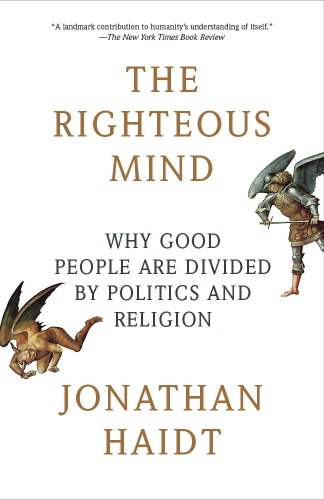
The Righteous Mind
19 Conservatism and Liberalism Books That Define Political Debateby Jonathan Haidt
“Ingenious prose…Beautifully written, Haidt’s book shines a new and creative light on moral psychology and presents a provocative message.”
Get a weekly reading digest
New expert-recommended books every week. No account needed.