The Economist
Book Recommendations:
Recommended by The Economist
“A book filled with genuine insights. . . . ‘Blowin’ in the Wind,’ the anthem that transformed a little-known folk singer into the conscience of a nation, is exhibit A for Mr. Marcus’s theory of empathy. . . . Mr. Marcus is at his best in exploring this rootedness.” (from Amazon)

Acclaimed cultural critic Greil Marcus tells the story of Bob Dylan through the lens of seven penetrating songs “The most interesting writer on Dylan over the years has been the cultural critic Greil Marcus. . . . No one alive knows the music that fueled Dylan’s imagination better. . . . Folk Music . . . [is an] ingenious book of close listening.”—David Remnick, New Yorker Named a Best Music Book of 2022 by Rolling Stone “Further elevates Marcus to what he has always been: a supreme artist-critic.”—Hilton Als Across seven decades, Bob Dylan has been the first singer of American song. As a writer and performer, he has rewritten the national songbook in a way that comes from his own vision and yet can feel as if it belongs to anyone who might listen. In Folk Music, Greil Marcus tells Dylan’s story through seven of his most transformative songs. Marcus’s point of departure is Dylan’s ability to “see myself in others.” Like Dylan’s songs, this book is a work of implicit patriotism and creative skepticism. It illuminates Dylan’s continuing presence and relevance through his empathy—his imaginative identification with other people. This is not only a deeply felt telling of the life and times of Bob Dylan but a rich history of American folk songs and the new life they were given as Dylan sat down to write his own.
Recommended by The Economist
“The book is superbly researched. Ms. Lesser captures the charisma of Kahn.” (from Amazon)

WINNER OF THE MARFIELD PRIZE AND PEN AMERICA LOS ANGELES'S 2018 LITERARY AWARD IN RESEARCH NONFICTION. FINALIST FOR THE 2018 PEN/BOGRAD WELD PRIZE FOR BIOGRAPHY One of the Washington Post's 50 Notable Works of Nonfiction in 2017, a New York Times Notable Book of 2017, and one of Kirkus's Best Nonfiction Books of 2017 "Wendy Lesser's You Say to Brick is easily the most complete narrative of Kahn's life and career, magnificently researched and gracefully written." ―Inga Saffron, New York Times Book Review Born in Estonia 1901 and brought to America in 1906, the architect Louis Kahn grew up in poverty in Philadelphia. By the time of his mysterious death in 1974, he was widely recognized as one of the greatest architects of his era. Yet this enormous reputation was based on only a handful of masterpieces, all built during the last fifteen years of his life. Wendy Lesser’s You Say to Brick: The Life of Louis Kahn is a major exploration of the architect’s life and work. Kahn, perhaps more than any other twentieth-century American architect, was a “public” architect. Rather than focusing on corporate commissions, he devoted himself to designing research facilities, government centers, museums, libraries, and other structures that would serve the public good. But this warm, captivating person, beloved by students and admired by colleagues, was also a secretive man hiding under a series of masks. Kahn himself, however, is not the only complex subject that comes vividly to life in these pages. His signature achievements―like the Salk Institute in La Jolla, the National Assembly Building of Bangladesh, and the Indian Institute of Management in Ahmedabad―can at first seem as enigmatic and beguiling as the man who designed them. In attempts to describe these structures, we are often forced to speak in contradictions and paradoxes: structures that seem at once unmistakably modern and ancient; enormous built spaces that offer a sense of intimate containment; designs in which light itself seems tangible, a raw material as tactile as travertine or Kahn’s beloved concrete. This is where Lesser’s talents as one of our most original and gifted cultural critics come into play. Interspersed throughout her account of Kahn’s life and career are exhilarating “in situ” descriptions of what it feels like to move through his built structures. Drawing on extensive original research, lengthy interviews with his children, his colleagues, and his students, and travel to the far-flung sites of his career-defining buildings, Lesser has written a landmark biography of this elusive genius, revealing the mind behind some of the twentieth century’s most celebrated architecture.
Recommended by The Economist
“Mr. Gioia could not have done a better job. Through him, jazz might even find new devotees.” (from Amazon)

A "radiantly accomplished" music scholar presents an accessible introduction to the art of listening to jazz (Wall Street Journal) In How to Listen to Jazz, award-winning music scholar Ted Gioia presents a lively introduction to one of America's premier art forms. He tells us what to listen for in a performance and includes a guide to today's leading jazz musicians. From Louis Armstrong's innovative sounds to the jazz-rock fusion of Miles Davis, Gioia covers the music's history and reveals the building blocks of improvisation. A true love letter to jazz by a foremost expert, How to Listen to Jazz is a must-read for anyone who's ever wanted to understand and better appreciate America's greatest contribution to music. "Mr. Gioia could not have done a better job. Through him, jazz might even find new devotees." -- Economist
Recommended by The Economist
“Riveting . . . Westover brings readers deep into this world, a milieu usually hidden from outsiders. . . . Her story is remarkable, as each extreme anecdote described in tidy prose attests.” (from Amazon)

#1 NEW YORK TIMES, WALL STREET JOURNAL, AND BOSTON GLOBE BESTSELLER • One of the most acclaimed books of our time: an unforgettable memoir about a young woman who, kept out of school, leaves her survivalist family and goes on to earn a PhD from Cambridge University “Extraordinary . . . an act of courage and self-invention.”—The New York Times NAMED ONE OF THE TEN BEST BOOKS OF THE YEAR BY THE NEW YORK TIMES BOOK REVIEW • ONE OF PRESIDENT BARACK OBAMA’S FAVORITE BOOKS OF THE YEAR • BILL GATES’S HOLIDAY READING LIST • FINALIST: National Book Critics Circle’s Award In Autobiography and John Leonard Prize For Best First Book • PEN/Jean Stein Book Award • Los Angeles Times Book Prize Born to survivalists in the mountains of Idaho, Tara Westover was seventeen the first time she set foot in a classroom. Her family was so isolated from mainstream society that there was no one to ensure the children received an education, and no one to intervene when one of Tara’s older brothers became violent. When another brother got himself into college, Tara decided to try a new kind of life. Her quest for knowledge transformed her, taking her over oceans and across continents, to Harvard and to Cambridge University. Only then would she wonder if she’d traveled too far, if there was still a way home. “Beautiful and propulsive . . . Despite the singularity of [Westover’s] childhood, the questions her book poses are universal: How much of ourselves should we give to those we love? And how much must we betray them to grow up?”—Vogue ONE OF THE BEST BOOKS OF THE YEAR: The Washington Post, O: The Oprah Magazine, Time, NPR, Good Morning America, San Francisco Chronicle, The Guardian, The Economist, Financial Times, Newsday, New York Post, theSkimm, Refinery29, Bloomberg, Self, Real Simple, Town & Country, Bustle, Paste, Publishers Weekly, Library Journal, LibraryReads, Book Riot, Pamela Paul, KQED, New York Public Library
Recommended by The Economist
“The coup of 1960 may seem remote, but the forces it unleashed are still at work - perhaps more than ever, which is what makes Mr Seal's book so timely” (from Amazon)

The most dramatic, revealing and little-known story in Turkey's history - which illuminates the nation 'Through the spellbinding career of a single, ill-fated leader, Jeremy Seal illuminates a bitterly divided country' Colin Thubron 'Read this book if you're interested in Turkey. Read it if you're interested in power, hubris and redemption. Read it' Christopher de Bellaigue, author of The Islamic Enlightenment In the spring of 2016 travel writer Jeremy Seal went to Turkey to investigate perhaps the most dramatic, revealing and little-known episode in the country's history - the 'original' coup of 1960, which deposed the traditionalist Prime Minister Adnan Menderes. The story of Menderes - to his adoring supporters the country's founding democrat; to his sworn enemies its most infamous traitor - goes to the heart of the feud that continues to rage between the Western and secular ambitions of a minority elite and the religious and conservative instincts of the small-town majority. A Coup in Turkey is a thrilling account of the events leading up to the coup and the trials and executions that followed, a story of political subterfuge and score-settling, courtroom drama, state execution, authoritarian intolerance and ideological division. Seal travels through President Erdogan's Turkey, tracking down eye-witness accounts from survivors of the Menderes era in Istanbul, the historic metropolis, and the new capital at Ankara. As he expertly guides us through this extraordinary story, so the compelling parallels between past and present become strikingly clear, and he illuminates this troubled nation with a deep sympathy and love for the people and places he writes about. By focussing on one key event - one which many Turks regard with shame - this evocative, gripping portrait of Turkey recentres our understanding of the past and makes sense of one of Europe's most bewildering yet intriguing neighbours. 'A wonderful writer' Robert Macfarlane
Recommended by The Economist
“Time is a persistent theme in Jim Al-Khalili's account of modern physics.” (from Amazon)

Bringing the material up to date, Black Holes, Wormholes and Time Machines, Second Edition captures the new ideas and discoveries made in physics since the publication of the best-selling first edition. While retaining the popular format and style of its predecessor, this edition explores the latest developments in high-energy astroparticle physics and Big Bang cosmology. The book continues to make the ideas and theories of modern physics easily understood by anyone, from researchers to students to general science enthusiasts. Taking you on a journey through space and time, author Jim Al-Khalili covers some of the most fascinating topics in physics today, including: Black holes Space warps The Big Bang Time travel Wormholes Parallel universes Professor Al-Khalili explains often complex scientific concepts in simple, nontechnical terms and imparts an appreciation of the cosmos, helping you see how time traveling may not be so far-fetched after all.
Recommended by The Economist
“A sweeping account…The most original and passionately written parts concern the fight between Russians and Turks in eastern Anatolia and the Caucasus. Two things distinguish Mr. McMeekin from many other writers in English about this period. First, he has a deep empathy with Turkish concerns, and he hews closer to the official Turkish line than to the revisionist, self-critical approach taken by some courageous Turkish liberals. Second, he has some unusual insights into imperial Russian thinking, based on study of the tsarist archives…[Mr. McMeekin] brings some useful correctives into focus.” (from Amazon)

An astonishing retelling of twentieth-century history from the Ottoman perspective, delivering profound new insights into World War I and the contemporary Middle East Between 1911 and 1922, a series of wars would engulf the Ottoman Empire and its successor states, in which the central conflict, of course, is World War I—a story we think we know well. As Sean McMeekin shows us in this revelatory new history of what he calls the “wars of the Ottoman succession,” we know far less than we think. The Ottoman Endgame brings to light the entire strategic narrative that led to an unstable new order in postwar Middle East—much of which is still felt today. The Ottoman Endgame: War, Revolution, and the Making of the Modern Middle East draws from McMeekin’s years of groundbreaking research in newly opened Ottoman and Russian archives. With great storytelling flair, McMeekin makes new the epic stories we know from the Ottoman front, from Gallipoli to the exploits of Lawrence in Arabia, and introduces a vast range of new stories to Western readers. His accounts of the lead-up to World War I and the Ottoman Empire’s central role in the war itself offers an entirely new and deeper vision of the conflict. Harnessing not only Ottoman and Russian but also British, German, French, American, and Austro-Hungarian sources, the result is a truly pioneering work of scholarship that gives full justice to a multitiered war involving many belligerents. McMeekin also brilliantly reconceives our inherited Anglo-French understanding of the war’s outcome and the collapse of the empire that followed. The book chronicles the emergence of modern Turkey and the carve-up of the rest of the Ottoman Empire as it has never been told before, offering a new perspective on such issues as the ethno-religious bloodletting and forced population transfers which attended the breakup of empire, the Balfour Declaration, the toppling of the caliphate, and the partition of Iraq and Syria—bringing the contemporary consequences into clear focus. Every so often, a work of history completely reshapes our understanding of a subject of enormous historical and contemporary importance. The Ottoman Endgame is such a book, an instantly definitive and thrilling example of narrative history as high art.
Recommended by The Economist
“[Duhigg] looks at the numerous ways that people can become more effective, whether in improving motivation, setting goals, making decisions or thinking creatively . . . [He’s] an effective storyteller with a knack for combining social science, fastidious reporting and entertaining anecdotes.” (from Amazon)

NEW YORK TIMES BESTSELLER • The author of The Power of Habit and Supercommunicators and “master of the life hack” (GQ) explores the fascinating science of productivity and offers real-world takeaways to apply your life, whether you’re chasing peak productivity or simply trying to get back on track. “Duhigg melds cutting-edge science, deep reporting, and wide-ranging stories to give us a fuller, more human way of thinking about how productivity actually happens.”—Susan Cain, author of Quiet In The Power of Habit, Pulitzer Prize–winning journalist Charles Duhigg explained why we do what we do. In Smarter Faster Better, he applies the same relentless curiosity and rich storytelling to how we can improve at the things we do. At the core of Smarter Faster Better are eight key concepts—from motivation and goal setting to focus and decision making—that explain why some people and companies get so much done. Drawing on the latest findings in neuroscience, psychology, and behavioral economics—as well as the experiences of CEOs, educational reformers, four-star generals, FBI agents, airplane pilots, and Broadway songwriters—this book reveals that the most productive people, companies, and organizations don’t merely act differently. They view the world, and their choices, in profoundly different ways. Smarter Faster Better is a story-filled exploration of the science of productivity, one that can help us learn to succeed with less stress and struggle—and become smarter, faster, and better at everything we do.
Recommended by The Economist
“[A] lively and wide-ranging history . . . [an] engrossing history of censorship.” (from Amazon)

The urge to censor is as old as the urge to speak. From the first Chinese emperor's wholesale elimination of books to the Vatican's suppression of pornography from its own collection, and on to the attack on Charlie Hebdo and the advent of Internet troll armies, words, images and ideas have always been hunted down by those trying to suppress them. In this compelling account, Eric Berkowitz reveals why and how humanity has, from the beginning, sought to silence itself. Ranging from the absurd - such as Henry VIII's decree of death for anyone who 'imagined' his demise - to claims by American slave owners that abolitionist literature should be supressed because it hurt their feelings, Berkowitz takes the reader on an unruly ride through history, highlighting the use of censorship to reinforce class, race and gender privilege and guard against offence. Elucidating phrases like 'fake news' and 'hate speech', Dangerous Ideas exposes the dangers of erasing history, how censorship has shaped our modern society and what forms it is taking today - and to what disturbing effects.
Recommended by The Economist
“Written in the snappy style of a hardboiled detective novel...an in-depth history of the growth, development and eventual decline of organized crime in America.” (from Amazon)

A rich biography of the legendary figure at the center of the century’s darkest secrets: an untold story of golden age Hollywood, modern Las Vegas, JFK-era scandal and international intrigue from Lee Server, the New York Times bestselling author of Ava Gardner: Love is Nothing… A singular figure in the annals of the American underworld, Johnny Rosselli’s career flourished for an extraordinary fifty years, from the bloody years of bootlegging in the Roaring Twenties--the last protégé of Al Capone―to the modern era of organized crime as a dominant corporate power. The Mob’s “Man in Hollywood,” Johnny Rosselli introduced big-time crime to the movie industry, corrupting unions and robbing moguls in the biggest extortion plot in history. A man of great allure and glamour, Rosselli befriended many of the biggest names in the movie capital―including studio boss Harry Cohn, helping him to fund Columbia Pictures--and seduced some of its greatest female stars, including Jean Harlow and Marilyn Monroe. In a remarkable turn of events, Johnny himself would become a Hollywood filmmaker―producing two of the best film noirs of the 1940s. Following years in federal prison, Rosselli began a new venture, overseeing the birth and heyday of Las Vegas. Working for new Chicago boss Sam Giancana, he became the gambling mecca’s behind-the-scenes boss, running the town from his suites and poolside tables at the Tropicana and Desert Inn, enjoying the Rat Pack nightlife with pals Frank Sinatra and Dean Martin. In the 1960s, in the most unexpected chapter in an extraordinary life, Rosselli became the central figure in a bizarre plot involving the Kennedy White House, the CIA, and an attempt to assassinate Fidel Castro. Based upon years of research, written with compelling style and vivid detail, Handsome Johnny is the great telling of an amazing tale.
Recommended by The Economist
“This intriguing book is an indictment. From its first page it argues that the CIA lost its way, in all senses, in the first decade of the cold war. Its witnesses are four courageous and initially idealistic patriots. Frank Wisner oversaw some of the earliest efforts to “roll back” communism in Europe. Michael Burke was a daredevil figure in the same game. Edward Lansdale was an éminence grise in the Far East. Peter Sichel, a German-born Jewish wine-merchant and Wunderkind—and the only one of the four still alive—held his nose as he co-opted former Nazis into the agency, an initiative cited as one of its original sins....Many of the CIA’s failures stemmed from familiar shortcomings. ‘We all have this tendency to look for information that confirms our beliefs and to ignore what conflicts with them,” explains Mr Sichel. “It’s very hard to give somebody information he doesn’t want to hear, and the more senior they are, the worse it is.’” (from Amazon)

From the bestselling author of Lawrence in Arabia—the gripping story of four CIA agents during the early days of the Cold War—and how the United States, at the very pinnacle of its power, managed to permanently damage its moral standing in the world. “Enthralling … captivating reading.” —The New York Times Book Review At the end of World War II, the United States was considered the victor over tyranny and a champion of freedom. But it was clear—to some—that the Soviet Union was already seeking to expand and foment revolution around the world, and the American government’s strategy in response relied on the secret efforts of a newly formed CIA. Chronicling the fascinating lives of four agents, Scott Anderson follows the exploits of four spies: Michael Burke, who organized parachute commandos from an Italian villa; Frank Wisner, an ingenious spymaster who directed actions around the world; Peter Sichel, a German Jew who outwitted the ruthless KGB in Berlin; and Edward Lansdale, a mastermind of psychological warfare in the Far East. But despite their lofty ambitions, time and again their efforts went awry, thwarted by a combination of ham-fisted politicking and ideological rigidity at the highest levels of the government.
Recommended by The Economist
“A how-to manual for anyone faced with a financial crisis… Mr Geithner was known for his brutal candor, and as an author, he does not disappoint.” (from Amazon)

New York Times Bestseller Washington Post Bestseller Los Angeles Times Bestseller Stress Test is the story of Tim Geithner’s education in financial crises. As president of the Federal Reserve Bank of New York and then as President Barack Obama’s secretary of the Treasury, Timothy F. Geithner helped the United States navigate the worst financial crisis since the Great Depression, from boom to bust to rescue to recovery. In a candid, riveting, and historically illuminating memoir, he takes readers behind the scenes of the crisis, explaining the hard choices and politically unpalatable decisions he made to repair a broken financial system and prevent the collapse of the Main Street economy. This is the inside story of how a small group of policy makers—in a thick fog of uncertainty, with unimaginably high stakes—helped avoid a second depression but lost the American people doing it. Stress Test is also a valuable guide to how governments can better manage financial crises, because this one won’t be the last. Stress Test reveals a side of Secretary Geithner the public has never seen, starting with his childhood as an American abroad. He recounts his early days as a young Treasury official helping to fight the international financial crises of the 1990s, then describes what he saw, what he did, and what he missed at the New York Fed before the Wall Street boom went bust. He takes readers inside the room as the crisis began, intensified, and burned out of control, discussing the most controversial episodes of his tenures at the New York Fed and the Treasury, including the rescue of Bear Stearns; the harrowing weekend when Lehman Brothers failed; the searing crucible of the AIG rescue as well as the furor over the firm’s lavish bonuses; the battles inside the Obama administration over his widely criticized but ultimately successful plan to end the crisis; and the bracing fight for the most sweeping financial reforms in more than seventy years. Secretary Geithner also describes the aftershocks of the crisis, including the administration’s efforts to address high unemployment, a series of brutal political battles over deficits and debt, and the drama over Europe’s repeated flirtations with the economic abyss. Secretary Geithner is not a politician, but he has things to say about politics—the silliness, the nastiness, the toll it took on his family. But in the end, Stress Test is a hopeful story about public service. In this revealing memoir, Tim Geithner explains how America withstood the ultimate stress test of its political and financial systems.
Recommended by The Economist
“A wonderfully vivid and clear account . . . [Madden is] a skilled narrator, negotiating the twists and turns in the city’s destiny.” (from Amazon)

One of Time’s 12 Books for the History Buffs on Your Holiday Gift List The first single-volume history of Istanbul in decades: a biography of the city at the center of civilizations past and present. For more than two millennia Istanbul has stood at the crossroads of the world, perched at the very tip of Europe, gazing across the shores of Asia. The history of this city--known as Byzantium, then Constantinople, now Istanbul--is at once glorious, outsized, and astounding. Founded by the Greeks, its location blessed it as a center for trade but also made it a target of every empire in history, from Alexander the Great and his Macedonian Empire to the Romans and later the Ottomans. At its most spectacular Emperor Constantine I re-founded the city as New Rome, the capital of the eastern Roman empire, and dramatically expanded the city, filling it with artistic treasures, and adorning the streets with opulent palaces. Around it all Constantine built new walls, truly impregnable, that preserved power, wealth, and withstood any aggressor--walls that still stand for tourists to visit. From its ancient past to the present, we meet the city through its ordinary citizens--the Jews, Muslims, Italians, Greeks, and Russians who used the famous baths and walked the bazaars--and the rulers who built it up and then destroyed it, including Mustafa Kemal Ataturk, the man who christened the city "Istanbul" in 1930. Thomas F. Madden's entertaining narrative brings to life the city we see today, including the rich splendor of the churches and monasteries that spread throughout the city. Istanbul draws on a lifetime of study and the latest scholarship, transporting readers to a city of unparalleled importance and majesty that holds the key to understanding modern civilization. In the words of Napoleon Bonaparte, "If the Earth were a single state, Istanbul would be its capital."
Recommended by The Economist
“One of the most valuable and detailed accounts of its subject to appear in the past decade.” (from Amazon)

The definitive account of an FBI special agent’s al-Qaeda story, unredacted for the first time. Widely heralded on publication as a "must-read" (Military Review) and "important window on America’s battle with al-Qaeda" (Washington Post), Ali Soufan’s revelatory account of the war on terror as seen from its front lines changed the way we understand al-Qaeda and how the United States prosecuted the war―and led to hard questions being asked of our leaders. When The Black Banners was published in 2011, significant portions of the text were redacted. After subsequent review by the Central Intelligence Agency, those redactions have been lifted. Their removal corrects the record on how vital intelligence was obtained from al-Qaeda suspects and brings forth important new details on the controversial use of enhanced interrogation techniques (torture) to extract information from terror suspects. For many years, proponents of the use of these techniques have argued that they produced actionable intelligence in the war on terror. This edition of The Black Banners explodes this myth; it shows Soufan at work using guile and intelligent questioning―not force or violence―to extract some of the most important confessions in the war, and it vividly recounts the failures of the government’s torture program. Drawing on Soufan’s experiences as a lead operative for the FBI and declassified government records, The Black Banners (Declassified) documents the intelligence failures that lead to the tragic attacks on New York and Washington, DC, and subsequently how torture derailed the fight against al-Qaeda. With this edition, eighteen years on from the first sanctioned enhanced interrogation technique, the public can finally read the complete story of what happened in their name after the events of 9/11. The Black Banners (Declassified) includes a new foreword from Ali Soufan that addresses the significance of the CIA’s decision to lift the redactions.
Recommended by The Economist
“The most important book of the Trump era was not Bob Woodward’s Fear or Michael Wolff’s Fire and Fury or any of the other bestselling exposes of the White House circus. Arguably it was a wonkish tome by two Harvard political scientists, Steven Levitsky and Daniel Ziblatt, published a year into Donald Trump’s presidency and entitled How Democracies Die.” (from Amazon)

NEW YORK TIMES BESTSELLER • “Comprehensive, enlightening, and terrifyingly timely.”—The New York Times Book Review (Editors' Choice) WINNER OF THE GOLDSMITH BOOK PRIZE • SHORTLISTED FOR THE LIONEL GELBER PRIZE • NAMED ONE OF THE BEST BOOKS OF THE YEAR BY The Washington Post • Time • Foreign Affairs • WBUR • Paste Donald Trump’s presidency has raised a question that many of us never thought we’d be asking: Is our democracy in danger? Harvard professors Steven Levitsky and Daniel Ziblatt have spent more than twenty years studying the breakdown of democracies in Europe and Latin America, and they believe the answer is yes. Democracy no longer ends with a bang—in a revolution or military coup—but with a whimper: the slow, steady weakening of critical institutions, such as the judiciary and the press, and the gradual erosion of long-standing political norms. The good news is that there are several exit ramps on the road to authoritarianism. The bad news is that, by electing Trump, we have already passed the first one. Drawing on decades of research and a wide range of historical and global examples, from 1930s Europe to contemporary Hungary, Turkey, and Venezuela, to the American South during Jim Crow, Levitsky and Ziblatt show how democracies die—and how ours can be saved. Praise for How Democracies Die “What we desperately need is a sober, dispassionate look at the current state of affairs. Steven Levitsky and Daniel Ziblatt, two of the most respected scholars in the field of democracy studies, offer just that.”—The Washington Post “Where Levitsky and Ziblatt make their mark is in weaving together political science and historical analysis of both domestic and international democratic crises; in doing so, they expand the conversation beyond Trump and before him, to other countries and to the deep structure of American democracy and politics.”—Ezra Klein, Vox “If you only read one book for the rest of the year, read How Democracies Die. . . .This is not a book for just Democrats or Republicans. It is a book for all Americans. It is nonpartisan. It is fact based. It is deeply rooted in history. . . . The best commentary on our politics, no contest.”—Michael Morrell, former Acting Director of the Central Intelligence Agency (via Twitter) “A smart and deeply informed book about the ways in which democracy is being undermined in dozens of countries around the world, and in ways that are perfectly legal.”—Fareed Zakaria, CNN
Recommended by The Economist
“An illuminating mosaic. Sharp economic analysis and informed political discussion are interspersed with elegant scholarly commentary.” (from Amazon)

Publisher change book cover. So This book is paperback cover. And publisher revised book title. This book language is korean.
Recommended by The Economist
“Mr Levinson... makes a strong case that it was McLean's thinking that led to modern-day containerisation...” (from Amazon)
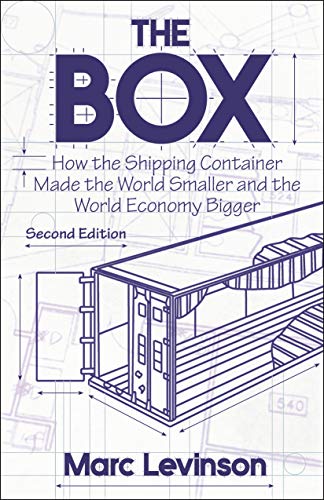
In April 1956, a refitted oil tanker carried fifty-eight shipping containers from Newark to Houston. From that modest beginning, container shipping developed into a huge industry that made the boom in global trade possible. The Box tells the dramatic story of the container's creation, the decade of struggle before it was widely adopted, and the sweeping economic consequences of the sharp fall in transportation costs that containerization brought about. But the container didn't just happen. Its adoption required huge sums of money, both from private investors and from ports that aspired to be on the leading edge of a new technology. It required years of high-stakes bargaining with two of the titans of organized labor, Harry Bridges and Teddy Gleason, as well as delicate negotiations on standards that made it possible for almost any container to travel on any truck or train or ship. Ultimately, it took McLean's success in supplying U.S. forces in Vietnam to persuade the world of the container's potential. Drawing on previously neglected sources, economist Marc Levinson shows how the container transformed economic geography, devastating traditional ports such as New York and London and fueling the growth of previously obscure ones, such as Oakland. By making shipping so cheap that industry could locate factories far from its customers, the container paved the way for Asia to become the world's workshop and brought consumers a previously unimaginable variety of low-cost products from around the globe. Published in hardcover on the fiftieth anniversary of the first container voyage, this is the first comprehensive history of the shipping container. Now with a new chapter, The Box tells the dramatic story of how the drive and imagination of an iconoclastic entrepreneur turned containerization from an impractical idea into a phenomenon that transformed economic geography, slashed transportation costs, and made the boom in global trade possible.
Recommended by The Economist
“[Peak] offers an optimistic anti-determinism that ought to influence how people educate children, manage employees, and spend their time. The good news is that to excel one need only look within.” (from Amazon)

From the world’s reigning expert on expertise comes a powerful new approach to mastering almost any skill. Have you ever wanted to learn a language or pick up an instrument, only to become too daunted by the task at hand? Expert performance guru Anders Ericsson has made a career studying chess champions, violin virtuosos, star athletes, and memory mavens. Peak condenses three decades of original research to introduce an incredibly powerful approach to learning that is fundamentally different from the way people traditionally think about acquiring a skill. Ericsson’s findings have been lauded and debated, but never properly explained. So the idea of expertise still intimidates us — we believe we need innate talent to excel, or think excelling seems prohibitively difficult. Peak belies both of these notions, proving that almost all of us have the seeds of excellence within us — it’s just a question of nurturing them by reducing expertise to a discrete series of attainable practices. Peak offers invaluable, often counterintuitive, advice on setting goals, getting feedback, identifying patterns, and motivating yourself. Whether you want to stand out at work, or help your kid achieve academic goals, Ericsson’s revolutionary methods will show you how to master nearly anything.
Recommended by The Economist
“Rather like the books of Stephen Hawking or Carlo Rovelli…this one is rewarding on different levels. Everyone can grasp the significance of the puzzles posed, and if readers want to follow the genius through the steps of his solutions then Bhattacharya is a clear and authoritative guide.” (from Amazon)

An electrifying biography of one of the most extraordinary scientists of the twentieth century and the world he made. The smartphones in our pockets and computers like brains. The vagaries of game theory and evolutionary biology. Nuclear weapons and self-replicating spacecrafts. All bear the fingerprints of one remarkable, yet largely overlooked, man: John von Neumann. Born in Budapest at the turn of the century, von Neumann is one of the most influential scientists to have ever lived. A child prodigy, he mastered calculus by the age of eight, and in high school made lasting contributions to mathematics. In Germany, where he helped lay the foundations of quantum mechanics, and later at Princeton, von Neumann’s colleagues believed he had the fastest brain on the planet―bar none. He was instrumental in the Manhattan Project and the design of the atom bomb; he helped formulate the bedrock of Cold War geopolitics and modern economic theory; he created the first ever programmable digital computer; he prophesized the potential of nanotechnology; and, from his deathbed, he expounded on the limits of brains and computers―and how they might be overcome. Taking us on an astonishing journey, Ananyo Bhattacharya explores how a combination of genius and unique historical circumstance allowed a single man to sweep through a stunningly diverse array of fields, sparking revolutions wherever he went. The Man from the Future is an insightful and thrilling intellectual biography of the visionary thinker who shaped our century. 12 illustrations
Recommended by The Economist
“Gripping, haunting and superbly told...Judy Batalion brings to light half-forgotten tales of astounding courage.” (from Amazon)

THE INSTANT NEW YORK TIMES BESTSELLER! Also on the USA Today, Washington Post, Boston Globe, Globe and Mail, Publishers Weekly, and Indie bestseller lists. One of the most important stories of World War II, already optioned by Steven Spielberg for a major motion picture: a spectacular, searing history that brings to light the extraordinary accomplishments of brave Jewish women who became resistance fighters—a group of unknown heroes whose exploits have never been chronicled in full, until now. Witnesses to the brutal murder of their families and neighbors and the violent destruction of their communities, a cadre of Jewish women in Poland—some still in their teens—helped transform the Jewish youth groups into resistance cells to fight the Nazis. With courage, guile, and nerves of steel, these “ghetto girls” paid off Gestapo guards, hid revolvers in loaves of bread and jars of marmalade, and helped build systems of underground bunkers. They flirted with German soldiers, bribed them with wine, whiskey, and home cooking, used their Aryan looks to seduce them, and shot and killed them. They bombed German train lines and blew up a town’s water supply. They also nursed the sick, taught children, and hid families. Yet the exploits of these courageous resistance fighters have remained virtually unknown. As propulsive and thrilling as Hidden Figures, In the Garden of Beasts, and Band of Brothers, The Light of Days at last tells the true story of these incredible women whose courageous yet little-known feats have been eclipsed by time. Judy Batalion—the granddaughter of Polish Holocaust survivors—takes us back to 1939 and introduces us to Renia Kukielka, a weapons smuggler and messenger who risked death traveling across occupied Poland on foot and by train. Joining Renia are other women who served as couriers, armed fighters, intelligence agents, and saboteurs, all who put their lives in mortal danger to carry out their missions. Batalion follows these women through the savage destruction of the ghettos, arrest and internment in Gestapo prisons and concentration camps, and for a lucky few—like Renia, who orchestrated her own audacious escape from a brutal Nazi jail—into the late 20th century and beyond. Powerful and inspiring, featuring twenty black-and-white photographs, The Light of Days is an unforgettable true tale of war, the fight for freedom, exceptional bravery, female friendship, and survival in the face of staggering odds. NPR's Best Books of 2021 National Jewish Book Award, 2021 Canadian Jewish Literary Award, 2021
Get a weekly reading digest
New expert-recommended books every week. No account needed.