William Cohan
Former Wall Street Banker and New York Times Bestselling Author of House of Cards and Power Failure
Book Recommendations:
Recommended by William Cohan
“An elegant, thrilling tour-de-force. . . . Nathaniel Popper gives us a front-row seat on the origins of Bitcoin and its captivating cast of characters. The fast-paced action never stops.” (from Amazon)

New York Times Book Review Editor’s Choice SHORTLISTED FOR THE 2015 FINANCIAL TIMES AND MCKINSEY BUSINESS BOOK OF THE YEAR A New York Times technology and business reporter charts the dramatic rise of Bitcoin and the fascinating personalities who are striving to create a new global money for the Internet age. Digital Gold is New York Times reporter Nathaniel Popper’s brilliant and engrossing history of Bitcoin, the landmark digital money and financial technology that has spawned a global social movement. The notion of a new currency, maintained by the computers of users around the world, has been the butt of many jokes, but that has not stopped it from growing into a technology worth billions of dollars, supported by the hordes of followers who have come to view it as the most important new idea since the creation of the Internet. Believers from Beijing to Buenos Aires see the potential for a financial system free from banks and governments. More than just a tech industry fad, Bitcoin has threatened to decentralize some of society’s most basic institutions. An unusual tale of group invention, Digital Gold charts the rise of the Bitcoin technology through the eyes of the movement’s colorful central characters, including an Argentinian millionaire, a Chinese entrepreneur, Tyler and Cameron Winklevoss, and Bitcoin’s elusive creator, Satoshi Nakamoto. Already, Bitcoin has led to untold riches for some, and prison terms for others.
Recommended by William Cohan
“Thanks to Leonard's gripping narrative, I now have a new monetary hero: former Fed governor Tom Hoenig. If, like me, you are desperate to understand how we got into this predicament, The Lords of Easy Money is required reading.” (from Amazon)

The Wall Street Journal Best Book of the Year NEW YORK TIMES BESTSELLER The New York Times bestselling business journalist Christopher Leonard infiltrates one of America’s most mysterious institutions—the Federal Reserve—to show how its policies spearheaded by Chairman Jerome Powell over the past ten years have accelerated income inequality and put our country’s economic stability at risk. If you asked most people what forces led to today’s unprecedented income inequality and financial crashes, no one would say the Federal Reserve. For most of its history, the Fed has enjoyed the fawning adoration of the press. When the economy grew, it was credited to the Fed. When the economy imploded in 2008, the Fed got credit for rescuing us. But the Fed also has a unique power to reshape the American economy for the worse, which it did, fatefully, on November 4, 2010 through a radical intervention called quantitative easing. In just a few short years, the Fed more than quadrupled the money supply with one goal: to encourage banks and other investors to extend more risky debt. Leaders at the Fed knew that they were undertaking a bold experiment that would produce few real jobs, with long-term risks that were hard to measure. But the Fed proceeded anyway...and then found itself trapped. Once it printed all that money, there was no way to withdraw it from circulation. The Fed tried several times, only to see market start to crash, at which point the Fed turned the money spigot back on. That’s what it did when COVID hit, printing 300 years’ worth of money in two short months. Which brings us to now: Ten years on, the gap between the rich and poor has grown dramatically, stock prices are trading far above what’s justified by actual corporate profits, corporate debt in America is at an all-time high, and this debt is being traded by big banks on Wall Street, leaving them vulnerable—just as they were during the mortgage boom. Middle-class wages have barely budged in a decade, and consumers are buried under credit card debt, car loan debt, and student debt. The Lords of Easy Money tells the shocking, riveting tale of how quantitative easing is imperiling the American economy through the story of the one man who tried to warn us. This will be the first inside story of how we really got here—and why we face a frightening future.
Recommended by William Cohan
“In LOSING THE SIGNAL, Jacquie McNish and Sean Silcoff tell the harrowing and riveting story of how we lost the connection to the Blackberry, a communication device so innovative and addictive that it was known, among aficionados, as a Crackberry. It's a tale of rivalries, jealousies and missed opportunities. You won't be able to put it down.” (from Amazon)
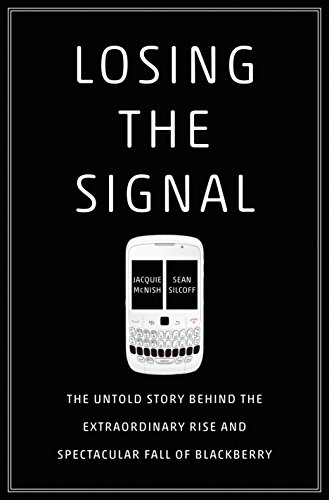
Short-listed for the 2015 Financial Times and McKinsey Business Book of the Year A Wall Street Journal Best Business Book of 2015 A Best Business Book of the Year, Forbes Magazine A Times of London Book of the Week Best Narrative Business Book of 2015 by Strategy+Business In 2009, BlackBerry controlled half of the smartphone market. Today that number is less than one percent. What went so wrong? Losing the Signal is a riveting story of a company that toppled global giants before succumbing to the ruthlessly competitive forces of Silicon Valley. This is not a conventional tale of modern business failure by fraud and greed. The rise and fall of BlackBerry reveals the dangerous speed at which innovators race along the information superhighway. With unprecedented access to key players, senior executives, directors and competitors, Losing the Signal unveils the remarkable rise of a company that started above a bagel store in Ontario. At the heart of the story is an unlikely partnership between a visionary engineer, Mike Lazaridis, and an abrasive Harvard Business school grad, Jim Balsillie. Together, they engineered a pioneering pocket email device that became the tool of choice for presidents and CEOs. The partnership enjoyed only a brief moment on top of the world, however. At the very moment BlackBerry was ranked the world's fastest growing company internal feuds and chaotic growth crippled the company as it faced its gravest test: Apple and Google's entry in to mobile phones. Expertly told by acclaimed journalists, Jacquie McNish and Sean Silcoff, this is an entertaining, whirlwind narrative that goes behind the scenes to reveal one of the most compelling business stories of the new century.
Recommended by William Cohan
“Stockman has masterfully diagnosed the cancer that the Federal Reserve has embedded in our financial markets, which have become, as Stockman artfully writes, ‘a coiled spring of irrational exuberance and momentum chasing.’ Couldn’t have said it better myself.” (from Amazon)
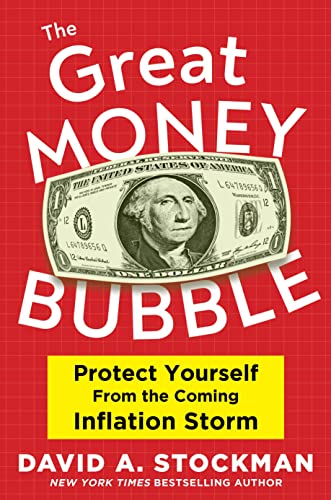
"I urge everyone to read this important new book.”—Ron Paul, Host of Ron Paul Liberty Report Americans are facing sticker shock at every turn: from the gas pump to the grocery store and every kind of consumer service. But the eye-popping price increases are just the tip of the iceberg in terms of the threat to the country’s economic recovery. Inflation showers windfalls on the rich while penalizing workers, savers, retirees, small businesses, and most of Main Street economic life. New York Times bestselling author and former investment manager David A. Stockman, who served as director of the Office of Management and Budget under President Reagan, explains the roots of today’s runaway inflation so investors at all levels can calibrate their financial strategies to survive and thrive despite economic uncertainty. The Great Money Bubble covers the entire economic landscape, including: Why the rising price of assets is far more dangerous than rising consumer pricesThe inside story on stock market manipulations and the effects of ultracheap debtWhy real estate is no longer a guaranteed inflationary hedgeStockman’s four-step strategy to protect your savings and portfolio After spearheading the economic policy for the Reagan Revolution, Stockman worked on Wall Street at the highest levels, and is now an adviser to professional investors. With this book, readers at all investment levels can have access to his groundbreaking financial advice.
Get a weekly reading digest
New expert-recommended books every week. No account needed.