8 Game Design Books That Separate Experts from Amateurs
Discover game design wisdom from Tim Schafer, Ryan Hoover, and Tracy Fullerton in these top 8 books
Updated on June 25, 2025·We may earn commissions for purchases made via this page
1 of 8 books have Audiobook versions
We're launchingLaunching on Product Hunt today 🎉We just launchedJust launched on Product Hunt 🎉
Modelpeers, from the BookAuthority teamFrom the BookAuthority team: Modelpeers, a free way to follow AI models and agents like you follow people. We'd love your support.
What if I told you that mastering game design isn’t just about coding or art but understanding the human experience behind every play session? The best games hook players not just with visuals but with well-crafted mechanics and storytelling that resonate deeply. In an industry continually evolving with new technologies, solid foundations in design remain your greatest asset.
Consider how Tim Schafer, known for his work at Double Fine Productions, praises “A Playful Production Process” for its focus on sustaining creativity amid industry crunch. Meanwhile, Ryan Hoover, founder of Product Hunt, and Nir Eyal, author of "Hooked," recommend "The Art of Game Design" for its unique perspectives that sharpen player engagement skills. These voices stand out among leading developers and researchers shaping the field.
While these expert-curated books provide proven frameworks, readers seeking content tailored to their specific background, goals, and subtopics might consider creating a personalized Game Design book that builds on these insights. This approach ensures your learning journey is as unique as the games you aspire to create.
Tim Schafer, studio head at Double Fine Productions, highlights this book's focus on preserving creativity and joy through collaborative team efforts, an approach that helped him navigate tough industry pressures. He says, "By focusing on the creative experience and the joy of making things collaboratively as a team, Lemarchand shows his readers how to survive in the game industry and come out with your creativity and inspiration intact!" This perspective reshaped how Schafer views sustainable game development. Similarly, Tracy Fullerton, director of the USC Game Innovation Lab, praises the blend of AAA and indie practices, calling it a near-perfect model for best development techniques.
“By focusing on the creative experience and the joy of making things collaboratively as a team, Lemarchand shows his readers how to survive in the game industry and come out with your creativity and inspiration intact!”
Richard Lemarchand, a game designer who worked in the videogame industry for more than twenty years, is Associate Professor in the USC Games program at the University of Southern California. Among many other projects, he led or co-led the design of all three games in the PlayStation 3 Uncharted series, including the award-winning Uncharted 2: Among Thieves. Between 2004 and 2012, he was a lead game designer at Naughty Dog, contributing to major titles and now teaches game design, development, and production while working on experimental virtual reality projects.
While working as a lead designer on blockbuster games like Uncharted 2, Richard Lemarchand observed the toll that traditional game production methods took on creativity and wellbeing. He developed a process that balances the artistic side of game design with structured project management to avoid burnout and chaotic crunch periods. You'll learn how to navigate four key phases—ideation, preproduction, full production, and post-production—giving you clear milestones from concept to finished game. This approach suits game designers, developers, and students eager to sustain creativity while delivering polished projects on time.
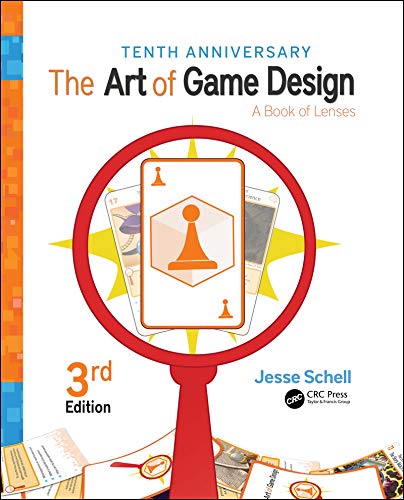
Jesse Schell, professor at Carnegie Mellon University's Entertainment Technology Center and CEO of Schell Games, brings a wealth of experience from Disney and leadership in the game industry to this book. His dual expertise in creative and technical realms shapes a resource that guides you through viewing your game design through more than 100 unique perspectives. This depth of insight comes from his work with VR, AR, and major game franchises, making the book an authoritative companion for anyone looking to refine their craft in a rapidly evolving field.
Jesse Schell is professor of entertainment technology for Carnegie Mellon University's Entertainment Technology Center (ETC), a joint master's program between Carnegie Mellon's College of Fine Arts and School of Computer Science, where he teaches game design and leads several research projects. He is also CEO of Schell Games, LLC, an independent game studio in Pittsburgh. Formerly he was creative director of the Walt Disney Imagineering Virtual Reality Studio and chairman of the International Game Developers Association (IGDA). Schell worked as a designer, programmer, and manager on several projects for Disney theme parks and DisneyQuest. He received his undergraduate degree from Rensselaer Polytechnic Institute and master's degree in information networking from Carnegie Mellon. In 2004, he was named as one of the World's 100 Top Young Innovators by MIT's Technology Review.
Jesse Schell's extensive experience in entertainment technology and game development led him to craft this insightful guide to the art of game design. You explore over 100 thought-provoking perspectives, or "lenses," that challenge you to rethink your design choices and deepen your understanding of player experience. The book walks you through how classic game principles apply to modern platforms, including VR and AR, illustrated with examples from titles like Uncharted 4 and The Last of Us. Whether you're a designer, programmer, or producer, this book sharpens your ability to create engaging, innovative games through practical questioning and iterative design.
This AI-created book on game design is tailored to your skill level and personal goals. You share your experience, interests, and which design aspects you want to focus on, and the book is crafted to cover those areas in depth. This personalized approach makes it easier to grasp complex concepts and create games that resonate with your unique vision.
TailoredRead AI creates personalized nonfiction books that adapt to your unique background, goals, and interests. Instead of reading generic content, you get a custom book written specifically for your profession, experience level, and learning objectives. Whether you're a beginner looking for fundamentals or an expert seeking advanced insights, TailoredRead crafts a book that speaks directly to you. Learn more.
2026·50-300 pages·Game Design, Player Engagement, Game Mechanics, Storytelling, Level Design
This tailored book explores the core principles of game design, crafted specifically to match your background and goals. It examines fundamental concepts such as player engagement, mechanics, storytelling, and level design, while diving into more nuanced areas that align with your interests. By focusing on your individual learning needs, this personalized guide reveals how to navigate complex design decisions and create memorable gaming experiences.
With a customized pathway through essential game design knowledge, this book provides a unique synthesis of collective expertise tailored to you. It encourages deep understanding and practical application, ensuring your journey toward mastering game design is both engaging and effective.
Murray Campbell, co-creator of Deep Blue, knows the deep roots linking artificial intelligence and gaming since the earliest computers. He highlights, "Artificial intelligence and games have been inextricably linked since the dawn of the computer era. This book provides a unique and entertaining review of the interplay between them." His endorsement underscores the book’s broad yet detailed approach, blending history with current AI techniques. Alongside him, Jeff Orkin, inventor of Goal-Oriented Action Planning and AI lead on F.E.A.R., praises the authors for weaving diverse AI topics into a coherent whole, confirming the book’s value for both practitioners and academics.
“Artificial intelligence and games have been inextricably linked since the dawn of the computer era. This book provides a unique and entertaining review of the interplay between them.”
Georgios N. Yannakakis is an Associate Professor at the Institute of Digital Games, University of Malta (UoM). He received his Ph.D. in informatics from the University of Edinburgh in 2006. He was previously an Associate Professor at the Center for Computer Games Research at the IT University of Copenhagen. His research lies at the crossroads of artificial intelligence, computational creativity, affective computing, and human-computer interaction with an emphasis on the domain of games. He has published over 200 journal and conference papers in the aforementioned fields, his research has been supported by numerous national and European grants, and it has been featured in Science Magazine and New Scientist among other publications. He is an associate editor of the IEEE Trans. on Computational Intelligence and AI in Games and was an associate editor of the IEEE Trans. on Affective Computing (2009-2016). He was the general chair of related key conferences such as IEEE CIG(Computational Intelligence and Games) and Foundations of Digital Games (FDG).
After analyzing extensive AI applications in gaming, Georgios N. Yannakakis and Julian Togelius developed this textbook to bridge artificial intelligence techniques with game development. You explore how AI powers gameplay, generates dynamic content, and models player behavior, with chapters dedicated to foundational AI concepts and their practical gaming uses. The book suits you if you're an undergraduate, graduate student, or industry professional aiming to deepen your technical understanding of game AI and computational creativity. For instance, it offers exercises and frameworks that illuminate procedural content generation and player modeling, enabling you to grasp both theory and practice within game design contexts.
Steve Bromley led research studies for many of PlayStation's top European games including Horizon: Zero Dawn, SingStar, and the PlayStation VR launch lineup. His extensive experience working directly with games and VR studios motivated him to write this guide, addressing the core questions his mentees have when starting a career in games user research. This book reflects his commitment to improving player experiences and helping newcomers break into the industry with practical knowledge and insider perspectives.
Steve Bromley led research studies for many of PlayStation's top European games including Horizon: Zero Dawn, SingStar and the PlayStation VR launch lineup. He continues to work with games and VR studios to improve the player experience of their games. For the last five years, Steve Bromley has run a games user research mentoring scheme, which has partnered over one hundred students with more than fifty industry professionals from top companies such as Sony, EA, Valve, Ubisoft, and Microsoft, and helped many people get their first job in games. This book covers many of the topics that mentees have asked as they start their games user research career.
What happens when a seasoned games user researcher with a decade of experience shares his expertise? Steve Bromley draws on his work with top PlayStation titles like Horizon: Zero Dawn and SingStar to guide you through planning, running, and analyzing playtests that uncover usability and UX issues. You’ll learn how research fits within game development, how to communicate findings effectively to development teams, and how to launch your career in this specialized field. Whether you’re a student, UX researcher transitioning to games, or a developer aiming to improve playtests, this book offers precise insights tailored to your role.
Adam Kramarzewski is a seasoned game designer with over fifteen years of experience at prominent studios including Gameloft, Square Enix, and Space Ape Games. Having contributed to major titles like Lara Croft and Deus Ex, his expertise grounds this book, which aims to equip you with the skills needed to design captivating games across genres and platforms. His passion for psychology and cinematography informs the book’s comprehensive approach to storytelling and player engagement.
Adam Kramarzewski is a game designer who has gathered over fifteen years of experience with the likes of Gameloft, Square Enix, Space Ape Games, and Madbox. He has worked on over 30 game projects and many world-class IPs, including Lara Croft, Deus Ex, Transformers, and Boom Beach. Adam is an avid gamer, a fan of cinematography, psychology, and all things science.
Adam Kramarzewski’s extensive experience with studios like Gameloft and Square Enix shapes this deeply practical guide to video game design. You’ll move from ideation to polishing, gaining concrete skills in level design, storytelling, and gameplay system creation. The book’s new chapter on games as a service offers insight into evolving design roles and live operations, helping you prepare games meant to engage players indefinitely. Whether you're crafting your first title or refining veteran skills, the book’s detailed examples and focus on iteration and testing make it a robust toolkit for contemporary game designers.
This AI-created book on rapid game design skill development is crafted based on your background, experience, and specific goals. You share which aspects of game design you want to focus on and your current level, and the book is created to match exactly what you need. This personalized approach helps you concentrate on daily tasks that build your skills efficiently, making the complex field of game design more accessible and aligned with your learning pace and interests.
TailoredRead AI creates personalized nonfiction books that adapt to your unique background, goals, and interests. Instead of reading generic content, you get a custom book written specifically for your profession, experience level, and learning objectives. Whether you're a beginner looking for fundamentals or an expert seeking advanced insights, TailoredRead crafts a book that speaks directly to you. Learn more.
This tailored book explores rapid skill development in game design through a focused, day-by-day learning journey. It covers essential design principles, player psychology, narrative crafting, and interactive mechanics, blending foundational concepts with areas that match your interests and expertise. The tailored content examines how to apply these ideas efficiently, helping you sharpen your creativity and technical skills in a way that suits your background and goals. By concentrating on personalized topics and practical daily exercises, it reveals a path to accelerated learning that keeps you engaged and progressing steadily.
Don L. Daglow is the Emmy® Award-winning creator behind Neverwinter Nights™, with a career spanning over 40 years in game design and storytelling. His extensive background, including recognition by the Computerspielemuseum in Berlin and induction into the Games Rome Hall of Fame, fuels his authoritative approach in this book. Motivated by a desire to help indie developers navigate both creative and business challenges, Daglow offers a methodical yet personalized roadmap that guides you from initial concept to game delivery. His blend of practical wisdom and life balance advice makes this more than a manual—it’s a mentor in print.
Don Daglow is the Emmy® Award winning creator of Neverwinter Nights™, which ran for six years on AOL. His novel The Fog Seller has won multiple major independent book awards for fiction, and his non-fiction From Dream to Delivery books are also multiple award-winners. He is a past winner of the National Endowment for the Arts 'New Voices' playwriting competition, and his work has appeared in The Magazine of Fantasy and Science Fiction. Don studied writing and theatre at Pomona College, where he received his B.A. in English (Playwriting). He later earned his M.Ed. from Claremont Graduate University, where he became an adjunct instructor. His game and business honors include being placed on the Wall of Fame at the Computerspielemuseum in Berlin and being inducted into the Hall of Fame at Games Rome in Italy.
Don L. Daglow's decades of experience in game design and development led him to craft a guide that bridges creative vision and practical execution for indie developers. You’ll work through six sets of introspective questions that help shape your unique path, balancing game design, business fundamentals, and personal goals. The book dives deep into pitfalls to avoid, terminology to master, and strategies to sustain your passion without sacrificing your life outside work. It’s especially useful if you’re navigating the complexities of starting your own studio or refining your approach to indie development, offering insights that blend creative artistry with entrepreneurial savvy.
Wlad Marhulets overcame unimaginable hardships to make his dreams come true. He first came to the U.S. from Poland in 2007 with only $300 of borrowed cash, no knowledge of English, and a severe stutter. Despite these challenges, he became a Hollywood composer, scoring films like 'The Giver' and 'November Man'. Transitioning to game development, he launched his first game, DARQ, achieving commercial success and critical acclaim without any marketing budget. The game was featured in major media outlets and won numerous awards. In his book, Wlad shares his journey and the mindset needed for success in game development.
Wlad Marhulets, Brendan Haley, Sheree Haley, Nancy Haight, Kelsey Haley, John Corigliano(you?)·
About the Author
Wlad Marhulets overcame unimaginable hardships to make his dreams come true. He first came to the U.S. from Poland in 2007 with only $300 of borrowed cash, no knowledge of English, and a severe stutter. Despite these challenges, he became a Hollywood composer, scoring films like 'The Giver' and 'November Man'. Transitioning to game development, he launched his first game, DARQ, achieving commercial success and critical acclaim without any marketing budget. The game was featured in major media outlets and won numerous awards. In his book, Wlad shares his journey and the mindset needed for success in game development.
Drawing from his extraordinary journey from Hollywood composer to successful indie game developer, Wlad Marhulets offers a detailed roadmap for beginners eager to break into game development. The book dives into the many facets of creating a commercial game—from mastering the mindset and acquiring diverse skills like coding and design, to navigating funding, legalities, marketing, and launching strategies. You’ll find practical insights, such as how DARQ reached top Steam charts without a marketing budget, illuminating the challenges and opportunities of indie game creation. This is a solid guide if you’re starting out and want a realistic grasp of the entire game development process.
Dr. Jon Woodcock holds a physics degree from Oxford and a PhD in computational astrophysics from the University of London, bringing a deep understanding of coding and computational science to this book. Starting to code at eight, Jon has worked on diverse projects from space simulations to intelligent robots, fueling his passion for educating young programmers. This book reflects his commitment to making coding accessible, teaching kids how to build games with Scratch 3.0 through clear, visual instructions that simplify complex concepts.
Dr. Jon Woodcock has a degree in physics from the University of Oxford and a PhD in computational astrophysics from the University of London. He started coding at the age of eight and has programmed all kinds of computers, from single-chip microcontrollers to world-class supercomputers. His many projects include giant space simulations, research in high-tech companies, and intelligent robots made from junk. Jon has a passion for science and technology education, giving talks on space and running computer programming clubs in schools. He has worked on numerous science and technology books as a contributor and consultant, including DK's How Cool Stuff Works and Help Your Kids with Computer Coding.
2019·224 pages·Game Design, Programming, Scratch, STEM Education, Problem Solving
Dr. Jon Woodcock's extensive background in physics and computational astrophysics shapes this guide, designed specifically for young aspiring coders. You learn fundamental programming concepts through practical game-building exercises using Scratch 3.0, covering everything from setting scenes and game mechanics to fine-tuning controls and camera angles. The book breaks down complex coding ideas into approachable visual steps, making it easier for you to understand not just how to code, but why coding works that way. If you're a beginner eager to create diverse game types like platformers, puzzles, and racing challenges, this book offers a clear, engaging pathway without overwhelming technical jargon.
The best Game Design books and more, in your inbox each week. No account needed.
Conclusion
These eight books collectively illuminate the multifaceted world of game design—from sustainable production methods and player psychology to cutting-edge AI and indie development realities. They reflect a field where creativity meets technical skill and where player experience reigns supreme.
If you're navigating your first project, starting with "GAMEDEV" and "Indie Games" offers practical guidance and mindset preparation. For those aiming to deepen design mastery, pairing "The Art of Game Design" with "Practical Game Design" delivers both theory and applied skills. Meanwhile, "Artificial Intelligence and Games" serves as a gateway to the future of interactive experiences.
Alternatively, you can create a personalized Game Design book to bridge the gap between general principles and your specific situation. These books can help you accelerate your learning journey and craft games that truly connect.
Frequently Asked Questions
I'm overwhelmed by choice – which book should I start with?
Starting with "GAMEDEV" gives you a solid roadmap from concept to launch, perfect if you're new. If you want to focus on design principles, "The Art of Game Design" is a great next step.
Are these books too advanced for someone new to Game Design?
Not at all. Books like "Coding Games in Scratch" and "GAMEDEV" cater to beginners, while others like "Artificial Intelligence and Games" are more technical for experienced readers.
What's the best order to read these books?
Begin with beginner-friendly guides like "GAMEDEV" and "Coding Games in Scratch," then explore design-focused texts such as "The Art of Game Design" and "Practical Game Design," followed by specialized topics like AI and user research.
Should I start with the newest book or a classic?
Both have value. Newer books like "Practical Game Design" reflect current industry trends, while classics like "The Art of Game Design" provide timeless design insights.
Which books focus more on theory vs. practical application?
"The Art of Game Design" dives into theory and player psychology, whereas "Practical Game Design" and "GAMEDEV" emphasize hands-on skills and real-world development scenarios.
How can personalized books complement these expert recommendations?
Yes, expert books offer solid foundations, but personalized books tailor content to your background and goals, making learning more efficient. Try creating your own Game Design book to bridge theory with your unique needs.
📚 Love this book list?
Help fellow book lovers discover great books, share this curated list with others!